Integrating Essential Skills: Unit Study Guide
06.01 Core Skills Applied to Complex Problems
This topic covers the core skills the ACT builds into multi-step problems: ratios and rates, percents, integer arithmetic and reading data displays.
Ratios, Rates and Proportions
A ratio compares quantities; a proportion sets two ratios equal and is solved by cross-multiplying. Unit rates divide by the second quantity.
| Proportion | |
| Unit rate | |
| Scale |
Proportional relationships — find a value
Method. Set up equal ratios: = , so y = 35 × 30 ÷ 14 = 75.
- Proportional means y = kx.
- Find k: k = y ÷ x = 35 ÷ 14 = 2.5.
- Then y = 2.5 × 30 = 75.
- A (2.5): gave the constant of proportionality instead of y
- B (12): used x divided by y as the constant
- C (51): added the same amount to y as was added to x
Proportional relationships — constant from a graph
Method. Read any labelled point (x, y) on the line and divide y by x.
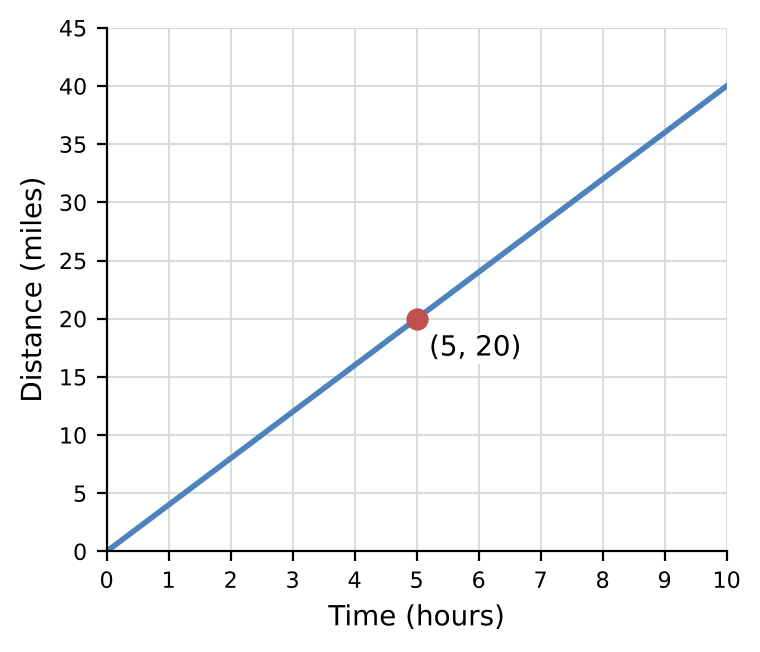
- The line passes through the origin and the point (5, 20).
- k = y ÷ x = 20 ÷ 5 = 4.
- A (): divided x by y instead of y by x
- C (15): subtracted the coordinates
- D (20): gave the y-value of the point
Scale drawings and maps
Method. Map → real: multiply by the scale; real → map: divide by the scale.
- Each centimeter stands for 25 km.
- So multiply: 8.4 × 25 = 210 km.
- A (0.336): divided by the scale instead of multiplying
- B (21): dropped a zero from the answer
- C (33.4): added the scale to the map distance
Unit conversions with square and cubic units
Method. Square units use the factor squared ; cubic units use it cubed .
- One square yard is 3 × 3 = 9 square feet, because every dimension is converted.
- So 6 square yards = 6 × 9 = 54 square feet.
- A (): divided instead of multiplying
- B (18): multiplied by the length factor 3 only
- C (36): multiplied by 3 × 2 instead of 3 to the power 2
Density
Method. Rate = amount ÷ time (or mass ÷ volume); amount = rate × time. Convert minutes to hours first.
- Density = mass ÷ volume.
- Density = 40 ÷ 16.
- So Density = 2.5 grams per cubic centimeter.
- A (0.4): divided volume by mass
- C (24): subtracted volume from mass
- D (640): multiplied mass by volume
Speed — find the distance
Method. Rate = amount ÷ time (or mass ÷ volume); amount = rate × time. Convert minutes to hours first.
- 30 minutes = = 0.5 hour.
- So the time is 1.5 hours.
- Distance = speed × time = 72 × 1.5 = 108 miles.
- A (72): ignored the minutes
- B (93.6): treated 1 hours 30 minutes as 1.30 hours
- D (2,232): added the minutes as if they were hours
Speed — find the rate
Method. Rate = amount ÷ time (or mass ÷ volume); amount = rate × time. Convert minutes to hours first.
- Speed = distance ÷ time.
- Speed = 220 ÷ 4.
- So Speed = 55 miles per hour.
- A (): divided time by distance
- C (224): added distance and time
- D (880): multiplied distance by time
Direct variation
Method. y changes by the same factor as x: 13 ÷ 4 = , so y = 32 × = 104.
- Direct variation: y = kx.
- k = 32 ÷ 4 = 8.
- So y = 8 × 13 = 104.
- A (): used inverse variation instead of direct variation
- B (41): added the change in x to y
- D (416): multiplied y by the new x without dividing by the old x
Inverse variation — work problems
Method. Multiply the given pair, then divide by the new value.
- Inverse variation: x × y stays constant.
- 2 × 20 = 40.
- So y = 40 ÷ 20 = 2.
- B (38): added the change in x to y
- C (40): gave the product xy (the constant) instead of y
- D (200): used direct variation instead of inverse variation
Inverse variation
Method. Multiply the given pair, then divide by the new value.
- Inverse variation: x × y stays constant.
- 4 × 9 = 36.
- So y = 36 ÷ 6 = 6.
- B (7): kept the sum of x and y constant
- C (13.5): used direct variation instead of inverse variation
- D (36): gave the product xy (the constant) instead of y
Dimensional analysis — rate conversions
Method. Multiply by conversion fractions so unwanted units cancel; check every unit is converted.
- 43.2 km/h × (1,000 m / 1 km) × (1 h / 3,600 s) = 43.2 × 1,000 ÷ 3,600.
- So 43.2 km/h × (1,000 m / 1 km) × (1 h / 3,600 s) = 12 .
- B (155.52): multiplied by 3.6 instead of dividing
- C (720): converted hours to minutes instead of seconds
- D (43,200): converted kilometers to meters but not hours to seconds
Sharing in a ratio
Method. Add the ratio numbers, find one part, then multiply.
- Total parts: 5 + 6 + 8 = 19.
- One part = $760 ÷ 19 = $40.
- The smallest share is 5 × $40 = $200.
- A ($40): gave the value of one part only
- B ($152): divided the total by the ratio number instead of by the total number of parts
- D ($320): gave the largest share
Ratios — find the total
Method. Total = boys × (total parts ÷ boy parts) = 27 × = 33.
- 9 parts are 27 boys.
- So one part is 27 ÷ 9 = 3.
- The club has 9 + 2 = 11 parts: 11 × 3 = 33 students.
- A (6): found the number of girls only
- C (38): added the ratio total to the number of boys
- D (297): multiplied the boys by the total number of parts
Multi-step rate problems
Method. Find the per-minute rate first, convert all time to minutes, then multiply.
- Rate: 21 ÷ 3 = 7 pages per minute.
- Time: 3 × 60 + 40 = 220 minutes.
- Pages: 7 × 220 = 1,540.
- A (301): added the hours and minutes without converting
- B (1,260): ignored the extra minutes
- D (4,620): used 21 pages per minute instead of per 3 minutes
Average speed for a round trip
Method. For equal distances, average speed = 2ab/(a + b) = 2 × 45 × 90 ÷ 135 = 60.
- Time out = 270 ÷ 45 = 6 h.
- Time back = 270 ÷ 90 = 3 h.
- Total distance 540 miles ÷ total time 9 h = 60 mph.
- B (67.5): averaged the two speeds
- C (90): used only the time for the first part of the trip
- D (180): used only the time for the return trip
Percents
Percent means per hundred. Convert to a decimal, then multiply; percent change compares the change with the original.
| Percent of | |
| Percent change | |
| Successive changes |
Percent increase and decrease
Method. New ÷ original = 1.4, so the change is 1.4 − 1 = +0.4 → 40%.
- Change = $728.00 − $520.00 = $208.00.
- Percent change = change ÷ original × 100 = 208 ÷ 520 × 100 = 40%.
- B (60%): gave the percent that remains instead of the change
- C (140%): gave the new value as a percent of the original
- D (208%): gave the amount of change as the percent
Discounts and sale prices
Method. Pay 85% of the price: 0.85 × $245.00 = $208.25.
- Discount = 15% of $245.00 = $36.75.
- Sale price = $245.00 − $36.75 = $208.25.
- A ($36.75): gave the discount instead of the sale price
- C ($230.00): subtracted 15 dollars instead of 15%
- D ($281.75): added the discount instead of subtracting
Tax and tips
Method. Multiply by 1.15 (115%) in one step: 1.15 × $29.60 = $34.04.
- Tip = 15% of $29.60 = 0.15 × $29.60 = $4.44.
- Total = $29.60 + $4.44 = $34.04.
- A ($4.44): gave the tip only, not the total
- C ($44.60): added 15 dollars instead of 15%
- D ($74.00): moved the decimal point when finding the percent
Simple interest
Method. One year's interest is $180.00; multiply by 5 years and add the principal.
- Simple interest I = P × r × t = $4,500 × 0.04 × 5 = $900.00.
- Total = $4,500 + $900.00 = $5,400.00.
- A ($90.00): moved the decimal point one place too far left in the rate
- B ($180.00): found the interest for one year only
- C ($900.00): gave the interest only, not the total
Markup
Method. Multiply the cost by 1.75: $182.00.
- Markup = 75% of $104.00 = $78.00.
- Selling price = $104.00 + $78.00 = $182.00.
- A ($78.00): gave the markup only, not the selling price
- C ($416.00): treated the markup as a percent of the selling price
- D ($7,800.00): used the percent without dividing by 100
Reverse percent — find the original
Method. Divide by the multiplier (1.2); do not take 20% of the new amount.
- The new amount is 120% of the original.
- So original = $57.60 ÷ 1.2 = $48.00.
- A ($11.52): gave the percent of the new price
- B ($37.60): subtracted 20 dollars
- C ($46.08): subtracted 20% of the new price
Successive percent changes
Method. Multiply the multipliers: 1.25 × 0.5 = 0.625, then × $70.00 = $43.75.
- Increase: $70.00 × 1.25 = $87.50.
- Decrease that by 50%: $87.50 × 0.5 = $43.75.
- A ($35.00): applied only the decrease
- C ($52.50): added and subtracted the percents as if they apply to the same amount
- D ($87.50): applied only the increase
Percentage points versus percent change
Method. Percentage points = simple difference of the rates; percent change = that difference ÷ the original rate × 100.
- The rate changed by 14 percentage points.
- Percent change = 14 ÷ 2 × 100 = 700%.
- A (14%): gave the change in percentage points, not the percent change
- B (18%): added the two rates
- C (87.5%): divided by the new rate instead of the original
Mixtures — percent concentration
Method. Weighted average: (amount₁ × percent₁ + amount₂ × percent₂) ÷ total amount.
- Salt: 0.15 × 10 + 0.05 × 40 = 1.5 + 2 = 3.5 liters, in 50 liters.
- Percent = 3.5 ÷ 50 × 100 = 7%.
- B (10%): averaged the two percents without weighting
- C (13%): matched each percent with the wrong amount
- D (20%): added the two percents
Percent of a percent
Method. Multiply the decimals: 0.3 × 0.1 × 850 = 25.5.
- Work from the right: 10% of 850 = 85.
- Then 30% of 85 = 25.5.
- B (85): found only 10% of 850
- C (255): found only 30% of 850
- D (340): added the percents
Repeated percent growth
Method. 2,500 × = 2,500 × 1.21 = 3,025.
- Each year multiply by 1.1: 2,500 → 2,750 → 3,025.
- After 2 years: 3,025.
- A (525): gave only the increase
- B (2,750): applied the growth for one year only
- C (3,000): added the same amount each year (simple growth)
Data Interpretation
Several questions share one display. Read the title, labels and scale carefully, then compute differences, totals, means and percents from the values you read.
| Mean | |
| Percent change | |
| Fraction of total |
Reading the display
Method. Find the row first, then move across to the column.
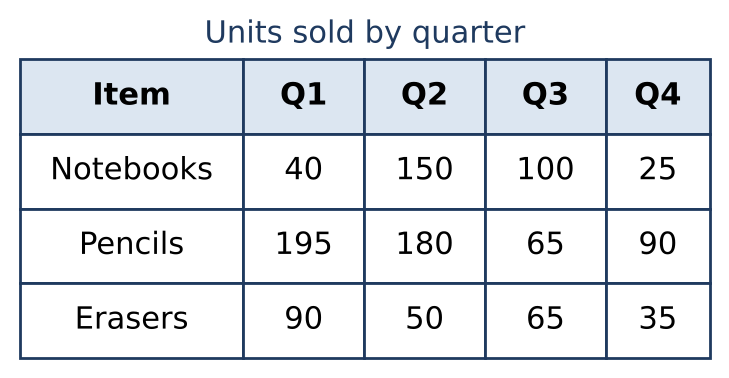
- Go to the Pencils row and the Q1 column.
- The entry is 195.
- A (90): read the Erasers row
- B (180): read the Q2 column
- D (530): gave the Pencils total for the year
Comparing values
Method. Add across the row for one item's yearly total.
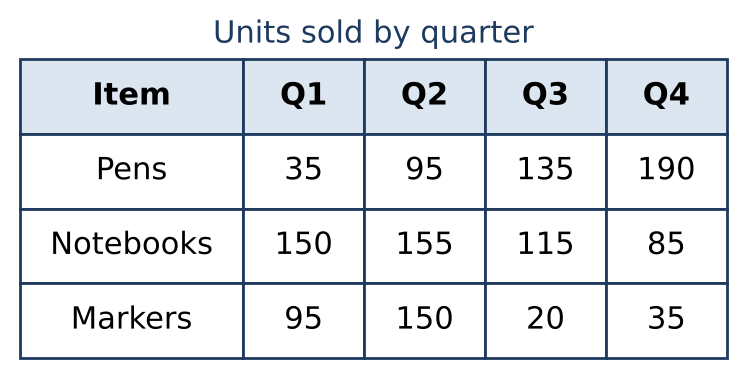
- Add the Pens row.
- 35 + 95 + 135 + 190 = 455.
- A (113.75): gave the mean instead of the total
- B (265): left out Q4
- C (280): added the Q1 column instead of the row
Averages, ratios and percents
Method. Fraction of the total = part ÷ total; simplify at the end.
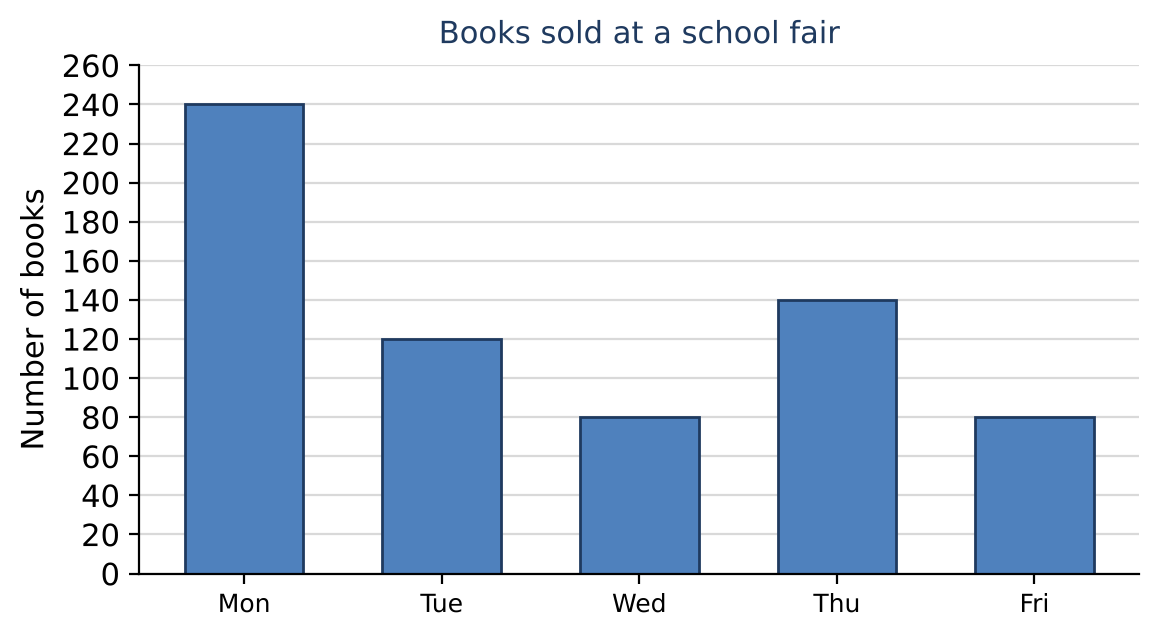
- The total is 660.
- Tue has 120.
- So the fraction is = .
- B (): divided by the rest instead of the total
- C (): gave the fraction not in Tue
- D (): compared Tue with Wed instead of the total
Real Numbers and Integers
Real numbers are rational (fractions of integers, terminating or repeating decimals) or irrational. Know the sign rules, absolute value, and the properties of operations.
| Sign rule (× and ÷) | |
| Absolute value | |
| Distance on a number line | |
| Commutative | |
| Associative | |
| Distributive | |
| |x| = k (k > 0) |
Add integers
Method. On a number line, start at 2 and move 13 to the left: you land on −11.
- The signs are different.
- So subtract the sizes (13 − 2 = 11) and take the sign of the number with the larger size (−13): −11.
- A (−15): added the sizes and made it negative
- C (11): gave the opposite sign
- D (15): ignored the signs and added the sizes
Subtract integers
Method. Keep – change – change: keep the first number, change − to +, change the sign of the second number.
- Subtracting a number is the same as adding its opposite: 1 − 12 = 1 + (−12).
- Then add: −11.
- B (11): gave the opposite sign
- C (12): multiplied instead of subtracting
- D (13): added instead of subtracting (did not change the sign of the second number)
Divide integers
Method. Find the size first, then the sign: an even number of negative signs gives +, an odd number gives −.
- Divide the sizes: 108 ÷ 9 = 12.
- Different signs give a negative quotient.
- So the answer is −12.
- A (−972): multiplied instead of dividing
- B (−117): subtracted instead of dividing
- D (12): used the wrong sign rule
Multiply integers
Method. Find the size first, then the sign: an even number of negative signs gives +, an odd number gives −.
- Multiply the sizes: 3 × 3 = 9.
- A negative times a positive is negative.
- So the product is −9.
- B (0): added instead of multiplying
- C (6): ignored the signs and added
- D (9): used the wrong sign rule
Integer expression — order of operations
Method. Find both products with their signs, then change the subtraction to adding the opposite: −12 + (−16) = −28.
- Multiply first: −4 × 3 = −12 and 4 × 4 = 16.
- Then subtract: −12 − 16 = −28.
- B (−4): got the sign of the first product wrong
- C (4): got the sign of the second product wrong
- D (28): gave the opposite sign
Absolute value — distance on a number line
Method. Points on opposite sides of 0: add their distances from 0: 16.
- Distance is the absolute value of the difference.
- |7 − (−9)| = |16|.
- So |7 − (−9)| = 16.
- A (−16): gave a negative distance
- B (2): subtracted the sizes, ignoring that the points are on opposite sides of 0
- D (63): multiplied the sizes
Absolute value — evaluate
Method. Absolute value is never negative: simplify inside, drop the sign, then do the outside operation.
- Work inside the bars first: |−10| = 10 and |1 − 5| = |−4| = 4.
- Then 10 − 4 = 6.
- A (−14): treated |−10| as −10
- B (−6): ignored all the absolute value bars
- D (14): treated |1 − 5| as −4
Integers in context — temperature
Method. Start at −15 on a number line and move 12 up.
- Rising means add.
- −15 + 12 = −3°F.
- A (−27): moved the wrong way on the number line
- C (3): gave the opposite sign
- D (27): ignored the negative sign and added
Order rational numbers
Method. Negatives are less than 0 and positives greater; among negatives, the one farther from 0 is less.
- Place the numbers on a number line (as decimals: −6 ≈ −6, −2 ≈ −2, 0.55 ≈ 0.55, 3 ≈ 3).
- From left to right: −6, −2, 0.55, 3.
- The least is −6.
- B (0.55): chose the number closest to 0
- C (3): chose the greatest number instead of the least
- D (−2): chose the negative number closest to 0 (thought it was the smallest)
Coordinate plane — quadrants
Method. Signs (x, y): I (+, +), II (−, +), III (−, −), IV (+, −) — counter-clockwise from the upper right.
- The x-coordinate 13 is positive (right of the y-axis) and the y-coordinate −2 is negative (below the x-axis).
- That is Quadrant IV.
- B (Quadrant II): swapped the x- and y-coordinates
- C (Quadrant III): used the wrong sign for x
- D (Quadrant I): used the wrong sign for y
Coordinate plane — read a point
Method. Run before you rise: read across (x) first, then up or down (y).
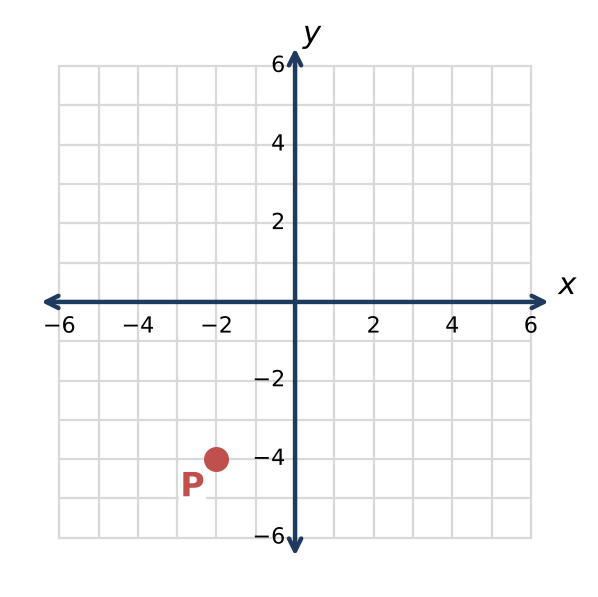
- Start at the origin.
- P is 2 units left (x = −2) and 4 units down (y = −4).
- So P = (−2, −4).
- A ((−4, −2)): swapped the x- and y-coordinates
- B ((2, −4)): used the wrong sign for x
- D ((−2, 4)): used the wrong sign for y
Integers on a number line
Method. Points left of 0 are negative; count the spaces back from 0.
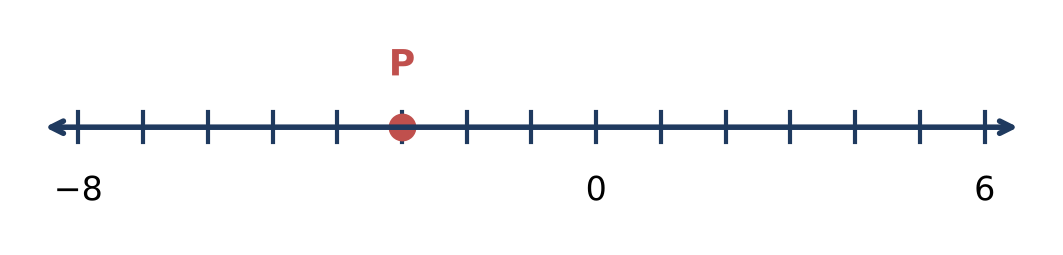
- Each tick mark is 1 unit.
- P is 3 spaces to the left of 0.
- So it shows −3.
- A (−5): counted spaces from the left end
- B (−4): counted one space too many from 0
- D (3): ignored the negative sign
Coordinate plane — distance on a grid line
Method. Opposite signs → add the sizes: 13 + 13 = 26.
- The y-coordinates are equal.
- So the points lie on a horizontal line.
- The distance is the absolute value of the difference of the other coordinates: |−13 − 13| = 26.
- A (−26): gave a negative distance
- B (0): subtracted the sizes, ignoring that the points are on opposite sides of an axis
- D (27): added the coordinate that stays the same
Evaluate an expression with a negative number
Method. Put every negative value in parentheses before squaring or multiplying.
- Substitute with parentheses.
- − 1 × (−5) = 25 − (−5).
- − 1 × (−5) = 25 + 5.
- So − 1 × (−5) = 30.
- A (−30): made both terms the wrong sign
- B (−20): computed as a negative number
- C (20): used x as positive in the second term