Number and Operations: Study Guide
Mathematics Knowledge (MK) is an AFQT subtest (AFQT = 2×VE + AR + MK). This topic covers number skills: integers and the order of operations, fractions, decimals, exponents and square roots, scientific notation, and factors, multiples and primes. The CAT-ASVAB gives 15 MK questions in 31 minutes and the paper test 25 in 24 minutes, with no calculator.
- Integers and Order of Operations
- Fractions
- Decimals
- Exponents, Roots and Scientific Notation
- Factors, Multiples and Primes
Integers and Order of Operations
Use the sign rules for adding and multiplying negative numbers, absolute value as distance from zero, and the order of operations: parentheses, exponents, multiplication and division left to right, then addition and subtraction left to right.
| Order of operations | |
| Sign rule (× and ÷) | |
| Subtracting a negative | |
| Absolute value | |
| Distance on a number line | |
| Distributive property |
Odd and even — parity rules
Method. Test with small numbers: a = 1, b = 1 gives a + b + 1 = 3, which is odd; check one more pair to be sure.
Worked example- Use the rules: even ± even = even, odd ± odd = even, odd ± even = odd.
- Even × anything = even, odd × odd = odd.
- Here a is odd and b is odd.
- So a + b + 1 is always odd.
- A (2a): chose an expression that is always even
- B (a + 3): chose an expression that is always even
- C (b + 1): chose an expression that is always even
Integer expression — order of operations
Method. Find both products with their signs, then change the subtraction to adding the opposite: −12 + (−16) = −28.
Worked example- Multiply first: −4 × 3 = −12 and 4 × 4 = 16.
- Then subtract: −12 − 16 = −28.
- B (−4): got the sign of the first product wrong
- C (4): got the sign of the second product wrong
- D (28): gave the opposite sign
Absolute value — distance on a number line
Method. Points on opposite sides of 0: add their distances from 0: 72.
Worked example- Distance is the absolute value of the difference.
- |56 − (−16)| = |72|.
- So |56 − (−16)| = 72.
- A (40): subtracted the sizes, ignoring that the points are on opposite sides of 0
- C (73): counted the tick marks instead of the spaces between the numbers
- D (896): multiplied the sizes
Absolute value — evaluate
Method. Absolute value is never negative: simplify inside, drop the sign, then do the outside operation.
Worked example- Work inside the bars first: |−23| = 23 and |6 − 7| = |−1| = 1.
- Then 23 − 1 = 22.
- A (−24): treated |−23| as −23
- B (−22): ignored all the absolute value bars
- D (24): treated |6 − 7| as −1
Order rational numbers
Method. Negatives are less than 0 and positives greater; among negatives, the one farther from 0 is less.
Worked example- Place the numbers on a number line: −3, −0.9, 0 and 0.1.
- From left to right: −3, −0.9, 0, 0.1.
- The least is −3.
- A (0): chose the number closest to 0
- C (0.1): chose the greatest number instead of the least
- D (−0.9): chose the negative number closest to 0 (thought it was the smallest)
Evaluate an expression with a negative number
Method. Put every negative value in parentheses before squaring or multiplying.
Worked example- Substitute with parentheses.
- − 4 × (−6) = 36 − (−24).
- − 4 × (−6) = 36 + 24.
- So − 4 × (−6) = 60.
- A (−60): made both terms the wrong sign
- B (−12): computed as a negative number
- C (12): used x as positive in the second term
Rational and irrational numbers
Method. Rational = fraction of integers (includes integers, terminating and repeating decimals, square roots of perfect squares). Irrational = non-ending, non-repeating decimal.
Worked example- = 2 = , a fraction of integers.
- So it is rational.
- (not a perfect square), π and 2 + are irrational.
- B (): chose an irrational number (its decimal never ends or repeats)
- C (2 + ): chose an irrational number (its decimal never ends or repeats)
- D (π): chose an irrational number (its decimal never ends or repeats)
Fractions
Add or subtract fractions over a common denominator. Multiply straight across. To divide, multiply by the reciprocal. Change mixed numbers to improper fractions before multiplying or dividing.
| Add / subtract | |
| Multiply | |
| Divide | |
| Mixed number | |
| Equivalent fractions | |
| Compare |
Compare fractions
Method. Compare each fraction with and with 1 first; for close ones cross-multiply: > when a × d > b × c.
Worked example- Compare each fraction with : is less than , because 6 × 2 = 12 is less than 13.
- , and are all greater than (each top number is more than half its bottom number).
- So is the least.
- B (): chose the fraction with the least top number
- C (): chose the fraction with the least bottom number
- D (): chose the greatest fraction instead of the least
Add — unlike denominators
Method. Butterfly method: = , then simplify to 1 .
Worked example- The least common denominator of 4 and 2 is 4.
- Rename: = and = .
- Add the tops: 3 + 2 = 5.
- So = 1 .
- A (): added the tops and added the bottoms
- B (1): used a common bottom number but did not rename the tops
- D (2): added the tops and kept the smaller bottom number
Subtract — unlike denominators
Method. Butterfly method: = , then simplify to .
Worked example- The least common denominator of 5 and 10 is 10.
- Rename: = and = .
- Subtract the tops: 4 − 3 = 1.
- So .
- B (): multiplied instead of subtracting
- C (): cross-multiplied the tops but added the bottoms
- D (): added instead of subtracting
Multiply — fraction × fraction
Method. Cancel any top number with any bottom number first (cross-cancel), then multiply the small numbers that are left.
Worked example- Multiply the tops and multiply the bottoms: = .
- Divide top and bottom by 3: .
- A (): divided only the top by the common factor
- C (): added the tops and added the bottoms
- D (2 ): divided instead of multiplying (flipped the second fraction)
Divide — fraction ÷ fraction
Method. Keep – change – flip: keep , change ÷ to ×, flip to 3.
Worked example- Dividing by is the same as multiplying by its reciprocal 3.
- × 3 = = = 2.
- A (): multiplied without flipping the second fraction
- B (): flipped the first number instead of the second
- C (1): added instead of dividing
Add mixed numbers
Method. Change to improper fractions and add: + = 11 ; or add wholes and fractions separately and carry any extra whole.
Worked example- Add the whole numbers: 4 + 6 = 10.
- Add the fractions with the common denominator 7: + = = 1 .
- Combine: 10 + 1 = 11 .
- A (10 ): subtracted the fraction parts instead of adding them
- B (10 ): did not carry the extra whole from the fraction part
- C (10 ): added the whole numbers, then added the tops and added the bottoms
Divide a mixed number by a fraction
Method. Keep – change – flip after converting the mixed number to an improper fraction.
Worked example- Change 3 to .
- Multiply by the reciprocal of : × = = 8 .
- A (1 ): multiplied without flipping the second fraction
- B (8): divided only the whole number 3 by , then added the back unchanged
- D (17 ): multiplied by the bottom of the second fraction but did not divide by its top
Find the whole from a fractional part
Method. Divide by the fraction: 4 ÷ = 4 × = 6.
Worked example- of the whole is 4.
- So one part is 4 ÷ 2 = 2.
- The whole has 3 parts: 3 × 2 = 6.
- A (2 ): found of 4 instead of the whole
- C (7): added the bottom number to the part
- D (12): multiplied by the bottom only
Number line — mixed numbers
Method. P is past 1, so start at 1 and count 1 space of size : 1 .
Worked example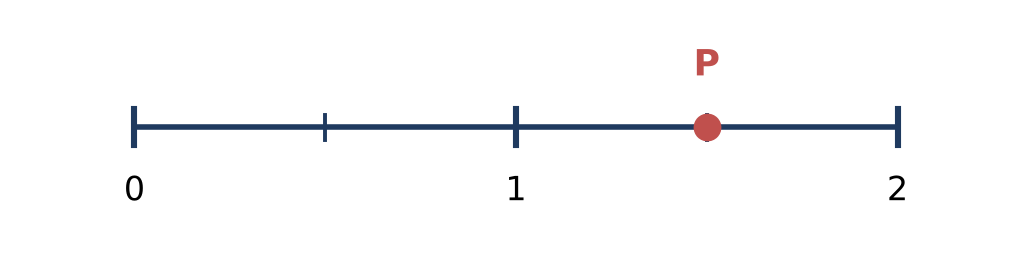
- Each whole is cut into 2 equal spaces.
- So each space is .
- P is 3 spaces from 0, which is = 1 (one whole and more).
- A (): left out the whole from 0 to 1
- B (): used all the spaces from 0 to 2 as the bottom number
- D (2 ): added an extra whole
Subtract mixed numbers (regrouping)
Method. Use improper fractions: − = 2 ; this avoids regrouping.
Worked example- Rename with denominator 35: 12 − 9 .
- Since is less than , regroup one whole: 12 = 11 .
- Now subtract: 11 − 9 = 2 and − = .
- Answer: 2 .
- B (3 ): subtracted the smaller fraction from the larger instead of regrouping
- C (3 ): added the fraction parts instead of subtracting
- D (3 ): regrouped but did not take 1 from the whole number
Multiply mixed numbers
Method. Never multiply the whole parts and the fraction parts separately; convert to improper fractions and cross-cancel first.
Worked example- Change each mixed number to an improper fraction: 4 = and 4 = .
- Multiply: = = 18 .
- A (): divided instead of multiplying
- B (8 ): added instead of multiplying
- C (16 ): multiplied the whole numbers and the fractions separately
Fraction of a quantity — two steps
Method. Multiply by what is left each time: 18 × × = 6.
Worked example- First purchase: of 18 = 18 ÷ 2 × 1 = 9, leaving 18 − 9 = 9.
- Second purchase: of the remaining 9 = 9 ÷ 3 × 1 = 3, leaving 9 − 3 = 6.
- A (3): took the second fraction of the original amount instead of the remaining amount
- C (9): forgot the second purchase
- D (12): gave the total spent instead of the amount left
Complex fraction
Method. Multiply the top and the bottom of the complex fraction by 84 (the LCD) to clear the small fractions, then divide.
Worked example- Work out the top first: 1 − = − = .
- Then divide by the bottom: ÷ = × = .
- A (): divided before subtracting
- C (): left out the 1 − part
- D (1 ): added instead of subtracting
Order of operations with fractions
Method. Do the × first, simplify it, then add with a common denominator.
Worked example- Multiply before adding: × = .
- Then add: + = .
- A (): added first, then multiplied (worked left to right)
- C (): divided instead of multiplying
- D (1 ): added all three
Fraction between two fractions
Method. Change all fractions to decimals (top ÷ bottom) and pick the one strictly between the two given decimals.
Worked example- Rename with the common denominator 70: = , = and = .
- Only has a top number strictly between 10 and 35.
- A (): is equal to , so it is not between
- C (): is less than , so it is not between
- D (): is greater than , so it is not between
Solve a proportion with expressions
Method. Multiply both sides by 72, then move the x-terms to the side with the larger coefficient to avoid negatives.
Worked example- Cross-multiply: 8(x + 4) = 9(x − 6).
- Distribute: 8x + 32 = 9x − 54.
- Collect terms: 32 + 54 = 9x − 8x.
- So 86 = 1x and x = 86.
- A (−84): cross-multiplied the wrong way
- B (−22): made a sign error with the subtracted number
- C (10): did not distribute when cross-multiplying
Rational reasoning — capacity from a change
Method. Capacity = amount added ÷ change in fraction = 6 ÷ = 180.
Worked example- The 6 liters filled − = of the tank.
- If of the capacity is 6, the capacity is 6 ÷ = 6 × 30 = 180 liters.
- A (): multiplied by the change instead of dividing
- B (3 ): added the two fractions instead of subtracting
- C (7 ): divided by the new fraction only
Rational reasoning — combined work
Method. Product over sum: = = 4 hours.
Worked example- Rates: Machine A does of the job per hour and Machine B does .
- Together: + = of the job per hour.
- Time = 1 ÷ = = 4 hours.
- B (6): subtracted the two times
- C (10): averaged the two times
- D (20): added the two times
Rational reasoning — fraction of a fraction
Method. Work backwards: girls = 3 ÷ = 9; students = 9 ÷ = 45.
Worked example- Chess-club girls are of = of all students.
- So of the total is 3, and the total is 3 ÷ = 45.
- A (): multiplied by the fractions instead of dividing
- B (9): found only the number of girls
- C (36): found the number of boys instead of all students
Decimals
Line up the decimal points to add or subtract. To multiply, count the total decimal places in the factors. To divide by a decimal, move both decimal points right until the divisor is a whole number.
| Multiply | |
| Divide by a decimal | |
| Powers of 10 | |
| Fraction to decimal | |
| Decimal to fraction |
Decimal place value — value of a digit
Method. Write 9, then put a zero in every place between it and the decimal point: 0.09.
Worked example- In 472.1953 the digit 9 is 2 places to the right of the decimal point, which is the hundredths place.
- Its value is 9 hundredths = 0.09.
- A (0.009): used the place one to the right
- C (0.9): used the place one to the left
- D (9): gave the digit itself, not its value
Multiply decimals
Method. Estimate first: about 4 × 3 = 12, then place the point in 1224 to get a number near that: 12.24.
Worked example- Multiply as whole numbers: 36 × 34 = 1224.
- The factors have 1 + 1 = 2 decimal places in all.
- So the product has 2: 12.24.
- A (1.224): counted one decimal place too many
- B (7): added instead of multiplying
- D (122.4): counted one decimal place too few
Multiply and divide by powers of 10
Method. Count the zeros in 100 (2) and slide the point that many places right, filling empty places with zeros.
Worked example- Multiplying by 100 moves the decimal point 2 places to the right (one place for each zero).
- 78.95 × 100 = 7895.
- A (0.7895): moved the decimal point the wrong way
- B (157.9): multiplied by the number of zeros instead of the power of ten
- C (789.5): moved the decimal point one place too few
Divide by a decimal
Method. Move the decimal point 1 place right in both numbers, then divide.
Worked example- Make the divisor a whole number: multiply both numbers by 10.
- 2.4 × 10 = 24 and 0.6 × 10 = 6.
- Now divide: 24 ÷ 6 = 4.
- A (0.4): moved the decimal point in the divisor but not in the dividend
- C (40): put the decimal point one place too far right
- D (400): put the decimal point two places too far right
Estimate a product of decimals
Method. Round first, then multiply the easy whole numbers: 13 × 20 = 260.
Worked example- 12.8 rounds to 13 and 19.7 rounds to 20.
- Multiply the rounded numbers: 13 × 20 = 260.
- A (26): placed the decimal point in the estimate
- B (33): added instead of multiplying
- D (2600): put one extra zero on the estimate
Estimation with money
Method. Round, then multiply whole numbers: 4 × 3 = 12.
Worked example- $2.75 rounds to $3 and 3.9 rounds to 4.
- Estimate: 4 × $3 = $12.
- A ($7): added instead of multiplying
- B ($8): rounded the price down instead of to the nearest dollar
- C ($9): rounded the amount the wrong way
Fraction to decimal
Method. Scale the bottom to 10, 100 or 1,000, then read the decimal off the top.
Worked example- A fraction means top ÷ bottom: 3 ÷ 5 = 0.6.
- Or rename with a power of 10: = = 0.6.
- A (0.06): put the decimal point one place too far left
- B (0.35): wrote the top and bottom digits after a decimal point
- C (0.4): used the other part (1 minus the fraction)
Decimals in money — multi-step
Method. Work in cents: 12 × 440 = 5280 cents; 10000 − 5280 = 4720 cents = $47.20.
Worked example- Total cost: 12 × $4.40 = $52.80.
- Change: $100.00 − $52.80 = $47.20.
- A ($42.80): multiplied by one item too many
- C ($52.80): gave the total cost instead of the change
- D ($95.60): subtracted the price of only one item
Reasonableness — place the decimal point
Method. Count decimal places: 1 + 2 = 3, so put the point 3 places from the right of 98982: 98.982.
Worked example- Estimate: 42.3 is about 42 and 2.34 is about 2.
- So the product is about 84.
- The only choice near that is 98.982.
- A (9.8982): placed the decimal point one place too far left
- C (989.82): placed the decimal point one place too far right
- D (9898.2): placed the decimal point two places too far right
Repeating decimal to fraction
Method. A block of 2 repeating digits goes over 99: , then simplify.
Worked example- Let x = 0.2828….
- Multiply by 100: 100x = 28.2828….
- Subtract: 99x = 28.
- So x = .
- A (): used one 9 too many in the bottom number
- B (): treated it as a terminating decimal
- D (): used a 9 followed by a 0 instead of all 9s
Exponents, Roots and Scientific Notation
An exponent counts repeated multiplication and a root undoes a power. ASVAB items test perfect squares and cubes, the exponent laws, estimating and simplifying square roots, and scientific notation.
| Product rule | |
| Quotient rule | |
| Power rule | |
| Zero exponent | |
| Negative exponent | |
| Simplify a square root | |
| Scientific notation |
Estimate a square root
Method. List the perfect squares until you pass the number; the roots of the two squares around it are the answer.
Worked example- Find the perfect squares on either side of 5: = 4 and = 9.
- Since 4 < 5 < 9, is between 2 and 3.
- A (1 and 2): picked the pair one step too low
- C (3 and 4): picked the pair one step too high
- D (4 and 6): gave the whole numbers next to the number itself
Exponent laws — product rule
Method. Multiply numbers, add exponents of the same base.
Worked example- Same base.
- So add the exponents: · = .
- Answer: .
- B (): multiplied the exponents instead of adding them
- C (2): added the coefficients instead of multiplying them
- D (2): added the coefficients and multiplied the exponents
Exponent laws — quotient rule
Method. Divide numbers, subtract exponents (top minus bottom).
Worked example- Divide the coefficients: 18 ÷ 3 = 6.
- Same base.
- So subtract the exponents: 12 − 4 = 8.
- Answer: 6.
- A (6): divided the exponents
- B (6): added the exponents
- D (15): subtracted the coefficients instead of dividing
Exponent laws — power rule
Method. Power of a power: multiply exponents; the coefficient is raised to the power too.
Worked example- Raise each factor to the power 5: = 32 and = (multiply the exponents).
- Answer: 32.
- A (32): added the exponents instead of multiplying
- B (2): did not raise the coefficient to the power
- C (10): multiplied the coefficient by the exponent
Zero exponent
Method. Replace every (nonzero)⁰ by 1 first.
Worked example- Any nonzero number to the power 0 is 1.
- So 5 · = 5 · 1 = 5.
- Then = 225.
- Sum: 5 + 225 = 230.
- A (35): computed as 15 × 2 = 30
- B (225): treated the zero power as 0
- D (300): treated the zero power as the base
Exponent laws — numerical
Method. Add the exponents first, then evaluate one power.
Worked example- Same base.
- So add the exponents: 4 + (−1) = 3.
- = 8.
- A (): multiplied the exponents instead of adding them
- C (32): subtracted the exponents
- D (64): multiplied the bases
Cube roots
Method. Memorize the cubes to ; a negative number has a negative cube root.
Worked example- The cube root is the number that, used as a factor three times, gives 343: 7 × 7 × 7 = 343.
- So = 7.
- A (−7): gave a negative root, but a positive number has a positive cube root
- C (49): squared the root
- D (): divided by 3 instead of taking the cube root
Negative exponents
Method. Flip the base, then make the exponent positive.
Worked example- A negative exponent means the reciprocal.
- = 1 ÷ .
- So = .
- A (−125): made the answer negative instead of taking the reciprocal
- C (): multiplied the base by the exponent in the denominator
- D (125): ignored the negative sign in the exponent
Scientific notation — operations
Method. Work with the first factors and the powers of 10 separately, then make the first factor between 1 and 10.
Worked example- Multiply the first factors: 8.5 × 4.6 = 39.1.
- Add the exponents: × = .
- Rewrite 39.1 as 3.91 × : answer 3.91 × .
- A (3.91 × ): multiplied the exponents instead of adding them
- B (1.31 × ): added the first factors instead of multiplying
- D (3.91 × ): moved the decimal point in 39.1 but did not add 1 to the exponent
Simplify square roots
Method. Find the largest perfect square that divides 175: 169, 144, 121, 100, 81, 64, 49 and 36 do not, 25 does (175 = 25 × 7), so = 5.
Worked example- Find the largest perfect square factor of 175: 175 = 25 × 7.
- Then = × = 5, and 7 has no square factor left.
- B (25): took out the perfect square without taking its square root
- C (5 + ): split the root of a product into a sum of roots
- D (7): swapped the outside number and the number under the root sign
Operations with radicals
Method. Simplify every root first; only roots with the same number under the sign can be added.
Worked example- Simplify each root: = 4 and = 2.
- Now they are like radicals: 4 + 2 = 6.
- A (2): added the numbers under the root signs
- B (6): added both the outside numbers and the radicands
- D (8): multiplied the outside numbers after simplifying
Solve exponential equations with a common base
Method. Count how many times you divide 625 by 5 to reach 1 (4), then subtract 2.
Worked example- Write 625 as a power of 5: 625 = .
- Equal bases → equal exponents: x + 2 = 4.
- So x = 2.
- B (4): set x equal to the whole exponent of the right side
- C (123): divided the right side by the base and subtracted
- D (623): subtracted from the right side instead of comparing exponents
Equivalent exponential forms — same exponent
Method. Same exponent → multiply bases; same base → add exponents.
Worked example- When the exponents are the same, multiply the bases: aˣ · bˣ = (ab)ˣ.
- So 6ˣ · 7ˣ = (6 · 7)ˣ = 42ˣ.
- A (13ˣ): added the bases
- B (ˣ): multiplied the bases and added the exponents
- C (ˣ): used one base as an exponent
Factors, Multiples and Primes
A prime has exactly two factors, 1 and itself. Write a number as a product of primes to find factors. The GCF is the largest number dividing both; the LCM is the smallest number both divide into.
| Prime factorization | |
| GCF and LCM | |
| Number of factors | |
| Divisibility by 3 and 9 | |
| Divisibility by 4 | |
| Factor out the GCF |
Primes — count the primes
Method. Cross out the evens and the multiples of 3, 5 and 7; what is left in the range are the primes.
Worked example- List the primes in the range: 61, 67.
- That is 2 primes.
- A (1): left out a prime
- C (3): counted a composite number as prime
- D (5): counted every odd number as prime
Factors — list all factors
Method. Find factor pairs from 1 upward and stop when the pairs meet at about .
Worked example- Test each whole number from 1 up: factors come in pairs.
- The factor pairs of 84 are 1 × 84, 2 × 42, 3 × 28, 4 × 21, 6 × 14, 7 × 12.
- All factors: 1, 2, 3, 4, 6, 7, 12, 14, 21, 28, 42, 84.
- A (1, 2, 3, 4, 5, 6, 7, 12, 14, 21, 28, 42, 84): included 5, which is not a factor
- B (1, 2, 3, 7, 84): listed only the prime factors, 1 and the number
- D (1, 2, 3, 4, 6, 12, 14, 21, 28, 42, 84): left out the factor 7
Factors — how many factors
Method. Write the prime factorization, add 1 to each exponent, and multiply: (6+1) = 7.
Worked example- List them in pairs: 1, 2, 4, 8, 16, 32, 64.
- That is 7 factors.
- A (1): counted only the prime factors
- B (4): counted factor pairs, not factors
- C (5): left out 1 and the number itself
Divisibility — which number is divisible
Method. Rule for 4: last two digits divisible by 4.
Worked example- Use the divisibility rule for 4 (last two digits divisible by 4).
- 3,272 passes.
- The others leave remainders.
- B (3,334): failed the 4-rule: remainder 2
- C (6,038): failed the 4-rule: remainder 2
- D (6,234): failed the 4-rule: remainder 2
Prime factorization — write it
Method. Use a factor tree or divide by 2, 3, 5, 7 in order, writing each prime as you go.
Worked example- Divide by primes until you reach 1: 132 ÷ 2 = 66, 66 ÷ 2 = 33, 33 ÷ 3 = 11, 11 ÷ 11 = 1.
- So 132 = × 3 × 11.
- B (2 × 3 × 11): left out one copy of a repeated prime
- C (4 × 3 × 11): used 4, which is not prime
- D ( × 3 × ): used one factor of 11 too many
GCF — two numbers
Method. Divide both numbers by common primes: ÷ 2 gives 18 and 33, ÷ 3 gives 6 and 11; nothing else is common, so GCF = 2 × 3 = 6.
Worked example- 36 = × and 66 = 2 × 3 × 11.
- Take each common prime to the lower power: GCF = 6.
- A (3): stopped at a common factor that is not the greatest
- C (36): chose the smaller number
- D (396): found the LCM instead
LCM — two numbers
Method. LCM = 14 × 6 ÷ GCF = 84 ÷ 2 = 42.
Worked example- 14 = 2 × 7 and 6 = 2 × 3.
- Take every prime at its higher power: LCM = 42.
- A (2): found the GCF instead
- B (14): chose the larger number
- D (84): multiplied the numbers
GCF/LCM — word problem
Method. Cancel common factors from 21 and 12 until nothing is common; the product of what you cancelled is 3.
Worked example- The number of bouquets must divide both 21 and 12.
- The greatest such number is the GCF = 3.
- A (1): stopped at a common factor that is not the greatest
- C (33): added the two numbers
- D (84): found the LCM instead
Distributive property — factor out the GCF
Method. Divide each term by the GCF 14: 70÷14 = 5, 42÷14 = 3.
Worked example- GCF(70, 42) = 14.
- 70 = 14 × 5 and 42 = 14 × 3.
- So 70 + 42 = 14(5 + 3).
- A (2(35 + 21)): factored out 2, a common factor that is not the greatest
- B (14(5 + 4)): divided only one term correctly
- C (14(5 × 3)): turned the sum into a product
Distributive property — factor the GCF from an expression
Method. Find GCF of the numbers only (20 and 16) since 16 has no x.
Worked example- GCF(20, 16) = 4.
- 20x ÷ 4 = 5x and 16 ÷ 4 = 4.
- So 20x + 16 = 4(5x + 4).
- A (4(6x + 4)): divided the first term incorrectly
- C (2(10x + 8)): factored out 2, which is not the greatest common factor
- D (4(5x + 4x)): kept the variable in the second term
Factors — count from prime factorization
Method. Exponent-plus-one rule: 4 × 3 = 12.
Worked example- Add 1 to each exponent and multiply.
- (3+1) × (2+1) = 12.
- A (5): added the exponents
- B (6): multiplied the exponents (forgot to add 1)
- C (10): left out 1 and the number itself
Number theory — remainders and LCM
Method. LCM + remainder: 12 + 3.
Worked example- The number minus 3 is a multiple of every divisor.
- So it is a multiple of LCM(4, 6) = 12.
- Least number = 12 + 3 = 15.
- A (9): subtracted the remainder
- B (12): forgot to add the remainder
- D (27): found a number that works but is not the least
Number theory — units digit of a power
Method. The units digits repeat 2, 4, 8, 6; when the exponent is a multiple of 4, the units digit is 6.
Worked example- The units digits of 2, , , … repeat in a cycle of length 4: 2, 4, 8, 6.
- 192 ÷ 4 leaves remainder 0.
- So the position is 4.
- So 6.
- A (2): used the 1st place in the cycle, as if 192 ÷ 4 left remainder 1
- B (4): used the 2nd place in the cycle, as if 192 ÷ 4 left remainder 2
- D (8): used the 3rd place in the cycle, as if 192 ÷ 4 left remainder 3