Algebra: Practice Paper 1
Choose one answer for each question, then select Check my answers. Every question has a full worked solution.
1.
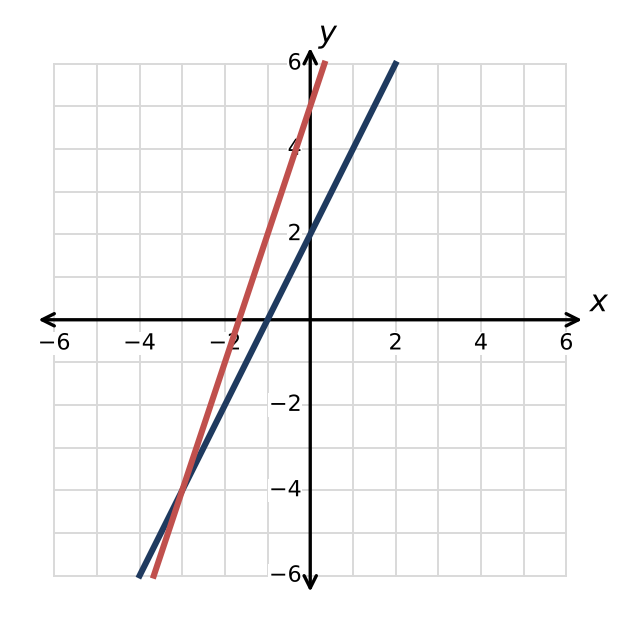
The graph shows the two lines of a system of linear equations. What is the solution of the system?
Show solution
AnswerC — (−3, −4)
Step-by-step
- The solution is the point where the lines cross: (−3, −4).
- Both lines pass through it: y = 2x + 2 and y = 3x + 5.
Fast methodLook for the intersection point and read x first, then y.
Quick checkat x = −3, the first line gives −4 and the second gives −4; both equal y = −4.
Why the other choices are wrong
- A ((−4, −3)): read the coordinates in the wrong order
- B ((0, 2)): gave where the first line crosses the y-axis
- D ((0, 5)): gave where the second line crosses the y-axis
2.
Simplify: −3x(−x − 7)
Show solution
AnswerB — 3 + 21x
Step-by-step
- −3x · −x = 3 and −3x · −7 = 21x.
- So the product is 3 + 21x.
Fast methodMultiply coefficients and ADD exponents for each term.
Quick checkat x = 1, −3x(−x − 7) = −3(−8) = 24, and 3 + 21x gives 24.
Why the other choices are wrong
- A (3 − 7): multiplied only the first term
- C (3x + 21): forgot to multiply the x-powers
- D (−4 − 10x): added the coefficients instead of multiplying
3.
Solve for x: 0.6x + 5.8 = 10.6
Show solution
AnswerD — 8
Step-by-step
- Subtract 5.8: 0.6x = 4.8.
- Divide by 0.6: x = 8.
Fast methodMultiply every term by 10 to clear the decimals, then solve.
Quick check0.6 × 8 + 5.8 = 4.8 + 5.8 = 10.6.
Why the other choices are wrong
- A (0.8): misplaced the decimal point when dividing (one place too far left)
- B (2.88): multiplied by the coefficient instead of dividing
- C (4.8): forgot to divide by the coefficient
4.
Solve: 2 − 5 = 3
Show solution
AnswerB — x = ±2
Step-by-step
- Add 5: 2 = 8.
- Divide by 2: = 4.
- Take square roots: x = ±2.
Fast method = k (k > 0) always has two solutions, ±.
Quick check2 − 5 = 8 − 5 = 3.
Why the other choices are wrong
- A (x = 2): forgot the negative square root
- C (x = ±4): forgot to take the square root
- D (x = ±8): did not divide by the coefficient (and forgot the square root)
5.
Solve: (x − 5)(x − 2) = 0
Show solution
AnswerD — x = 2 or x = 5
Step-by-step
- A product is 0 only when a factor is 0.
- x − 5 = 0 gives x = 5.
- x − 2 = 0 gives x = 2.
- So x = 2 or x = 5.
Fast methodSet each factor equal to 0; each root is the opposite of the number in its factor.
Quick checkat x = 5 the first factor is 0, so the product is 0.
Why the other choices are wrong
- A (x = −5 or x = −2): used the numbers in the factors with their signs instead of the zeros
- B (x = −2 or x = 5): changed the sign of only one root
- C (x = −5 or x = 2): changed the sign of only the other root
6.
Which ordered pair is a solution of the system 3x − 5y = −20 and −3x + 4y = 13?
Show solution
AnswerC — (5, 7)
Step-by-step
- A solution must make both equations true.
- (5, 7): 3(5) + (−5)(7) = −20 ✓ and −3(5) + 4(7) = 13 ✓.
Fast methodTest each choice in BOTH equations; one failure rules it out.
Quick checkevery other choice fails at least one of the two equations.
Why the other choices are wrong
- A ((0, 4)): checked only the first equation
- B ((−11, −5)): checked only the second equation
- D ((7, 5)): swapped the coordinates of the solution
7.
Which value of x is a solution of 2x − 7 < −21?
Show solution
AnswerA — −8
Step-by-step
- Solve: 2x < −14.
- So x < −7.
- Only −8 satisfies x < −7.
Fast methodSubstitute each choice, or solve once and compare.
Quick check2(−8) − 7 = −23, which is < −21.
Why the other choices are wrong
- B (−7): chose the boundary value, which is not included
- C (−4): chose a value on the wrong side of the boundary
- D (−1): chose a value on the wrong side of the boundary
8.
What is the greatest integer x that satisfies 6x − 10 ≤ 290?
Show solution
AnswerC — 50
Step-by-step
- 6x ≤ 300.
- So x ≤ 50.
- The greatest integer that works is 50.
Fast methodSolve, then step to the nearest integer on the allowed side (exclude the boundary for < or >).
Quick check6(50) − 10 = 290 ≤ 290 ✓, but x = 51 gives 296, which fails.
Why the other choices are wrong
- A (46): added the constant instead of subtracting it
- B (49): stopped one integer short
- D (51): went one integer past the boundary
9.
The sum of 4 consecutive integers is 218. What is the largest of these integers?
Show solution
AnswerC — 56
Step-by-step
- Let the smallest be n: n + (n + 1) + (n + 2) + (n + 3) = 218.
- So 4n + 6 = 218 and n = 53.
- The numbers are 53, 54, 55, 56.
- The largest is 56.
Fast methodThe average is 218 ÷ 4 = 54.5, so the four integers are 53, 54, 55, 56 (two just below and two just above 54.5); the largest is 54.5 + 1.5 = 56.
Quick check53 + 54 + 55 + 56 = 218, and the numbers are consecutive integers.
Why the other choices are wrong
- A (53): gave the smallest number
- B (54): gave the second number instead of the largest
- D (57): added one step too many
10.
Solve: 3 = 6
Show solution
AnswerA — x = 3 ±
Step-by-step
- Divide by 3: = 2.
- Take square roots: x − 3 = ±.
- Add 3 (move the constant): x = 3 ± .
Fast methodIsolate the squared bracket, take the ± square root of both sides, then undo the shift inside the bracket.
Quick checksubstituting either root makes equal 2.
Why the other choices are wrong
- B (x = −3 ± ): used the wrong sign for the 3 inside the bracket
- C (x = 3 + ): forgot the negative square root
- D (x = 1 or x = 5): forgot to take the square root
11.
Solve for x: −4x + 31 = 28x − 289
Show solution
AnswerD — 10
Step-by-step
- Subtract 28x from both sides: −32x + 31 = −289.
- Subtract 31: −32x = −320.
- Divide by −32: x = 10.
Fast methodCollect x-terms on one side and numbers on the other; then divide.
Quick checkleft side −4(10) + 31 = −9; right side 28(10) − 289 = −9.
Why the other choices are wrong
- A (−): added the x-terms instead of subtracting
- B (−10): made a sign error moving the constants
- C (): added the constants instead of subtracting
12.
Simplify: 4(5x − 3) − 4(8x − 8)
Show solution
AnswerC — −12x + 20
Step-by-step
- Distribute: 4(5x − 3) = 20x − 12 and −4(8x − 8) = −32x + 32.
- Combine: −12x + 20.
Fast methodMultiply the outside number by EVERY term inside, keeping the sign of the outside number.
Quick checkat x = 1 the original gives 8 and −12x + 20 gives 8.
Why the other choices are wrong
- A (−12x − 20): multiplied only the first term in the second parentheses by −4
- B (52x − 44): did not distribute the negative sign
- D (−12x + 29): multiplied only the first term in the first parentheses by 4
13.
Factor completely: −4 + 16 − 36
Show solution
AnswerA — 4
Step-by-step
- Every term contains 4: −4 + 16 − 36 = 4.
- The trinomial − + 4x − 9 has no common factor left.
Fast methodFind the largest number and the lowest power of x that divide every term.
Quick checkdistribute 4 back to get −4 + 16 − 36.
Why the other choices are wrong
- B (4): lost the negative sign of the last term
- C (4(−x + 4)): factored out , which does not divide the last term, and dropped that term
- D (4): did not divide the last term by 4
14.
Solve: −25 ≤ 2x − 9 < 5
Show solution
AnswerD — −8 ≤ x < 7
Step-by-step
- Do the same thing to all three parts.
- Add 9: −16 ≤ 2x < 14.
- Divide by 2: −8 ≤ x < 7.
Fast methodTreat the middle as the target and apply each step to all three parts.
Quick checkthe endpoints come from 2x − 9 = −25 and 2x − 9 = 5: x = −8 and x = 7.
Why the other choices are wrong
- A (− ≤ x < ): divided all three parts by 2 but did not add 9 first
- B (−16 ≤ x < 14): added 9 but did not divide by 2
- C (−8 < x ≤ 7): switched which endpoints are included
15.
What is the solution (x, y) of the system −6x + y = −7 and 3x + 5y = −2?
Show solution
AnswerA — (1, −1)
Step-by-step
- Multiply the first equation by 5 and the second by 1.
- Then subtract to eliminate y: (−30 − 3)x = −35 − (−2).
- So −33x = −33 and x = 1.
- Substitute into the first equation: −6(1) + y = −7.
- So y = −1.
Fast methodScale the equations so one variable has opposite (or equal) coefficients, then add (or subtract).
Quick checkCheck both equations: −6(1) + 1(−1) = −7 ✓ and 3(1) + 5(−1) = −2 ✓.
Why the other choices are wrong
- B ((−1, 1)): swapped x and y
- C ((1, 1)): made a sign error when solving −6 + y = −7 for y
- D (): subtracted the x-coefficients but added the constants: −33x = −37
16.
Maya is 13 years older than Leo. The sum of their ages is 77. How old is Leo?
Show solution
AnswerA — 32
Step-by-step
- Let Leo be L.
- Then Maya is L + 13, and L + (L + 13) = 77.
- So 2L = 64 and L = 32.
- Maya is 45.
Fast methodTake away the difference and share equally: (77 − 13) ÷ 2 = 32 for Leo; add 13 for Maya.
Quick check32 + 45 = 77 and 45 − 32 = 13.
Why the other choices are wrong
- B (45): gave Maya's age
- C (64): forgot to divide by 2
- D (90): added the difference instead of subtracting and forgot to divide by 2
17.
A pool charges a sign-up fee of $10 and $8.50 per lesson. Sam can spend at most $192. What is the greatest number of lessons he can pay for?
Show solution
AnswerB — 21
Step-by-step
- Let n be the number of lessons: 10 + 8.5n ≤ 192.
- Then 8.5n ≤ 182.
- So n ≤ ≈ 21.41.
- The greatest whole number is 21.
Fast methodSubtract the fixed fee, divide by the price, and round DOWN.
Quick check21 lessons cost $188.50 ≤ $192.00, but 22 cost $197.00.
Why the other choices are wrong
- A (10): added the fee to the price of each one
- C (22): rounded up instead of down
- D (23): added the fee to the budget
18.
Factor: 3 + 11x + 6
Show solution
AnswerC — (3x + 2)(x + 3)
Step-by-step
- Use the ac-method: a·c = 18.
- Find two numbers with product 18 and sum 11: 9 and 2.
- Split the middle term and group: 3 + 11x + 6 = (3x + 2)(x + 3).
Fast methodCheck the outer and inner products of each candidate against the middle coefficient.
Quick checkouter 3·3 + inner 2·1 = 9 + 2 = 11 ✓.
Why the other choices are wrong
- A ((3x + 3)(x + 2)): placed the constants in the wrong factors
- B ((3x − 2)(x − 3)): used the wrong signs in both factors
- D ((3x + 2)(x − 3)): used the wrong sign in one factor
19.
For what value of k does the system 4x + 4y = 2 and kx − 12y = −5 fail to have a unique solution?
Show solution
AnswerB — −12
Step-by-step
- There is no unique solution when the x- and y-coefficients of the two equations are in the same ratio (the lines are parallel or the same).
- The y-coefficients are 4 and −12, so the second equation's coefficients are −3 times the first's.
- So k = −3 × 4 = −12.
- Then 4x + 4y = 2 gives x + y = , but −12x − 12y = −5 gives x + y = , so there is no solution.
Fast methodMatch the ratios: = −, so k = −12.
Quick checkwith k = −12 the left side of the second equation is −3 times the first's: −3 × 4 = −12 and −3 × 4 = −12.
Why the other choices are wrong
- A (−48): multiplied 4 × (−12) and did not divide by 4
- C (0): thought k = 0 removes the unique solution
- D (12): made a sign error: used =
20.
Solve: 6 + 31x + 35 = 0
Show solution
AnswerD — x = − or x = −
Step-by-step
- Factor: (2x + 7)(3x + 5) = 0.
- Set each factor to 0: 2x + 7 = 0 gives x = −.
- 3x + 5 = 0 gives x = −.
Fast methodUse the ac-method (or test rational roots ±(factors of c)/(factors of a)).
Quick checkMultiply back: (2x + 7)(3x + 5) = 6 + 10x + 21x + 35 = 6 + 31x + 35 ✓.
Why the other choices are wrong
- A (x = or x = ): solved each factor with the wrong sign
- B (x = −7 or x = −5): forgot to divide by the x-coefficient in each factor
- C (x = − or x = −): divided by the wrong coefficients