Algebra: Study Guide
This MK topic covers algebra: simplifying expressions, solving linear equations and inequalities, factoring, solving quadratic equations and solving systems of two linear equations. Work neatly by hand, since no calculator is allowed, and check answers by substituting.
- Linear Equations
- Linear Inequalities
- Algebraic Expressions and Factoring
- Quadratic Equations
- Systems of Linear Equations
Linear Equations
Undo operations in reverse order, doing the same thing to both sides. Distribute and combine like terms first, clear fractions by multiplying by the common denominator, and check by substituting.
| Inverse operations | |
| Clearing fractions | |
| Literal equations | |
| No solution / all reals |
Two-step equations
Method. Undo addition/subtraction first, then multiplication.
Worked example- Add 22 on both sides: 11x = 44.
- Divide by 11: x = 4.
- A (0): subtracted the constant instead of adding it
- B (): divided the wrong way
- D (24): divided first but did not divide the constant
Multi-step equations — distributing
Method. Divide both sides by 8 first: x + 1 = 5, so x = 4.
Worked example- Distribute: 8x + 8 = 40.
- Subtract 8: 8x = 32.
- Divide by 8: x = 4.
- B (): multiplied only x by 8
- C (6): used the wrong sign when moving the constant
- D (32): forgot to divide by 8
Variables on both sides
Method. Collect x-terms on one side and numbers on the other; then divide.
Worked example- Add 2x to both sides: 7x + 19 = −16.
- Subtract 19: 7x = −35.
- Divide by 7: x = −5.
- B (): added the constants instead of subtracting
- C (5): made a sign error moving the constants
- D (−): ignored the x-term on the left side
Equations with fractions
Method. Multiply every term by 3 to clear the fraction: x − 15 = −18, so x = −3.
Worked example- Add 5: = −1.
- Multiply by 3: x = −3.
- A (−33): subtracted the constant instead of adding it
- B (−13): multiplied by the denominator before moving the constant but not on every term
- D (−): divided by the denominator instead of multiplying
Multi-step equations — combining like terms
Method. Distribute, combine like terms on each side, then solve the two-step equation.
Worked example- Distribute: 6x + 12 + 6x + 4 = −128.
- Combine like terms: 12x + 16 = −128.
- So 12x = −144 and x = −12.
- A (−24): did not combine the x-terms
- C (−): multiplied only x by 6
- D (−): used the wrong sign when moving the constants
Equations with decimals
Method. Multiply every term by 10 to clear the decimals, then solve.
Worked example- Subtract 3.4: 1.5x = −37.5.
- Divide by 1.5: x = −25.
- A (−250): misplaced the decimal point when dividing (one place too far right)
- B (−56.25): multiplied by the coefficient instead of dividing
- C (−37.5): forgot to divide by the coefficient
Literal equations
Method. Undo the last operation done to h first (inverse operations).
Worked example- Multiply both sides by 2: 2A = bh.
- Divide both sides by b: h = 2.
- A (h = ): divided by 2 instead of multiplying
- B (h = 2Ab): multiplied by b instead of dividing
- D (h = ): divided the wrong way
Number of solutions
Method. Compare x-coefficients first, then constants.
Worked example- Distribute the left side to get 5x − 15.
- Equal x-coefficients with different constants give no solution.
- Identical sides give infinitely many.
- Different x-coefficients give exactly one.
- 5(x − 3) = 5x − 17 has no solution.
- A (5(x − 3) = 5x − 15): chose an equation that has infinitely many solutions
- C (5(x − 3) = 6x − 17): chose an equation that has exactly one solution
- D (5(x − 3) = 7x − 16): chose an equation that has exactly one solution
Solving for an expression
Method. No need to find x: 15x + 16 = 3(5x + 9) − 11 = 3(64) − 11 = 181.
Worked example- x = = 11.
- Then 15x + 16 = 15(11) + 16 = 181.
- A (11): gave x instead of the value of the expression
- C (192): forgot the change to the constant (multiplied the equation by 3 only)
- D (203): used the wrong sign for the constant
Equations from word problems — consecutive integers
Method. The average is 56 ÷ 4 = 14, so the two middle numbers are 13 and 15; the largest is 15 + 2 = 17.
Worked example- Let the smallest be n: n + (n + 2) + (n + 4) + (n + 6) = 56.
- So 4n + 12 = 56 and n = 11.
- The numbers are 11, 13, 15, 17.
- The largest is 17.
- A (11): gave the smallest number
- B (14): gave the middle (average) value
- C (15): used the wrong number of steps between the numbers
Equations from word problems — ages
Method. Take away the difference and share equally: (33 − 15) ÷ 2 = 9 for Leo; add 15 for Maya.
Worked example- Let Leo be L.
- Then Maya is L + 15, and L + (L + 15) = 33.
- So 2L = 18 and L = 9.
- Maya is 24.
- A (9): gave Leo's age
- B (18): forgot to divide by 2
- D (48): added the difference to the sum and did not divide by 2
Equations from word problems — perimeter
Method. Half the perimeter is length + width = 30: 3w + 3 = 30, so w = 9.
Worked example- Let the width be w.
- Length = 2w + 3.
- Perimeter: 2w + 2(2w + 3) = 60.
- So 6w + 6 = 60 and w = 9.
- Length = 21.
- B (19): used the perimeter as one length plus one width
- C (21): gave the length
- D (30): gave half the perimeter
Solving equations with letters
Method. Treat the letters as numbers and undo each operation in reverse order.
Worked example- Subtract b from both sides: = c − b.
- Multiply both sides by a: x = a(c − b).
- A (x = ac − b): multiplied only c by a
- B (x = a(c + b)): added b instead of subtracting
- C (x = ): divided by a instead of multiplying
Linear models — when are two costs equal?
Method. Difference in fixed fees ÷ difference in rates = 39 ÷ 0.2 = 195.
Worked example- Set the costs equal: 7 + 4.1m = 46 + 3.9m.
- Then (4.1 − 3.9)m = 46 − 7.
- So 0.2m = 39 and m = 195.
- A (4.875): added the per-unit rates instead of subtracting
- B (10): divided by B's per-unit rate only
- D (265): added the fixed fees instead of subtracting
Linear Inequalities
Solve like an equation, but reverse the inequality sign when you multiply or divide both sides by a negative number. A compound 'and' inequality describes the values between two numbers.
| Flip rule | |
| Compound (and) | |
| Number line |
Solving inequalities
Method. Solve it like an equation; the sign flips only when you multiply or divide by a negative number.
Worked example- Subtract 12 on both sides: 6x ≥ −48.
- Divide by 6 (positive, so the sign stays): x ≥ −8.
- A (x ≤ −8): reversed the inequality sign without a reason
- B (x ≥ −4): added the constant instead of subtracting it
- C (x > −8): changed whether the endpoint is included
Solving inequalities — negative coefficient
Method. Dividing (or multiplying) both sides by a negative number reverses the inequality.
Worked example- Subtract 29: −2x < 28.
- Divide by −2 and reverse the sign (dividing by a negative): x > −14.
- A (x < −14): forgot to reverse the sign when dividing by a negative number
- B (x > 14): dropped the negative sign of the coefficient but still reversed the sign
- C (x < 14): divided by the positive number instead of the negative one
Inequalities with variables on both sides
Method. Collect x on one side; watch for dividing by a negative.
Worked example- Move the x-terms to the left: 13x > 26.
- Divide by 13: x > 2.
- A (x < 2): reversed the sign without dividing by a negative
- C (x > −): moved −8x with the wrong sign (−3x > 26), then divided by −3 without reversing the sign
- D (x > ): used the wrong sign when moving the constant
Graphs of inequalities on a number line
Method. Filled circle → ≤ or ≥; open circle → < or >; the arrow shows the direction.
Worked example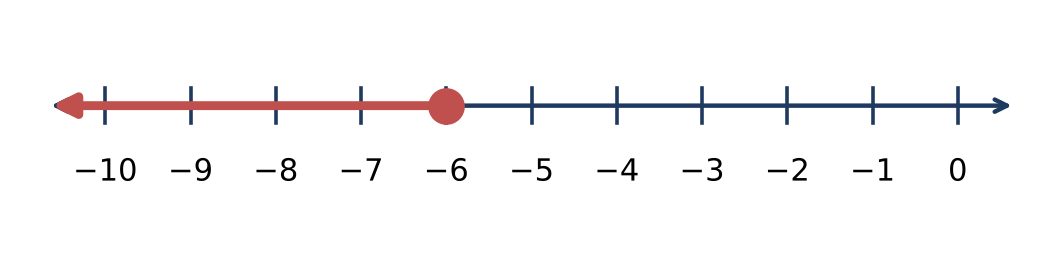
- The circle is at −6 and is filled (included).
- The ray points left, toward smaller numbers.
- So the graph is x ≤ −6.
- A (x < −6): read the open/closed circle the wrong way
- B (x ≥ −6): reversed the direction of the ray
- C (x > −6): reversed the direction and misread the circle
Testing solutions of inequalities
Method. Substitute each choice, or solve once and compare.
Worked example- Solve: 4x ≥ 24.
- So x ≥ 6.
- Only 9 satisfies x ≥ 6.
- A (0): chose a value on the wrong side of the boundary
- B (1): chose a value on the wrong side of the boundary
- C (5): chose a value on the wrong side of the boundary
Compound inequalities — and
Method. Treat the middle as the target and apply each step to all three parts.
Worked example- Do the same thing to all three parts.
- Subtract 6: 12 ≤ 6x ≤ 30.
- Divide by 6: 2 ≤ x ≤ 5.
- A (3 ≤ x ≤ 6): divided all three parts but did not subtract the constant
- B (12 ≤ x ≤ 30): subtracted the constant but did not divide
- C (2 < x < 5): switched which endpoints are included
Compound inequalities — or
Method. “Or” keeps everything from both parts; “and” keeps only the overlap.
Worked example- Solve each part.
- 4x + 8 < 16 gives x < 2.
- 3x + 4 > 31 gives x > 9.
- With “or”, the solution is either part: x < 2 or x > 9.
- B (2 < x < 9): took the values between the endpoints instead of outside them
- C (x > 2 or x < 9): reversed both inequality signs
- D (x ≤ 2 or x ≥ 9): included the endpoints
Greatest or least integer solution
Method. Solve, then step to the nearest integer on the allowed side (exclude the boundary for < or >).
Worked example- 3x < −3.
- So x < −1.
- The greatest integer that works is −2.
- A (−15): added the constant instead of subtracting it
- B (−3): stopped one integer short
- D (−1): included the boundary value although it is not allowed
Inequality word problems
Method. Subtract the fixed fee, divide by the price, and round DOWN.
Worked example- Let n be the number of rides: 39 + 15n ≤ 169.
- Then 15n ≤ 130.
- So n ≤ ≈ 8.67.
- The greatest whole number is 8.
- B (9): rounded up instead of down
- C (11): ignored the one-time fee
- D (13): added the fee to the budget
Algebraic Expressions and Factoring
Combine like terms and distribute to simplify. Multiply binomials with FOIL. To factor, take out the GCF first, then look for a trinomial pattern or a difference of squares.
| FOIL | |
| Square of a sum | |
| Square of a difference | |
| Difference of squares | |
| Trinomial |
Combining like terms
Method. Only terms with exactly the same variable part can be combined; keep each sign with its term.
Worked example- Group the x-terms: 8x and x make 9x.
- Group the constants: −7 and 1 make −6.
- Write the result: 9x − 6.
- A (7x − 6): used the wrong sign for one x-term
- B (9x − 8): used the wrong sign for a constant
- D (3x): combined the numbers with the x-terms
Multiplying a monomial by a polynomial
Method. Multiply coefficients and ADD exponents for each term.
Worked example- − · −5x = 5 and − · 8 = −8.
- So the product is 5 − 8.
- A (5 + 8): did not carry the negative sign of − to the second term
- B (5 − 8x): multiplied the constant term by x instead of by
- C (5 − 8x): multiplied by −x instead of −
Distributive property
Method. Multiply the outside number by EVERY term inside, keeping the sign of the outside number.
Worked example- Distribute: −3(3x + 1) = −9x − 3 and 3(−9x − 7) = −27x − 21.
- Combine: −36x − 24.
- A (−36x − 10): multiplied only the first term in the second parentheses by 3
- C (18x + 18): subtracted the second product instead of adding
- D (−36x − 20): multiplied only the first term in the first parentheses by −3
Adding and subtracting polynomials
Method. Line up like terms (, x, constants); with subtraction, change every sign in the second polynomial.
Worked example- Distribute the minus sign to every term of the second polynomial.
- Then combine like terms: 3 + 6x + 2.
- A (3 + 6x + 8): changed the sign of only the first term of the second polynomial
- C (−9 + 6x + 8): added instead of subtracting
- D (3 + 8): combined the x-terms with the constants
Multiplying binomials
Method. First, Outer, Inner, Last — then combine the two middle terms.
Worked example- FOIL: first 5x·4x = 20.
- Outer 5x·(−3) = −15x.
- Inner −3·4x = −12x.
- Last −3·(−3) = 9.
- Total: 20 − 27x + 9.
- A (20 + 9): multiplied only the first terms and the last terms
- C (20 − 3x + 9): subtracted the outer and inner products
- D (20 − 27x − 9): made a sign error on the last term
Special products
Method. Use the patterns = ± 2pq + and (p + q)(p − q) = − .
Worked example- = + 2pq + with p = x, q = −2.
- + 2(x)(−2) + 4 = − 4x + 4.
- A ( + 4): squared each term and forgot the middle term
- B ( − 2x + 4): used ab instead of 2ab for the middle term
- D ( + 4x + 4): used the wrong sign for the middle term
Factoring — greatest common factor
Method. Find the largest number and the lowest power of x that divide every term.
Worked example- Every term contains 2: −10 + 6 − 18 = 2.
- The trinomial −5 + 3x − 9 has no common factor left.
- A (2): factored out only the number, not the variable
- B (2(−5x + 3)): took out , which is not a factor of −18, and dropped that term
- C (2): did not divide the last term by 2
Factoring trinomials (leading coefficient 1)
Method. Product = c, sum = b; the signs of c and b tell you the signs of the two numbers.
Worked example- Find two numbers with product 30 and sum −11: −6 and −5.
- So − 11x + 30 = (x − 6)(x − 5).
- A ((x + 6)(x + 5)): used the wrong signs in both factors
- B ((x − 6)(x + 5)): used the wrong sign in one factor
- D ((x − 10)(x − 3)): chose a factor pair of 30 that does not add to −11
Factoring — difference of squares
Method. − = (p + q)(p − q); take out any common factor first.
Worked example- 9 − 4 = − .
- So it factors as (3x + 2)(3x − 2).
- A ((3x − 2)(3x − 2)): wrote a perfect square instead of a difference of squares
- B ((3x + 2)(3x + 2)): used + in both factors
- D ((9x + 2)(x − 2)): did not take the square root of the coefficient
Factoring trinomials (leading coefficient ≠ 1)
Method. Check the outer and inner products of each candidate against the middle coefficient.
Worked example- Use the ac-method: a·c = −60.
- Find two numbers with product −60 and sum −17: −20 and 3.
- Split the middle term and group: 15 − 17x − 4 = (5x + 1)(3x − 4).
- A ((5x − 4)(3x + 1)): placed the constants in the wrong factors
- C ((5x − 1)(3x + 4)): used the wrong signs in both factors
- D ((5x + 1)(3x + 4)): used the wrong sign in one factor
Quadratic Equations
Write the equation as ax² + bx + c = 0, then factor and use the zero-product property, take square roots, or use the quadratic formula.
| Standard form | |
| Zero-product property | |
| Square-root method | |
| Quadratic formula |
Square-root equations x² = k
Method. = k (k > 0) always has two solutions, ±.
Worked example- Add 25: 2 = 32.
- Divide by 2: = 16.
- Take square roots: x = ±4.
- A (x = 4): forgot the negative square root
- C (x = ±16): forgot to take the square root
- D (x = ±32): did not divide by the coefficient (and forgot the square root)
Zero-product property
Method. Set each factor equal to 0; each root is the opposite of the number in its factor.
Worked example- A product is 0 only when a factor is 0.
- x + 6 = 0 gives x = −6.
- x + 7 = 0 gives x = −7.
- So x = −7 or x = −6.
- A (x = 6 or x = 7): used the numbers in the factors with their signs instead of the zeros
- C (x = −6 or x = 7): changed the sign of only one root
- D (x = −7 or x = 6): changed the sign of only the other root
Solving by factoring
Method. Get 0 on one side, factor, then set each factor to 0.
Worked example- Find two numbers with product −48 and sum −8: −12 and 4.
- Factor: (x − 12)(x + 4) = 0.
- Zero-product property: x = −4 or x = 12.
- A (x = −12 or x = 4): used the numbers from the factors without changing their signs
- B (x = 4 or x = 12): made a sign error on one root
- C (x = −6 or x = 8): chose a factor pair of −48 that does not add to −8
Square-root method
Method. Isolate the squared bracket, take the ± square root of both sides, then undo the shift inside the bracket.
Worked example- Divide by 4: = 12.
- Take square roots: x − 5 = ± = ±2.
- Add 5 (move the constant): x = 5 ± 2.
- A (x = −5 ± 2): subtracted 5 instead of adding 5 when undoing x − 5
- B (x = 5 + 2): forgot the negative square root
- C (x = −7 or x = 17): forgot to take the square root
Quadratic word problems — area
Method. Look for two numbers 5 apart whose product is 84: 7 and 12.
Worked example- Let w be the width: w(w + 5) = 84.
- So + 5w − 84 = 0.
- Factor: (w − 7)(w + 12) = 0.
- So w = 7 (a width cannot be negative).
- Length = 7 + 5 = 12.
- A (7): gave the width
- C (42): halved the area
- D (79): subtracted the difference from the area
Solving by factoring (leading coefficient ≠ 1)
Method. Use the ac-method: a·c = 12 × 28 = 336 = 16 × 21 and 16 + 21 = 37, so split 37x as 16x + 21x and group.
Worked example- Factor: (4x + 7)(3x + 4) = 0.
- Set each factor to 0: 4x + 7 = 0 gives x = −.
- 3x + 4 = 0 gives x = −.
- B (x = or x = ): solved each factor with the wrong sign
- C (x = −7 or x = −4): forgot to divide by the x-coefficient in each factor
- D (x = − or x = −1): divided by the wrong coefficients
Quadratic formula
Method. Compute the discriminant first, simplify its square root, then divide every term by 2a.
Worked example- a = 3, b = 10, c = 4.
- Discriminant: − 4ac = 100 − 4(3)(4) = 52.
- x = = = , which simplifies to .
- A (x = ): used +b instead of −b
- B (x = ): used + 4ac in the discriminant
- C (x = ): divided by a instead of 2a
Systems of Linear Equations
Solve two equations together by substitution or elimination, then check the pair in both equations. Lines with the same slope and different intercepts never meet, so there is no solution.
| Substitution | |
| Elimination | |
| One solution | |
| No solution | |
| Infinitely many solutions |
Systems — solving by graphing
Method. Look for the intersection point and read x first, then y.
Worked example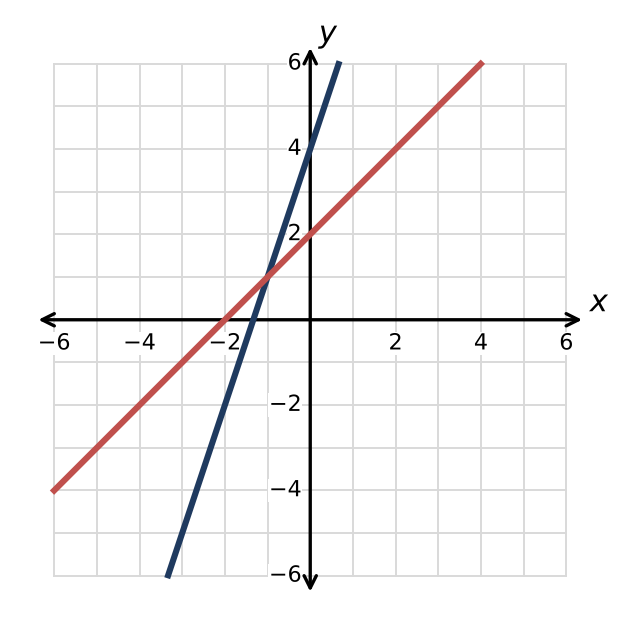
- The solution is the point where the lines cross: (−1, 1).
- Both lines pass through it: y = 3x + 4 and y = x + 2.
- A ((1, −1)): read the coordinates in the wrong order
- B ((0, 4)): gave where the first line crosses the y-axis
- C ((0, 2)): gave where the second line crosses the y-axis
Systems — checking a solution
Method. Test each choice in BOTH equations; one failure rules it out.
Worked example- A solution must make both equations true.
- (−1, −6): 1(−1) + 2(−6) = −13 ✓ and −1(−1) + (−5)(−6) = 31 ✓.
- B ((1, −7)): checked only the first equation
- C ((4, −7)): checked only the second equation
- D ((−6, −1)): swapped the coordinates of the solution
Systems — substitution
Method. When one equation already gives y, substitute it straight into the other.
Worked example- Substitute y = −2x + 2 into the second equation: −6x + (−1)(−2x + 2) = 6.
- So −4x − 2 = 6.
- So x = −2.
- Then y = −2(−2) + 2 = 6.
- B ((6, −2)): swapped x and y
- C ((−2, 2)): used −2 instead of +2 for the constant when finding y
- D ((−1, 4)): used the wrong sign for the constant after substituting
Systems — elimination
Method. Scale the equations so one variable has opposite (or equal) coefficients, then add (or subtract).
Worked example- Subtract the second equation from the first: (−7x − 2y) − (−6x − 2y) = −58 − (−50).
- So −x = −8 and x = 8.
- Substitute into the first equation: −7(8) − 2y = −58.
- So −2y = −2 and y = 1.
- A ((1, 8)): swapped x and y
- B ((−8, −1)): made a sign error when eliminating
- D ((8, −1)): got the sign wrong when dividing −2y = −2 by −2
Systems — number of solutions
Method. Compare slopes : different → one solution; same slope, different intercept → none; identical lines → infinitely many.
Worked example- Compare the equations: the left sides are proportional (ratio 2) but the constants are not.
- So the lines are parallel — no solution.
- A (infinitely many solutions): thought equal slopes always mean the same line
- C (exactly one solution): thought different-looking equations must cross once
- D (exactly two solutions): thought two lines can meet at two points
Systems — finding an expression directly
Method. Combine the equations so the coefficients of x and y become opposite; then divide.
Worked example- Subtract the second equation from the first: 5x − 5y = 15, which is 5(x − y) = 15.
- So x − y = 3.
- A (−51): added the equations but did not divide
- B (−13): found x + y instead
- C (−5): gave x only