Geometry: Practice Paper 1
Choose one answer for each question, then select Check my answers. Every question has a full worked solution.
1.
A circle has a diameter of 8 meters. What is its circumference, in meters?
Show solution
AnswerB —
Step-by-step
- The circumference is C = πd.
- So C = π × 8 = meters.
Fast methodC = πd = r: multiply the diameter by π.
Quick check ÷ π = 8, which is the diameter ✓.
Why the other choices are wrong
- A (): used π times the radius
- C (): used the diameter as the radius
- D (): used π times the diameter squared
2.
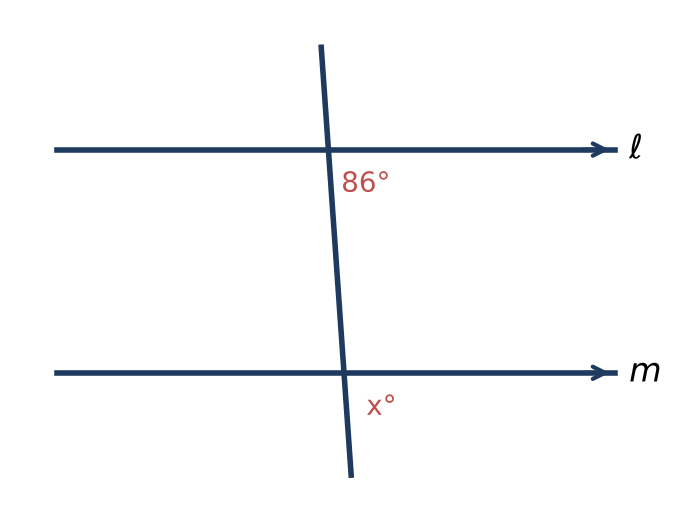
In the figure, lines ℓ and m are parallel. What is the value of x?
Show solution
AnswerC — 86
Step-by-step
- The angle marked 86° and the angle marked x° are corresponding angles.
- With parallel lines, corresponding angles are equal.
- So x = 86.
Fast methodParallel lines: all acute angles are equal, all obtuse angles are equal, and an acute + an obtuse = 180°.
Quick checkthe 86° angle and the x° angle are both below their line and to the right of the transversal, so they are equal; x = 86 ✓.
Why the other choices are wrong
- A (4): used complementary angles
- B (8): subtracted the angle twice from 180°
- D (94): assumed the angles are supplementary
3.
What is the distance between (4, 6) and (4, −5)?
Show solution
AnswerB — 11
Step-by-step
- The points have the same x-coordinate.
- So the distance is the difference of the other coordinates.
- 6 − (−5) = 11.
Fast methodSame x or same y: subtract the other coordinates (a point left of or below zero adds its distance).
Quick check5 units to zero plus 6 units past zero is 11 ✓.
Why the other choices are wrong
- A (1): subtracted the absolute values
- C (12): counted grid points instead of units
- D (30): multiplied the y-coordinates and dropped the negative sign
4.
A rectangle has vertices (−1, −5), (1, −5), (1, 2), (−1, 2). What is its perimeter?
Show solution
AnswerD — 18
Step-by-step
- The width is 1 − (−1) = 2 and the height is 2 − (−5) = 7.
- So the perimeter is 2 × (2 + 7) = 18.
Fast methodFind side lengths by subtracting coordinates.
Quick check2 + 7 + 2 + 7 = 18 ✓.
Why the other choices are wrong
- A (8): used the width for all four sides
- B (9): added only two sides
- C (14): found the area
5.
A box measures 5 feet by 6 feet by 3 feet. What is its volume, in cubic feet?
Show solution
AnswerC — 99
Step-by-step
- V = l × w × h.
- Write 5 as .
- So V = × 6 × 3 = 99 cubic feet.
Fast methodChange mixed numbers to improper fractions, then multiply.
Quick check5 × 18 = 99 because × 18 = 99 ✓.
Why the other choices are wrong
- A (14 ): added the three dimensions
- B (90): dropped the fraction part of the length
- D (108): rounded the length up
6.
What is the slope of a line parallel to y = 2x + 7?
Show solution
AnswerD — 2
Step-by-step
- Parallel lines have equal slopes.
- The slope of the given line is the coefficient of x, 2.
- So the parallel slope is 2.
Fast methodParallel: same slope. Perpendicular: negative reciprocal.
Quick checka line with slope 2 never meets y = 2x + 7 unless it is the same line ✓.
Why the other choices are wrong
- A (−2): changed the sign
- B (−): gave the perpendicular slope
- C (): took the reciprocal
7.
Two angles of a triangle measure 79° and 72°. What is the measure of the third angle, in degrees?
Show solution
AnswerA — 29
Step-by-step
- The angles of a triangle add to 180°.
- So the third angle is 180° − 79° − 72° = 29°.
Fast methodThird angle = 180° − (sum of the other two).
Quick check79 + 72 + 29 = 180 ✓.
Why the other choices are wrong
- B (101): subtracted only the first angle
- C (151): added the two angles
- D (209): used 360° for the angle sum
8.
Two angles measure (2x − 8)° and (4x − 4)°. The angles are complementary. What is the measure of the first angle, in degrees?
Show solution
AnswerB — 26
Step-by-step
- Complementary angles add to 90°: (2x − 8) + (4x − 4) = 90.
- So 6x − 12 = 90, 6x = 102 and x = 17.
- The first angle is 2(17) − 8 = 26°.
Fast methodWrite the angle relationship as an equation, then solve.
Quick checkthe angles are 26° and 64°, which add to 90° ✓.
Why the other choices are wrong
- A (17): gave x instead of the angle
- C (34): forgot the constant
- D (64): gave the other angle
9.
A cylinder has a volume of cubic units and a radius of 5 units. What is its height, in units?
Show solution
AnswerA — 4
Step-by-step
- V = πr²h.
- So = π × × h = h.
- Divide both sides by : h = 4.
Fast methodSubstitute into the volume formula and solve for the unknown.
Quick checkπ × × 4 = ✓.
Why the other choices are wrong
- B (10): divided by the diameter
- C (12): used the cone formula
- D (20): forgot to square the radius
10.
A circle is inscribed in a square with side length 10. What is the area of the region inside the square but outside the circle?
Show solution
AnswerA — 100 −
Step-by-step
- The circle's diameter equals the side.
- So r = 10 ÷ 2 = 5.
- Square area = = 100.
- Circle area = π × = .
- Shaded area = 100 − .
Fast methodShaded area = outer area − inner area.
Quick check100 − 25 × 3.14 = 21.5, which is positive and less than 100 ✓.
Why the other choices are wrong
- B (100 − ): used the side as the radius
- C (100 − ): subtracted the circumference
- D (): gave the area of the circle
11.
A quarter circle has a radius of 5 inches. Using 3.14 for π, what is its area, in square inches?
Show solution
AnswerB — 19.625
Step-by-step
- The whole circle has area 3.14 × = 78.5.
- A quarter circle is one fourth of that: 78.5 ÷ 4 = 19.625 square inches.
Fast methodTake the right fraction of the full circle, then add any straight edges.
Quick check4 × 19.625 = 78.5, the full circle's area ✓.
Why the other choices are wrong
- A (7.85): used the circumference formula
- C (39.25): found the area of a half circle
- D (78.5): gave the area of the whole circle
12.
The angles of a triangle are in the ratio 2:5:8. What is the measure of the largest angle, in degrees?
Show solution
AnswerD — 96
Step-by-step
- Let the angles be 2k, 5k and 8k.
- Then 15k = 180.
- So k = 12.
- The largest angle is 8 × 12 = 96°.
Fast methodLargest angle = 180 × (largest part ÷ sum of the parts).
Quick check24 + 60 + 96 = 180 ✓.
Why the other choices are wrong
- A (12): gave the value of one part
- B (24): gave the smallest angle
- C (60): assumed the three angles are equal
13.
What is the distance between (−5, 8) and (−11, 16)?
Show solution
AnswerA — 10
Step-by-step
- d = .
- The differences are −11 − (−5) = −6 and 16 − 8 = 8.
- So d = = = 10.
Fast methodDistance = ; look for a Pythagorean triple.
Quick check = 100 = 36 + 64 ✓.
Why the other choices are wrong
- B (14): added the horizontal and vertical distances
- C (8): added the coordinates instead of subtracting
- D (100): forgot to take the square root
14.
A circle has an area of square units. What is its circumference, in units?
Show solution
AnswerA —
Step-by-step
- A = πr² = .
- So = 196 and r = 14.
- The circumference is C = r = × 14 = units.
Fast methodFind the radius first, then use the other formula.
Quick checka radius of 14 gives A = and C = ✓.
Why the other choices are wrong
- B (): used times the diameter
- C (): gave the area
- D (): doubled the area value
15.
A triangle has sides of length 16, 34, 30. Is the triangle right, acute or obtuse?
Show solution
AnswerD — right
Step-by-step
- Compare the square of the longest side with the sum of the squares of the other two sides.
- + = 1156 and = 1156.
- They are equal.
- So the triangle is right.
Fast method + vs (c longest): equal → right, greater → acute, less → obtuse.
Quick checkthe sides form a triangle because 16 + 30 > 34 ✓.
Why the other choices are wrong
- A (acute): thought + is greater than
- B (obtuse): thought + is less than
- C (not a triangle): thought the sides cannot form a triangle
16.
In a circle with radius 5, a central angle of 135° intercepts an arc. What is the length of the arc?
Show solution
AnswerB —
Step-by-step
- Arc length = (central angle ÷ 360°) × r.
- So the arc length is × × 5 = × = .
Fast methodArc = × circumference.
Quick check ÷ = = ✓.
Why the other choices are wrong
- A (): used πr instead of r
- C (): found the sector area
- D (): gave the whole circumference
17.
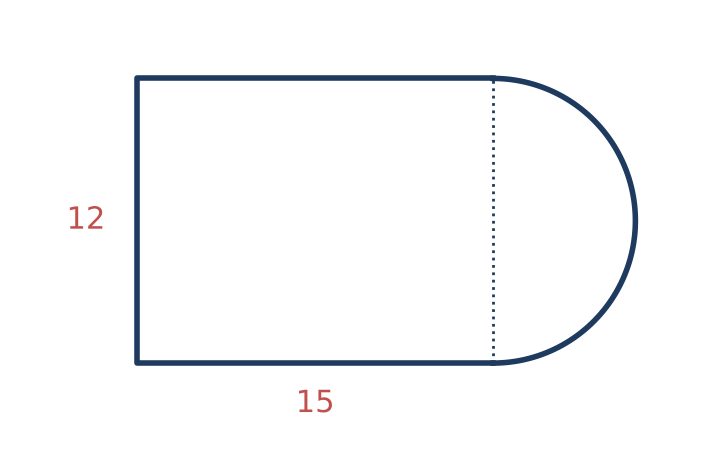
The figure shown is a rectangle with a semicircle on one end. Using 3.14 for π, what is the area of the figure?
Show solution
AnswerC — 236.52
Step-by-step
- Rectangle: 15 × 12 = 180.
- The semicircle has radius 12 ÷ 2 = 6.
- So its area is ½ × 3.14 × = 56.52.
- Total area = 180 + 56.52 = 236.52.
Fast methodSplit the figure into a rectangle and a semicircle whose diameter is the rectangle's 12-unit side; add the two areas.
Quick check236.52 − 180 = 56.52, half of 3.14 × 36 ✓.
Why the other choices are wrong
- A (123.48): subtracted the semicircle
- B (180): left out the semicircle
- D (293.04): added a whole circle
18.
What is the sum of the interior angles of a polygon with 12 sides, in degrees?
Show solution
AnswerB — 1800
Step-by-step
- Use the formula (n − 2) × 180° with n = 12.
- (12 − 2) × 180° = 10 × 180°.
- So (12 − 2) × 180° = 1800°.
Fast methodInterior sum (n − 2)·180°; exterior sum always 360°.
Quick checkat each of the 12 vertices interior + exterior = 180°, so the interior sum is 12 × 180° − 360° = 2160° − 360° = 1800° ✓.
Why the other choices are wrong
- A (360): gave the exterior-angle sum
- C (1980): used (n − 1) × 180°
- D (2160): used n × 180°
19.
The length of a rectangle is 2 more than its width. The area is 63 square units. What is the width?
Show solution
AnswerA — 7
Step-by-step
- Let the width be w.
- Then w(w + 2) = 63.
- So + 2w − 63 = 0.
- Factoring gives (w − 7)(w + 9) = 0.
- The width must be positive.
- So w = 7.
Fast methodWrite the formula with the unknown, then solve.
Quick check7 × 9 = 63, and 9 is 2 more than 7 ✓.
Why the other choices are wrong
- B (9): gave the length
- C (): divided the area by 4, as if it were the perimeter of a square
- D (): added the sides instead of multiplying
20.
A solid is a cylinder with radius 4 and height 6, with a cone of the same radius and height 3 on top. What is its volume? Give your answer in terms of π.
Show solution
AnswerC —
Step-by-step
- Cylinder: πr²h = π × × 6 = .
- Cone: ⅓πr²h = ⅓ × π × × 3 = .
- Total = + = .
Fast methodFind each part's volume and add.
Quick check is more than the cylinder alone, ✓.
Why the other choices are wrong
- A (): subtracted the cone
- B (): left out the cone
- D (): forgot the ⅓ for the cone