Mathematics Knowledge: Unit Study Guide
05.01 Number and Operations
Mathematics Knowledge (MK) is an AFQT subtest (AFQT = 2×VE + AR + MK). This topic covers number skills: integers and the order of operations, fractions, decimals, exponents and square roots, scientific notation, and factors, multiples and primes. The CAT-ASVAB gives 15 MK questions in 31 minutes and the paper test 25 in 24 minutes, with no calculator.
Integers and Order of Operations
Use the sign rules for adding and multiplying negative numbers, absolute value as distance from zero, and the order of operations: parentheses, exponents, multiplication and division left to right, then addition and subtraction left to right.
| Order of operations | |
| Sign rule (× and ÷) | |
| Subtracting a negative | |
| Absolute value | |
| Distance on a number line | |
| Distributive property |
Odd and even — parity rules
Method. Test with small numbers: a = 1, b = 1 gives a + b + 1 = 3, which is odd; check one more pair to be sure.
Worked example- Use the rules: even ± even = even, odd ± odd = even, odd ± even = odd.
- Even × anything = even, odd × odd = odd.
- Here a is odd and b is odd.
- So a + b + 1 is always odd.
- A (2a): chose an expression that is always even
- B (a + 3): chose an expression that is always even
- C (b + 1): chose an expression that is always even
Integer expression — order of operations
Method. Find both products with their signs, then change the subtraction to adding the opposite: −12 + (−16) = −28.
Worked example- Multiply first: −4 × 3 = −12 and 4 × 4 = 16.
- Then subtract: −12 − 16 = −28.
- B (−4): got the sign of the first product wrong
- C (4): got the sign of the second product wrong
- D (28): gave the opposite sign
Absolute value — distance on a number line
Method. Points on opposite sides of 0: add their distances from 0: 72.
Worked example- Distance is the absolute value of the difference.
- |56 − (−16)| = |72|.
- So |56 − (−16)| = 72.
- A (40): subtracted the sizes, ignoring that the points are on opposite sides of 0
- C (73): counted the tick marks instead of the spaces between the numbers
- D (896): multiplied the sizes
Absolute value — evaluate
Method. Absolute value is never negative: simplify inside, drop the sign, then do the outside operation.
Worked example- Work inside the bars first: |−23| = 23 and |6 − 7| = |−1| = 1.
- Then 23 − 1 = 22.
- A (−24): treated |−23| as −23
- B (−22): ignored all the absolute value bars
- D (24): treated |6 − 7| as −1
Order rational numbers
Method. Negatives are less than 0 and positives greater; among negatives, the one farther from 0 is less.
Worked example- Place the numbers on a number line: −3, −0.9, 0 and 0.1.
- From left to right: −3, −0.9, 0, 0.1.
- The least is −3.
- A (0): chose the number closest to 0
- C (0.1): chose the greatest number instead of the least
- D (−0.9): chose the negative number closest to 0 (thought it was the smallest)
Evaluate an expression with a negative number
Method. Put every negative value in parentheses before squaring or multiplying.
Worked example- Substitute with parentheses.
- − 4 × (−6) = 36 − (−24).
- − 4 × (−6) = 36 + 24.
- So − 4 × (−6) = 60.
- A (−60): made both terms the wrong sign
- B (−12): computed as a negative number
- C (12): used x as positive in the second term
Rational and irrational numbers
Method. Rational = fraction of integers (includes integers, terminating and repeating decimals, square roots of perfect squares). Irrational = non-ending, non-repeating decimal.
Worked example- = 2 = , a fraction of integers.
- So it is rational.
- (not a perfect square), π and 2 + are irrational.
- B (): chose an irrational number (its decimal never ends or repeats)
- C (2 + ): chose an irrational number (its decimal never ends or repeats)
- D (π): chose an irrational number (its decimal never ends or repeats)
Fractions
Add or subtract fractions over a common denominator. Multiply straight across. To divide, multiply by the reciprocal. Change mixed numbers to improper fractions before multiplying or dividing.
| Add / subtract | |
| Multiply | |
| Divide | |
| Mixed number | |
| Equivalent fractions | |
| Compare |
Compare fractions
Method. Compare each fraction with and with 1 first; for close ones cross-multiply: > when a × d > b × c.
Worked example- Compare each fraction with : is less than , because 6 × 2 = 12 is less than 13.
- , and are all greater than (each top number is more than half its bottom number).
- So is the least.
- B (): chose the fraction with the least top number
- C (): chose the fraction with the least bottom number
- D (): chose the greatest fraction instead of the least
Add — unlike denominators
Method. Butterfly method: = , then simplify to 1 .
Worked example- The least common denominator of 4 and 2 is 4.
- Rename: = and = .
- Add the tops: 3 + 2 = 5.
- So = 1 .
- A (): added the tops and added the bottoms
- B (1): used a common bottom number but did not rename the tops
- D (2): added the tops and kept the smaller bottom number
Subtract — unlike denominators
Method. Butterfly method: = , then simplify to .
Worked example- The least common denominator of 5 and 10 is 10.
- Rename: = and = .
- Subtract the tops: 4 − 3 = 1.
- So .
- B (): multiplied instead of subtracting
- C (): cross-multiplied the tops but added the bottoms
- D (): added instead of subtracting
Multiply — fraction × fraction
Method. Cancel any top number with any bottom number first (cross-cancel), then multiply the small numbers that are left.
Worked example- Multiply the tops and multiply the bottoms: = .
- Divide top and bottom by 3: .
- A (): divided only the top by the common factor
- C (): added the tops and added the bottoms
- D (2 ): divided instead of multiplying (flipped the second fraction)
Divide — fraction ÷ fraction
Method. Keep – change – flip: keep , change ÷ to ×, flip to 3.
Worked example- Dividing by is the same as multiplying by its reciprocal 3.
- × 3 = = = 2.
- A (): multiplied without flipping the second fraction
- B (): flipped the first number instead of the second
- C (1): added instead of dividing
Add mixed numbers
Method. Change to improper fractions and add: + = 11 ; or add wholes and fractions separately and carry any extra whole.
Worked example- Add the whole numbers: 4 + 6 = 10.
- Add the fractions with the common denominator 7: + = = 1 .
- Combine: 10 + 1 = 11 .
- A (10 ): subtracted the fraction parts instead of adding them
- B (10 ): did not carry the extra whole from the fraction part
- C (10 ): added the whole numbers, then added the tops and added the bottoms
Divide a mixed number by a fraction
Method. Keep – change – flip after converting the mixed number to an improper fraction.
Worked example- Change 3 to .
- Multiply by the reciprocal of : × = = 8 .
- A (1 ): multiplied without flipping the second fraction
- B (8): divided only the whole number 3 by , then added the back unchanged
- D (17 ): multiplied by the bottom of the second fraction but did not divide by its top
Find the whole from a fractional part
Method. Divide by the fraction: 4 ÷ = 4 × = 6.
Worked example- of the whole is 4.
- So one part is 4 ÷ 2 = 2.
- The whole has 3 parts: 3 × 2 = 6.
- A (2 ): found of 4 instead of the whole
- C (7): added the bottom number to the part
- D (12): multiplied by the bottom only
Number line — mixed numbers
Method. P is past 1, so start at 1 and count 1 space of size : 1 .
Worked example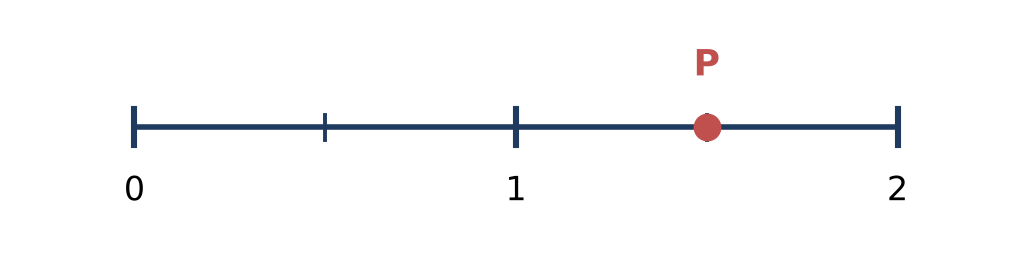
- Each whole is cut into 2 equal spaces.
- So each space is .
- P is 3 spaces from 0, which is = 1 (one whole and more).
- A (): left out the whole from 0 to 1
- B (): used all the spaces from 0 to 2 as the bottom number
- D (2 ): added an extra whole
Subtract mixed numbers (regrouping)
Method. Use improper fractions: − = 2 ; this avoids regrouping.
Worked example- Rename with denominator 35: 12 − 9 .
- Since is less than , regroup one whole: 12 = 11 .
- Now subtract: 11 − 9 = 2 and − = .
- Answer: 2 .
- B (3 ): subtracted the smaller fraction from the larger instead of regrouping
- C (3 ): added the fraction parts instead of subtracting
- D (3 ): regrouped but did not take 1 from the whole number
Multiply mixed numbers
Method. Never multiply the whole parts and the fraction parts separately; convert to improper fractions and cross-cancel first.
Worked example- Change each mixed number to an improper fraction: 4 = and 4 = .
- Multiply: = = 18 .
- A (): divided instead of multiplying
- B (8 ): added instead of multiplying
- C (16 ): multiplied the whole numbers and the fractions separately
Fraction of a quantity — two steps
Method. Multiply by what is left each time: 18 × × = 6.
Worked example- First purchase: of 18 = 18 ÷ 2 × 1 = 9, leaving 18 − 9 = 9.
- Second purchase: of the remaining 9 = 9 ÷ 3 × 1 = 3, leaving 9 − 3 = 6.
- A (3): took the second fraction of the original amount instead of the remaining amount
- C (9): forgot the second purchase
- D (12): gave the total spent instead of the amount left
Complex fraction
Method. Multiply the top and the bottom of the complex fraction by 84 (the LCD) to clear the small fractions, then divide.
Worked example- Work out the top first: 1 − = − = .
- Then divide by the bottom: ÷ = × = .
- A (): divided before subtracting
- C (): left out the 1 − part
- D (1 ): added instead of subtracting
Order of operations with fractions
Method. Do the × first, simplify it, then add with a common denominator.
Worked example- Multiply before adding: × = .
- Then add: + = .
- A (): added first, then multiplied (worked left to right)
- C (): divided instead of multiplying
- D (1 ): added all three
Fraction between two fractions
Method. Change all fractions to decimals (top ÷ bottom) and pick the one strictly between the two given decimals.
Worked example- Rename with the common denominator 70: = , = and = .
- Only has a top number strictly between 10 and 35.
- A (): is equal to , so it is not between
- C (): is less than , so it is not between
- D (): is greater than , so it is not between
Solve a proportion with expressions
Method. Multiply both sides by 72, then move the x-terms to the side with the larger coefficient to avoid negatives.
Worked example- Cross-multiply: 8(x + 4) = 9(x − 6).
- Distribute: 8x + 32 = 9x − 54.
- Collect terms: 32 + 54 = 9x − 8x.
- So 86 = 1x and x = 86.
- A (−84): cross-multiplied the wrong way
- B (−22): made a sign error with the subtracted number
- C (10): did not distribute when cross-multiplying
Rational reasoning — capacity from a change
Method. Capacity = amount added ÷ change in fraction = 6 ÷ = 180.
Worked example- The 6 liters filled − = of the tank.
- If of the capacity is 6, the capacity is 6 ÷ = 6 × 30 = 180 liters.
- A (): multiplied by the change instead of dividing
- B (3 ): added the two fractions instead of subtracting
- C (7 ): divided by the new fraction only
Rational reasoning — combined work
Method. Product over sum: = = 4 hours.
Worked example- Rates: Machine A does of the job per hour and Machine B does .
- Together: + = of the job per hour.
- Time = 1 ÷ = = 4 hours.
- B (6): subtracted the two times
- C (10): averaged the two times
- D (20): added the two times
Rational reasoning — fraction of a fraction
Method. Work backwards: girls = 3 ÷ = 9; students = 9 ÷ = 45.
Worked example- Chess-club girls are of = of all students.
- So of the total is 3, and the total is 3 ÷ = 45.
- A (): multiplied by the fractions instead of dividing
- B (9): found only the number of girls
- C (36): found the number of boys instead of all students
Decimals
Line up the decimal points to add or subtract. To multiply, count the total decimal places in the factors. To divide by a decimal, move both decimal points right until the divisor is a whole number.
| Multiply | |
| Divide by a decimal | |
| Powers of 10 | |
| Fraction to decimal | |
| Decimal to fraction |
Decimal place value — value of a digit
Method. Write 9, then put a zero in every place between it and the decimal point: 0.09.
Worked example- In 472.1953 the digit 9 is 2 places to the right of the decimal point, which is the hundredths place.
- Its value is 9 hundredths = 0.09.
- A (0.009): used the place one to the right
- C (0.9): used the place one to the left
- D (9): gave the digit itself, not its value
Multiply decimals
Method. Estimate first: about 4 × 3 = 12, then place the point in 1224 to get a number near that: 12.24.
Worked example- Multiply as whole numbers: 36 × 34 = 1224.
- The factors have 1 + 1 = 2 decimal places in all.
- So the product has 2: 12.24.
- A (1.224): counted one decimal place too many
- B (7): added instead of multiplying
- D (122.4): counted one decimal place too few
Multiply and divide by powers of 10
Method. Count the zeros in 100 (2) and slide the point that many places right, filling empty places with zeros.
Worked example- Multiplying by 100 moves the decimal point 2 places to the right (one place for each zero).
- 78.95 × 100 = 7895.
- A (0.7895): moved the decimal point the wrong way
- B (157.9): multiplied by the number of zeros instead of the power of ten
- C (789.5): moved the decimal point one place too few
Divide by a decimal
Method. Move the decimal point 1 place right in both numbers, then divide.
Worked example- Make the divisor a whole number: multiply both numbers by 10.
- 2.4 × 10 = 24 and 0.6 × 10 = 6.
- Now divide: 24 ÷ 6 = 4.
- A (0.4): moved the decimal point in the divisor but not in the dividend
- C (40): put the decimal point one place too far right
- D (400): put the decimal point two places too far right
Estimate a product of decimals
Method. Round first, then multiply the easy whole numbers: 13 × 20 = 260.
Worked example- 12.8 rounds to 13 and 19.7 rounds to 20.
- Multiply the rounded numbers: 13 × 20 = 260.
- A (26): placed the decimal point in the estimate
- B (33): added instead of multiplying
- D (2600): put one extra zero on the estimate
Estimation with money
Method. Round, then multiply whole numbers: 4 × 3 = 12.
Worked example- $2.75 rounds to $3 and 3.9 rounds to 4.
- Estimate: 4 × $3 = $12.
- A ($7): added instead of multiplying
- B ($8): rounded the price down instead of to the nearest dollar
- C ($9): rounded the amount the wrong way
Fraction to decimal
Method. Scale the bottom to 10, 100 or 1,000, then read the decimal off the top.
Worked example- A fraction means top ÷ bottom: 3 ÷ 5 = 0.6.
- Or rename with a power of 10: = = 0.6.
- A (0.06): put the decimal point one place too far left
- B (0.35): wrote the top and bottom digits after a decimal point
- C (0.4): used the other part (1 minus the fraction)
Decimals in money — multi-step
Method. Work in cents: 12 × 440 = 5280 cents; 10000 − 5280 = 4720 cents = $47.20.
Worked example- Total cost: 12 × $4.40 = $52.80.
- Change: $100.00 − $52.80 = $47.20.
- A ($42.80): multiplied by one item too many
- C ($52.80): gave the total cost instead of the change
- D ($95.60): subtracted the price of only one item
Reasonableness — place the decimal point
Method. Count decimal places: 1 + 2 = 3, so put the point 3 places from the right of 98982: 98.982.
Worked example- Estimate: 42.3 is about 42 and 2.34 is about 2.
- So the product is about 84.
- The only choice near that is 98.982.
- A (9.8982): placed the decimal point one place too far left
- C (989.82): placed the decimal point one place too far right
- D (9898.2): placed the decimal point two places too far right
Repeating decimal to fraction
Method. A block of 2 repeating digits goes over 99: , then simplify.
Worked example- Let x = 0.2828….
- Multiply by 100: 100x = 28.2828….
- Subtract: 99x = 28.
- So x = .
- A (): used one 9 too many in the bottom number
- B (): treated it as a terminating decimal
- D (): used a 9 followed by a 0 instead of all 9s
Exponents, Roots and Scientific Notation
An exponent counts repeated multiplication and a root undoes a power. ASVAB items test perfect squares and cubes, the exponent laws, estimating and simplifying square roots, and scientific notation.
| Product rule | |
| Quotient rule | |
| Power rule | |
| Zero exponent | |
| Negative exponent | |
| Simplify a square root | |
| Scientific notation |
Estimate a square root
Method. List the perfect squares until you pass the number; the roots of the two squares around it are the answer.
Worked example- Find the perfect squares on either side of 5: = 4 and = 9.
- Since 4 < 5 < 9, is between 2 and 3.
- A (1 and 2): picked the pair one step too low
- C (3 and 4): picked the pair one step too high
- D (4 and 6): gave the whole numbers next to the number itself
Exponent laws — product rule
Method. Multiply numbers, add exponents of the same base.
Worked example- Same base.
- So add the exponents: · = .
- Answer: .
- B (): multiplied the exponents instead of adding them
- C (2): added the coefficients instead of multiplying them
- D (2): added the coefficients and multiplied the exponents
Exponent laws — quotient rule
Method. Divide numbers, subtract exponents (top minus bottom).
Worked example- Divide the coefficients: 18 ÷ 3 = 6.
- Same base.
- So subtract the exponents: 12 − 4 = 8.
- Answer: 6.
- A (6): divided the exponents
- B (6): added the exponents
- D (15): subtracted the coefficients instead of dividing
Exponent laws — power rule
Method. Power of a power: multiply exponents; the coefficient is raised to the power too.
Worked example- Raise each factor to the power 5: = 32 and = (multiply the exponents).
- Answer: 32.
- A (32): added the exponents instead of multiplying
- B (2): did not raise the coefficient to the power
- C (10): multiplied the coefficient by the exponent
Zero exponent
Method. Replace every (nonzero)⁰ by 1 first.
Worked example- Any nonzero number to the power 0 is 1.
- So 5 · = 5 · 1 = 5.
- Then = 225.
- Sum: 5 + 225 = 230.
- A (35): computed as 15 × 2 = 30
- B (225): treated the zero power as 0
- D (300): treated the zero power as the base
Exponent laws — numerical
Method. Add the exponents first, then evaluate one power.
Worked example- Same base.
- So add the exponents: 4 + (−1) = 3.
- = 8.
- A (): multiplied the exponents instead of adding them
- C (32): subtracted the exponents
- D (64): multiplied the bases
Cube roots
Method. Memorize the cubes to ; a negative number has a negative cube root.
Worked example- The cube root is the number that, used as a factor three times, gives 343: 7 × 7 × 7 = 343.
- So = 7.
- A (−7): gave a negative root, but a positive number has a positive cube root
- C (49): squared the root
- D (): divided by 3 instead of taking the cube root
Negative exponents
Method. Flip the base, then make the exponent positive.
Worked example- A negative exponent means the reciprocal.
- = 1 ÷ .
- So = .
- A (−125): made the answer negative instead of taking the reciprocal
- C (): multiplied the base by the exponent in the denominator
- D (125): ignored the negative sign in the exponent
Scientific notation — operations
Method. Work with the first factors and the powers of 10 separately, then make the first factor between 1 and 10.
Worked example- Multiply the first factors: 8.5 × 4.6 = 39.1.
- Add the exponents: × = .
- Rewrite 39.1 as 3.91 × : answer 3.91 × .
- A (3.91 × ): multiplied the exponents instead of adding them
- B (1.31 × ): added the first factors instead of multiplying
- D (3.91 × ): moved the decimal point in 39.1 but did not add 1 to the exponent
Simplify square roots
Method. Find the largest perfect square that divides 175: 169, 144, 121, 100, 81, 64, 49 and 36 do not, 25 does (175 = 25 × 7), so = 5.
Worked example- Find the largest perfect square factor of 175: 175 = 25 × 7.
- Then = × = 5, and 7 has no square factor left.
- B (25): took out the perfect square without taking its square root
- C (5 + ): split the root of a product into a sum of roots
- D (7): swapped the outside number and the number under the root sign
Operations with radicals
Method. Simplify every root first; only roots with the same number under the sign can be added.
Worked example- Simplify each root: = 4 and = 2.
- Now they are like radicals: 4 + 2 = 6.
- A (2): added the numbers under the root signs
- B (6): added both the outside numbers and the radicands
- D (8): multiplied the outside numbers after simplifying
Solve exponential equations with a common base
Method. Count how many times you divide 625 by 5 to reach 1 (4), then subtract 2.
Worked example- Write 625 as a power of 5: 625 = .
- Equal bases → equal exponents: x + 2 = 4.
- So x = 2.
- B (4): set x equal to the whole exponent of the right side
- C (123): divided the right side by the base and subtracted
- D (623): subtracted from the right side instead of comparing exponents
Equivalent exponential forms — same exponent
Method. Same exponent → multiply bases; same base → add exponents.
Worked example- When the exponents are the same, multiply the bases: aˣ · bˣ = (ab)ˣ.
- So 6ˣ · 7ˣ = (6 · 7)ˣ = 42ˣ.
- A (13ˣ): added the bases
- B (ˣ): multiplied the bases and added the exponents
- C (ˣ): used one base as an exponent
Factors, Multiples and Primes
A prime has exactly two factors, 1 and itself. Write a number as a product of primes to find factors. The GCF is the largest number dividing both; the LCM is the smallest number both divide into.
| Prime factorization | |
| GCF and LCM | |
| Number of factors | |
| Divisibility by 3 and 9 | |
| Divisibility by 4 | |
| Factor out the GCF |
Primes — count the primes
Method. Cross out the evens and the multiples of 3, 5 and 7; what is left in the range are the primes.
Worked example- List the primes in the range: 61, 67.
- That is 2 primes.
- A (1): left out a prime
- C (3): counted a composite number as prime
- D (5): counted every odd number as prime
Factors — list all factors
Method. Find factor pairs from 1 upward and stop when the pairs meet at about .
Worked example- Test each whole number from 1 up: factors come in pairs.
- The factor pairs of 84 are 1 × 84, 2 × 42, 3 × 28, 4 × 21, 6 × 14, 7 × 12.
- All factors: 1, 2, 3, 4, 6, 7, 12, 14, 21, 28, 42, 84.
- A (1, 2, 3, 4, 5, 6, 7, 12, 14, 21, 28, 42, 84): included 5, which is not a factor
- B (1, 2, 3, 7, 84): listed only the prime factors, 1 and the number
- D (1, 2, 3, 4, 6, 12, 14, 21, 28, 42, 84): left out the factor 7
Factors — how many factors
Method. Write the prime factorization, add 1 to each exponent, and multiply: (6+1) = 7.
Worked example- List them in pairs: 1, 2, 4, 8, 16, 32, 64.
- That is 7 factors.
- A (1): counted only the prime factors
- B (4): counted factor pairs, not factors
- C (5): left out 1 and the number itself
Divisibility — which number is divisible
Method. Rule for 4: last two digits divisible by 4.
Worked example- Use the divisibility rule for 4 (last two digits divisible by 4).
- 3,272 passes.
- The others leave remainders.
- B (3,334): failed the 4-rule: remainder 2
- C (6,038): failed the 4-rule: remainder 2
- D (6,234): failed the 4-rule: remainder 2
Prime factorization — write it
Method. Use a factor tree or divide by 2, 3, 5, 7 in order, writing each prime as you go.
Worked example- Divide by primes until you reach 1: 132 ÷ 2 = 66, 66 ÷ 2 = 33, 33 ÷ 3 = 11, 11 ÷ 11 = 1.
- So 132 = × 3 × 11.
- B (2 × 3 × 11): left out one copy of a repeated prime
- C (4 × 3 × 11): used 4, which is not prime
- D ( × 3 × ): used one factor of 11 too many
GCF — two numbers
Method. Divide both numbers by common primes: ÷ 2 gives 18 and 33, ÷ 3 gives 6 and 11; nothing else is common, so GCF = 2 × 3 = 6.
Worked example- 36 = × and 66 = 2 × 3 × 11.
- Take each common prime to the lower power: GCF = 6.
- A (3): stopped at a common factor that is not the greatest
- C (36): chose the smaller number
- D (396): found the LCM instead
LCM — two numbers
Method. LCM = 14 × 6 ÷ GCF = 84 ÷ 2 = 42.
Worked example- 14 = 2 × 7 and 6 = 2 × 3.
- Take every prime at its higher power: LCM = 42.
- A (2): found the GCF instead
- B (14): chose the larger number
- D (84): multiplied the numbers
GCF/LCM — word problem
Method. Cancel common factors from 21 and 12 until nothing is common; the product of what you cancelled is 3.
Worked example- The number of bouquets must divide both 21 and 12.
- The greatest such number is the GCF = 3.
- A (1): stopped at a common factor that is not the greatest
- C (33): added the two numbers
- D (84): found the LCM instead
Distributive property — factor out the GCF
Method. Divide each term by the GCF 14: 70÷14 = 5, 42÷14 = 3.
Worked example- GCF(70, 42) = 14.
- 70 = 14 × 5 and 42 = 14 × 3.
- So 70 + 42 = 14(5 + 3).
- A (2(35 + 21)): factored out 2, a common factor that is not the greatest
- B (14(5 + 4)): divided only one term correctly
- C (14(5 × 3)): turned the sum into a product
Distributive property — factor the GCF from an expression
Method. Find GCF of the numbers only (20 and 16) since 16 has no x.
Worked example- GCF(20, 16) = 4.
- 20x ÷ 4 = 5x and 16 ÷ 4 = 4.
- So 20x + 16 = 4(5x + 4).
- A (4(6x + 4)): divided the first term incorrectly
- C (2(10x + 8)): factored out 2, which is not the greatest common factor
- D (4(5x + 4x)): kept the variable in the second term
Factors — count from prime factorization
Method. Exponent-plus-one rule: 4 × 3 = 12.
Worked example- Add 1 to each exponent and multiply.
- (3+1) × (2+1) = 12.
- A (5): added the exponents
- B (6): multiplied the exponents (forgot to add 1)
- C (10): left out 1 and the number itself
Number theory — remainders and LCM
Method. LCM + remainder: 12 + 3.
Worked example- The number minus 3 is a multiple of every divisor.
- So it is a multiple of LCM(4, 6) = 12.
- Least number = 12 + 3 = 15.
- A (9): subtracted the remainder
- B (12): forgot to add the remainder
- D (27): found a number that works but is not the least
Number theory — units digit of a power
Method. The units digits repeat 2, 4, 8, 6; when the exponent is a multiple of 4, the units digit is 6.
Worked example- The units digits of 2, , , … repeat in a cycle of length 4: 2, 4, 8, 6.
- 192 ÷ 4 leaves remainder 0.
- So the position is 4.
- So 6.
- A (2): used the 1st place in the cycle, as if 192 ÷ 4 left remainder 1
- B (4): used the 2nd place in the cycle, as if 192 ÷ 4 left remainder 2
- D (8): used the 3rd place in the cycle, as if 192 ÷ 4 left remainder 3
05.02 Algebra
This MK topic covers algebra: simplifying expressions, solving linear equations and inequalities, factoring, solving quadratic equations and solving systems of two linear equations. Work neatly by hand, since no calculator is allowed, and check answers by substituting.
Linear Equations
Undo operations in reverse order, doing the same thing to both sides. Distribute and combine like terms first, clear fractions by multiplying by the common denominator, and check by substituting.
| Inverse operations | |
| Clearing fractions | |
| Literal equations | |
| No solution / all reals |
Two-step equations
Method. Undo addition/subtraction first, then multiplication.
Worked example- Add 22 on both sides: 11x = 44.
- Divide by 11: x = 4.
- A (0): subtracted the constant instead of adding it
- B (): divided the wrong way
- D (24): divided first but did not divide the constant
Multi-step equations — distributing
Method. Divide both sides by 8 first: x + 1 = 5, so x = 4.
Worked example- Distribute: 8x + 8 = 40.
- Subtract 8: 8x = 32.
- Divide by 8: x = 4.
- B (): multiplied only x by 8
- C (6): used the wrong sign when moving the constant
- D (32): forgot to divide by 8
Variables on both sides
Method. Collect x-terms on one side and numbers on the other; then divide.
Worked example- Add 2x to both sides: 7x + 19 = −16.
- Subtract 19: 7x = −35.
- Divide by 7: x = −5.
- B (): added the constants instead of subtracting
- C (5): made a sign error moving the constants
- D (−): ignored the x-term on the left side
Equations with fractions
Method. Multiply every term by 3 to clear the fraction: x − 15 = −18, so x = −3.
Worked example- Add 5: = −1.
- Multiply by 3: x = −3.
- A (−33): subtracted the constant instead of adding it
- B (−13): multiplied by the denominator before moving the constant but not on every term
- D (−): divided by the denominator instead of multiplying
Multi-step equations — combining like terms
Method. Distribute, combine like terms on each side, then solve the two-step equation.
Worked example- Distribute: 6x + 12 + 6x + 4 = −128.
- Combine like terms: 12x + 16 = −128.
- So 12x = −144 and x = −12.
- A (−24): did not combine the x-terms
- C (−): multiplied only x by 6
- D (−): used the wrong sign when moving the constants
Equations with decimals
Method. Multiply every term by 10 to clear the decimals, then solve.
Worked example- Subtract 3.4: 1.5x = −37.5.
- Divide by 1.5: x = −25.
- A (−250): misplaced the decimal point when dividing (one place too far right)
- B (−56.25): multiplied by the coefficient instead of dividing
- C (−37.5): forgot to divide by the coefficient
Literal equations
Method. Undo the last operation done to h first (inverse operations).
Worked example- Multiply both sides by 2: 2A = bh.
- Divide both sides by b: h = 2.
- A (h = ): divided by 2 instead of multiplying
- B (h = 2Ab): multiplied by b instead of dividing
- D (h = ): divided the wrong way
Number of solutions
Method. Compare x-coefficients first, then constants.
Worked example- Distribute the left side to get 5x − 15.
- Equal x-coefficients with different constants give no solution.
- Identical sides give infinitely many.
- Different x-coefficients give exactly one.
- 5(x − 3) = 5x − 17 has no solution.
- A (5(x − 3) = 5x − 15): chose an equation that has infinitely many solutions
- C (5(x − 3) = 6x − 17): chose an equation that has exactly one solution
- D (5(x − 3) = 7x − 16): chose an equation that has exactly one solution
Solving for an expression
Method. No need to find x: 15x + 16 = 3(5x + 9) − 11 = 3(64) − 11 = 181.
Worked example- x = = 11.
- Then 15x + 16 = 15(11) + 16 = 181.
- A (11): gave x instead of the value of the expression
- C (192): forgot the change to the constant (multiplied the equation by 3 only)
- D (203): used the wrong sign for the constant
Equations from word problems — consecutive integers
Method. The average is 56 ÷ 4 = 14, so the two middle numbers are 13 and 15; the largest is 15 + 2 = 17.
Worked example- Let the smallest be n: n + (n + 2) + (n + 4) + (n + 6) = 56.
- So 4n + 12 = 56 and n = 11.
- The numbers are 11, 13, 15, 17.
- The largest is 17.
- A (11): gave the smallest number
- B (14): gave the middle (average) value
- C (15): used the wrong number of steps between the numbers
Equations from word problems — ages
Method. Take away the difference and share equally: (33 − 15) ÷ 2 = 9 for Leo; add 15 for Maya.
Worked example- Let Leo be L.
- Then Maya is L + 15, and L + (L + 15) = 33.
- So 2L = 18 and L = 9.
- Maya is 24.
- A (9): gave Leo's age
- B (18): forgot to divide by 2
- D (48): added the difference to the sum and did not divide by 2
Equations from word problems — perimeter
Method. Half the perimeter is length + width = 30: 3w + 3 = 30, so w = 9.
Worked example- Let the width be w.
- Length = 2w + 3.
- Perimeter: 2w + 2(2w + 3) = 60.
- So 6w + 6 = 60 and w = 9.
- Length = 21.
- B (19): used the perimeter as one length plus one width
- C (21): gave the length
- D (30): gave half the perimeter
Solving equations with letters
Method. Treat the letters as numbers and undo each operation in reverse order.
Worked example- Subtract b from both sides: = c − b.
- Multiply both sides by a: x = a(c − b).
- A (x = ac − b): multiplied only c by a
- B (x = a(c + b)): added b instead of subtracting
- C (x = ): divided by a instead of multiplying
Linear models — when are two costs equal?
Method. Difference in fixed fees ÷ difference in rates = 39 ÷ 0.2 = 195.
Worked example- Set the costs equal: 7 + 4.1m = 46 + 3.9m.
- Then (4.1 − 3.9)m = 46 − 7.
- So 0.2m = 39 and m = 195.
- A (4.875): added the per-unit rates instead of subtracting
- B (10): divided by B's per-unit rate only
- D (265): added the fixed fees instead of subtracting
Linear Inequalities
Solve like an equation, but reverse the inequality sign when you multiply or divide both sides by a negative number. A compound 'and' inequality describes the values between two numbers.
| Flip rule | |
| Compound (and) | |
| Number line |
Solving inequalities
Method. Solve it like an equation; the sign flips only when you multiply or divide by a negative number.
Worked example- Subtract 12 on both sides: 6x ≥ −48.
- Divide by 6 (positive, so the sign stays): x ≥ −8.
- A (x ≤ −8): reversed the inequality sign without a reason
- B (x ≥ −4): added the constant instead of subtracting it
- C (x > −8): changed whether the endpoint is included
Solving inequalities — negative coefficient
Method. Dividing (or multiplying) both sides by a negative number reverses the inequality.
Worked example- Subtract 29: −2x < 28.
- Divide by −2 and reverse the sign (dividing by a negative): x > −14.
- A (x < −14): forgot to reverse the sign when dividing by a negative number
- B (x > 14): dropped the negative sign of the coefficient but still reversed the sign
- C (x < 14): divided by the positive number instead of the negative one
Inequalities with variables on both sides
Method. Collect x on one side; watch for dividing by a negative.
Worked example- Move the x-terms to the left: 13x > 26.
- Divide by 13: x > 2.
- A (x < 2): reversed the sign without dividing by a negative
- C (x > −): moved −8x with the wrong sign (−3x > 26), then divided by −3 without reversing the sign
- D (x > ): used the wrong sign when moving the constant
Graphs of inequalities on a number line
Method. Filled circle → ≤ or ≥; open circle → < or >; the arrow shows the direction.
Worked example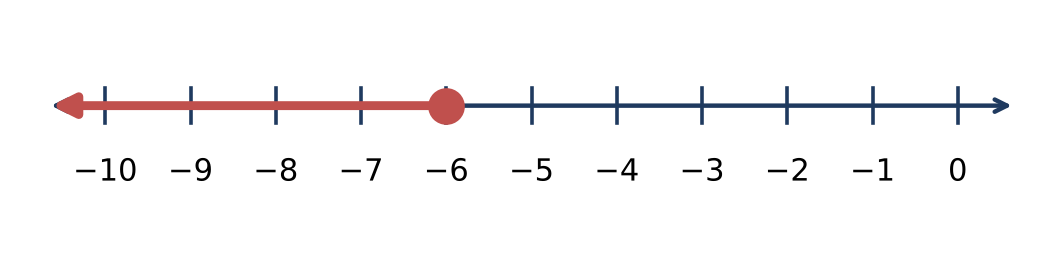
- The circle is at −6 and is filled (included).
- The ray points left, toward smaller numbers.
- So the graph is x ≤ −6.
- A (x < −6): read the open/closed circle the wrong way
- B (x ≥ −6): reversed the direction of the ray
- C (x > −6): reversed the direction and misread the circle
Testing solutions of inequalities
Method. Substitute each choice, or solve once and compare.
Worked example- Solve: 4x ≥ 24.
- So x ≥ 6.
- Only 9 satisfies x ≥ 6.
- A (0): chose a value on the wrong side of the boundary
- B (1): chose a value on the wrong side of the boundary
- C (5): chose a value on the wrong side of the boundary
Compound inequalities — and
Method. Treat the middle as the target and apply each step to all three parts.
Worked example- Do the same thing to all three parts.
- Subtract 6: 12 ≤ 6x ≤ 30.
- Divide by 6: 2 ≤ x ≤ 5.
- A (3 ≤ x ≤ 6): divided all three parts but did not subtract the constant
- B (12 ≤ x ≤ 30): subtracted the constant but did not divide
- C (2 < x < 5): switched which endpoints are included
Compound inequalities — or
Method. “Or” keeps everything from both parts; “and” keeps only the overlap.
Worked example- Solve each part.
- 4x + 8 < 16 gives x < 2.
- 3x + 4 > 31 gives x > 9.
- With “or”, the solution is either part: x < 2 or x > 9.
- B (2 < x < 9): took the values between the endpoints instead of outside them
- C (x > 2 or x < 9): reversed both inequality signs
- D (x ≤ 2 or x ≥ 9): included the endpoints
Greatest or least integer solution
Method. Solve, then step to the nearest integer on the allowed side (exclude the boundary for < or >).
Worked example- 3x < −3.
- So x < −1.
- The greatest integer that works is −2.
- A (−15): added the constant instead of subtracting it
- B (−3): stopped one integer short
- D (−1): included the boundary value although it is not allowed
Inequality word problems
Method. Subtract the fixed fee, divide by the price, and round DOWN.
Worked example- Let n be the number of rides: 39 + 15n ≤ 169.
- Then 15n ≤ 130.
- So n ≤ ≈ 8.67.
- The greatest whole number is 8.
- B (9): rounded up instead of down
- C (11): ignored the one-time fee
- D (13): added the fee to the budget
Algebraic Expressions and Factoring
Combine like terms and distribute to simplify. Multiply binomials with FOIL. To factor, take out the GCF first, then look for a trinomial pattern or a difference of squares.
| FOIL | |
| Square of a sum | |
| Square of a difference | |
| Difference of squares | |
| Trinomial |
Combining like terms
Method. Only terms with exactly the same variable part can be combined; keep each sign with its term.
Worked example- Group the x-terms: 8x and x make 9x.
- Group the constants: −7 and 1 make −6.
- Write the result: 9x − 6.
- A (7x − 6): used the wrong sign for one x-term
- B (9x − 8): used the wrong sign for a constant
- D (3x): combined the numbers with the x-terms
Multiplying a monomial by a polynomial
Method. Multiply coefficients and ADD exponents for each term.
Worked example- − · −5x = 5 and − · 8 = −8.
- So the product is 5 − 8.
- A (5 + 8): did not carry the negative sign of − to the second term
- B (5 − 8x): multiplied the constant term by x instead of by
- C (5 − 8x): multiplied by −x instead of −
Distributive property
Method. Multiply the outside number by EVERY term inside, keeping the sign of the outside number.
Worked example- Distribute: −3(3x + 1) = −9x − 3 and 3(−9x − 7) = −27x − 21.
- Combine: −36x − 24.
- A (−36x − 10): multiplied only the first term in the second parentheses by 3
- C (18x + 18): subtracted the second product instead of adding
- D (−36x − 20): multiplied only the first term in the first parentheses by −3
Adding and subtracting polynomials
Method. Line up like terms (, x, constants); with subtraction, change every sign in the second polynomial.
Worked example- Distribute the minus sign to every term of the second polynomial.
- Then combine like terms: 3 + 6x + 2.
- A (3 + 6x + 8): changed the sign of only the first term of the second polynomial
- C (−9 + 6x + 8): added instead of subtracting
- D (3 + 8): combined the x-terms with the constants
Multiplying binomials
Method. First, Outer, Inner, Last — then combine the two middle terms.
Worked example- FOIL: first 5x·4x = 20.
- Outer 5x·(−3) = −15x.
- Inner −3·4x = −12x.
- Last −3·(−3) = 9.
- Total: 20 − 27x + 9.
- A (20 + 9): multiplied only the first terms and the last terms
- C (20 − 3x + 9): subtracted the outer and inner products
- D (20 − 27x − 9): made a sign error on the last term
Special products
Method. Use the patterns = ± 2pq + and (p + q)(p − q) = − .
Worked example- = + 2pq + with p = x, q = −2.
- + 2(x)(−2) + 4 = − 4x + 4.
- A ( + 4): squared each term and forgot the middle term
- B ( − 2x + 4): used ab instead of 2ab for the middle term
- D ( + 4x + 4): used the wrong sign for the middle term
Factoring — greatest common factor
Method. Find the largest number and the lowest power of x that divide every term.
Worked example- Every term contains 2: −10 + 6 − 18 = 2.
- The trinomial −5 + 3x − 9 has no common factor left.
- A (2): factored out only the number, not the variable
- B (2(−5x + 3)): took out , which is not a factor of −18, and dropped that term
- C (2): did not divide the last term by 2
Factoring trinomials (leading coefficient 1)
Method. Product = c, sum = b; the signs of c and b tell you the signs of the two numbers.
Worked example- Find two numbers with product 30 and sum −11: −6 and −5.
- So − 11x + 30 = (x − 6)(x − 5).
- A ((x + 6)(x + 5)): used the wrong signs in both factors
- B ((x − 6)(x + 5)): used the wrong sign in one factor
- D ((x − 10)(x − 3)): chose a factor pair of 30 that does not add to −11
Factoring — difference of squares
Method. − = (p + q)(p − q); take out any common factor first.
Worked example- 9 − 4 = − .
- So it factors as (3x + 2)(3x − 2).
- A ((3x − 2)(3x − 2)): wrote a perfect square instead of a difference of squares
- B ((3x + 2)(3x + 2)): used + in both factors
- D ((9x + 2)(x − 2)): did not take the square root of the coefficient
Factoring trinomials (leading coefficient ≠ 1)
Method. Check the outer and inner products of each candidate against the middle coefficient.
Worked example- Use the ac-method: a·c = −60.
- Find two numbers with product −60 and sum −17: −20 and 3.
- Split the middle term and group: 15 − 17x − 4 = (5x + 1)(3x − 4).
- A ((5x − 4)(3x + 1)): placed the constants in the wrong factors
- C ((5x − 1)(3x + 4)): used the wrong signs in both factors
- D ((5x + 1)(3x + 4)): used the wrong sign in one factor
Quadratic Equations
Write the equation as ax² + bx + c = 0, then factor and use the zero-product property, take square roots, or use the quadratic formula.
| Standard form | |
| Zero-product property | |
| Square-root method | |
| Quadratic formula |
Square-root equations x² = k
Method. = k (k > 0) always has two solutions, ±.
Worked example- Add 25: 2 = 32.
- Divide by 2: = 16.
- Take square roots: x = ±4.
- A (x = 4): forgot the negative square root
- C (x = ±16): forgot to take the square root
- D (x = ±32): did not divide by the coefficient (and forgot the square root)
Zero-product property
Method. Set each factor equal to 0; each root is the opposite of the number in its factor.
Worked example- A product is 0 only when a factor is 0.
- x + 6 = 0 gives x = −6.
- x + 7 = 0 gives x = −7.
- So x = −7 or x = −6.
- A (x = 6 or x = 7): used the numbers in the factors with their signs instead of the zeros
- C (x = −6 or x = 7): changed the sign of only one root
- D (x = −7 or x = 6): changed the sign of only the other root
Solving by factoring
Method. Get 0 on one side, factor, then set each factor to 0.
Worked example- Find two numbers with product −48 and sum −8: −12 and 4.
- Factor: (x − 12)(x + 4) = 0.
- Zero-product property: x = −4 or x = 12.
- A (x = −12 or x = 4): used the numbers from the factors without changing their signs
- B (x = 4 or x = 12): made a sign error on one root
- C (x = −6 or x = 8): chose a factor pair of −48 that does not add to −8
Square-root method
Method. Isolate the squared bracket, take the ± square root of both sides, then undo the shift inside the bracket.
Worked example- Divide by 4: = 12.
- Take square roots: x − 5 = ± = ±2.
- Add 5 (move the constant): x = 5 ± 2.
- A (x = −5 ± 2): subtracted 5 instead of adding 5 when undoing x − 5
- B (x = 5 + 2): forgot the negative square root
- C (x = −7 or x = 17): forgot to take the square root
Quadratic word problems — area
Method. Look for two numbers 5 apart whose product is 84: 7 and 12.
Worked example- Let w be the width: w(w + 5) = 84.
- So + 5w − 84 = 0.
- Factor: (w − 7)(w + 12) = 0.
- So w = 7 (a width cannot be negative).
- Length = 7 + 5 = 12.
- A (7): gave the width
- C (42): halved the area
- D (79): subtracted the difference from the area
Solving by factoring (leading coefficient ≠ 1)
Method. Use the ac-method: a·c = 12 × 28 = 336 = 16 × 21 and 16 + 21 = 37, so split 37x as 16x + 21x and group.
Worked example- Factor: (4x + 7)(3x + 4) = 0.
- Set each factor to 0: 4x + 7 = 0 gives x = −.
- 3x + 4 = 0 gives x = −.
- B (x = or x = ): solved each factor with the wrong sign
- C (x = −7 or x = −4): forgot to divide by the x-coefficient in each factor
- D (x = − or x = −1): divided by the wrong coefficients
Quadratic formula
Method. Compute the discriminant first, simplify its square root, then divide every term by 2a.
Worked example- a = 3, b = 10, c = 4.
- Discriminant: − 4ac = 100 − 4(3)(4) = 52.
- x = = = , which simplifies to .
- A (x = ): used +b instead of −b
- B (x = ): used + 4ac in the discriminant
- C (x = ): divided by a instead of 2a
Systems of Linear Equations
Solve two equations together by substitution or elimination, then check the pair in both equations. Lines with the same slope and different intercepts never meet, so there is no solution.
| Substitution | |
| Elimination | |
| One solution | |
| No solution | |
| Infinitely many solutions |
Systems — solving by graphing
Method. Look for the intersection point and read x first, then y.
Worked example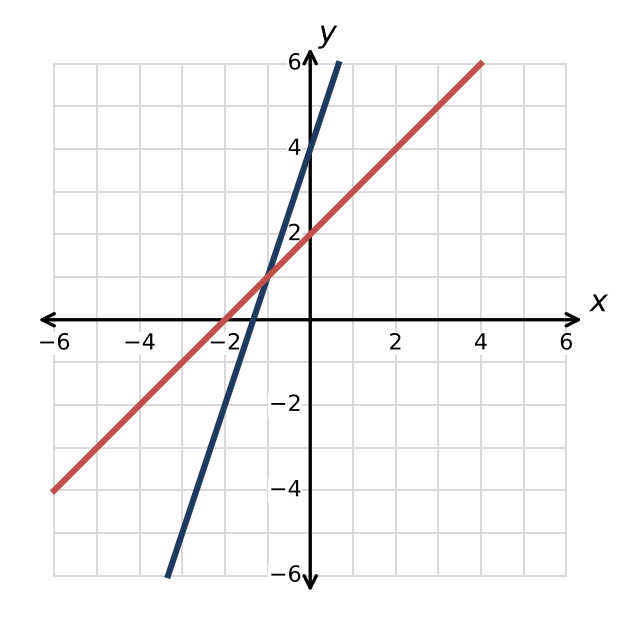
- The solution is the point where the lines cross: (−1, 1).
- Both lines pass through it: y = 3x + 4 and y = x + 2.
- A ((1, −1)): read the coordinates in the wrong order
- B ((0, 4)): gave where the first line crosses the y-axis
- C ((0, 2)): gave where the second line crosses the y-axis
Systems — checking a solution
Method. Test each choice in BOTH equations; one failure rules it out.
Worked example- A solution must make both equations true.
- (−1, −6): 1(−1) + 2(−6) = −13 ✓ and −1(−1) + (−5)(−6) = 31 ✓.
- B ((1, −7)): checked only the first equation
- C ((4, −7)): checked only the second equation
- D ((−6, −1)): swapped the coordinates of the solution
Systems — substitution
Method. When one equation already gives y, substitute it straight into the other.
Worked example- Substitute y = −2x + 2 into the second equation: −6x + (−1)(−2x + 2) = 6.
- So −4x − 2 = 6.
- So x = −2.
- Then y = −2(−2) + 2 = 6.
- B ((6, −2)): swapped x and y
- C ((−2, 2)): used −2 instead of +2 for the constant when finding y
- D ((−1, 4)): used the wrong sign for the constant after substituting
Systems — elimination
Method. Scale the equations so one variable has opposite (or equal) coefficients, then add (or subtract).
Worked example- Subtract the second equation from the first: (−7x − 2y) − (−6x − 2y) = −58 − (−50).
- So −x = −8 and x = 8.
- Substitute into the first equation: −7(8) − 2y = −58.
- So −2y = −2 and y = 1.
- A ((1, 8)): swapped x and y
- B ((−8, −1)): made a sign error when eliminating
- D ((8, −1)): got the sign wrong when dividing −2y = −2 by −2
Systems — number of solutions
Method. Compare slopes : different → one solution; same slope, different intercept → none; identical lines → infinitely many.
Worked example- Compare the equations: the left sides are proportional (ratio 2) but the constants are not.
- So the lines are parallel — no solution.
- A (infinitely many solutions): thought equal slopes always mean the same line
- C (exactly one solution): thought different-looking equations must cross once
- D (exactly two solutions): thought two lines can meet at two points
Systems — finding an expression directly
Method. Combine the equations so the coefficients of x and y become opposite; then divide.
Worked example- Subtract the second equation from the first: 5x − 5y = 15, which is 5(x − y) = 15.
- So x − y = 3.
- A (−51): added the equations but did not divide
- B (−13): found x + y instead
- C (−5): gave x only
05.03 Geometry
This MK topic covers geometry: angles and parallel lines, triangles and the Pythagorean theorem, quadrilaterals, circles, perimeter, area, volume and surface area, and points and distance on the coordinate plane. Leave answers in terms of π when the choices do.
Lines and Angles
Complementary angles add to 90°, supplementary angles add to 180°, and vertical angles are equal. When a transversal crosses parallel lines, corresponding and alternate interior angles are equal.
| Complementary | |
| Supplementary | |
| Around a point | |
| Parallel lines: equal angles | |
| Parallel lines: co-interior angles | |
| Interior angles of an n-gon | |
| Each angle of a regular n-gon |
Complementary and supplementary angles
Method. Complement → 90° − angle; supplement → 180° − angle.
Worked example- Supplementary angles add to 180°.
- The supplement of 54° is 180° − 54° = 126°.
- A (36°): used the complement instead of the supplement
- B (54°): gave the same angle
- C (72°): found the difference of the two angles
Vertical and adjacent angles
Method. Vertical angles are equal; angles on a straight line add to 180°.
Worked example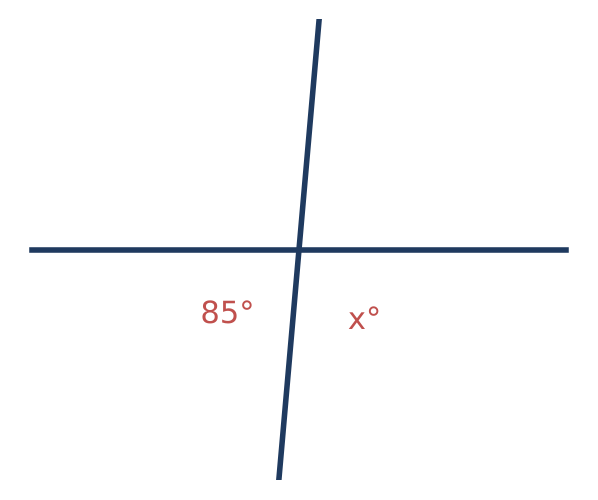
- The marked angles are adjacent angles on a straight line.
- So they are supplementary.
- x = 180 − 85 = 95.
- A (5): used complementary angles
- B (85): thought the angles are vertical (equal)
- D (275): subtracted from 360°
Parallel lines and transversals
Method. Parallel lines: all acute angles are equal, all obtuse angles are equal, and an acute + an obtuse = 180°.
Worked example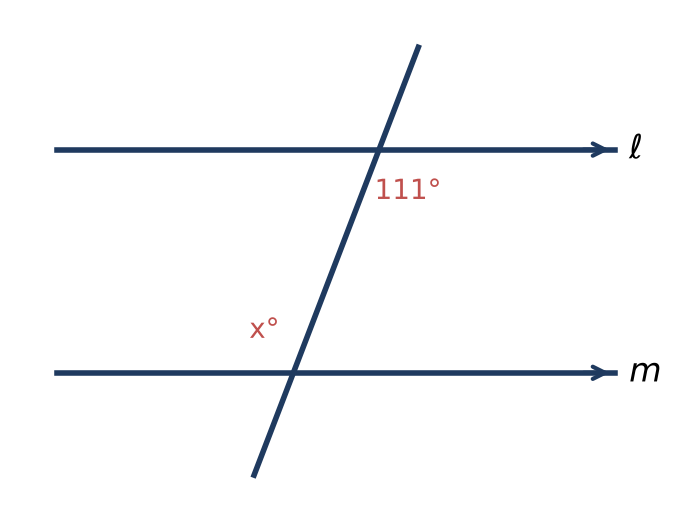
- The angle marked 111° and the angle marked x° are alternate interior angles.
- With parallel lines, alternate interior angles are equal.
- So x = 111.
- A (42): subtracted the supplement from the angle (111 − 69)
- B (69): assumed the angles are supplementary
- D (249): subtracted from 360°
Exterior angles of triangles
Method. Exterior angle = sum of the two remote interior angles.
Worked example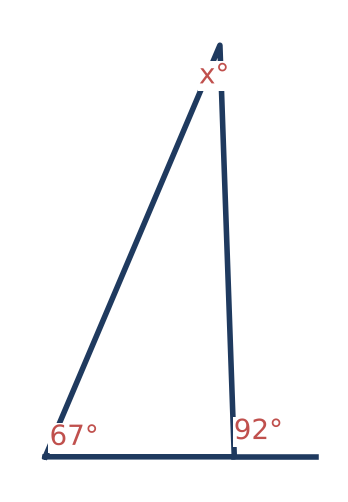
- The exterior angle equals the sum of the two remote interior angles: 92 = 67 + x.
- So x = 92 − 67 = 25.
- B (88): gave the adjacent interior angle
- C (155): gave the supplement
- D (159): added instead of subtracting
Angles on a clock
Method. Each hour mark is 30°; the hour hand also moves 0.5° per minute.
Worked example- The 12 hour marks split 360° into 12 parts of 30°.
- At 6:00 the hands are 6 hour marks apart.
- So the smaller angle is 6 × 30° = 180°.
- A (36°): used 6° per hour (the minute-hand rate)
- B (90°): used 15° per hour mark
- C (150°): counted one hour mark too few
Angle relationships with algebra
Method. Write the angle relationship as an equation, then solve.
Worked example- Complementary angles add to 90°: (4x − 2) + (5x + 29) = 90.
- So 9x + 27 = 90, 9x = 63 and x = 7.
- The first angle is 4(7) − 2 = 26°.
- A (7): gave x instead of the angle
- C (28): forgot the constant
- D (64): gave the other angle
Angles in polygons
Method. Interior sum (n − 2)·180°; exterior sum always 360°.
Worked example- Use the formula (n − 2) × 180° with n = 9.
- (9 − 2) × 180° = 7 × 180°.
- So (9 − 2) × 180° = 1260°.
- A (140°): gave one interior angle
- B (360°): gave the exterior-angle sum
- D (1620°): used n × 180°
Parallel lines with algebra
Method. Decide equal or supplementary first, then solve the linear equation.
Worked example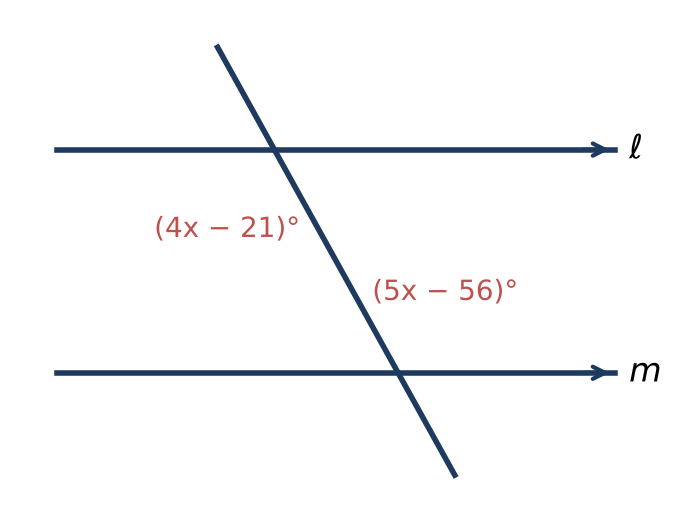
- The two angles are alternate interior angles.
- So they are equal: (4x − 21) = (5x − 56).
- Solving gives x = 35.
- So the angles are 119° and 119°.
- A (): set the angles to add to 90°
- B (): assumed the angles are supplementary
- D (119): gave the angle instead of x
Triangles and the Pythagorean Theorem
The angles of a triangle add to 180°. In a right triangle, the legs and hypotenuse satisfy a² + b² = c². Similar triangles have equal angles and proportional sides.
| Angle sum | |
| Pythagorean theorem | |
| Common triples | |
| Exterior angle | |
| Special right triangles | |
| Triangle inequality | |
| Area |
Angle sum of a triangle
Method. Third angle = 180° − (sum of the other two).
Worked example- The angles of a triangle add to 180°.
- So the third angle is 180° − 78° − 53° = 49°.
- B (102): subtracted only the first angle
- C (131): added the two angles
- D (229): used 360° for the angle sum
Pythagorean theorem
Method. Recognize the triple 8–15–17.
Worked example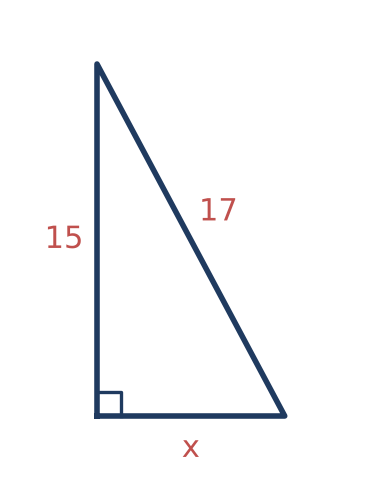
- By the Pythagorean theorem, + = .
- So = 289 − 225 = 64, and x = = 8.
- A (2): subtracted the sides
- C (64): forgot to take the square root
- D (): added the squares instead of subtracting
Similar triangles
Method. Find the scale factor from one known pair, then multiply.
Worked example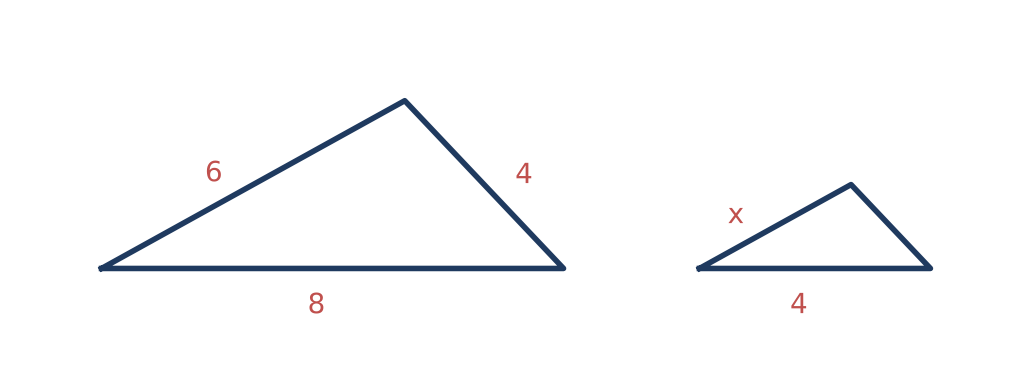
- The triangles are similar.
- So corresponding sides are proportional.
- The scale factor from the first triangle to the second is 4 ÷ 8 = .
- So x = 6 × = 3.
- A (2): subtracted the difference of the bases (8 − 4 = 4) from 6 instead of multiplying by the scale factor
- C (6): gave the corresponding side of the first triangle
- D (12): divided by the scale factor
Similar triangles in context
Method. Height ÷ shadow is constant at one time of day.
Worked example- The sun's rays make similar right triangles.
- So height ÷ shadow is the same for both.
- = .
- So x = 5 × 27 ÷ 9 = 15.
- B (23): added the difference instead of using a ratio
- C (): set up the proportion upside down
- D (135): multiplied without dividing
Triangle angle problems
Method. Add the three expressions, set the sum equal to 180 and solve.
Worked example- The angles add to 180°.
- So 10x − 10 = 180.
- Then 10x = 190.
- So x = 19.
- A (17): moved the constants with the wrong sign
- B (18): ignored the constants
- D (37): used 360° for the angle sum
Special right triangles
Method. 45°-45°-90°: 1 : 1 : . 30°-60°-90°: 1 : : 2.
Worked example- In a 45°-45°-90° triangle, leg = hypotenuse ÷ .
- So leg = = 22 = 11.
- B (11): halved the hypotenuse
- C (22): multiplied by instead of dividing
- D (11): used the 30°-60°-90° ratio
Triangle inequality
Method. Third side: difference < x < sum.
Worked example- By the triangle inequality, the third side must be greater than the difference and less than the sum of the other two sides.
- 23 − 22 = 1 and 22 + 23 = 45.
- So 1 < x < 45.
- A (1 ≤ x ≤ 45): included the endpoints
- C (x < 45): forgot the lower bound
- D (22 < x < 23): used the two given sides as the bounds
Converse of the Pythagorean theorem
Method. + vs (c longest): equal → right, greater → acute, less → obtuse.
Worked example- Compare the square of the longest side with the sum of the squares of the other two sides.
- + = 697 and = 576.
- The sum is greater.
- So the triangle is acute.
- A (right): thought + equals
- B (obtuse): reversed the inequality test
- D (not a triangle): thought the sides cannot form a triangle
Perimeter and Area
Perimeter is the distance around a figure; area is the number of square units inside. Split a composite figure into rectangles and triangles, or subtract a shaded part from the whole.
| Rectangle | |
| Square | |
| Triangle | |
| Parallelogram | |
| Trapezoid | |
| Scaling |
Area of rectangles and squares
Method. Square: P = 4s and A = .
Worked example- Area of a square = side × side.
- So A = 11 × 11 = 121 square meters.
- A (22): doubled the side
- B (33): added three sides
- C (44): found the perimeter
Area of triangles
Method. Use the perpendicular height, not the slanted side.
Worked example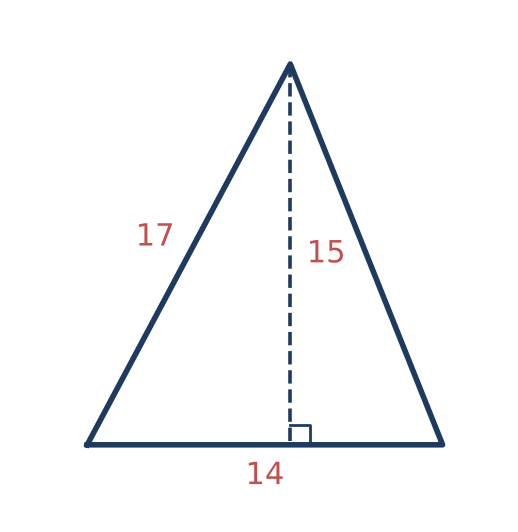
- Area of a triangle = ½ × base × height.
- The height is the dashed segment, 15, which is perpendicular to the base 14.
- So A = ½ × 14 × 15 = 105.
- B (119): used the slanted side as the height
- C (210): forgot to multiply by ½
- D (238): used the slanted side and forgot the ½
Perimeter of polygons
Method. Parallelogram: A = base × height; P uses the slanted sides.
Worked example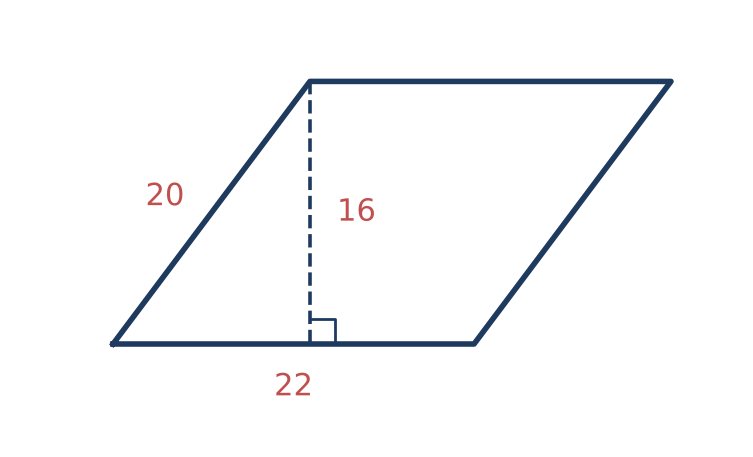
- A parallelogram has two pairs of equal sides: 22 and 20.
- The height is not a side.
- So P = 2 × (22 + 20) = 84.
- A (42): added only two sides
- B (58): added the three labeled lengths
- C (76): used the height instead of the slanted side
Area of parallelograms and trapezoids
Method. Average the two bases, then multiply by the height.
Worked example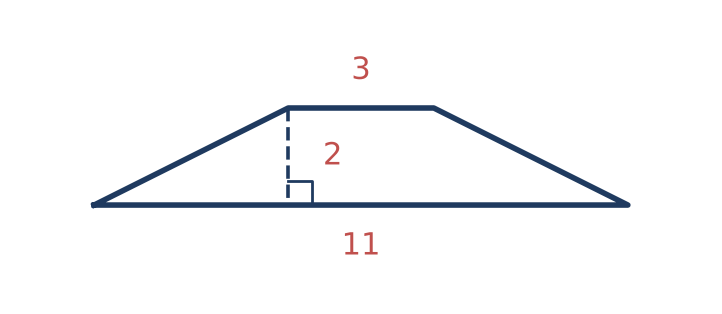
- Area of a trapezoid = ½ × (base₁ + base₂) × height.
- So A = ½ × (3 + 11) × 2 = ½ × 14 × 2 = 14.
- B (22): used only the longer base
- C (28): forgot to multiply by ½
- D (33): multiplied the two bases
Composite figures
Method. Area of the rectangle plus half the area of a circle whose diameter is the shared side.
Worked example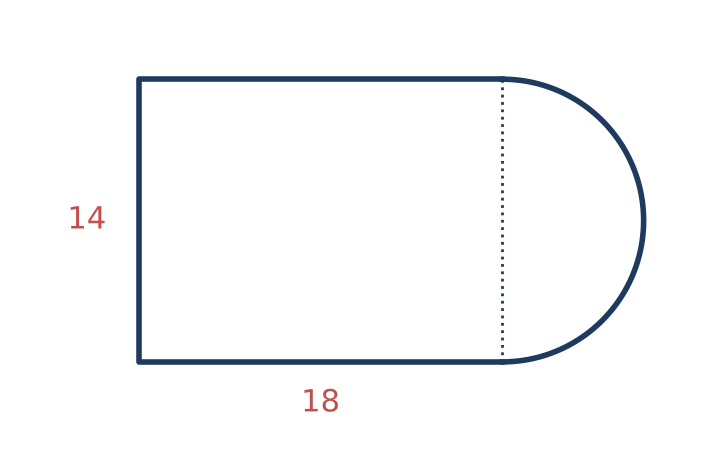
- Rectangle: 18 × 14 = 252.
- The semicircle has radius 14 ÷ 2 = 7.
- So its area is ½ × 3.14 × = 76.93.
- Total area = 252 + 76.93 = 328.93.
- A (252): left out the semicircle
- C (405.86): added a whole circle
- D (559.72): used the diameter as the radius
Area and perimeter with algebra
Method. Write the formula with the unknown, then solve.
Worked example- Area = ½ × base × height = ½ × 4x × x = 2.
- So 2 = 200, = 100 and x = 10.
- B (10): multiplied by ½ twice
- C (40): gave the base
- D (100): forgot to take the square root
Scaling and area
Method. Area scales by ; length ratio is the square root of the area ratio.
Worked example- When lengths are multiplied by k, the area is multiplied by .
- So the new area is 13 × = 13 × 16 = 208.
- A (29): added the square of the scale factor
- B (52): multiplied the area by the scale factor
- C (104): multiplied the area by twice the scale factor
Area in the coordinate plane
Method. Use a horizontal or vertical side as the base, or box the figure and subtract.
Worked example- Two vertices have y = −4.
- So that side is horizontal with length 2 − (−7) = 9.
- The height is the vertical distance from the third vertex: |2 − (−4)| = 6.
- So A = ½ × 9 × 6 = 27.
- A (): added the base and height instead of multiplying, then halved: (9 + 6) ÷ 2
- B (18): used the y-coordinate of the top vertex as the height without halving
- D (54): forgot to multiply by ½
Shaded regions
Method. Shaded area = outer area − inner area.
Worked example- The circle's diameter equals the side.
- So r = 14 ÷ 2 = 7.
- Square area = = 196.
- Circle area = π × = .
- Shaded area = 196 − .
- B (196 − ): used the side as the radius
- C (196 − ): subtracted the circumference
- D (): gave the area of the circle
Circles
The diameter is twice the radius. Circumference is the distance around and area is the space inside; both use π. A semicircle is half a circle and a sector is a fraction of the circle set by its central angle.
| Diameter | |
| Circumference | |
| Area | |
| Arc length | |
| Sector area |
Parts of a circle
Method. Match the description word for word with the definition of each part.
Worked example- An arc is a part of the circle between two points on the circle.
- So the answer is arc.
- B (chord): confused an arc with a chord
- C (diameter): confused an arc with a diameter
- D (secant): confused an arc with a secant
Circumference
Method. C = πd = r: multiply the diameter by π.
Worked example- The circumference is C = πd = r.
- The diameter is 2 × 9 = 18.
- So C ≈ 3.14 × 18 = 56.52 meters.
- A (28.26): forgot to double the radius (used πr)
- C (113.04): used times the diameter
- D (254.34): used the area formula πr²
Area of a circle
Method. A = πr²; halve the diameter first.
Worked example- The radius is 48 ÷ 2 = 24.
- The area is A = πr².
- So A ≈ 3.14 × = 3.14 × 576 = 1808.64 square feet.
- A (75.36): forgot to square the radius
- B (150.72): found the circumference
- D (7234.56): used the diameter as the radius
Working backward with circles
Method. Find the radius first, then use the other formula.
Worked example- C = r.
- So r = .
- Dividing both sides by gives r = 9.
- A (): divided by 4 instead of 2
- C (18): gave the diameter
- D (36): multiplied by 2 instead of dividing
Semicircles and quarter circles
Method. Take the right fraction of the full circle, then add any straight edges.
Worked example- The whole circle has area 3.14 × = 200.96.
- A quarter circle is one fourth of that: 200.96 ÷ 4 = 50.24 square inches.
- A (12.56): took one fourth of the circumference instead of the area
- C (100.48): found the area of a half circle
- D (200.96): gave the area of the whole circle
Arc length
Method. Arc = × circumference.
Worked example- Arc length = (central angle ÷ 360°) × r.
- So the arc length is × × 17 = × = .
- A (): found the other arc
- B (): used πr instead of r
- D (): found the sector area
Sector area
Method. Sector = × area of the circle.
Worked example- Sector area = (central angle ÷ 360°) × πr².
- So the area is × π × = × = .
- A (): found the arc length
- C (): found the area of the rest of the circle
- D (): gave the whole area
Volume and Surface Area
Volume counts cubic units inside a solid; surface area adds the areas of all faces. Prisms and cylinders use base area × height; cones and pyramids take one third of that.
| Rectangular box | |
| Cube | |
| Prism / cylinder | |
| Pyramid / cone | |
| Sphere | |
| Cylinder surface | |
| Scaling |
Volume of rectangular prisms
Method. V = l × w × h; to find a missing edge, divide V by the other two.
Worked example- Volume = length × width × height.
- So V = 6 × 3 × 8 = 144 cubic feet.
- A (17): added the three dimensions
- B (18): found only the area of the base
- C (26): added the height instead of multiplying
Volume of cylinders
Method. Cylinder: V = πr²h; SA = r² + rh.
Worked example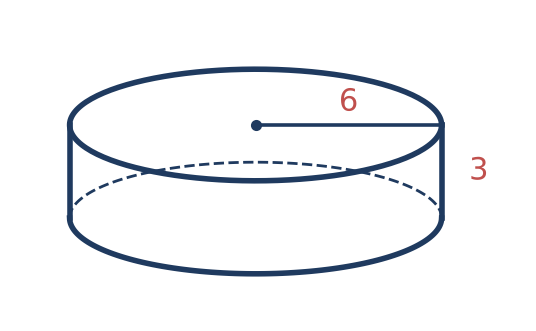
- V = πr²h.
- V = π × × 3.
- So V = .
- B (): multiplied by an extra 2
- C (): used the diameter as the radius
- D (): cubed the radius
Volume of triangular prisms
Method. Prism: V = base area × length; use the legs for a right triangle.
Worked example- V = (area of base) × length.
- The base area is ½ × 9 × 12 = 54.
- So V = 54 × 15 = 810 cubic units.
- A (540): found the lateral area
- C (): used the hypotenuse as a leg
- D (1620): forgot the ½ in the triangle's area
Surface area of prisms
Method. Cube: V = and SA = 6.
Worked example- A cube has 6 square faces, each with area = 169.
- So SA = 6 × 169 = 1014.
- A (78): multiplied the edge by 6 without squaring
- B (169): found the area of one face
- C (676): counted only four faces
Volume with fractional edges
Method. Change mixed numbers to improper fractions, then multiply.
Worked example- V = l × w × h.
- Write 4 as .
- So V = × 7 × 4 = 17 × 7 = 119 cubic feet.
- A (15 ): added the three dimensions
- B (29 ): found only the area of the base
- C (112): dropped the fraction part of the length
Surface area of cylinders
Method. Cylinder: V = πr²h; SA = r² + rh.
Worked example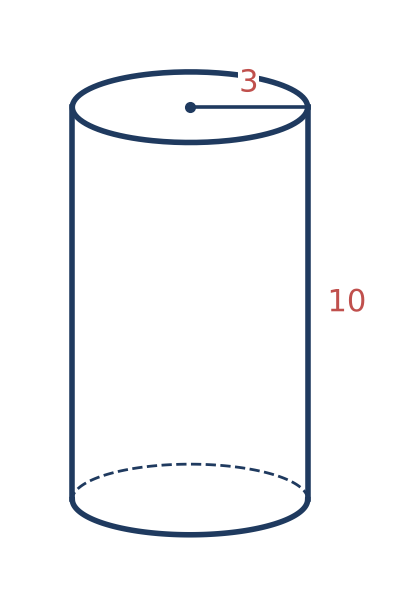
- SA = r² + rh = × + × 3 × 10 = + = .
- Using 3.14 for π, this is 3.14 × 78 = 244.92.
- B (282.6): found the volume
- C (433.32): counted the curved surface twice
- D (602.88): used the diameter as the radius
Cones and pyramids
Method. Cone: V = ⅓πr²h; height is perpendicular, not the slant.
Worked example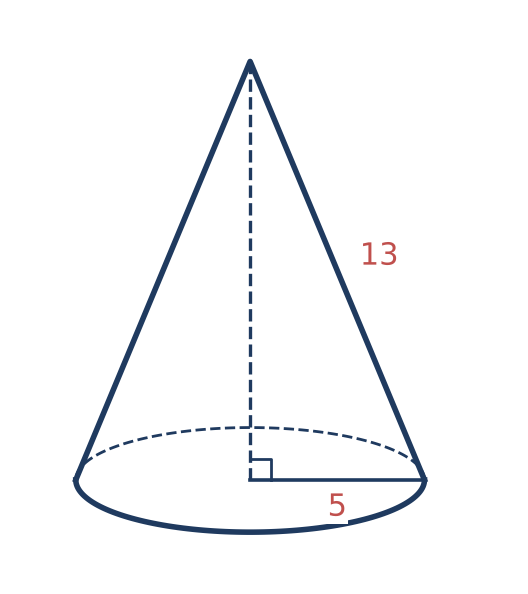
- The height, slant height and radius form a right triangle.
- So h = = = 12.
- V = ⅓πr²h = ⅓ × π × × 12 = ⅓ × = .
- A (): forgot to square the radius
- C (): used the slant height as the height
- D (): forgot the ⅓
Spheres
Method. Sphere: V = πr³ and SA = r².
Worked example- SA = r².
- SA = 4 × π × .
- So SA = .
- A (): found the area of a great circle
- B (): forgot to square the radius
- C (): found the volume
Scaling and volume
Method. Volume scales by ; area by .
Worked example- When lengths are multiplied by k, volume is multiplied by .
- So the new volume is 35 × = 35 × 27 = 945.
- A (62): added the cube of the scale factor
- B (105): multiplied the volume by the scale factor
- C (315): squared the scale factor
Solving for a dimension
Method. Substitute into the volume formula and solve for the unknown.
Worked example- V = πr²h.
- So = π × × 4.
- Divide by : = 25.
- So r = 5.
- B (10): gave the diameter
- C (): divided by 2h instead of taking a square root
- D (25): forgot to take the square root
Composite solids
Method. Find each part's volume and add.
Worked example- Cylinder: πr²h = π × × 13 = .
- Cone: ⅓πr²h = ⅓ × π × × 3 = .
- Total = + = .
- A (): left out the cone
- C (): forgot the ⅓ for the cone
- D (): used the diameter as the radius of the cone
Coordinate Geometry
A point (x, y) is x units across and y units up. The distance formula comes from the Pythagorean theorem and the midpoint averages the coordinates. Parallel lines have equal slopes.
| Slope | |
| Distance | |
| Midpoint | |
| Parallel / perpendicular | |
| Quadrants | |
| Reflections |
Distance along grid lines
Method. Same x or same y: subtract the other coordinates (a point left of or below zero adds its distance).
Worked example- The points have the same x-coordinate.
- So the distance is the difference of the other coordinates.
- 1 − (−11) = 12.
- A (10): subtracted the absolute values
- B (11): counted only the distance from −11 to 0
- D (13): counted grid points instead of units
Polygons on the coordinate plane
Method. Find side lengths by subtracting coordinates.
Worked example- The width is 7 − (−3) = 10 and the height is 7 − (−6) = 13.
- So the perimeter is 2 × (10 + 13) = 46.
- A (23): added only two sides
- B (40): used the width for all four sides
- D (130): found the area
Midpoint formula
Method. Midpoint: average the x's and average the y's.
Worked example- Average the x-coordinates: (7 + (−5)) ÷ 2 = 1.
- Average the y-coordinates: (−8 + (−10)) ÷ 2 = −9.
- So the midpoint is (1, −9).
- A ((−6, −1)): subtracted the coordinates before halving
- B ((2, −18)): added without dividing by 2
- D ((−9, 1)): reversed the x- and y-coordinates
Slopes of parallel and perpendicular lines
Method. Parallel: same slope. Perpendicular: negative reciprocal.
Worked example- The slope of the given line is −2.
- Perpendicular slopes are negative reciprocals (their product is −1).
- So the perpendicular slope is −1 ÷ (−2) = .
- A (−2): gave the slope of a parallel line
- C (2): changed the sign but did not take the reciprocal
- D (6): gave the y-intercept
Distance formula
Method. Distance = ; look for a Pythagorean triple.
Worked example- d = .
- The differences are −9 − (−3) = −6 and −1 − 8 = −9.
- So d = = = 3.
- B (): added the coordinates instead of subtracting
- C (15): added the horizontal and vertical distances
- D (117): forgot to take the square root