Expressions and Equations: Practice Paper 1
Choose one answer for each question, then select Check my answers. Every question has a full worked solution.
1.
Two cars leave the same town at the same time and drive in opposite directions, one at 33 miles per hour and the other at 55 miles per hour. After how many hours will they be 44 miles apart?
Show solution
AnswerA — 0.5
Step-by-step
- Moving apart, the distance grows at 33 + 55 = 88 miles per hour.
- Time = distance ÷ rate: 44 ÷ 88 = 0.5 hours.
Fast methodDistance = rate × time; opposite directions or toward each other → add speeds, same direction → subtract.
Quick check33 × 0.5 + 55 × 0.5 = 16.5 + 27.5 = 44 ✓.
Why the other choices are wrong
- B (0.8): used only the second car's speed
- C (1): divided by the average speed instead of the sum of the speeds
- D (2): subtracted the speeds instead of adding
2.
Solve: −2x − 2 ≤ −12
Show solution
AnswerD — x ≥ 5
Step-by-step
- Add 2: −2x ≤ −10.
- Divide by −2 and reverse the sign (dividing by a negative): x ≥ 5.
Fast methodDividing (or multiplying) both sides by a negative number reverses the inequality.
Quick checkx = 6 should work: −2(6) − 2 = −14, which is ≤ −12.
Why the other choices are wrong
- A (x ≤ 5): forgot to reverse the sign when dividing by a negative number
- B (x ≥ −5): dropped the negative sign of the coefficient but still reversed the sign
- C (x ≤ −5): divided by the positive number instead of the negative one
3.
Factor completely: 6 + 12 + 16x
Show solution
AnswerD — 2x
Step-by-step
- Every term contains 2x: 6 + 12 + 16x = 2x.
- The trinomial 3 + 6x + 8 has no common factor left.
Fast methodFind the largest number and the lowest power of x that divide every term.
Quick checkdistribute 2x back to get 6 + 12 + 16x.
Why the other choices are wrong
- A (2): factored out only the number, not the variable
- B (2(3x + 6)): factored 2 out of the first two terms only and dropped the 16x term
- C (2x): did not divide the last term by 2
4.
Solve: −7 ≤ 2x − 3 < 3
Show solution
AnswerC — −2 ≤ x < 3
Step-by-step
- Do the same thing to all three parts.
- Add 3: −4 ≤ 2x < 6.
- Divide by 2: −2 ≤ x < 3.
Fast methodTreat the middle as the target and apply each step to all three parts.
Quick checkthe endpoints come from 2x − 3 = −7 and 2x − 3 = 3: x = −2 and x = 3.
Why the other choices are wrong
- A (− ≤ x < ): divided all three parts but did not subtract the constant
- B (−4 ≤ x < 6): subtracted the constant but did not divide
- D (−2 < x ≤ 3): switched which endpoints are included
5.
In the equation −5(x − 5) + 12 = −5x + m, m is a constant. If the equation has infinitely many solutions, what is the value of m?
Show solution
AnswerD — 37
Step-by-step
- Distribute: −5x + 37 = −5x + m.
- The x-terms already match.
- So the equation is true for every x exactly when the constants match: m = 25 + 12 = 37.
Fast methodInfinitely many solutions ⇔ both sides are the same expression; match the constants.
Quick checkwith m = 37 both sides are −5x + 37.
Why the other choices are wrong
- A (−37): changed the sign of the answer
- B (7): did not multiply −5 by −5
- C (13): subtracted 12 instead of adding it, so m = 25 − 12 = 13
6.
Simplify, for values of x where the expression is defined:
Show solution
AnswerB —
Step-by-step
- Factor the numerator: + 10x + 24 = (x + 4)(x + 6).
- Factor the denominator: + 11x + 28 = (x + 4)(x + 7).
- Cancel the common factor (x + 4): .
Fast methodFactor top and bottom completely, then cancel common FACTORS (never individual terms).
Quick checkat x = 0 the original is and the simplified form is .
Why the other choices are wrong
- A (): used the wrong signs after cancelling
- C (): made a sign error in the denominator
- D (): inverted the fraction
7.
Which equation has no solution?
Show solution
AnswerC — 5(x + 4) = 5x + 25
Step-by-step
- Distribute the left side to get 5x + 20.
- Equal x-coefficients with different constants give no solution.
- Identical sides give infinitely many.
- Different x-coefficients give exactly one.
- 5(x + 4) = 5x + 25 has no solution.
Fast methodCompare x-coefficients first, then constants.
Quick checksubtracting 5x from both sides of 5(x + 4) = 5x + 25 leaves a false statement.
Why the other choices are wrong
- A (5(x + 4) = 5x + 20): chose an equation that has infinitely many solutions
- B (5(x + 4) = 7x + 19): chose an equation that has exactly one solution
- D (5(x + 4) = 7x + 23): chose an equation that has exactly one solution
8.
How many real solutions does | − 4x + 3| = 2 have?
Show solution
AnswerB — 2
Step-by-step
- |f(x)| = 2 means f(x) = 2 or f(x) = −2.
- f(x) = − 4x + 3 has minimum value −1 (at x = 2).
- f(x) = 2 always has 2 solutions.
- f(x) = −2 has no solutions because −2 < −1.
- Total: 2.
Fast methodReflect the negative part of y = f(x) above the x-axis and count intersections with y = c.
Quick checkthe reflected graph reaches up to 1 between the roots 1 and 3; y = 2 is above that height.
Why the other choices are wrong
- A (0): thought the graph never reaches that height
- C (3): misjudged the height of the reflected arch as 2, so counted its top point x = 2 as a third solution (the arch only reaches 1)
- D (4): assumed f(x) = −2 also has two solutions
9.
Divide ÷ (x − 4).
Show solution
AnswerB — −2 + 6x − 4 −
Step-by-step
- Synthetic division with 4: bring down −2, multiply by 4 and add down the columns.
- Quotient −2 + 6x − 4, remainder −9.
- So the result is −2 + 6x − 4 − .
Fast methodSynthetic division uses the zero of the divisor, x = 4.
Quick check(x − 4) − 9 = −2 + 14 − 28x + 7.
Why the other choices are wrong
- A (−2 + 22x − 116 + ): used −4 instead of 4 in synthetic division
- C (−2 + 6x − 4 + ): used the wrong sign for the remainder
- D (−2 − 6x − 4 − ): made a sign error in the second coefficient of the quotient
10.
A ball is thrown upward from a platform. Its height, in feet, after t seconds is h = −16 + 112t + 288. After how many seconds does it hit the ground?
Show solution
AnswerC — 9
Step-by-step
- Set h = 0: −16 + 112t + 288 = 0.
- Divide by −16: − 7t − 18 = 0, which factors as (t − 9)(t + 2) = 0.
- So t = 9 or t = −2.
- Time cannot be negative.
- So t = 9.
Fast methodSet the height to 0, divide out the common factor, factor, and keep the positive root.
Quick checkh(9) = −16(81) + 112(9) + 288 = 0.
Why the other choices are wrong
- A (2): gave the negative root without its sign as a time
- B (): gave the time of maximum height
- D (18): divided the starting height by 16
11.
Solve: − 34 + 225 = 0
Show solution
AnswerD — x = −5 or x = −3 or x = 3 or x = 5
Step-by-step
- Let u = : − 34u + 225 = 0.
- So (u − 9)(u − 25) = 0 and u = 9 or u = 25.
- Then = 9 gives x = ±3 and = 25 gives x = ±5.
Fast methodSubstitute u for the repeated expression, solve the quadratic in u, then convert back to x.
Quick checksubstitute each value back into the original equation.
Why the other choices are wrong
- A (x = 3 or x = 5): kept only the positive square roots
- B (x = 9 or x = 25): solved for but did not take square roots
- C (x = −25 or x = −9): used the wrong signs and forgot the square roots
12.
Factor: −4 − 9 − 20x − 45
Show solution
AnswerC — (−4x − 9)
Step-by-step
- Group the first two terms and the last two terms: + (−20x − 45).
- Factor out of the first group and 5 out of the second: (−4x − 9) + 5(−4x − 9).
- Factor out the common binomial (−4x − 9): (−4x − 9).
Fast methodPair the terms, factor each pair, then factor out the common binomial.
Quick check(−4x − 9) expands to −4 − 9 − 20x − 45.
Why the other choices are wrong
- A ((−4x + 9)): made a sign error when factoring the first group
- B ((−4x − 9)): made a sign error when factoring the second group
- D ((−4x − 9)(x + 5)): wrote x instead of in the common factor
13.
Solve: = x − 6
Show solution
AnswerB — x = 9
Step-by-step
- Square both sides: x = = − 12x + 36.
- Rearrange: − 13x + 36 = 0.
- Factor: (x − 4)(x − 9) = 0.
- So x = 4 or x = 9.
- Check x = 4: the right side x − 6 = −2 is negative, but a square root cannot be negative.
- So it is extraneous.
- Check x = 9: = 3 ✓.
Fast methodSquaring can create extra roots — always substitute back into the ORIGINAL equation.
Quick check = 3 and (9) − 6 = 3.
Why the other choices are wrong
- A (x = 4 or x = 9): kept the extraneous solution
- C (x = 4): kept only the extraneous solution
- D (no solution): rejected both solutions
14.
How many liters of a 30% acid solution must be added to 4 liters of a 15% acid solution to make a 20% acid solution?
Show solution
AnswerA — 2
Step-by-step
- Let y = liters of the 30% solution.
- Acid: 0.15(4) + 0.3y = 0.2(4 + y).
- Multiply by 100: 60 + 30y = 80 + 20y.
- Collect: 10y = 20.
- Divide: y = 2 liters.
Fast methodBalance the differences: 4 × (20 − 15) = y × (30 − 20).
Quick checkacid = 0.6 + 0.6 = 1.2 liters, and 20% of 6 = 1.2 ✓.
Why the other choices are wrong
- B (4): assumed equal amounts of the two solutions
- C (6): gave the total amount of the mixture
- D (8): inverted the ratio of the differences
15.
The system 4x − y = −12 and px − 3y = −36 has infinitely many solutions, where p is a constant. What is the value of p?
Show solution
AnswerD — 12
Step-by-step
- For infinitely many solutions the second equation is a multiple of the first.
- The y-coefficients give the factor − = 3 (and the constants agree: − = 3).
- So p = 3 × 4 = 12.
Fast methodInfinitely many solutions ⇔ one equation is a constant multiple of the other.
Quick checkmultiplying 4x − y = −12 through by 3 gives 12x − 3y = −36, the same line.
Why the other choices are wrong
- A (−12): made a sign error when scaling
- B (4): did not scale the coefficient
- C (7): added the scale factor instead of multiplying
16.
In the system below, a is a constant.
x + y = 6
ax − y = 2
For which of the following values of a does the system have a solution (x, y) with x > 0 and y > 0?
I. a = −
II. a =
III. a = 2
Show solution
AnswerA — III only
Step-by-step
- Add the equations: (1 + a)x = 8, so x = (a ≠ −1), and y = 6 − x.
- x > 0 requires a + 1 > 0. y > 0 requires x < 6, so < 6, that is, a + 1 > , so a > .
- I: a = − gives x = 16, y = −10 ✗. II: a = gives x = , y = − ✗. III: a = 2 gives x = , y = ✓.
- Only III works.
Fast methodCheck y directly: y = 6 − is positive only when < 6, i.e. a + 1 > ; only a = 2 qualifies.
Quick checka = 2: x = , y = ; + = 6 ✓ and − = 2 ✓, both positive.
Why the other choices are wrong
- B (I and II only): reversed the last inequality, keeping −1 < a < instead of a >
- C (II and III only): inverted the fraction in < 6, getting a + 1 > , so a > −
- D (I, II and III): checked only x = > 0, which holds for every a > −1
17.
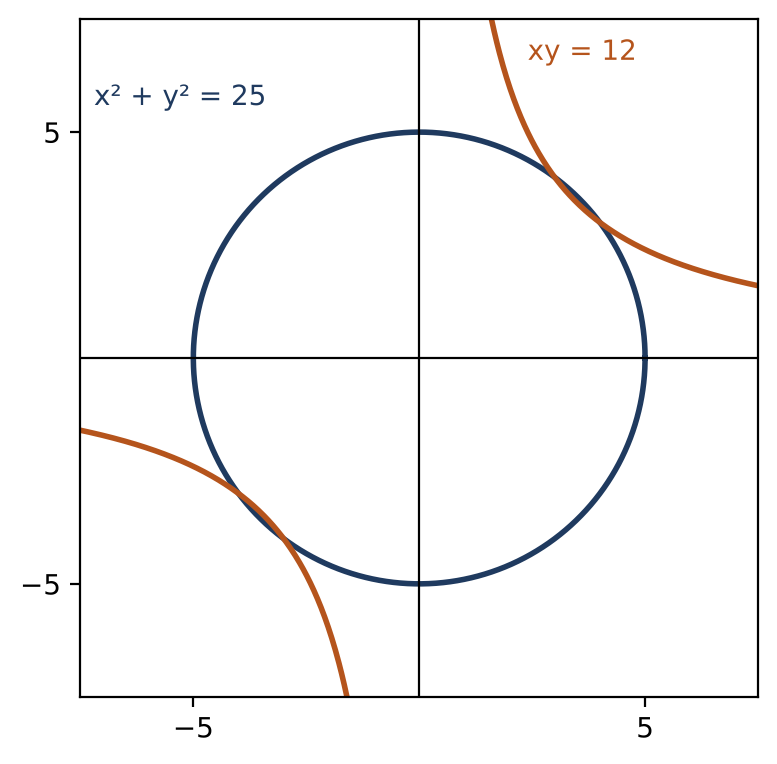
The figure (not drawn to scale) shows the graphs of + = 25 and xy = 12, which intersect in four points. Over all real solutions (x, y) of the system, what is the greatest possible value of x + 2y?
Show solution
AnswerD — 11
Step-by-step
- = + + 2xy = 25 + 24 = 49, so x + y = ±7.
- = 25 − 24 = 1, so x − y = ±1.
- The solutions are (4, 3), (3, 4), (−3, −4) and (−4, −3).
- x + 2y takes the values 10, 11, −11, −10, so the greatest is 11, at (3, 4).
Fast methodTo make x + 2y large, take the positive solution with the larger y-coordinate: (3, 4) gives 3 + 8 = 11.
Quick check(3, 4): 9 + 16 = 25 ✓ and 3 × 4 = 12 ✓; 3 + 2(4) = 11.
Why the other choices are wrong
- A (−11): found the least value of x + 2y, at (−3, −4), instead of the greatest
- B (7): computed the greatest value of x + y instead of x + 2y
- C (10): used the solution (4, 3), doubling the smaller coordinate
18.
What is the sum of all real solutions of the equation ||x − 3| − 2| = 1?
Show solution
AnswerD — 12
Step-by-step
- The outer absolute value gives |x − 3| − 2 = 1 or |x − 3| − 2 = −1.
- So |x − 3| = 3 or |x − 3| = 1.
- |x − 3| = 3 gives x = 6 or x = 0; |x − 3| = 1 gives x = 4 or x = 2.
- All four values satisfy the equation, and their sum is 6 + 0 + 4 + 2 = 12.
Fast methodEach equation |x − 3| = c with c > 0 has two solutions symmetric about 3, with sum 6; there are two such equations, so the sum is 2 × 6 = 12.
Quick checkx = 2: ||−1| − 2| = |−1| = 1; x = 6: ||3| − 2| = 1. Similarly x = 0 and x = 4 work.
Why the other choices are wrong
- A (2): used only the negative case x − 3 < 0 inside, getting x = 0 and x = 2
- B (6): used only |x − 3| − 2 = 1, so |x − 3| = 3, getting x = 6 and x = 0
- C (10): used only the positive case x − 3 ≥ 0 inside, getting x = 6 and x = 4
19.
What is the product of all real solutions of the equation − 4x + 2 = ?
Show solution
AnswerC — −1
Step-by-step
- Let u = , so u ≥ 0 and − 4x = − 8.
- The equation becomes − 8 + 2 = u, that is, − u − 6 = 0, so (u − 3)(u + 2) = 0.
- u = −2 is impossible because a square root is never negative, so u = 3: − 4x + 8 = 9, that is, − 4x − 1 = 0.
- Its discriminant 16 + 4 = 20 is positive, so it has two real solutions, x = 2 ± , and their product is −1.
Fast methodThe two real solutions are the roots of − 4x − 1 = 0; by Vieta their product is −1.
Quick checkx = 2 + : − 4x = − 4 = 5 − 4 = 1, so the left side is 3 and the right side is = 3 ✓. x = 2: left side 4 − 8 + 2 = −2 ≠ = 2 ✗.
Why the other choices are wrong
- A (−4): kept the extraneous x = 2 and counted it twice as a double root, (−1)(2)(2)
- B (−2): also kept x = 2 (from = −2, or from squaring), where the left side is −2 but the right side is 2
- D (1): used + = +1 instead of −1 for the product of the roots of − 4x − 1 = 0
20.
The length of a rectangular garden plot is 3 meters more than twice its width. The perimeter of the plot can be at most 60 meters, and its area must be at least 54 square meters. If the width is a whole number of meters, how many different widths are possible?
Show solution
AnswerB — 5
Step-by-step
- With width w, the length is 2w + 3.
- Perimeter: 2(w + 2w + 3) = 6w + 6 ≤ 60, so w ≤ 9.
- Area: w(2w + 3) ≥ 54, so 2 + 3w − 54 ≥ 0, that is, (2w − 9)(w + 6) ≥ 0, so w ≥ 4.5.
- Whole-number widths 5, 6, 7, 8, 9: five widths.
Fast methodTest the boundary widths: w = 4 gives area 4 × 11 = 44 < 54 (fails), w = 5 gives 5 × 13 = 65 (works), w = 9 gives perimeter 60 (works), w = 10 gives 66 (fails).
Quick checkw = 9: length 21, perimeter 60 ≤ 60 ✓, area 189 ✓; w = 5: perimeter 36, area 65 ✓.
Why the other choices are wrong
- A (4): treated the perimeter condition as strict (< 60), excluding the width 9
- C (6): rounded the area boundary 4.5 down to 4 and included the width 4
- D (9): used only the perimeter condition, allowing widths 1 to 9