Functions: Practice Paper 1
Choose one answer for each question, then select Check my answers. Every question has a full worked solution.
1.
What is the minimum value of f(x) = 2 − 20x + 53?
Show solution
AnswerA — 3
Step-by-step
- a = 2 is positive.
- So the parabola opens up and has a minimum at the vertex.
- x = − = 5.
- f(5) = 50 − 100 + 53 = 3.
- The minimum value is 3.
Fast methodMinimum value = f, the y-coordinate of the vertex.
Quick checkf(4) = 5 and f(6) = 5 are both greater than 3 ✓.
Why the other choices are wrong
- B (5): gave the x-value where the minimum occurs
- C (53): gave the y-intercept
- D (203): used the wrong sign for the x-coordinate of the vertex
2.
The function f is defined by f(x) = −x + 5 for x ≤ 4, and f(x) = 2 for x > 4. What is f(3)?
Show solution
AnswerC — 2
Step-by-step
- Decide which piece applies: x = 3 satisfies x ≤ 4.
- So use f(x) = −x + 5.
- Substitute: f(3) = −(3) + 5 = 2.
Fast methodFirst pick the piece whose condition the input satisfies (watch < versus ≤ at the boundary).
Quick checkthe other piece would give 18, but 3 does not satisfy its condition ✓.
Why the other choices are wrong
- A (−8): used the opposite sign for the constant
- B (−2): made a sign error
- D (18): used the wrong piece
3.
The table shows a linear function. x: 2, 3, 4, 5; y: 12, 15, 18, 21. What is the value of y when x = 0?
Show solution
AnswerB — 6
Step-by-step
- Rate of change: (15 − 12) ÷ 1 = 3.
- Going from x = 2 back to x = 0 is 2 units.
- So y changes by 3 × (−2) = −6.
- So y(0) = 12 − 6 = 6.
Fast methodInitial value = first y − rate × first x.
Quick checky = 3x + 6 gives 15 at x = 3, matching the table ✓.
Why the other choices are wrong
- A (3): gave the rate of change
- C (9): went back only one unit of x
- D (12): gave the first y-value in the table
4.
A linear function passes through (−1, 3) and (4, 28). Which equation defines it?
Show solution
AnswerD — y = 5x + 8
Step-by-step
- Slope: (28 − 3) ÷ (4 − (−1)) = 25 ÷ 5 = 5.
- Intercept: substitute (−1, 3) into y = 5x + b: 3 = −5 + b.
- So b = 8.
- The equation is y = 5x + 8.
Fast methodSlope from the two points, then b = y − mx with either point.
Quick checkat x = 4, 5(4) + 8 = 28 ✓.
Why the other choices are wrong
- A (y = x + ): divided the change in x by the change in y
- B (y = 5x − 2): made a sign error finding the intercept
- C (y = −5x − 2): made a sign error in the slope
5.
The table shows a pattern. Input: 1, 2, 3, 4. Output: 3, 6, 11, 18. If the pattern continues, what is the output when the input is 6?
Show solution
AnswerC — 38
Step-by-step
- The changes in output are 3, 5, 7, which grow by 2.
- So the rule involves squaring.
- Compare with the squares: 3 = + 2, 6 = + 2, 11 = + 2, 18 = + 2.
- The rule is output = (input)² + 2.
- For 6: + 2 = 38.
Fast methodIf the changes grow by a constant amount, compare the outputs with the square numbers.
Quick checkthe rule gives 3, 6, 11, 18 for inputs 1, 2, 3, 4 ✓.
Why the other choices are wrong
- A (14): doubled the input instead of squaring it
- B (32): continued with the last change in y as if the function were linear
- D (64): added the constant before squaring
6.
A painting is worth $400 and its value increases by 50% each year. What will it be worth after 3 years?
Show solution
AnswerC — $1,350
Step-by-step
- Each year the value is multiplied by 1 + 0.5 = 1.5.
- After 3 years: $400 × = $400 × 3.375 = $1,350.
Fast methodMultiply by (1 ± r) once per year — never add r·t.
Quick checkyear by year $400 → $600 → $900 → $1,350 ✓.
Why the other choices are wrong
- A ($600): applied the change only once
- B ($1,000): used simple (linear) change instead of compounding
- D ($2,025): applied the change one time too many
7.
Plan A costs $76 to join plus $19 per month. Plan B costs $34 to join plus $20 per month. After how many months do the two plans cost the same total amount?
Show solution
AnswerD — 42
Step-by-step
- Set the costs equal: 76 + 19m = 34 + 20m.
- Move the m-terms to one side and the constants to the other: −m = −42.
- Divide: m = 42 months.
Fast methodEqual cost: difference in fees ÷ difference in rates.
Quick checkPlan A costs 76 + 19 × 42 = 874; Plan B costs 34 + 20 × 42 = 874 ✓.
Why the other choices are wrong
- A (): added the rates instead of subtracting them
- B (): divided by one rate instead of the difference of the rates
- C (): added the fees and the rates
8.
Which equation is equivalent to = 100?
Show solution
AnswerA — log₁₀ 100 = 2
Step-by-step
- bᵉ = N means log_b N = e.
- Here the base is 10, the exponent is 2 and the result is 100.
- So log₁₀ 100 = 2.
Fast methodlog_b N = e ⇔ bᵉ = N: the base stays the base.
Quick check = 100, so both forms say the same thing ✓.
Why the other choices are wrong
- B (log₂ 100 = 10): swapped the base and the exponent
- C (log₁₀ 2 = 100): swapped the exponent and the result
- D (log₁₀₀ 10 = 2): used the result as the base
9.
If f(x) = 3 − 5x + 2, which expression is equal to f(x − 2)?
Show solution
AnswerA — 3 − 17x + 24
Step-by-step
- Replace every x with (x − 2): f(x − 2) = 3 − 5(x − 2) + 2.
- Expand: = − 4x + 4.
- So f(x − 2) = 3 − 12x + 12 − (5x − 10) + 2.
- Combine like terms: 3 − 17x + 24.
Fast methodSubstitute the whole expression for x with parentheses, then expand.
Quick checkCheck at x = 0: f(−2) = 24, and the answer at x = 0 is 24 ✓.
Why the other choices are wrong
- B (3 − 5x): added −2 to the output instead of the input
- C (3 − 5x + 24): squared (x − 2) as + 4
- D (3 − 17x + 14): replaced x only in the squared term
10.
A quantity is modeled by Q(t) = 500 · (1.08)ᵗ, where t is in years. By what factor does the quantity grow each quarter?
Show solution
AnswerC —
Step-by-step
- Let m be the quarterly growth factor.
- There are 4 quarters in a year.
- So = 1.08.
- So m = , and Q can be written 500 · .
Fast methodPer-quarter factor = (yearly factor)^.
Quick check = 1.08, the yearly factor ✓.
Why the other choices are wrong
- A (): divided the yearly factor by 4
- B (1 + ): divided the yearly rate by 4
- D (): raised the factor to the power 4
11.
The graph of f(x) = is reflected across the x-axis, then shifted 3 units left, then shifted 5 units down to give the graph of g. Which equation defines g?
Show solution
AnswerA — g(x) = − − 5
Step-by-step
- A reflection across the x-axis multiplies by −1.
- A shift 3 left replaces x with x + 3.
- A shift 5 down adds −5.
- So g(x) = − − 5.
Fast methodInside the square: opposite direction (x − h shifts right). Outside: same direction.
Quick checkthe vertex of g is (−3, −5), which is (0, 0) moved 3 left and 5 down ✓.
Why the other choices are wrong
- B (g(x) = − − 5): used the wrong direction for the horizontal shift
- C (g(x) = − + 5): used the wrong direction for the vertical shift
- D (g(x) = − 5): missed the reflection
12.
A rectangular garden is enclosed by 116 meters of fence on all four sides. What is the greatest possible area of the garden, in square meters?
Show solution
AnswerA — 841
Step-by-step
- Let the width be w.
- Then the length is 58 − w and A(w) = w(58 − w) = − + 58w.
- The vertex is at w = = 29.
- So the garden is a 29 × 29 square.
- Area = = 841.
Fast methodWrite area as a quadratic in one side; the maximum is at the vertex.
Quick checka 28 × 30 rectangle uses the same fence but has area 840 < 841 ✓.
Why the other choices are wrong
- B (1682): used the formula for a fence along a wall
- C (3364): used half the perimeter as the side
- D (13456): squared the perimeter
13.
The table shows values of a quadratic function f. x: 0, 1, 2, 3, 4; f(x): −2, −5, −14, −29, −50. What is the coefficient of in f(x)?
Show solution
AnswerB — −3
Step-by-step
- First differences: −3, −9, −15, −21.
- Second differences: all −6.
- For f(x) = ax² + bx + c with x-steps of 1 the second difference is 2a.
- So a = −6 ÷ 2 = −3.
Fast methodQuadratic ⇔ constant second differences; second difference = 2a for x-steps of 1.
Quick checkf(x) = −3 − 2 gives −2, −5, −14, −29, −50 ✓.
Why the other choices are wrong
- A (−6): gave the second difference without halving it
- C (−2): gave the value at x = 0
- D (3): made a sign error
14.
An exponential function f(x) = a · bˣ passes through (1, 8) and (3, 128). What is b?
Show solution
AnswerA — 4
Step-by-step
- Divide the outputs: f(3) ÷ f(1) = = .
- So = 128 ÷ 8 = 16.
- Take the root: b = 4 (b > 0).
Fast methodRatio of outputs = ; then take the root.
Quick checkf(3) = f(1) × = 8 × = 128 ✓.
Why the other choices are wrong
- B (8): divided the ratio by the change in x
- C (16): did not take the root of the ratio
- D (60): found the linear slope instead of the growth factor
15.
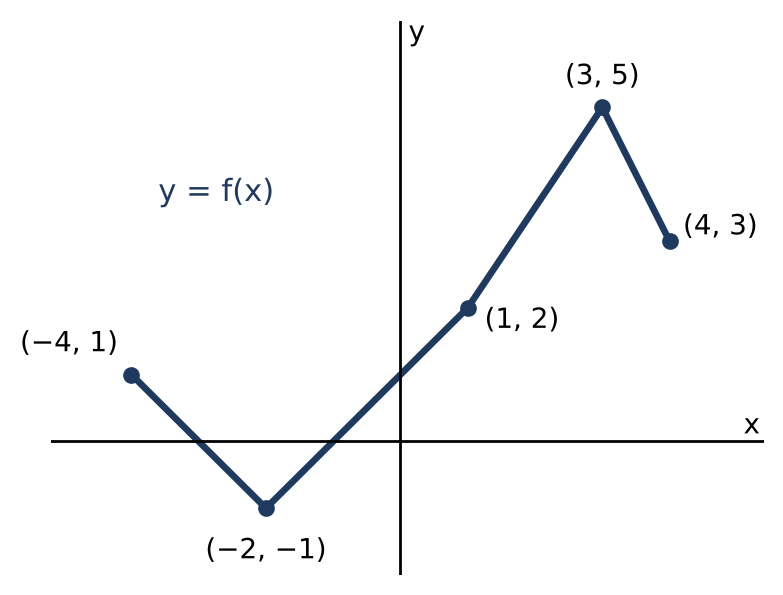
The complete graph of the function f, for −4 ≤ x ≤ 4, consists of the four line segments shown. The function g is defined by g(x) = 2 − f(x − 1). At what value of x does g attain its maximum value, and what is that maximum value?
Show solution
AnswerD — x = −1; maximum 3
Step-by-step
- g(x) = 2 − f(x − 1) is largest when f(x − 1) is smallest, because f is subtracted.
- The least value of f is −1, at x = −2 (the lowest vertex of the graph).
- f(x − 1) = −1 when x − 1 = −2, that is, x = −1.
- So g has its maximum at x = −1, and the maximum is 2 − (−1) = 3.
Fast methodMap the lowest point (−2, −1) of f: shifting right 1 gives x = −1; reflecting in the x-axis and adding 2 gives y = 2 + 1 = 3.
Quick checkg(−1) = 2 − f(−2) = 3; g(4) = 2 − f(3) = −3 is the least value; g(2) = 2 − f(1) = 0 < 3.
Why the other choices are wrong
- A (x = −3; maximum 3): shifted the graph 1 unit left instead of right, taking x = −2 − 1
- B (x = 4; maximum 7): ignored the minus sign in front of f, maximizing 2 + f at the image of f's peak (3, 5)
- C (x = 4; maximum −3): used f's maximum point (3, 5): 2 − 5 = −3 at x = 3 + 1, which is g's minimum
16.
The function g is defined by g(x) = log₂(8x) for x > 0. Which of the following statements are true?
I. The graph of g is the graph of y = log₂ x shifted up 3 units.
II. The graph of g is the graph of y = log₂ x compressed horizontally toward the y-axis by a factor of 8 (each x-coordinate divided by 8).
III. g(x) = 3 log₂(2x) for all x > 0.
Show solution
AnswerB — I and II only
Step-by-step
- I: log₂(8x) = log₂ 8 + log₂ x = 3 + log₂ x, a vertical shift up 3. True.
- II: replacing x by 8x in y = log₂ x moves each point (p, q) to , a horizontal compression by a factor of 8. True.
- III: 3 log₂(2x) = 3 + 3 log₂ x, which differs from 3 + log₂ x unless log₂ x = 0; for example at x = 2, g(2) = 4 but 3 log₂ 4 = 6. False.
- So I and II only.
Fast methodOne graph can be described two ways: g(x) = log₂ x + 3 (shift) and g(x) = log₂(8x) (compression). III equals 3 + 3 log₂ x, which is not 3 + log₂ x, so it is a different function.
Quick checkx = 2: g(2) = log₂ 16 = 4 = log₂ 2 + 3 ✓; the point (16, 4) of y = log₂ x moves to (2, 4) ✓; 3 log₂ 4 = 6 ≠ 4.
Why the other choices are wrong
- A (I only): used log₂(8x) = 3 + log₂ x but did not see that replacing x by 8x is a horizontal compression
- C (I and III only): treated log₂ 8 = 3 as a multiplier, writing log₂(8x) = 3 log₂(2x), and so took the change to be a vertical stretch rather than a horizontal compression
- D (I, II and III): checked III only at x = 1, where both sides equal 3
17.
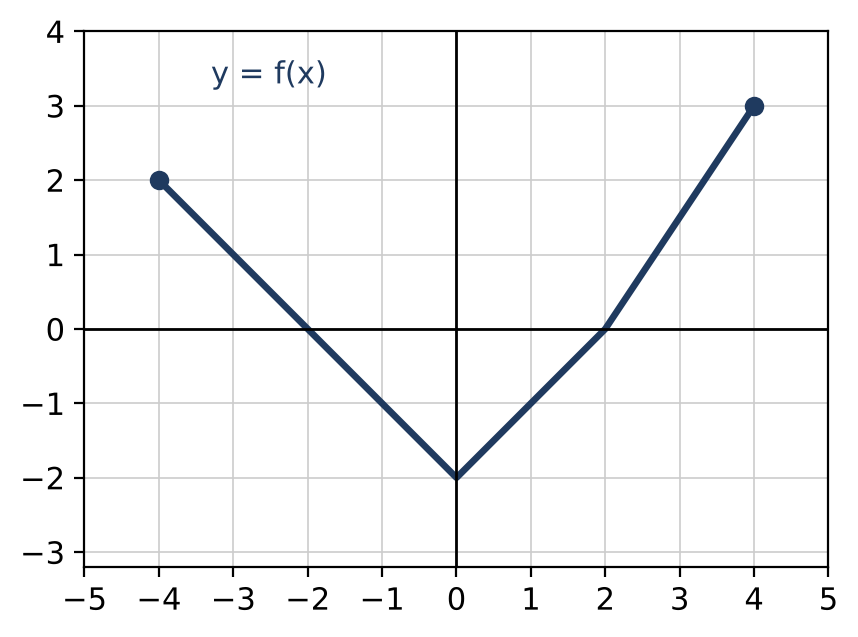
The complete graph of the function f, for −4 ≤ x ≤ 4, consists of the three line segments shown. How many values of x satisfy f(f(x)) = 0?
Show solution
AnswerC — 3
Step-by-step
- f(f(x)) = 0 means f(x) is a zero of f. From the graph, f(u) = 0 only for u = −2 and u = 2.
- f(x) = −2: the graph reaches −2 only at its lowest point, x = 0 (1 solution).
- f(x) = 2: at the left endpoint x = −4, and once on the segment from (2, 0) to (4, 3), where x = 2 + (2) = (2 solutions).
- Total: 3 values of x.
Fast methodDraw the horizontal lines y = −2 and y = 2 across the graph and count the crossings: 1 + 2 = 3.
Quick checkx = : on the last segment f(x) = (x − 2) = 2, and f(2) = 0 ✓; x = −4: f(−4) = 2 and f(2) = 0 ✓.
Why the other choices are wrong
- A (1): solved only f(x) = −2
- B (2): gave the number of zeros of f itself (x = −2 and x = 2)
- D (4): counted the lowest point x = 0 twice, as if f(x) = −2 had two solutions
18.
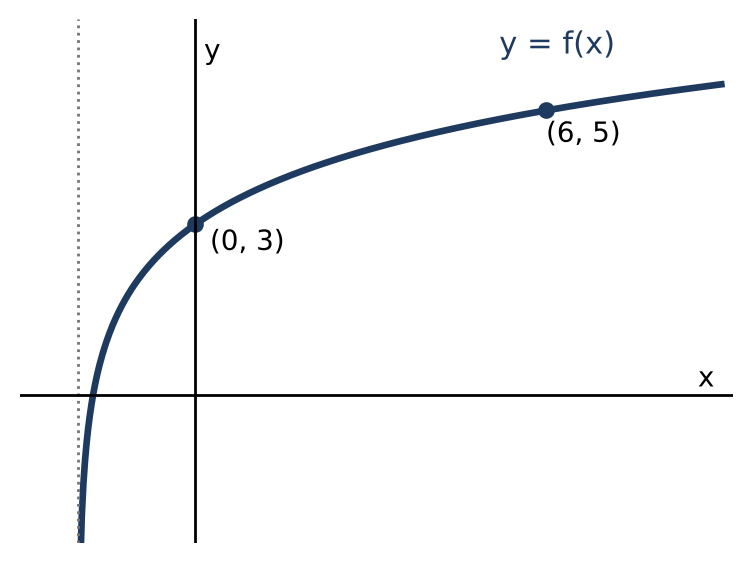
The graph of f(x) = log₂(x + a) + b, where a and b are constants, passes through the points (0, 3) and (6, 5), as shown. At what x-coordinate does the graph cross the x-axis?
Show solution
AnswerA — −
Step-by-step
- From (0, 3): log₂ a + b = 3. From (6, 5): log₂(6 + a) + b = 5.
- Subtracting: log₂ = 2, so = 4, 6 + a = 4a and a = 2. Then b = 3 − log₂ 2 = 2.
- So f(x) = log₂(x + 2) + 2. The graph crosses the x-axis where log₂(x + 2) = −2, that is, x + 2 = = .
- x = − 2 = −.
Fast methodFrom (0, 3) to (6, 5) the output rises by 2, so the input x + a is multiplied by = 4: 6 + a = 4a, a = 2, and then b = 2. Now f(x) = 0 means log₂(x + 2) = −2, so x + 2 = and x = −.
Quick checkf = log₂ + 2 = −2 + 2 = 0 ✓; f(0) = log₂2 + 2 = 3 ✓; f(6) = log₂8 + 2 = 5 ✓.
Why the other choices are wrong
- B (−): solved log₂(x + 2) = −2 as x + 2 = , using instead of
- C (−1): found a = 2 but forgot b, solving log₂(x + 2) = 0
- D (2): dropped the minus sign, solving log₂(x + 2) = 2 so x + 2 = 4
19.
A function f satisfies f(x) + 2f = 3x for every nonzero real number x. What is the value of f(2)?
Show solution
AnswerA — −1
Step-by-step
- Put x = 2: f(2) + 2f = 6.
- Put x = : f + 2f(2) = .
- Double the second equation: 2f + 4f(2) = 3. Subtract the first: 3f(2) = 3 − 6 = −3.
- So f(2) = −1.
Fast methodSolving the two equations in general gives f(x) = − x, so f(2) = 1 − 2 = −1.
Quick checkf(2) = −1 and f = : −1 + 2 = 6 ✓ and + 2(−1) = ✓.
Why the other choices are wrong
- B (1): subtracted in the wrong order, getting 3f(2) = 6 − 3 = 3
- C (2): treated f as if it were f(2), so 3f(2) = 6
- D (): solved the system correctly but reported f
20.
The function f is defined by f(x) = + 2x, and g is a linear function such that f(g(x)) = 4 − 1 for all real x. What is the sum of all possible values of g(3)?
Show solution
AnswerB — −2
Step-by-step
- f(g(x)) = g + 2g(x) = − 1.
- So − 1 = 4 − 1, that is, = 4 for all x.
- Since g is linear, g(x) + 1 = 2x for all x or g(x) + 1 = −2x for all x: g(x) = 2x − 1 or g(x) = −2x − 1.
- g(3) = 5 or g(3) = −7; the sum is −2.
Fast methodWrite g(x) = mx + b: matching f(g(x)) = + 2m(b + 1)x + + 2b with 4 − 1 gives m = ±2, b = −1; then g(3) = ±6 − 1, summing to −2.
Quick checkg(x) = −2x − 1: f(g(x)) = + 2(−2x − 1) = 4 + 4x + 1 − 4x − 2 = 4 − 1 ✓.
Why the other choices are wrong
- A (−7): took only the negative square root, g(x) + 1 = −2x, so g(x) = −2x − 1
- C (5): took only the positive square root, g(x) + 1 = 2x, so g(x) = 2x − 1
- D (6): matched only the terms and took g(x) = 2x