Functions: Study Guide
CLT function questions use function notation, custom operations defined in the question, and linear, quadratic, exponential, polynomial and basic logarithmic functions, with their graphs and transformations.
Function Concepts
A function gives exactly one output for each input. Evaluate by substitution, read domain and range, compose functions, and find inverses by swapping x and y.
| Evaluate | |
| Composition | |
| Inverse | |
| Inverse check | |
| Vertical line test | |
| Even and odd functions | |
| Transformations |
Function notation — evaluating
Method. Put negative inputs in parentheses; square before multiplying by the coefficient.
Worked example- Substitute x = −3 with parentheses: f(−3) = 4 + 4(−3) − 1.
- Square first: = 9.
- Then 36 − 12 − 1 = 23.
- B (25): made a sign error with the constant
- C (47): evaluated f(3) instead of f(−3)
- D (131): multiplied by 4 before squaring
Range
Method. Range of a parabola = from the vertex y-value upward (a > 0) or downward (a < 0).
Worked example- The vertex form a + k has vertex (3, −9).
- Since a = −2 is negative, the parabola opens down.
- So −9 is the greatest value.
- The range is y ≤ −9.
- A (y ≥ −9): reversed the direction of the parabola
- B (y ≤ 3): used the x-coordinate of the vertex
- C (y ≤ 9): used the wrong sign for the vertical shift
Piecewise functions
Method. First pick the piece whose condition the input satisfies (watch < versus ≤ at the boundary).
Worked example- Decide which piece applies: x = 3 satisfies x ≥ 1.
- So use f(x) = −2 + 7.
- Substitute: f(3) = −2 + 7 = −11.
- B (−7): used the wrong piece
- C (−5): doubled instead of squaring
- D (11): made a sign error
Reading key features from graphs
Method. Inputs are read on the x-axis, outputs on the y-axis.
Worked example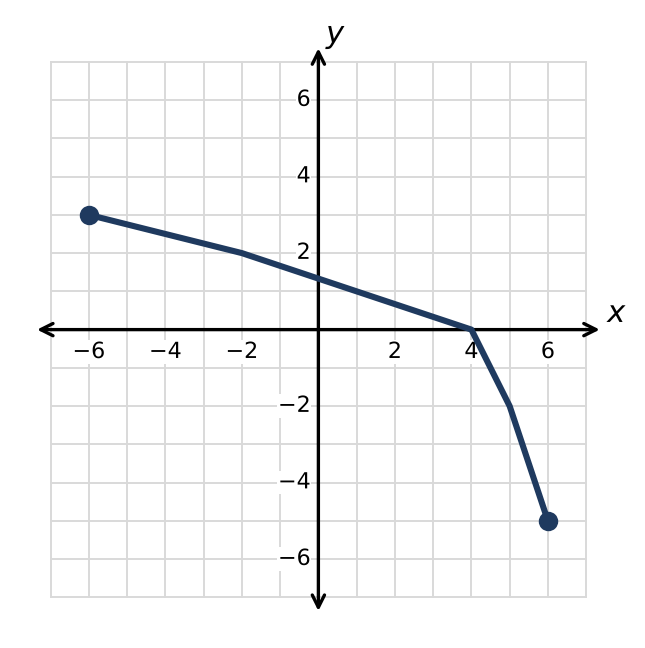
- The domain is the set of x-values the graph covers.
- The graph starts at x = −6 and ends at x = 6, with both endpoints included.
- So the domain is −6 ≤ x ≤ 6.
- B (−5 ≤ x ≤ 3): gave the y-values (range) instead of the x-values
- C (−6 < x < 6): left out the endpoints
- D (all real numbers): assumed the graph continues forever
Even and odd functions
Method. Even: mirror in the y-axis (same output). Odd: rotate 180° about the origin (opposite output).
Worked example- An even function satisfies f(−x) = f(x) for every x.
- So f(−3) = f(3) = −6.
- B (−): took the reciprocal
- C (): took the negative reciprocal
- D (6): treated f as odd
One-to-one functions
Method. Look for a symmetric graph : symmetry means two inputs share each output.
Worked example- A function is one-to-one when different inputs always give different outputs (it passes the horizontal line test).
- 3ˣ is always increasing.
- So no two inputs share an output.
- Each other choice repeats an output for two different inputs.
- B (f(x) = − 4x): missed that f(0) = f(4)
- C (f(x) = − 2): missed that f(−1) = f(1)
- D (f(x) = ): missed that f(−4) = f(0)
Nonlinear patterns
Method. If the changes grow by a constant amount, compare the outputs with the square numbers.
Worked example- The changes in output are 3, 5, 7, which grow by 2.
- So the rule involves squaring.
- Compare with the squares: 1 = , 4 = , 9 = , 16 = .
- The rule is output = (input)².
- For 7: = 49.
- A (14): doubled the input instead of squaring it
- B (37): continued with the last change in y as if the function were linear
- C (43): added the next change in y once for every step
Function notation — expressions
Method. Substitute the whole expression for x with parentheses, then expand.
Worked example- Replace every x with (x − 2): f(x − 2) = − + 2(x − 2) − 7.
- Expand: = − 4x + 4.
- So f(x − 2) = − + 4x − 4 + 2x − 4 − 7.
- Combine like terms: − + 6x − 15.
- A (− + 2x − 9): added −2 to the output instead of the input
- B (− + 2x − 15): squared (x − 2) as + 4
- C (− + 6x − 11): replaced x only in the squared term
Linear Functions
A linear function has a constant rate of change. Use slope-intercept or point-slope form.
| Slope | |
| Slope-intercept | |
| Point-slope | |
| Standard form of a line |
Initial value from a table
Method. Initial value = first y − rate × first x.
Worked example- Rate of change: (−33 − (−27)) ÷ 1 = −6.
- Going from x = 3 back to x = 0 is 3 units.
- So y changes by −6 × (−3) = 18.
- So y(0) = −27 + 18 = −9.
- A (−27): gave the first y-value in the table
- B (−21): went back only one unit of x
- D (−6): gave the rate of change
Rate and initial value in context
Method. Two data points → rate = Δamount ÷ Δtime; initial value = amount − rate × time.
Worked example- Rate = (change in amount) ÷ (change in time).
- Rate = (56 − 48) ÷ (5 − 4) = 8 ÷ 1.
- So Rate = 8 centimeters per day.
- A (−8): made a sign error (ignored whether the amount went up or down)
- B (): divided the change in time by the change in amount
- D (): divided an amount by its time
Linear function from two points
Method. Slope from the two points, then b = y − mx with either point.
Worked example- Slope: (20 − (−4)) ÷ (5 − (−1)) = 24 ÷ 6 = 4.
- Intercept: substitute (−1, −4) into y = 4x + b: −4 = −4 + b.
- So b = 0.
- The equation is y = 4x.
- B (y = x − ): divided the change in x by the change in y
- C (y = 4x − 8): made a sign error finding the intercept
- D (y = −4x − 8): made a sign error in the slope
Comparing linear models
Method. Equal cost: difference in fees ÷ difference in rates.
Worked example- Set the costs equal: 78 + 7m = 26 + 8m.
- Move the m-terms to one side and the constants to the other: −m = −52.
- Divide: m = 52 months.
- A (): added the rates instead of subtracting them
- B (): divided by one rate instead of the difference of the rates
- C (): added the fees and the rates
Arithmetic sequences as linear functions
Method. Arithmetic sequence = linear function of n with slope = common difference.
Worked example- The common difference is −6 − (−9) = 3.
- Term n = first term + (n − 1) × difference = −9 + 13 × 3 = 30.
- A (−126): multiplied the first term by n
- C (33): used n instead of n − 1
- D (42): forgot the first term
Solving with linear models
Method. Undo the model: subtract the start value, divide by the rate.
Worked example- Substitute H = 194: 194 = 10d + 54.
- Subtract 54: 140 = 10d.
- Divide by 10: d = 14.
- B (): ignored the constant
- C (): added the constant instead of subtracting it
- D (1994): evaluated H at 194 instead of solving
Quadratic Functions
Parabolas: the vertex is the turning point, the axis of symmetry passes through it, and the sign of a tells the direction.
| Vertex form | |
| Axis of symmetry | |
| Factored form | |
| Max/min | |
| Average rate of change |
Vertex form
Method. Vertex form: change the sign inside the parentheses, keep the sign of k.
Worked example- In vertex form f(x) = a + k the vertex is (h, k).
- Here x − 6 = x − (6).
- So h = 6, and k = 9.
- The vertex is (6, 9).
- A ((−6, 9)): used the sign inside the parentheses
- B ((6, −9)): used the wrong sign for k
- C ((9, 6)): swapped the coordinates
Factored form and intercepts
Method. Factored form a(x − p)(x − q): zeros p and q, vertex halfway, y-intercept a·p·q.
Worked example- x-intercepts are where f(x) = 0.
- A product is 0 when a factor is 0: x + 4 = 0 gives x = −4.
- x − 5 = 0 gives x = 5.
- So x = −4 and x = 5.
- A (x = −5 and x = 4): used the signs shown in the factors
- C (x = 20): gave the y-intercept
- D (x = −5 and x = −4): changed the sign of only one zero
Graphs of quadratic functions
Method. Read the vertex from the grid; check the direction and the step from the vertex for a.
Worked example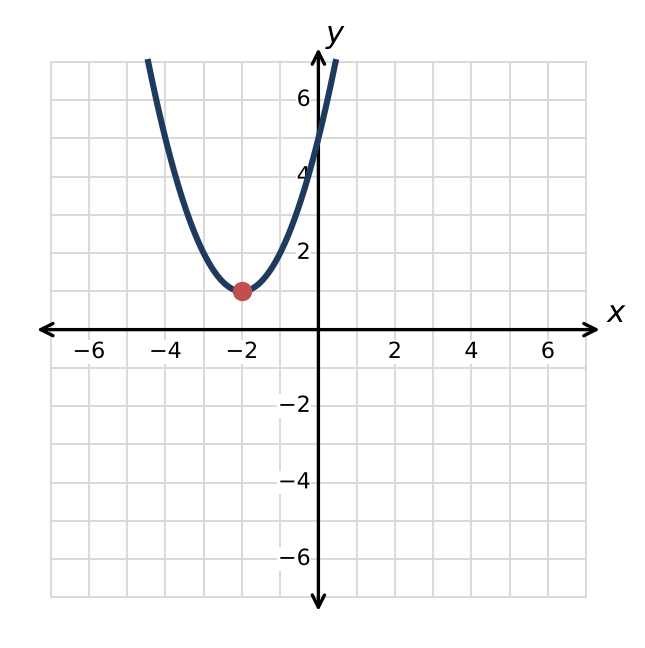
- The vertex is the turning point of the parabola: its lowest point.
- Reading the grid, it is at x = −2, y = 1.
- So the vertex is (−2, 1).
- A ((1, −2)): swapped the coordinates
- B ((2, 1)): misread the sign of the x-coordinate
- D ((−2, −1)): misread the sign of the y-coordinate
Vertex and axis from standard form
Method. x-vertex = −; plug it back in for the y-coordinate.
Worked example- The x-coordinate of the vertex is − = − = −6.
- The y-coordinate is f(−6) = −72 + 144 − 78 = −6.
- So the vertex is (−6, −6).
- A ((6, −294)): used instead of −
- B ((−12, −78)): forgot the 2 in −
- D ((−6, −78)): used c as the y-coordinate
Maximum and minimum values
Method. Minimum value = f, the y-coordinate of the vertex.
Worked example- a = 2 is positive.
- So the parabola opens up and has a minimum at the vertex.
- x = − = 4.
- f(4) = 32 − 64 + 45 = 13.
- The minimum value is 13.
- A (4): gave the x-value where the minimum occurs
- C (45): gave the y-intercept
- D (141): used the wrong sign for the x-coordinate of the vertex
Projectile models
Method. Time of max = −; max height = h of that time.
Worked example- The maximum is at the vertex.
- t = −.
- t = − = .
- So t = 0.5 seconds.
- B (1): used − instead of −
- C (2.25): gave the maximum height instead of the time
- D (2.5): divided b by 2 only
Area optimization
Method. Write area as a quadratic in one side; the maximum is at the vertex.
Worked example- Let each side touching the wall be w.
- The side parallel to the wall is 224 − 2w.
- A(w) = w(224 − 2w) = −2 + 224w.
- The vertex is at w = = 56.
- So the other side is 224 − 112 = 112.
- Area = 56 × 112 = 6272.
- A (56): gave the width instead of the area
- B (112): gave the length instead of the area
- C (3136): fenced all four sides
Transformations of quadratics
Method. Inside the square: opposite direction (x − h shifts right). Outside: same direction.
Worked example- A reflection across the x-axis multiplies by −1.
- A shift 4 right replaces x with x − 4.
- A shift 6 up adds 6.
- So g(x) = − + 6.
- A (g(x) = − + 6): used the wrong direction for the horizontal shift
- B (g(x) = − − 6): used the wrong direction for the vertical shift
- D (g(x) = + 6): missed the reflection
Average rate of change
Method. For ax² + bx + c the average rate from p to q equals a(p + q) + b.
Worked example- Average rate of change = (f(4) − f(−3)) ÷ (4 − (−3)).
- f(4) = 24 and f(−3) = 31.
- So (24 − 31) ÷ 7 = −7 ÷ 7 = −1.
- A (−7): did not divide by the change in x
- C (1): subtracted in the wrong order
- D (): added the function values
Second differences
Method. Quadratic ⇔ constant second differences; second difference = 2a for x-steps of 1.
Worked example- First differences: 7, 9, 11, 13.
- Second differences: all 2.
- For f(x) = ax² + bx + c with x-steps of 1 the second difference is 2a.
- So a = 2 ÷ 2 = 1.
- A (−6): gave the value at x = 0
- B (−1): made a sign error
- D (2): gave the second difference without halving it
Parameters and the discriminant
Method. One x-intercept: c = (a perfect-square trinomial).
Worked example- Exactly one x-intercept means the discriminant is 0: − 4(1)(c) = 0.
- So 36 − 4c = 0 and c = = 9.
- A (−9): made a sign error
- B (3): used instead of
- D (18): used 2 instead of 4 in − 4ac
Exponential Functions
Growth or decay by a constant factor each step. In f(x) = a·bˣ with a > 0, a base b > 1 grows and 0 < b < 1 decays; the y-intercept is a.
| Exponential function | |
| Growth / decay | |
| Half-life | |
| Doubling | |
| Compound interest |
Repeated multiplication
Method. Growth by a factor each period: start × facto.
Worked example- Each hour multiplies the number by 3.
- After 3 hours: 5 × = 5 × 27 = 135.
- A (14): added the factor once per period
- B (27): forgot the starting amount
- C (45): multiplied by the factor once for each period (linear growth)
Growth patterns
Method. Term n = first term × rati.
Worked example- Each term is 3 times the one before.
- Term 8 is the first term multiplied by 3 a total of 7 times: 6 × = 6 × 2187 = 13122.
- A (126): multiplied instead of using an exponent
- B (594): continued with the last difference (linear pattern)
- C (2187): forgot the first term
Evaluating exponential functions
Method. Raise the base to the power first, then multiply by the coefficient.
Worked example- Substitute x = −2: f(−2) = 5 × .
- First the power: = 9.
- Then multiply: 5 × 9 = 45.
- A (−): multiplied by the exponent instead of raising to a power
- B (): multiplied 5 and before raising to the power
- D (135): used one power too many: 5 × = 5 × 27
Growth and decay rates
Method. Factor b = 1 + r for growth, 1 − r for decay; rate = distance of b from 1.
Worked example- In f(t) = a · bᵗ, b > 1 means growth and 0 < b < 1 means decay.
- Here b = 1.15 is greater than 1.
- The rate is |b − 1| = |1.15 − 1| = 0.15 = 15%.
- So it is growth of 15% per year.
- B (decay of 15% per year): confused growth with decay
- C (growth of 115% per year): used the factor itself as the percent
- D (decay of 115% per year): used the factor as the percent and the wrong direction
Compound interest
Method. Rate per period = ; number of periods = n·t.
Worked example- Compound interest: A = P with P = 5000, r = 0.12 and n = 12 periods per year.
- Each period the rate is , and there are 12t periods in t years.
- So A = 5,000.
- A (5,000): did not divide the rate by the number of periods
- C (5,000ᵗ): did not multiply the time by the number of periods
- D (5,000): multiplied the rate and divided the time
Doubling and half-life
Method. Count the periods (time ÷ period length), then multiply by 2 or that many times.
Worked example- The number of doubling periods is 10 ÷ 2 = 5.
- Value = 500 × = 500 × 32 = 16000.
- A (8000): counted one period too few
- C (32000): counted one period too many
- D (512000): used 10 instead of as the exponent
Linear versus exponential models
Method. Constant difference → linear; constant ratio → exponential.
Worked example- Differences in y: 4, 12, 36.
- Ratios: 3, 3, 3.
- The ratios are constant (3).
- So the function is exponential with starting value 2: y = 2 · 3ˣ.
- B (Linear, y = 2 + 4x): used only the first difference
- C (Exponential, y = 3 · 2ˣ): swapped the starting value and the ratio
- D (Linear, y = 2 + 3x): treated the constant ratio as a constant difference
Exponential graphs
Method. Starting value = y at x = 0; base = (y at x = 1) ÷ (y at x = 0).
Worked example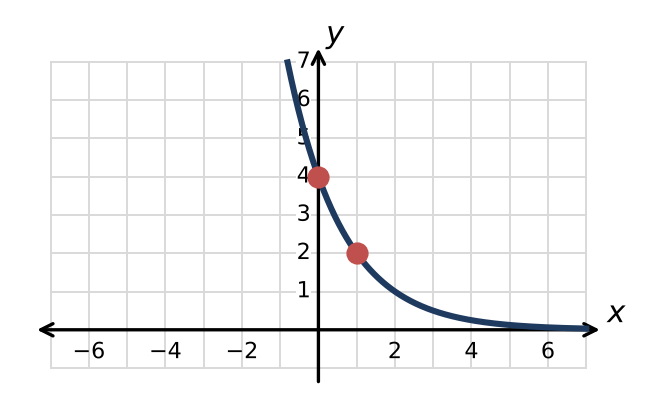
- The marked points are (0, 4) and (1, 2).
- For f(x) = a · bˣ, f(0) = a = 4.
- Then f(1) = a · b.
- So b = 2 ÷ 4 = .
- So f(x) = 4 · (0.5)ˣ.
- A (f(x) = 4 · 2ˣ): inverted the base (growth versus decay)
- C (f(x) = −2x + 4): fitted a line through the two marked points
- D (f(x) = 2 · (0.5)ˣ): used the value at x = 1 as the starting value
Geometric sequences as exponential functions
Method. Geometric sequence = exponential function of n: a · .
Worked example- First term a = −6.
- Common ratio r = 12 ÷ (−6) = −2.
- Term 6 = −6 × = −6 × −32 = 192.
- A (−384): used n instead of n − 1
- B (−32): forgot the first term
- C (60): multiplied instead of using an exponent
Percent growth and decay
Method. Multiply by (1 ± r) once per year — never add r·t.
Worked example- Each year the value is multiplied by 1 − 0.25 = 0.75.
- After 3 years: $800 × = $800 × 0.421875 = $337.50.
- A ($200): used simple (linear) change instead of compounding
- C ($600): applied the change only once
- D ($1,562.50): used the wrong direction of change
Exponential functions from two points
Method. Ratio of outputs = ; then take the root.
Worked example- Divide the outputs: f(3) ÷ f(1) = = .
- So = 64 ÷ 4 = 16.
- Take the root: b = 4 (b > 0).
- B (8): divided the ratio by the change in x
- C (16): did not take the root of the ratio
- D (30): found the linear slope instead of the growth factor
Changing time units
Method. Per-month factor = (yearly factor)^.
Worked example- Let m be the monthly growth factor.
- There are 12 months in a year.
- So = 1.06.
- So m = , and Q can be written 500 · .
- A (): divided the yearly factor by 12
- C (1 + ): divided the yearly rate by 12
- D (): raised the factor to the power 12
Logarithmic Functions
y = log_b x is the inverse of y = bˣ: domain x > 0, vertical asymptote x = 0, passes through (1, 0).
| Inverse pair | |
| Key point | |
| Domain |
Evaluating logarithms
Method. log_b N = the exponent that turns b into N.
Worked example- log₆ 216 asks: to what power must 6 be raised to give 216? 216 = .
- So log₆ 216 = 3.
- B (4): counted one power too many
- C (36): divided the number by the base
- D (1296): multiplied the number by the base
Exponential and logarithmic form
Method. log_b N = e ⇔ bᵉ = N: the base stays the base.
Worked example- log_b x = e means bᵉ = x.
- Here b = 5 and e = 3.
- So x = .
- A (x = ): swapped the base and the exponent
- C (x = 5 · 3): multiplied the base by the exponent
- D (5 = ): made x the base