Exponents and Radicals: Practice Paper 1
Choose one answer for each question, then select Check my answers. Every question has a full worked solution.
1.
What is + ?
Show solution
AnswerD — 5
Step-by-step
- Simplify each root: = 2 and = 3.
- Now they are like radicals: 2 + 3 = 5.
Fast methodSimplify every root first; only roots with the same number under the sign can be added.
Quick check = 125 and = 20 + 45 + 2 = 65 + 60 = 125 ✓.
Why the other choices are wrong
- A (): added the numbers under the root signs
- B (5): added both the outside numbers and the radicands
- C (6): multiplied the outside numbers after simplifying
2.
Which expression is equivalent to ?
Show solution
AnswerD — 3^x / 9
Step-by-step
- Use bᵐ⁻ⁿ = bᵐ ÷ bⁿ.
- = 3^x ÷ .
- So = 3^x / 9.
Fast methodAn added constant in the exponent becomes a multiplied constant out front (subtracted → divided).
Quick checkTest x = 1: and / 9 give the same number.
Why the other choices are wrong
- A (3^x − 9): subtracted instead of dividing
- B (3^x / 6): multiplied the base by the subtracted number
- C (3^x · 9): multiplied instead of dividing
3.
Which formula gives the nth term of the sequence 2, 6, 18, 54, …?
Show solution
AnswerB — aₙ = 2 ·
Step-by-step
- The ratio is 6 ÷ 2 = 3.
- aₙ = a₁ · = 2 · .
Fast methodGeometric: first term times ratio to the power (n − 1).
Quick checkn = 3 gives 2 · = 18, the third term.
Why the other choices are wrong
- A (aₙ = 2 · 3^n): used n instead of n − 1 as the exponent
- C (aₙ = ): multiplied the first term and the ratio before raising to the power
- D (aₙ = 3 · ): swapped the first term and the ratio
4.
Priya saves $18 in week 1 and saves $3 more each week than the week before. How much does Priya save in week 9?
Show solution
AnswerB — $42
Step-by-step
- This is arithmetic with a₁ = 18 and d = 3.
- aₙ = 18 + (n − 1) × 3.
- So a₉ = 18 + 8 × 3 = 42.
Fast methodCount the steps: from 1 to 9 is 8 increases of 3.
Quick checkthe second term is 18 + 3 = 21, as described.
Why the other choices are wrong
- A ($27): forgot to start from the first term
- C ($45): used n instead of n − 1
- D ($162): multiplied the first term by n
5.
Which expression is equivalent to 2^x · 11^x?
Show solution
AnswerA — 22^x
Step-by-step
- When the exponents are the same, multiply the bases: aˣ · bˣ = (ab)ˣ.
- So 2^x · 11^x = (2 · 11)^x = 22^x.
Fast methodSame exponent → multiply bases; same base → add exponents.
Quick checkTest x = 2: · = 484 and = 484.
Why the other choices are wrong
- B (13^x): added the bases
- C (): multiplied the bases and added the exponents
- D (): used one base as an exponent
6.
Which expression is equivalent to ?
Show solution
AnswerD — (1.21)^t
Step-by-step
- Use .
- = ^t.
- So = (1.21)^t.
Fast methodCompute once; that number becomes the new base.
Quick checkTest t = 1: = 1.21, which matches .
Why the other choices are wrong
- A ((2.2)^t): multiplied the growth factor by the exponent
- B ((1.2)^t): multiplied the percent by the exponent (simple instead of compound)
- C (2(1.1)^t): moved the exponent in front as a coefficient
7.
If = 32, what is x?
Show solution
AnswerA — 2
Step-by-step
- Write 32 as a power of 2: 32 = .
- Equal bases → equal exponents: x + 3 = 5.
- So x = 2.
Fast methodCount how many times you divide 32 by 2 to reach 1 (5), then subtract 3.
Quick checkSubstitute to check: = = 32, the right side.
Why the other choices are wrong
- B (5): set x equal to the whole exponent of the right side
- C (13): divided the right side by the base and subtracted
- D (29): subtracted from the right side instead of comparing exponents
8.
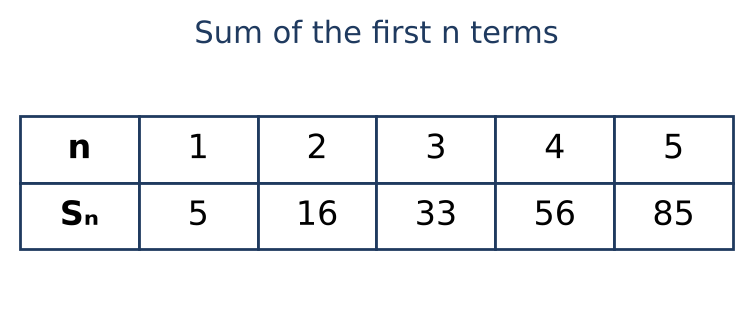
For an arithmetic sequence a₁, a₂, a₃, …, the table shows Sₙ, the sum of the first n terms, for n = 1 to 5. What is the value of a₁₂?
Show solution
AnswerA — 71
Step-by-step
- The terms are differences of consecutive sums: a₁ = S₁ = 5, a₂ = 16 − 5 = 11, a₃ = 33 − 16 = 17, a₄ = 56 − 33 = 23.
- So a₁ = 5 and the common difference is d = 6.
- a₁₂ = a₁ + 11d = 5 + 66 = 71.
Fast methoda₁ = 5 and a₂ = S₂ − S₁ = 11 give d = 6 at once, so a₁₂ = 5 + 11 · 6 = 71.
Quick checkWith a₁ = 5, d = 6: S₅ = · (2 · 5 + 4 · 6) = · 34 = 85, matching the table; S₁₂ − S₁₁ = 456 − 385 = 71.
Why the other choices are wrong
- B (77): Found a₁ = 5 and d = 6 correctly but used a₁₂ = a₁ + 12d instead of a₁ + 11d.
- C (126): Took the common difference to be S₂ − S₁ = 11 (a difference of the table entries) instead of a₂ − a₁ = 6: 5 + 11 · 11 = 126.
- D (456): Treated the table entries as the terms themselves and continued their pattern, which gives S₁₂ = 456, the sum of 12 terms.
9.
The arithmetic sequence 50, 47, 44, 41, … continues by subtracting 3 each time. What is the greatest possible value of the sum of the first n terms of the sequence, for a positive integer n?
Show solution
AnswerC — 442
Step-by-step
- The sum keeps growing as long as the terms added are positive.
- aₙ = 50 − 3(n − 1) = 53 − 3n, which is positive for n ≤ 17 (a₁₇ = 2) and negative from n = 18 (a₁₈ = −1).
- So the greatest sum is S₁₇ = 17 = 17 = 17 × 26.
- 17 × 26 = 442.
Fast methodAdd terms while they are positive: the last positive term is 2 (since 50 ≡ 2 mod 3), the 17th; S₁₇ = 17 × (average of 50 and 2) = 17 × 26 = 442.
Quick checkS₁₆ = 16 = 440 and S₁₈ = 442 − 1 = 441, both less than 442.
Why the other choices are wrong
- A (440): stopped at the 16th term, 5, missing the positive 17th term, 2
- B (441): included the 18th term, −1, which lowers the sum
- D (884): found n = 17 but used n(a₁ + aₙ) without dividing by 2: 17 × 52
10.
An infinite geometric series has first term 12 and sum . What is its common ratio?
Show solution
AnswerA — −
Step-by-step
- Use S = a ÷ (1 − r).
- So = 12 ÷ (1 − r), which gives 1 − r = 12 ÷ = .
- Then r = 1 − = −.
Fast methodSolve S = for r: r = 1 − .
Quick check12 ÷ = 12 ÷ = , the given sum ✓.
Why the other choices are wrong
- B (): got the sign of r wrong
- C (): divided the sum by the first term
- D (): divided the first term by the sum
11.
If x < 0, which of the following is equal to − ?
Show solution
AnswerA — −5x
Step-by-step
- = 3|x|, and since x < 0, |x| = −x, so = −3x (a positive number).
- = 2x for every real x, because = 8; a cube root keeps the sign.
- So − = −3x − 2x = −5x.
Fast methodTest x = −1: − = 3 − (−2) = 5, and −5x = 5 ✓ (x gives −1, −x gives 1, 5x gives −5).
Quick checkx = −2: − = 6 + 4 = 10 = −5(−2) ✓.
Why the other choices are wrong
- B (x): simplified as 3x, forgetting that a square root is never negative
- C (−x): used = −3x correctly but also flipped the sign of the cube root, = −2x
- D (5x): simplified as 3x and as −2x — both signs reversed
12.
When the number · is written out in full, what is the sum of its digits?
Show solution
AnswerD — 13
Step-by-step
- = and = , so the number is · .
- Pair each 2 with a 5: · = , leaving = 625.
- So the number is 625 × , that is, 625 followed by 18 zeros.
- Its digit sum is 6 + 2 + 5 = 13.
Fast method · = · = · 625 = 625 × ; digit sum 13.
Quick checkCheck the exponents: · = = and the extra = 625; total digits 3 + 18 = 21, nonzero digits 6, 2, 5.
Why the other choices are wrong
- A (1): assumed the product is a power of 10, as if the 2s and 5s paired off completely
- B (7): wrote the number as · but then kept only 25 instead of = 625
- C (8): wrote as instead of , leaving = 125 after pairing
13.
A sequence is defined by a₁ = 5 and aₙ₊₁ = 2aₙ − 3 for every positive integer n. What is the value of a₂₀?
Show solution
AnswerB — + 3
Step-by-step
- Subtract 3 from both sides: aₙ₊₁ − 3 = 2aₙ − 6 = 2(aₙ − 3).
- So the numbers bₙ = aₙ − 3 form a geometric sequence with ratio 2 and b₁ = 5 − 3 = 2.
- bₙ = 2 · = , so aₙ = + 3.
- a₂₀ = + 3.
Fast methodList a few terms: 5, 7, 11, 19, 35 = + 3, + 3, + 3, + 3, + 3, so aₙ = + 3.
Quick checka₂ = 2(5) − 3 = 7 = + 3 ✓; a₃ = 11 = + 3 ✓; and 2 − 3 = + 3 ✓.
Why the other choices are wrong
- A ( + 3): found aₙ − 3 doubles each time but used instead of (a₁ − 3 = 2, not 1)
- C (5 · − 57): doubled 5 nineteen times and then subtracted 3 once per step, 19 × 3 = 57, ignoring that earlier 3s are doubled too
- D (5 · ): ignored the −3 and treated the sequence as geometric with ratio 2
14.
A sequence is defined by a₁ = 2 and aₙ₊₁ = for n ≥ 1. What is the sum of the first 40 terms of the sequence?
Show solution
AnswerD —
Step-by-step
- Compute terms: a₁ = 2, a₂ = = −1, a₃ = = , a₄ = = 2, so the sequence repeats every 3 terms: 2, −1, , ….
- Each block of 3 terms sums to 2 − 1 + = .
- 40 = 3 · 13 + 1: thirteen blocks (39 terms) sum to 13 · = , and the 40th term is a₄₀ = a₁ = 2.
- Total: + 2 = .
Fast methodPeriod 3 with block sum ; 40 terms = 13 blocks + one extra term (which is 2): + 2 = .
Quick checka₅ = = = −1 = a₂, confirming the period 3; 40 = 3 · 13 + 1, so a₄₀ = a₁ = 2; 13 · + 2 = + = . ✓
Why the other choices are wrong
- A (): Miscounted the position in the cycle and took the 40th term to be −1 (the value of a₂) instead of 2: − 1 = .
- B (): Found 13 full cycles of each (39 terms) but left out the 40th term.
- C (20): Multiplied 40 by the average of one cycle, ÷ 3 = , ignoring that 40 is not a multiple of 3.
15.
In a geometric sequence of positive numbers, the product of the 2nd term and the 8th term is 36. What is the value of a₄ · a₆ + a₅, where aₙ is the nth term?
Show solution
AnswerB — 42
Step-by-step
- Write aₙ = a₁rⁿ⁻¹. Then a₂ · a₈ = a₁r · a₁ = .
- Also a₄ · a₆ = a₁ · a₁ = = 36 and = = = 36.
- Since the terms are positive, a₅ = 6. So a₄ · a₆ + a₅ = 36 + 6 = 42.
Fast methodIn a geometric sequence, terms equally far from a middle term multiply to the square of that middle term: a₂a₈ = a₄a₆ = = 36, so the answer is 36 + 6.
Quick checkExample: a₁ = , r = 2 gives a₂ = , a₈ = 48 (product 36), a₄ = 3, a₅ = 6, a₆ = 12, and 3 · 12 + 6 = 42.
Why the other choices are wrong
- A (18): Took a₄ · a₆ to be 2a₅ = 12 instead of = 36, so got 12 + 6.
- C (54): Found a₄ · a₆ = 36 but took a₅ as half of 36 instead of its square root: 36 + 18.
- D (72): Found a₄ · a₆ = 36 but took a₅ itself to be a₂ · a₈ = 36: 36 + 36.
16.
A ball is dropped from a height of 81 feet. Each time it hits the ground, it rebounds to of the height from which it last fell. What is the total distance, in feet, the ball has traveled at the moment it hits the ground for the 5th time?
Show solution
AnswerC — 341
Step-by-step
- The rebound heights are 81 · = 54, then 36, 24 and 16 feet.
- Before the 5th hit the ball falls 81 feet once, and then for each of the 4 rebounds it goes up and comes back down.
- Distance = 81 + 2(54 + 36 + 24 + 16) = 81 + 2 · 130 = 341 feet.
Fast methodThink of it as twice all five heights minus the one upward trip that never happened: 2(211) − 81 = 341.
Quick checkHits: 1st at 81; 2nd at 81 + 108 = 189; 3rd at 189 + 72 = 261; 4th at 261 + 48 = 309; 5th at 309 + 32 = 341. ✓
Why the other choices are wrong
- A (211): Counted each height once (only the downward trips), 81 + 54 + 36 + 24 + 16 = 211, leaving out the upward trips.
- B (309): Stopped at the 4th hit: 81 + 2(54 + 36 + 24) = 309.
- D (422): Doubled the first drop as well: 2(81 + 54 + 36 + 24 + 16) = 422, but the ball does not travel up before it is dropped.
17.
The sum of the first 10 terms of an arithmetic sequence is 175, and the sum of the first 20 terms is 650. What is the 30th term of the sequence?
Show solution
AnswerC — 91
Step-by-step
- Sₙ = · (2a₁ + (n − 1)d). S₁₀ = 5(2a₁ + 9d) = 175 gives 2a₁ + 9d = 35.
- S₂₀ = 10(2a₁ + 19d) = 650 gives 2a₁ + 19d = 65.
- Subtract: 10d = 30, so d = 3, and 2a₁ = 35 − 27 = 8, so a₁ = 4.
- a₃₀ = a₁ + 29d = 4 + 87 = 91.
Fast methodThe average of the first 10 terms is 17.5 = a₅.₅ and of the first 20 is 32.5 = a₁₀.₅; 5 steps raise the average by 15, so d = 3, and a₃₀ = a₁₀.₅ + 19.5 · 3 = 32.5 + 58.5 = 91.
Quick checka₁ = 4, d = 3: terms 4, 7, …, 31 (10th) sum to 10 · = 175; 20th term 61 and 20 · = 650. ✓
Why the other choices are wrong
- A (88): Found a₁ = 4 and d = 3 correctly but used a₃₀ = a₁ + 28d.
- B (89.5): Used the wrong sum formula Sₙ = · (2a₁ + nd), which gives d = 3 but a₁ = 2.5, so a₃₀ = 2.5 + 87 = 89.5.
- D (94): Found a₁ = 4 and d = 3 correctly but used a₃₀ = a₁ + 30d.
18.
Here denotes the real cube root of x, and = . What is the sum of all real solutions of + − 6 = 0?
Show solution
AnswerA — −19
Step-by-step
- Let u = . Then = , and the equation is + u − 6 = 0, so (u + 3)(u − 2) = 0.
- u = 2 gives x = = 8.
- u = −3 gives x = = −27. A cube root can be negative, so this solution is valid.
- The sum is 8 + (−27) = −19.
Fast methodThe two cube roots are 2 and −3; the solutions are their cubes, 8 and −27.
Quick checkx = −27: = −3, = 9, and 9 − 3 − 6 = 0 ✓; x = 8: 4 + 2 − 6 = 0 ✓.
Why the other choices are wrong
- B (−1): added the values of u = , 2 + (−3), instead of the values of x
- C (8): rejected u = = −3 as if it were a square root, keeping only x = 8
- D (35): cubed 3 instead of −3, getting x = 27 in place of x = −27
19.
The 1st, 3rd and 9th terms of an arithmetic sequence with a nonzero common difference are, in that order, three consecutive terms of a geometric sequence. What is the common ratio of the geometric sequence?
Show solution
AnswerA — 3
Step-by-step
- Let the arithmetic sequence have first term a and difference d ≠ 0. The 1st, 3rd and 9th terms are a, a + 2d, a + 8d.
- Geometric means = a(a + 8d): + 4ad + 4 = + 8ad, so 4 = 4ad, and since d ≠ 0, d = a.
- The three terms are a, 3a, 9a (a ≠ 0, or every term would be 0), so the ratio is 3 = 3.
Fast methodIn a geometric triple x, y, z with ratio q ≠ 1, = q as well; here = 6 = 3.
Quick checka = d = 1: the sequence 1, 2, 3, …, 9 has 1st, 3rd, 9th terms 1, 3, 9 — ratio 3. ✓
Why the other choices are wrong
- B (): Wrote the 9th term as a + 9d instead of a + 8d; = a(a + 9d) gives d = 5 and ratio .
- C (4): Expanded as + 2ad + 4 (cross term 2ad instead of 4ad), which gives d = 3 and ratio = 4.
- D (9): Found the terms a, 3a, 9a but gave = 9, which is the square of the ratio.
20.
An arithmetic sequence begins with 1, and its common difference d is a positive integer. For some positive integer n ≥ 2, the sum of the first n terms is exactly 100. How many values of d are possible?
Show solution
AnswerC — 3
Step-by-step
- Sₙ = n = 100, so n(2 + (n − 1)d) = 200. Thus n divides 200 and (n − 1)d = − 2.
- Divisors n ≥ 2 of 200: 2, 4, 5, 8, 10, 20, 25, 40, 50, 100, 200. We need − 2 to be a positive multiple of n − 1.
- n = 2: = 98 ✓. n = 4: = 16 ✓. n = 5: ✗. n = 8: ✗. n = 10: = 2 ✓. n = 20: ✗; for n ≥ 25, − 2 is smaller than n − 1 (and is 0 or negative from n = 100), so ✗.
- So d = 98, 16 or 2: three values.
Fast methodSince (n − 1)d = − 2 must be at least n − 1, n(n + 1) ≤ 200, so n ≤ 13: test only n = 2, 4, 5, 8, 10.
Quick check1 + 99 = 100 ✓; 1 + 17 + 33 + 49 = 100 ✓; 1 + 3 + 5 + … + 19 = = 100 ✓.
Why the other choices are wrong
- A (1): found only n = 10, d = 2 (the sum of the first ten odd numbers) by trial
- B (2): assumed n ≥ 3 and missed the two-term case 1 + 99 (d = 98)
- D (4): also counted d = 0 with n = 100, although d must be positive