Plane Geometry: Practice Paper 1
Choose one answer for each question, then select Check my answers. Every question has a full worked solution.
1.
In a 30°-60°-90° triangle, the longer leg has length 3. What is the length of the shorter leg?
Show solution
AnswerD — 3
Step-by-step
- In a 30°-60°-90° triangle the sides are in the ratio 1 : : 2 (shorter leg : longer leg : hypotenuse).
- The longer leg is 3.
- So the shorter leg is 3.
Fast method45°-45°-90°: 1 : 1 : . 30°-60°-90°: 1 : : 2.
Quick check + = 36 = ✓.
Why the other choices are wrong
- A (3): gave the longer leg instead
- B (6): gave the hypotenuse instead
- C (): divided the longer leg by 3 instead of by
2.
A sector of a circle with radius 6 has a central angle of 80°. What is the area of the sector?
Show solution
AnswerA —
Step-by-step
- Sector area = (central angle ÷ 360°) × πr².
- So the area is × π × = × = .
Fast methodSector = × area of the circle.
Quick check ÷ = = ✓.
Why the other choices are wrong
- B (): divided by 180 instead of 360
- C (): found the area of the rest of the circle
- D (): gave the whole area
3.
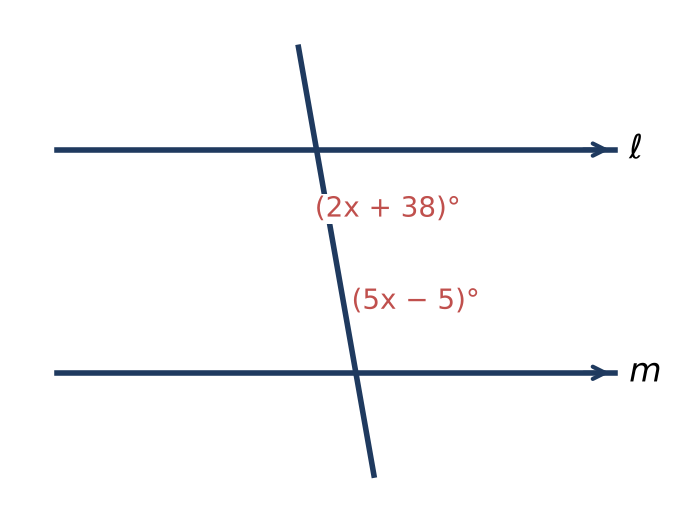
In the figure, lines ℓ and m are parallel. What is the value of x?
Show solution
AnswerD — 21
Step-by-step
- The two angles are same-side interior angles.
- So they are supplementary: (2x + 38) + (5x − 5) = 180.
- Solving gives x = 21.
- So the angles are 80° and 100°.
Fast methodDecide equal or supplementary first, then solve the linear equation.
Quick checkwith x = 21 the angles are 80° and 100°, which add to 180° ✓.
Why the other choices are wrong
- A (): set the angles to add to 90°
- B (): assumed the angles are equal
- C (): combined the constants as 38 + 5 = 43 instead of 38 − 5 = 33, so 7x = 137
4.
Two sides of a triangle have lengths 14 and 24. Which of the following could be the length of the third side?
Show solution
AnswerC — 16
Step-by-step
- The third side must be strictly between 24 − 14 = 10 and 14 + 24 = 38.
- Only 16 lies strictly between 10 and 38.
Fast methodThird side: difference < x < sum.
Quick check10 < 16 < 38, so the three lengths form a triangle ✓.
Why the other choices are wrong
- A (9): allowed a side shorter than the difference
- B (10): allowed the third side to equal the difference
- D (38): allowed the third side to equal the sum
5.
Two chords of a circle intersect. One chord is divided into segments of length 3 and 10. The other chord is divided into segments of length 2 and x. What is the value of x?
Show solution
AnswerD — 15
Step-by-step
- For intersecting chords, the products of the segments are equal: 3 × 10 = 2 × x.
- So 30 = 2x and x = 15.
Fast methodChords: part × part. Secants and tangents: outside × whole.
Quick check2 × 15 = 30 = 3 × 10 ✓.
Why the other choices are wrong
- A (): set 3 × 2 = 10 × x
- B (): set 10 × 2 = 3 × x
- C (11): set 3 + 10 = 2 + x
6.
Two angles measure (3x − 13)° and (2x + 5)°. The angles are vertical angles. What is the measure of the first angle, in degrees?
Show solution
AnswerC — 41
Step-by-step
- Vertical angles are equal: 3x − 13 = 2x + 5.
- So x = 18.
- The first angle is 3(18) − 13 = 41°.
Fast methodWrite the angle relationship as an equation, then solve.
Quick checkthe angles are 41° and 41°, which are equal ✓.
Why the other choices are wrong
- A (11): moved the constants with the wrong sign, getting x = 13 − 5 = 8 and the angle 3(8) − 13 = 11
- B (18): gave x instead of the angle
- D (139): gave the supplement
7.
What is the smaller angle between the hour hand and the minute hand of a clock at 9:30?
Show solution
AnswerB — 105°
Step-by-step
- The minute hand at 30 minutes points at 6, which is 180° from 12.
- The hour hand moves 0.5° per minute.
- So at 9:30 it is at 270° + 15° = 285°.
- The difference is |285 − 180| = 105°.
- So the smaller angle is 105°.
Fast methodEach hour mark is 30°; the hour hand also moves 0.5° per minute.
Quick checkthe hour hand is halfway between 9 and 10, and the angle is less than 180° ✓.
Why the other choices are wrong
- A (90°): forgot that the hour hand moves halfway to the next number
- C (120°): moved the hour hand a full hour
- D (255°): measured the reflex angle
8.
Two secants meet at a point outside a circle. They intercept a far arc of 112° and a near arc of 38°. What is the measure of the angle between the secants, in degrees?
Show solution
AnswerA — 37
Step-by-step
- An angle formed outside a circle is half the difference of the intercepted arcs.
- So the angle is (112° − 38°) ÷ 2 = 74° ÷ 2 = 37°.
Fast methodInside: ½(sum of arcs). Outside: ½(far − near).
Quick check2 × 37 = 74 = 112 − 38 ✓.
Why the other choices are wrong
- B (56): used only the far arc
- C (74): forgot to halve the difference
- D (75): added the arcs
9.
A convex polygon has exactly two interior angles that measure 90°, and each of its other interior angles measures 150°. How many sides does the polygon have?
Show solution
AnswerB — 8
Step-by-step
- Use exterior angles, which sum to 360° for a convex polygon: each 90° angle has exterior angle 90°, each 150° angle has exterior angle 30°.
- With n sides there are n − 2 angles of 150°: 90 + 90 + 30(n − 2) = 360.
- 30(n − 2) = 180, so n − 2 = 6 and n = 8.
Fast methodThe two right angles use up 180° of exterior angle; the remaining 180° is split into 30° pieces: 6 more vertices, 8 in all.
Quick checkInterior sum for an octagon: 6 · 180° = 1080° = 2 · 90° + 6 · 150° = 180° + 900°. ✓
Why the other choices are wrong
- A (6): Used exterior angles but wrote the 30° angles as n of them instead of n − 2: 180 + 30n = 360 gives n = 6.
- C (10): Found that a polygon with all angles 150° has 12 sides, then subtracted the two right angles: 12 − 2 = 10.
- D (12): Ignored the two right angles and used 150° for every angle, which gives a regular 12-gon.
10.
Point P lies outside a circle. A segment from P is tangent to the circle at T, and PT = 12. The point of the circle closest to P is 8 units from P. What is the radius of the circle?
Show solution
AnswerA — 5
Step-by-step
- The radius to the point of tangency is perpendicular to the tangent, so triangle OTP (O the center) has a right angle at T.
- The closest point of the circle to P lies on segment OP, so OP = r + 8.
- Pythagorean theorem: + = , so + 144 = + 16r + 64.
- 16r = 80, so r = 5.
Fast methodTangent–secant: PT² = 8 · (8 + 2r), so 144 = 64 + 16r and r = 5.
Quick checkr = 5: OP = 13 and + = 169 = . ✓
Why the other choices are wrong
- B (4): Treated 8 as a leg of the right triangle with hypotenuse 12: = − = 80.
- C (10): Found r = 5 but gave the diameter.
- D (13): Found r = 5 but gave the distance from P to the center, r + 8 = 13.
11.
What is the radius of the circle + + 6x − 4y − 12 = 0?
Show solution
AnswerC — 5
Step-by-step
- Complete the square in x and in y.
- + = 12 + 9 + 4 = 25.
- So = 25 and r = 5.
Fast method = + − F.
Quick check + − (−12) = 9 + 4 − (−12) = 25 ✓.
Why the other choices are wrong
- A (2): forgot to add the completed-square constants
- B (): added half of each coefficient without squaring
- D (25): gave as the radius
12.
A chord is 16 units from the center of a circle with radius 20. What is the length of the chord?
Show solution
AnswerC — 24
Step-by-step
- The perpendicular from the center bisects the chord, forming a right triangle with hypotenuse 20 and leg 16.
- Half the chord is = = 12.
- So the chord is 2 × 12 = 24.
Fast methodHalf-chord² + distance² = radius².
Quick check + = 400 = ✓.
Why the other choices are wrong
- A (8): doubled the difference of the lengths instead of using the Pythagorean theorem: 2 × (20 − 16) = 8
- B (12): gave half the chord
- D (8): added the squares
13.
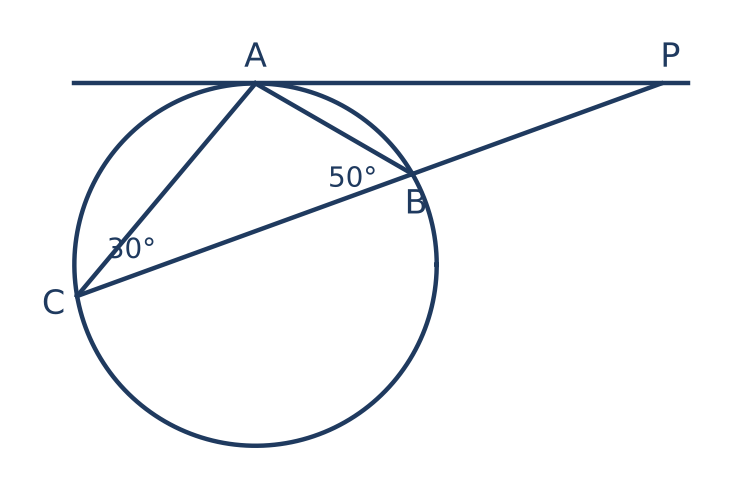
In the figure, triangle ABC is inscribed in the circle, angle ABC = 50° and angle ACB = 30°. The line tangent to the circle at A meets line CB, extended beyond B, at point P. What is the measure of angle APB?
Show solution
AnswerA — 20°
Step-by-step
- The angle between the tangent PA and the chord AB equals the inscribed angle on the other side of AB: angle PAB = angle ACB = 30°.
- Angle ABP is supplementary to angle ABC (C, B, P are collinear): angle ABP = 180° − 50° = 130°.
- In triangle ABP: angle APB = 180° − 30° − 130° = 20°.
Fast methodIn triangle APC, the angles at A and C are 30° + 100° = 130° and 30°, so angle P = 180° − 160° = 20° (it always equals angle B − angle C).
Quick checkangle ABC = 50° is an exterior angle of triangle ABP at B, so 50° = angle PAB + angle APB = 30° + 20°. ✓
Why the other choices are wrong
- B (30°): Found angle PAB = angle ACB = 30° (tangent–chord angle) and gave that angle instead of angle APB.
- C (50°): Assumed angle APB equals angle ABC, as if the tangent were parallel to BC.
- D (80°): Took angle APB as the supplement of angle BAC = 100°.
14.
A rhombus has perimeter 52, and the sum of the lengths of its two diagonals is 34. What is the positive difference between the lengths of the diagonals?
Show solution
AnswerC — 14
Step-by-step
- Each side is = 13. The diagonals of a rhombus bisect each other at right angles, so the half-diagonals p and q satisfy + = = 169.
- The diagonals sum to 34, so p + q = 17.
- Then 2pq = − = 289 − 169 = 120, and = 169 − 120 = 49, so p − q = 7 (taking p > q).
- The diagonals are 2p and 2q, so their difference is 2(p − q) = 14.
Fast methodHalf-diagonals add to 17 and form a right triangle with hypotenuse 13: that is the 5-12-13 triangle, so the diagonals are 10 and 24, difference 14.
Quick checkDiagonals 24 and 10: 24 + 10 = 34 ✓, half-diagonals 12 and 5 give side = 13 and perimeter 52 ✓.
Why the other choices are wrong
- A (7): Worked with half-diagonals 12 and 5 and gave their difference, 7, without doubling.
- B (10): Found the diagonals 24 and 10 but gave the shorter diagonal.
- D (24): Found the diagonals 24 and 10 but gave the longer diagonal.
15.
Two vertical poles, 6 meters and 12 meters tall, stand 15 meters apart on level ground. A straight wire runs from the top of each pole to the bottom of the other pole. How high above the ground, in meters, do the two wires cross?
Show solution
AnswerA — 4
Step-by-step
- Let the wires cross at height h, a horizontal distance u from the 6 m pole, with the poles 15 m apart.
- The wire from the top of the 12 m pole to the foot of the 6 m pole gives similar triangles: = . The other wire gives = .
- So u = 15 and 15 − u = 15. Adding: 15 = 15 + 15 = 15h, so 1 = h · and h = 4.
Fast methodh = = = 4, whatever the distance between the poles.
Quick checkCoordinates: wires y = x and y = 6 − x meet where x = 6, x = 5, y = 4. ✓
Why the other choices are wrong
- B (4.8): Divided 6 · 12 by the distance between the poles, 15, instead of by 6 + 12.
- C (7.5): Assumed the crossing is at a height equal to half the distance between the poles.
- D (9): Took the average of the two heights.
16.
Point P lies inside a circle of radius 13 and is 5 units from the center of the circle. A chord AB passes through P, and AP = 9. What is the length of chord AB?
Show solution
AnswerC — 25
Step-by-step
- Draw the diameter through P. Its two pieces from P have lengths 13 − 5 = 8 and 13 + 5 = 18.
- For two chords that cross at P, the products of the pieces are equal: AP · PB = 8 · 18 = 144.
- 9 · PB = 144, so PB = 16.
- AB = AP + PB = 9 + 16 = 25.
Fast methodEvery chord through P has AP · PB = − = 169 − 25 = 144; so PB = = 16 and AB = 25.
Quick checkthe midpoint M of AB is from A, so PM = − 9 = , and OM² = − = 169 − = ; then OP² = OM² + PM² = + = 25, so OP = 5 as given. ✓ (Also 25 < 26, the diameter.)
Why the other choices are wrong
- A (16): Found PB = = 16 correctly but gave PB instead of the whole chord AB.
- B (24): Assumed P is the midpoint of AB, so the half-chord is = 12 and AB = 24.
- D (27): Took PB to be the longer piece of the diameter through P, 13 + 5 = 18, so AB = 9 + 18 = 27.
17.
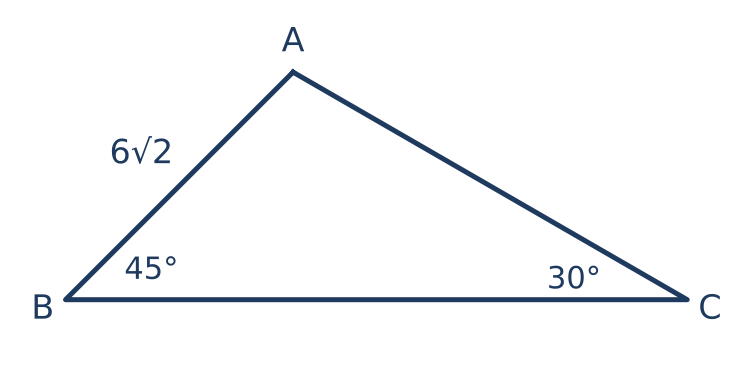
In triangle ABC shown, angle B = 45°, angle C = 30° and AB = 6. What is the length of BC?
Show solution
AnswerD — 6 + 6
Step-by-step
- Draw the altitude AD to BC. Triangle ABD is a 45°-45°-90° triangle with hypotenuse 6, so AD = BD = 6.
- Triangle ADC is a 30°-60°-90° triangle with the 30° angle at C, so the leg AD = 6 is opposite 30° and DC = 6.
- BC = BD + DC = 6 + 6.
Fast methodSplit at the foot of the altitude: 6 (from the 45° side) + 6 (from the 30° side).
Quick checkAC = 12 and AD = 6 give DC = = = 6 ✓; the angles 45°, 30° and 105° sum to 180°.
Why the other choices are wrong
- A (6 + 2): Divided by instead of multiplying in the 30°-60°-90° triangle: took DC = = 2.
- B (12): Gave AC = 12, the hypotenuse of the 30°-60°-90° triangle, instead of BC.
- C (6 + 6): Mixed up legs and hypotenuses: took BD = AB = 6 and DC = AD = 6.
18.
A quarter circle has center O and radius 6. A smaller circle lies inside the quarter circle and is tangent to both bounding radii and to the arc. What is the radius of the smaller circle?
Show solution
AnswerB — 6 − 6
Step-by-step
- The small circle is tangent to both radii, so its center P is r from each radius: P lies on the angle bisector with OP = r.
- It is tangent to the arc from inside, so the arc's point on ray OP is r beyond P: OP + r = 6.
- r + r = 6, so r = = 6 = 6 − 6.
Fast methodAlong the diagonal of the square of side r at O: r + r = 6, so r = = 6 − 6.
Quick checkr = 6 = 6(2 − 1) = 6, so OP + r = r + r = 6. ✓
Why the other choices are wrong
- A (2): Took the distance from O to the small circle's center as 2r instead of r, so 2r + r = 6.
- C (3): Assumed the small circle's diameter is the radius of the quarter circle.
- D (3): Set the distance from O to the small center, r, equal to 6, forgetting to add the small radius r.
19.
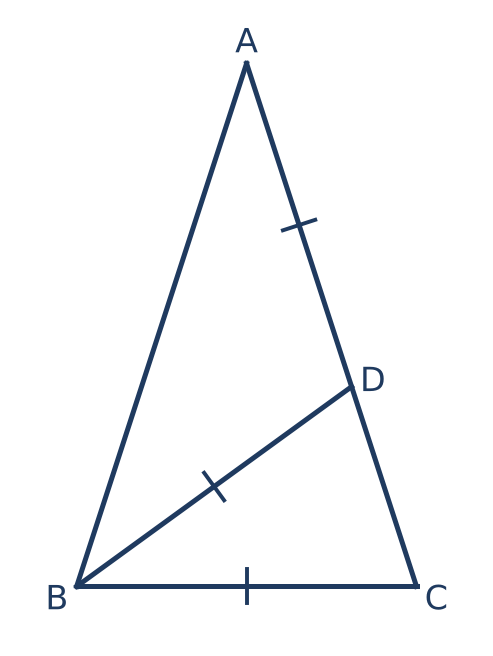
In the figure, D lies on side AC of triangle ABC, AB = AC, and AD = BD = BC. What is the measure of angle BAC?
Show solution
AnswerA — 36°
Step-by-step
- Let angle A = a. Since AD = BD, triangle ABD is isosceles and angle ABD = a.
- Angle BDC is an exterior angle of triangle ABD, so angle BDC = a + a = 2a.
- Since BD = BC, triangle BDC is isosceles with angle BCD = angle BDC = 2a.
- Since AB = AC, angle ABC = angle ACB = 2a. In triangle ABC: a + 2a + 2a = 180°, so a = 36°.
Fast methodEvery angle is a multiple of a: the triangle's angles are a, 2a, 2a, so 5a = 180° and a = 36°.
Quick checkAngles 36°, 72°, 72° sum to 180°; in triangle BDC the angles are 72°, 72° and 36° (angle DBC = 72° − 36°). ✓
Why the other choices are wrong
- B (60°): Took angle BDC equal to angle A instead of 2 · angle A (it is an exterior angle of triangle ABD), which gives 3A = 180.
- C (72°): Found the angles correctly but gave angle ABC (= angle ACB = 72°) instead of angle A.
- D (108°): Found angle A = 36° but gave angle ADB = 180° − 2 · 36° = 108°.
20.
In a circle of radius 13, two parallel chords have lengths 10 and 24. Which of the following could be the distance between the chords?
I. 7
II. 12
III. 17
Show solution
AnswerD — I and III only
Step-by-step
- The perpendicular from the center bisects a chord. For the chord of length 10: distance = 12. For the chord of length 24: distance = 5.
- If the chords are on the same side of the center, they are 12 − 5 = 7 apart.
- If they are on opposite sides, they are 12 + 5 = 17 apart.
- 12 is not possible. Answer: I and III only.
Fast methodCenter distances 12 and 5 (5-12-13 triangles); the chords are 12 ± 5 apart.
Quick checkBoth configurations fit inside the circle, since 12 < 13 and 5 < 13; the distances are 7 and 17 only.
Why the other choices are wrong
- A (I only): Placed both chords on the same side of the center only, missing the case 12 + 5 = 17.
- B (II only): Took the distance to be half of the longer chord, 12, without using the center.
- C (III only): Placed the chords on opposite sides of the center only, missing the case 12 − 5 = 7.