Plane Geometry: Study Guide
Plane geometry on the CLT covers angles, parallel lines, triangles (congruence, similarity, the Pythagorean theorem), polygons and circles, including arcs, sectors, chords, tangents and inscribed angles. Figures are not drawn to scale unless the question says so, so reason from the given facts.
Lines and Angles
Angle pairs: complementary add to 90°, supplementary to 180°, vertical angles are equal. With parallel lines, corresponding and alternate angles are equal.
| Complementary | |
| Supplementary | |
| Vertical angles | |
| Around a point | |
| Parallel lines |
Angles on a clock
Method. Each hour mark is 30°; the hour hand also moves 0.5° per minute.
Worked example- The minute hand at 30 minutes points at 6, which is 180° from 12.
- The hour hand moves 0.5° per minute.
- So at 4:30 it is at 120° + 15° = 135°.
- The difference is |135 − 180| = 45°.
- So the smaller angle is 45°.
- A (30°): moved the hour hand a full hour
- C (60°): forgot that the hour hand moves halfway to the next number
- D (315°): measured the reflex angle
Parallel lines and transversals
Method. Parallel lines: all acute angles are equal, all obtuse angles are equal, and an acute + an obtuse = 180°.
Worked example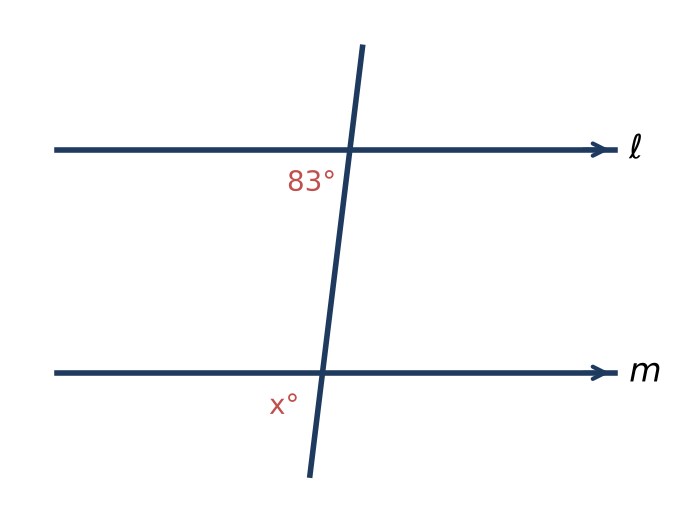
- The angle marked 83° and the angle marked x° are corresponding angles.
- With parallel lines, corresponding angles are equal.
- So x = 83.
- A (7): used complementary angles
- C (97): assumed the angles are supplementary
- D (277): subtracted from 360°
Angle relationships with algebra
Method. Write the angle relationship as an equation, then solve.
Worked example- Supplementary angles add to 180°: (3x − 4) + (6x − 5) = 180.
- So 9x − 9 = 180, 9x = 189 and x = 21.
- A (11): used 90° instead of 180°
- B (19): moved the constants with the wrong sign
- C (20): ignored the constants
Angles in polygons
Method. Interior sum (n − 2)·180°; exterior sum always 360°.
Worked example- Use the formula (n − 2) × 180° with n = 9.
- (9 − 2) × 180° = 7 × 180°.
- So (9 − 2) × 180° = 1260°.
- A (360): gave the exterior-angle sum
- C (1440): used (n − 1) × 180°
- D (1620): used n × 180°
Parallel lines with algebra
Method. Decide equal or supplementary first, then solve the linear equation.
Worked example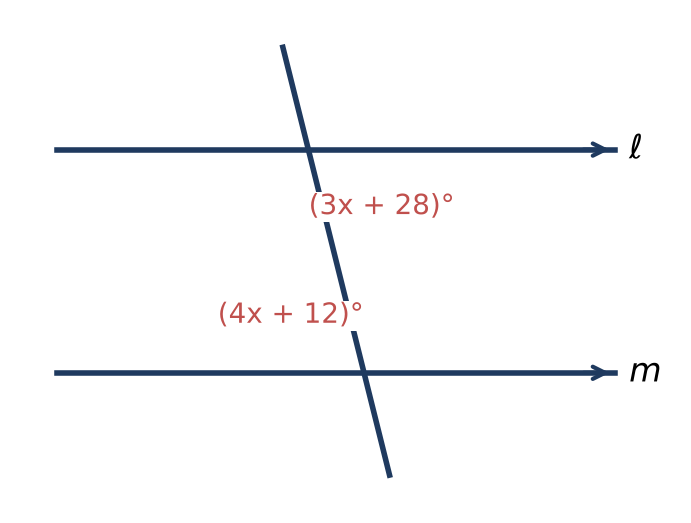
- The two angles are alternate interior angles.
- So they are equal: (3x + 28) = (4x + 12).
- Solving gives x = 16.
- So the angles are 76° and 76°.
- B (20): assumed the angles are supplementary
- C (40): moved the constants with the wrong sign
- D (76): gave the angle instead of x
Triangles
Angles sum to 180°, the Pythagorean theorem links right-triangle sides, and similar triangles have proportional sides.
| Angle sum | |
| Pythagorean theorem | |
| Exterior angle | |
| Special right triangles | |
| Triangle inequality |
Triangle angle problems
Method. Base angle = (180 − vertex angle) ÷ 2.
Worked example- The two base angles are equal and the three angles add to 180°.
- So each base angle is (180 − 92) ÷ 2 = 88 ÷ 2 = 44°.
- B (46): halved the vertex angle
- C (88): forgot to split the remaining angle between the two base angles
- D (92): gave the vertex angle
Pythagorean theorem
Method. Recognize the triple 20–21–29.
Worked example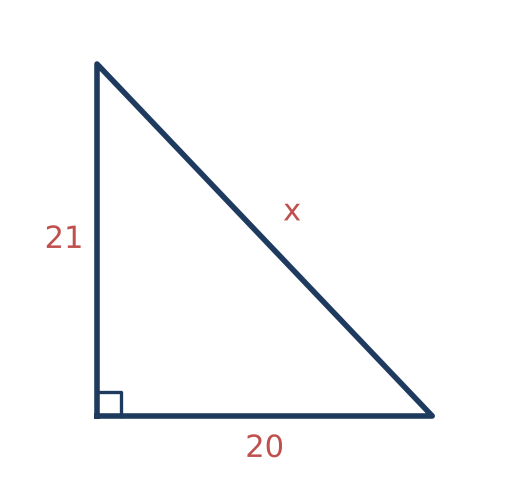
- By the Pythagorean theorem, = + = 441 + 400 = 841.
- So x = = 29.
- A (41): added the legs
- B (): subtracted the squares
- D (841): forgot to take the square root
Converse of the Pythagorean theorem
Method. + vs (c longest): equal → right, greater → acute, less → obtuse.
Worked example- Compare the square of the longest side with the sum of the squares of the other two sides.
- + = 754 and = 729.
- The sum is greater.
- So the triangle is acute.
- A (right): thought + equals
- B (obtuse): reversed the inequality test
- C (not a triangle): thought the sides cannot form a triangle
Similar triangles
Method. Find the scale factor from one known pair, then multiply.
Worked example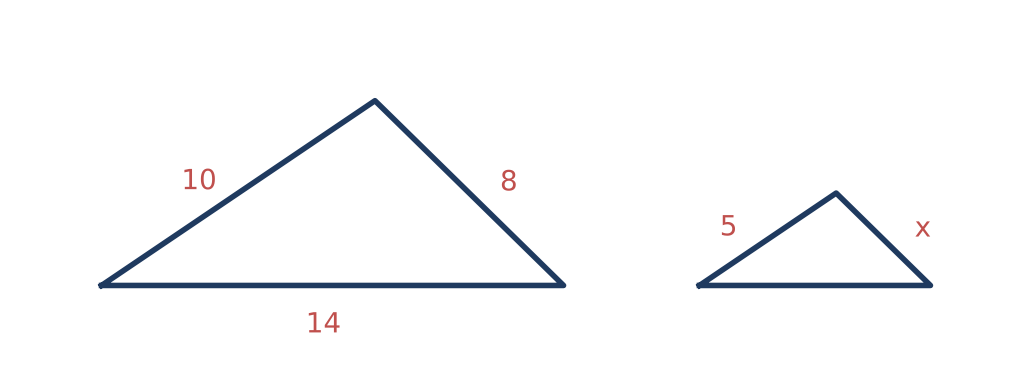
- The triangles are similar.
- So corresponding sides are proportional.
- The scale factor from the first triangle to the second is 5 ÷ 10 = .
- So x = 8 × = 4.
- B (5): gave the known side of the second triangle
- C (8): gave the corresponding side of the first triangle
- D (16): divided by the scale factor
Special right triangles
Method. 45°-45°-90°: 1 : 1 : . 30°-60°-90°: 1 : : 2.
Worked example- In a 30°-60°-90° triangle the sides are in the ratio 1 : : 2 (shorter leg : longer leg : hypotenuse).
- The longer leg is 8.
- So the shorter leg is 8.
- Then the hypotenuse is 16.
- B (8): gave the shorter leg instead
- C (8): gave the longer leg instead
- D (8): used the 45°-45°-90° ratio
Triangle inequality
Method. Third side: difference < x < sum.
Worked example- The third side must be strictly between 21 − 3 = 18 and 3 + 21 = 24.
- Only 21 lies strictly between 18 and 24.
- A (17): allowed a side shorter than the difference
- B (18): allowed the third side to equal the difference
- D (24): allowed the third side to equal the sum
Triangle congruence
Method. Valid: SSS, SAS, ASA, AAS, HL. Not valid: SSA, AAA.
Worked example- Two pairs of sides are congruent, but the congruent angle is not between them (SSA).
- SSA does not guarantee congruence.
- So the triangles cannot be proved congruent.
- B (AAS): assumed two pairs of angles are congruent
- C (ASA): assumed two pairs of angles are congruent
- D (SAS): treated the angle as the included angle
Similar triangles in context
Method. Height ÷ shadow is constant at one time of day.
Worked example- The sun's rays make similar right triangles.
- So height ÷ shadow is the same for both.
- = .
- So x = 5 × 30 ÷ 6 = 25.
- B (29): added the difference instead of using a ratio
- C (36): set up the proportion upside down
- D (150): multiplied without dividing
Circles
Circumference and area use π; arcs and sectors are fractions of the whole circle; a tangent is perpendicular to the radius.
| Circumference | |
| Area | |
| Arc length (degrees) | |
| Arc length (radians) | |
| Sector area (degrees) | |
| Central angle | |
| Inscribed angle | |
| Tangent | |
| Angle in a semicircle | |
| Tangent segments | |
| Intersecting chords | |
| Equation of a circle |
Working backward with circles
Method. Find the radius first, then use the other formula.
Worked example- C = r = .
- So r = 3.
- The area is A = πr² = π × = square units.
- A (): forgot to square the radius
- B (): gave the circumference
- D (): used the diameter as the radius
Arc length
Method. Arc = × circumference.
Worked example- Arc length = (central angle ÷ 360°) × r.
- So the arc length is × × 11 = × = .
- A (): used πr instead of r
- C (): found the sector area
- D (): gave the whole circumference
Sector area
Method. Sector = × area of the circle.
Worked example- Sector area = (central angle ÷ 360°) × πr².
- So the area is × π × = × = .
- A (): forgot to square the radius
- B (): found the arc length
- D (): gave the whole area
Inscribed and central angles
Method. Inscribed angle = ½ arc; central angle = arc; opposite angles of a cyclic quadrilateral add to 180°.
Worked example- An inscribed angle is half its intercepted arc.
- So the angle is 114° ÷ 2 = 57°.
- B (114): used the arc measure
- C (123): found the supplement
- D (228): doubled instead of halving
Tangent lines
Method. Radius ⊥ tangent, so use the Pythagorean theorem.
Worked example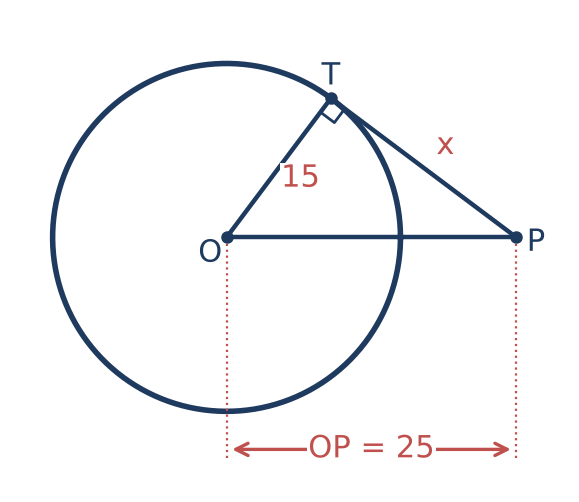
- A tangent is perpendicular to the radius at the point of tangency.
- So the triangle is a right triangle with hypotenuse 25.
- = − = 625 − 225 = 400.
- So x = 20.
- B (5): added the squares
- C (40): added the lengths
- D (400): forgot to take the square root
Equation of a circle
Method. Center: flip the signs inside the parentheses. Radius: square root of the right side.
Worked example- The standard form is + = , with center (h, k) and radius r.
- Here h = −2, k = 6 and = 16.
- So the center is (−2, 6) and the radius is = 4.
- A (center (2, −6), radius 4): reversed the signs of the center
- B (center (−2, 6), radius 16): gave as the radius
- C (center (2, −6), radius 16): reversed the signs and gave as the radius
Chords
Method. Half-chord² + distance² = radius².
Worked example- The perpendicular from the center bisects the chord, forming a right triangle with hypotenuse 29 and leg 21.
- Half the chord is = = 20.
- So the chord is 2 × 20 = 40.
- B (58): gave the diameter
- C (2): added the squares
- D (400): forgot to take the square root
Completing the square for circles
Method. = + − F.
Worked example- Complete the square in x and in y.
- + = −9 + 16 + 36 = 43.
- So = 43 and r = .
- A (1): added half of each coefficient without squaring
- C (): added the squares of the full coefficients
- D (43): gave as the radius
Segments of chords, secants and tangents
Method. Chords: part × part. Secants and tangents: outside × whole.
Worked example- Tangent-secant theorem: = (external segment) × (whole secant).
- The whole secant is 9 + 7 = 16.
- So = 9 × 16 = 144 and x = 12.
- A (3): used the internal segment instead of the whole secant
- B (): used the Pythagorean theorem
- D (144): forgot to take the square root
Angles formed by chords and secants
Method. Inside: ½(sum of arcs). Outside: ½(far − near).
Worked example- An angle formed outside a circle is half the difference of the intercepted arcs.
- So the angle is (211° − 47°) ÷ 2 = 164° ÷ 2 = 82°.
- B (): used only the far arc
- C (129): added the arcs
- D (164): forgot to halve the difference
Geometric Reasoning
Geometry questions on the CLT often ask what must be true from given facts. Use definitions and theorems step by step: parallel lines, congruent and similar triangles, properties of quadrilaterals, and the angle sums of polygons.
| Angle sum of a polygon | |
| Exterior angles | |
| Congruence | |
| Similarity | |
| Parallelogram properties |
Constructing triangles from conditions
Method. SSS, SAS, ASA fix one triangle; AAA allows many; impossible measurements give none.
Worked example- The angles add to 180°.
- So triangles exist, but any size works (similar triangles).
- So more than one triangle is possible.
- So the answer is more than one triangle.
- A (exactly one triangle): thought the conditions fix a single triangle
- B (no triangle): thought the conditions are impossible
- D (exactly two triangles): thought each set of conditions gives two mirror-image triangles