Area and Volume: Practice Paper 1
Choose one answer for each question, then select Check my answers. Every question has a full worked solution.
1.
A prism has a right-triangle base with legs 9 and 12 and hypotenuse 15. The prism is 4 units long. What is its volume, in cubic units?
Show solution
AnswerB — 216
Step-by-step
- V = (area of base) × length.
- The base area is ½ × 9 × 12 = 54.
- So V = 54 × 4 = 216 cubic units.
Fast methodPrism: V = base area × length; use the legs for a right triangle.
Quick check216 ÷ 4 = 54 = ½ × 9 × 12 ✓.
Why the other choices are wrong
- A (144): found the lateral area: (9 + 12 + 15) × 4 = 144
- C (270): used the hypotenuse 15 in place of the leg 12: ½ × 9 × 15 × 4 = 270
- D (432): forgot the ½ in the triangle's area
2.
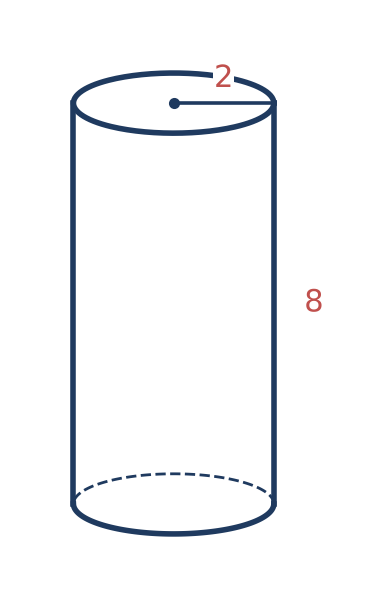
What is the total surface area of the cylinder shown? Give your answer in terms of π.
Show solution
AnswerC —
Step-by-step
- SA = r² + rh.
- SA = × + × 2 × 8 = + .
- So SA = .
Fast methodCylinder: V = πr²h; SA = r² + rh.
Quick check ÷ π = 40, matching the formula ✓.
Why the other choices are wrong
- A (): found only the lateral area
- B (): included only one circular base
- D (): used the diameter as the radius
3.
Two similar figures have areas in the ratio 9 : 1. If the ratio of their corresponding lengths is k : 1, what is the value of k?
Show solution
AnswerA — 3
Step-by-step
- The area ratio is the square of the length ratio.
- So the length ratio is = 3, that is 3 : 1.
Fast methodArea scales by ; length ratio is the square root of the area ratio.
Quick check = 9, the area ratio ✓.
Why the other choices are wrong
- B (): halved the area ratio
- C (9): gave the area ratio
- D (27): cubed the length ratio
4.
A sphere has a radius of 6. What is its surface area? Give your answer in terms of π.
Show solution
AnswerB —
Step-by-step
- SA = r².
- SA = 4 × π × .
- So SA = .
Fast methodSphere: V = πr³ and SA = r².
Quick check ÷ 4 = = π × ✓.
Why the other choices are wrong
- A (): found the area of a great circle
- C (): found the volume
- D (): used the diameter as the radius
5.
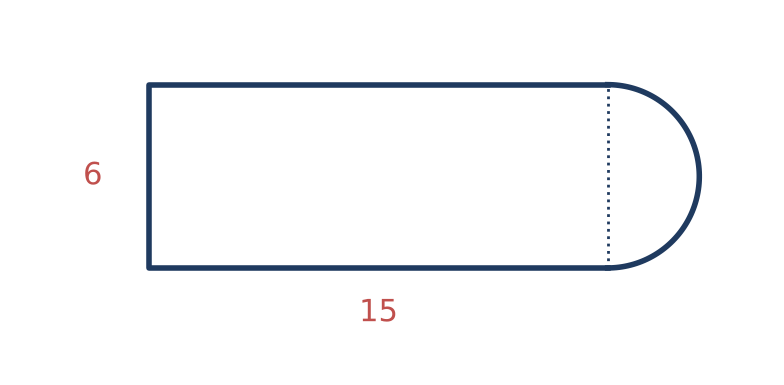
The figure shown is a rectangle with a semicircle on one end. Using 3.14 for π, what is the area of the figure?
Show solution
AnswerC — 104.13
Step-by-step
- Rectangle: 15 × 6 = 90.
- The semicircle has radius 6 ÷ 2 = 3.
- So its area is ½ × 3.14 × = 14.13.
- Total area = 90 + 14.13 = 104.13.
Fast methodAdd the parts; the side shared with the semicircle is not on the boundary.
Quick check104.13 − 90 = 14.13, half of 3.14 × 9 ✓.
Why the other choices are wrong
- A (75.87): subtracted the semicircle
- B (90): left out the semicircle
- D (118.26): added a whole circle
6.
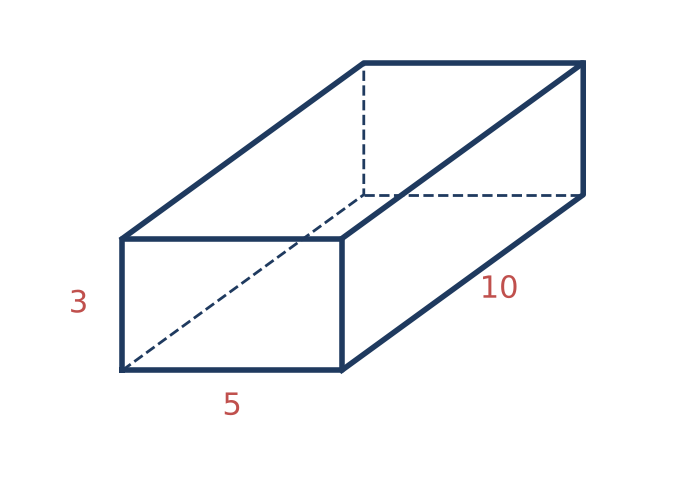
What is the surface area of the rectangular prism shown?
Show solution
AnswerD — 190
Step-by-step
- A rectangular prism has three pairs of equal faces.
- The faces have areas 5 × 10 = 50, 5 × 3 = 15 and 10 × 3 = 30.
- So SA = 2 × (50 + 15 + 30) = 2 × 95 = 190.
Fast methodSA = 2(lw + lh + wh): add the three different faces, then double.
Quick checkthe six faces are 50, 50, 15, 15, 30 and 30, which add to 190 ✓.
Why the other choices are wrong
- A (95): forgot to double each face
- B (145): doubled only the top and bottom
- C (150): found the volume
7.
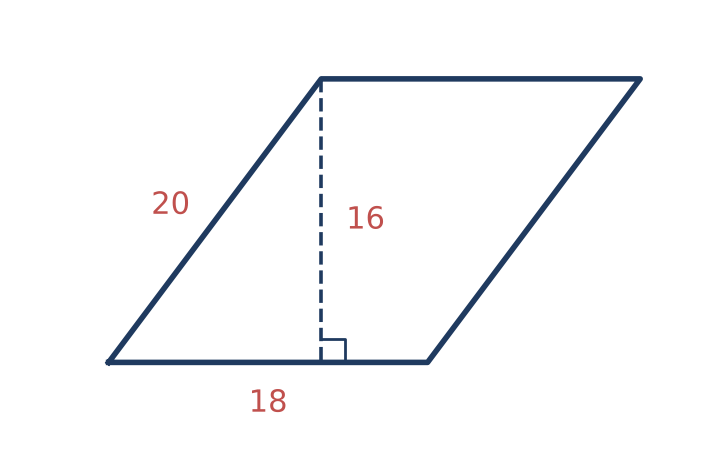
What is the area of the parallelogram shown?
Show solution
AnswerD — 288
Step-by-step
- Area of a parallelogram = base × height.
- The height 16 is perpendicular to the base 18.
- So A = 18 × 16 = 288.
Fast methodParallelogram: A = base × height; P uses the slanted sides.
Quick check288 ÷ 18 = 16, the height ✓.
Why the other choices are wrong
- A (34): added the base and height
- B (76): found the perimeter
- C (144): multiplied by ½ as for a triangle
8.
A solid wooden cube with edges 6 centimeters long is painted on all six faces and then cut into 216 cubes with edges 1 centimeter long. How many of the small cubes have paint on exactly two of their faces?
Show solution
AnswerA — 48
Step-by-step
- A small cube has exactly two painted faces when it lies on an edge of the big cube but is not a corner cube.
- Each edge holds 6 small cubes; removing the 2 corner cubes leaves 4.
- The cube has 12 edges, so 12 × 4 = 48.
Fast methodTwo-face cubes = 12(n − 2) = 12 × 4 = 48.
Quick check8 (three faces) + 48 (two) + 96 (one) + 64 (none) = 216 ✓.
Why the other choices are wrong
- B (64): Counts the cubes with no paint, the inner 4 × 4 × 4 block.
- C (72): Counts all 6 cubes along each of the 12 edges, including the corner cubes, which have three painted faces.
- D (96): Counts the cubes with exactly one painted face, the 4 × 4 = 16 center squares on each of 6 faces.
9.
An equilateral triangle and a square have the same perimeter. What is the ratio of the area of the triangle to the area of the square?
Show solution
AnswerC — 4
Step-by-step
- Let the common perimeter be 12. The triangle's side is 4, and the square's side is 3.
- Triangle area = = 4. Square area = = 9.
- Ratio = 4.
Fast methodPick the perimeter 12 so both sides are whole numbers; then the ratio is 4 : 9.
Quick check4 ≈ 0.77 < 1, as it must be — for a fixed perimeter the square encloses more area than the equilateral triangle.
Why the other choices are wrong
- A (): Compares the shapes as if they had the same side length: ÷ = .
- B (): Gives the ratio of the side lengths upside down, square side : triangle side = 3 : 4, instead of comparing areas.
- D (): Gives the ratio of the side lengths, 4 : 3, instead of the areas.
10.
A right circular cone has volume cubic inches and height 12 inches. What is the total surface area of the cone, including its base, in square inches?
Show solution
AnswerA —
Step-by-step
- πr²(12) = , so 4 = 100, = 25 and r = 5.
- Slant height l = = 13.
- Total surface area = πrl + πr² = π(5)(13) + π(25) = + = .
Fast methodr = 5 from 4 = 100; the 5-12-13 triangle gives l = 13; πr(l + r) = (18) = .
Quick checkπ(25)(12) = ✓, and the curved surface is the sector of radius 13 with arc : (13) = ✓.
Why the other choices are wrong
- B (): Adds two circular bases, as for a cylinder: + 2 = .
- C (): Uses rl for the curved surface, (5)(13) = , and leaves out the base.
- D (): Uses rl for the curved surface and adds the base: + = .
11.
A solid is a cylinder with radius 5 and height 7, with a cone of the same radius and height 9 on top. What is its volume? Give your answer in terms of π.
Show solution
AnswerB —
Step-by-step
- Cylinder: πr²h = π × × 7 = .
- Cone: ⅓πr²h = ⅓ × π × × 9 = .
- Total = + = .
Fast methodFind each part's volume and add.
Quick check is more than the cylinder alone, ✓.
Why the other choices are wrong
- A (): left out the cone
- C (): forgot the ⅓ for the cone
- D (): used the diameter as the radius of the cone
12.
A regular hexagon has sides of length 6. Joining every other vertex of the hexagon forms an equilateral triangle. What is the total area of the parts of the hexagon that lie outside this triangle?
Show solution
AnswerC — 27
Step-by-step
- The hexagon is 6 equilateral triangles of side 6: area 6 × (36) = 54.
- Each side of the inner triangle joins two vertices with one vertex between them; the angle there is 120°, so the side is 2 × 6 × = 6.
- The inner triangle has area = (108) = 27.
- Outside area = 54 − 27 = 27.
Fast methodEach cut-off piece is a 6-6-120° triangle with area (6)(6) = 9, and there are three: 27 (exactly half the hexagon).
Quick check3 × 9 = 27 equals 54 − 27 ✓.
Why the other choices are wrong
- A (9): Finds the area of just one of the three cut-off triangles, (6)(6) sin 120° = 9.
- B (18): Takes the triangle's side as 12, the long diagonal of the hexagon: 54 − 36 = 18.
- D (54): Gives the area of the whole hexagon, 6 × (36) = 54, without removing the triangle.
13.
In the xy-plane, what is the area of the region consisting of all points (x, y) that satisfy |x − 2| + 2|y + 1| ≤ 4?
Show solution
AnswerB — 16
Step-by-step
- The region is centered at (2, −1). Along y = −1 it reaches |x − 2| ≤ 4, from x = −2 to x = 6: a horizontal diagonal of 8.
- Along x = 2 it reaches 2|y + 1| ≤ 4, |y + 1| ≤ 2, from y = −3 to y = 1: a vertical diagonal of 4.
- The boundary is made of four straight segments joining (6, −1), (2, 1), (−2, −1) and (2, −3), so the region is a rhombus.
- Area = (8)(4) = 16.
Fast methodA rhombus's area is half its bounding box: = 16.
Quick checkthe rhombus is four right triangles with legs 4 and 2, each of area 4: 4 × 4 = 16 ✓.
Why the other choices are wrong
- A (8): Halves the vertical reach twice, using diagonals 8 and 2: (8)(2) = 8.
- C (32): Finds the diagonals 8 and 4 but multiplies them without the , which is the area of the bounding rectangle.
- D (64): Ignores the factor 2 on |y + 1| and uses the 8-by-8 bounding square.
14.
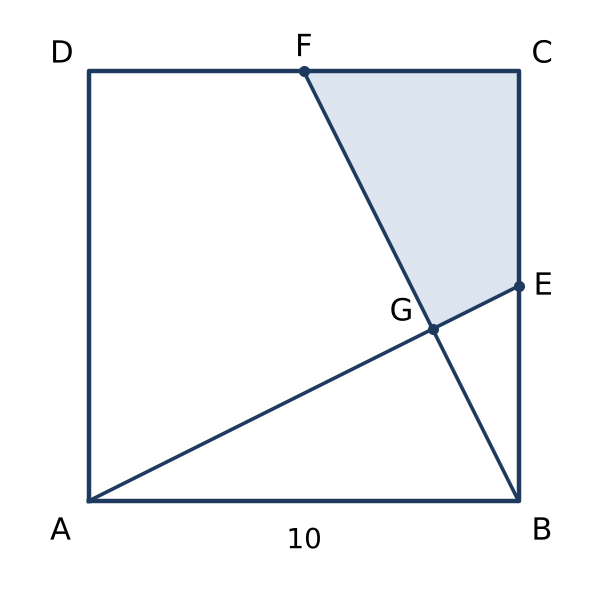
In the figure, ABCD is a square with sides of length 10. E is the midpoint of side BC, F is the midpoint of side CD, and segments AE and BF meet at G. What is the area of the shaded quadrilateral GECF?
Show solution
AnswerC — 20
Step-by-step
- Put A at (0, 0), B(10, 0), C(10, 10), D(0, 10); then E = (10, 5) and F = (5, 10).
- Line AE: y = . Line BF: slope = −2, so y = −2x + 20. They meet where = −2x + 20: x = 8, y = 4, so G = (8, 4).
- Quadrilateral GECF = triangle BCF minus triangle BGE. Triangle BCF has legs 10 and 5: area 25.
- Triangle BGE has base BE = 5 on the line x = 10 and height 10 − 8 = 2: area 5. So GECF has area 25 − 5 = 20.
Fast methodThe slopes and −2 multiply to −1, so AE ⊥ BF; triangles ABG, BEG and ABE are similar with AB : BE = 2 : 1, giving BG = 2 and EG = , so area BGE = = 5 and GECF = 25 − 5 = 20.
Quick checkCheck (shoelace, G(8,4), E(10,5), C(10,10), F(5,10)): |8·5 − 10·4 + 10·10 − 10·5 + 10·10 − 5·10 + 5·4 − 8·10| = |0 + 50 + 50 − 60| = 20 ✓.
Why the other choices are wrong
- A (): Assumes G is the center of the square, (5, 5): triangle BGE then has area (5)(5) = 12.5, and 25 − 12.5 = .
- B (): Assumes G is the midpoint of BF, (7.5, 5): triangle BGE has area (5)(2.5) = 6.25, and 25 − 6.25 = .
- D (25): Gives the area of triangle BCF, (10)(5) = 25, forgetting to remove triangle BGE.
15.
A rectangular sheet of paper is 16 inches by 12 inches. It can be rolled into the curved surface of an open cylinder in two ways: with the 16-inch side going around (height 12 inches) or with the 12-inch side going around (height 16 inches). How much greater, in cubic inches, is the volume of the larger cylinder than the volume of the smaller one?
Show solution
AnswerA —
Step-by-step
- The side that goes around becomes the circumference: r = 16 gives r = , and r = 12 gives r = .
- Larger: π(12) = . Smaller: π(16) = .
- Difference = .
Fast methodV = πr²h = : = = .
Quick checkthe ratio of the volumes is 768 : 576 = 4 : 3 = 16 : 12, as V = predicts (C × h is the same sheet area, so V ∝ C).
Why the other choices are wrong
- B (): Computes the smaller cylinder's volume, π(16) = , and reports it as the difference.
- C (): Computes the larger cylinder's volume, π(12) = , and reports it as the difference.
- D (): Takes the radii as 8 and 6 (half of each side) instead of and : − = .
16.
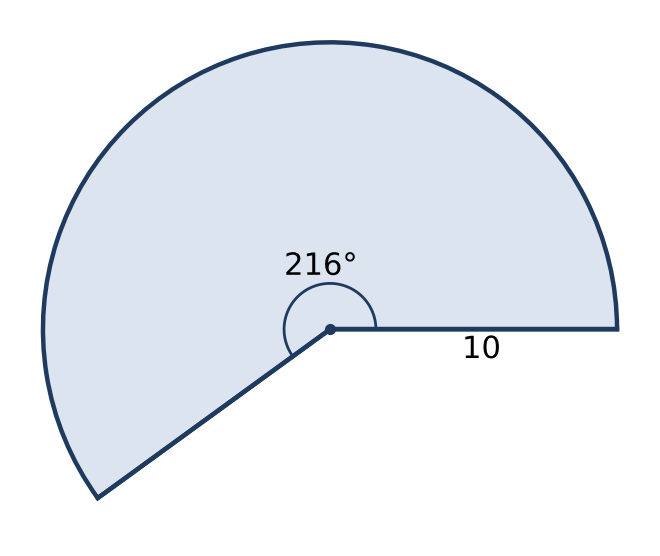
The figure shows a sector of a circle with radius 10 and central angle 216°. The sector is rolled up so that its two straight edges meet, forming the curved surface of a right circular cone with no base. What is the volume of the cone?
Show solution
AnswerC —
Step-by-step
- The sector's arc becomes the circumference of the cone's base: arc = = , so the base radius is 6.
- The sector's radius 10 becomes the slant height, so the cone's height is = 8.
- Volume = π(8) = .
Fast methodBase radius = slant × (angle/360) = 10 × = 6; a 6-8-10 triangle gives h = 8; V = (8) = .
Quick checkthe cone's lateral area πrl = π(6)(10) = equals the sector's area = ✓.
Why the other choices are wrong
- A (): Finds r = 6 but takes the height as 10 − 6 = 4 instead of using the Pythagorean theorem: π(36)(4) = .
- B (): Computes the area of the sector, = , which is the cone's curved surface area, not its volume.
- D (): Swaps the radius and the height of the cone: π(6) = .
17.
A square is inscribed in a semicircle of radius 5: one side of the square lies on the diameter, and the other two vertices lie on the arc. What is the area of the square?
Show solution
AnswerB — 20
Step-by-step
- By symmetry the square is centered on the center of the diameter, so an upper vertex is to the side of the center and s above it.
- That vertex is on the arc, so + = .
- = 25, so = 20.
Fast method + = gives = = (25) = 20.
Quick checks = 2, so the upper vertex is from the center and 5 + 20 = 25 = ✓.
Why the other choices are wrong
- A (): Draws the radius to an upper vertex but uses the full side s, not , as the horizontal leg: + = 25.
- C (25): Takes the side of the square equal to the radius, 5.
- D (50): Uses the square inscribed in the whole circle, whose diagonal is the diameter 10: area = 50.
18.
Two similar right circular cylinders have total surface areas in the ratio 9 : 16. The volume of the smaller cylinder is 54 cubic inches. What is the volume of the larger cylinder, in cubic inches?
Show solution
AnswerD — 128
Step-by-step
- Areas scale as the square of the length ratio, so the length ratio is : = 3 : 4.
- Volumes scale as the cube: 27 : 64.
- Larger volume = 54 × = 2 × 64 = 128.
Fast method54 = 2 × 27, so the larger is 2 × 64 = 128.
Quick check = = ✓.
Why the other choices are wrong
- A (64): Finds the volume ratio 27 : 64 and answers 64, forgetting to scale by = 2.
- B (72): Uses the length ratio 3 : 4 for the volumes: 54 × = 72.
- C (96): Applies the area ratio 9 : 16 to the volumes: 54 × = 96.
19.
A closed right circular cylinder has a height equal to its diameter. The number of square units in its total surface area equals the number of cubic units in its volume. What is the volume of the cylinder, in cubic units?
Show solution
AnswerD —
Step-by-step
- Height h = 2r. Total surface area = r² + r(2r) = r². Volume = πr²(2r) = r³.
- Set them equal: r² = r³, so r = 3 (r ≠ 0).
- Volume = = .
Fast methodr² = r³ gives r = 3 at once; V = r³ = .
Quick checksurface area (9) = and volume — equal numbers ✓.
Why the other choices are wrong
- A (): Leaves out the top and bottom: r(2r) = r³ gives r = 2 and volume (8) = .
- B (): Finds r = 3 but uses the height 3 instead of 6: π(3) = .
- C (): Counts only one circular base, like an open can: πr² + r² = r³ gives r = and volume .
20.
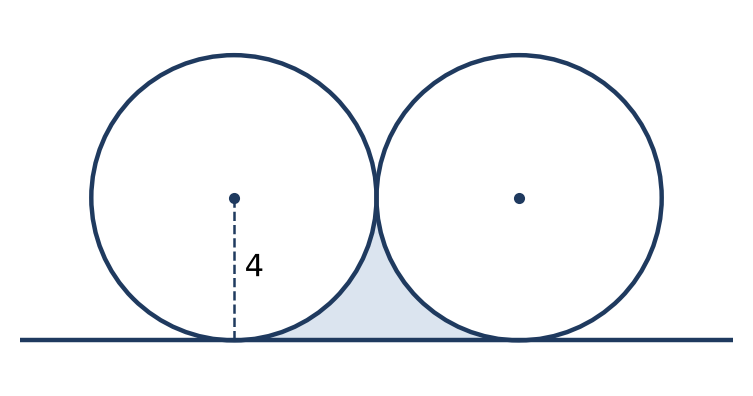
In the figure, two circles, each of radius 4, are tangent to each other, and both are tangent to the same straight line. What is the area of the shaded region bounded by the two circles and the line?
Show solution
AnswerB — 32 −
Step-by-step
- Join the two centers and drop perpendiculars from them to the line. The centers are 4 + 4 = 8 apart, and each is 4 above the line, so these form a rectangle 8 wide and 4 tall.
- The rectangle has area 8 × 4 = 32.
- Inside the rectangle, each circle occupies a quarter circle of radius 4 (the corner angles are 90°): each has area π(16) = .
- Shaded area = 32 − 2 = 32 − .
Fast methodThe two quarter circles together are a half circle of radius 4, area ; the rectangle is 2r × r = 32, so the gap is 32 − .
Quick check32 − ≈ 32 − 25.1 = 6.9, which is positive and a small part of the 32-square-unit rectangle, as the figure suggests ✓.
Why the other choices are wrong
- A (8 − ): Reads the 4 in the figure as a diameter, so r = 2: rectangle 4 × 2 = 8 minus two quarter circles of area π each, 8 − .
- C (64 − ): Uses an 8-by-8 square and removes two semicircles: 64 − 2 = 64 − .
- D (32 − ): Uses the 8-by-4 rectangle but removes only one quarter circle: 32 − .