Area and Volume: Study Guide
This topic covers perimeter, area, surface area and volume of plane figures and solids, including scaling. The CLT prints a short formula list (circle, rectangle, triangle and sphere formulas), so memorize the others, such as the cylinder, cone and pyramid volumes; leave answers in terms of π when the choices do.
Area and Perimeter
Area measures square units inside a figure; perimeter adds the side lengths. Split composite figures into simple shapes.
| Rectangle | |
| Triangle | |
| Parallelogram | |
| Trapezoid | |
| Shaded region |
Area of parallelograms and trapezoids
Method. Parallelogram: A = base × height; P uses the slanted sides.
Worked example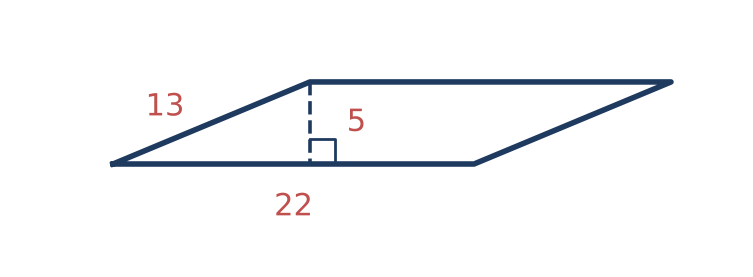
- Area of a parallelogram = base × height.
- The height 5 is perpendicular to the base 22.
- So A = 22 × 5 = 110.
- A (55): multiplied by ½ as for a triangle
- B (70): found the perimeter
- D (286): used the slanted side as the height
Composite figures
Method. Split the figure into rectangles or subtract the missing corner.
Worked example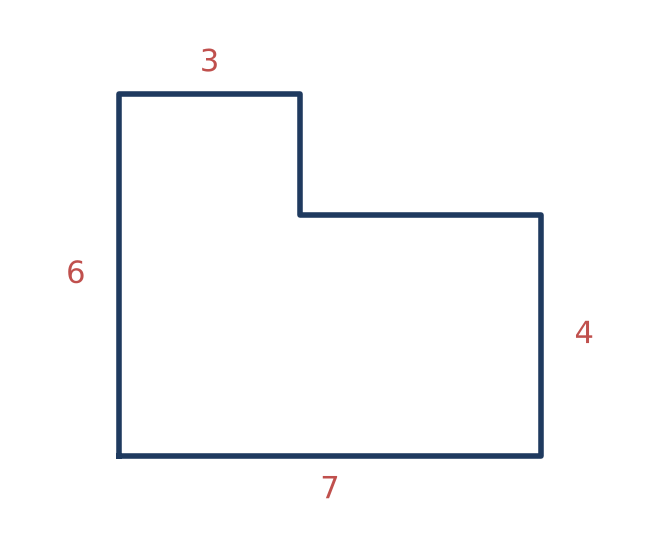
- The two unlabeled sides are 7 − 3 = 4 and 6 − 4 = 2.
- So P = 7 + 6 + 3 + 4 + 4 + 2 = 26.
- A (20): added only the labeled sides
- C (32): added the corner's sides twice
- D (34): found the area
Area and perimeter with algebra
Method. Write the formula with the unknown, then solve.
Worked example- Area = ½ × base × height = ½ × 6x × x = 3.
- So 3 = 75, = 25 and x = 5.
- B (5): multiplied by ½ twice
- C (25): forgot to take the square root
- D (30): gave the base
Scaling and area
Method. Area scales by ; length ratio is the square root of the area ratio.
Worked example- The area ratio is the square of the length ratio.
- So the length ratio is = 2, that is 2 : 1.
- A (): took the square root twice
- C (4): gave the area ratio
- D (8): cubed the length ratio
Area in the coordinate plane
Method. Use a horizontal or vertical side as the base, or box the figure and subtract.
Worked example- Two vertices have y = 0.
- So that side is horizontal with length −2 − (−6) = 4.
- The height is the vertical distance from the third vertex: |−7 − 0| = 7.
- So A = ½ × 4 × 7 = 14.
- A (): added the base and height
- C (22): used a horizontal distance as the height
- D (28): forgot to multiply by ½
Shaded regions
Method. Shaded area = outer area − inner area.
Worked example- The circle's diameter equals the side.
- So r = 8 ÷ 2 = 4.
- Square area = = 64.
- Circle area = π × = .
- Shaded area = 64 − .
- A (64 − ): used the side as the radius
- B (64 − ): subtracted the circumference
- C (): gave the area of the circle
Volume and Surface Area
Volume measures cubic units; prisms and cylinders use base area × height, pyramids and cones take one third of that.
| Prism / cylinder | |
| Pyramid / cone | |
| Sphere | |
| Rectangular box | |
| Cylinder surface | |
| Scaling |
Surface area of prisms
Method. SA = 2(lw + lh + wh): add the three different faces, then double.
Worked example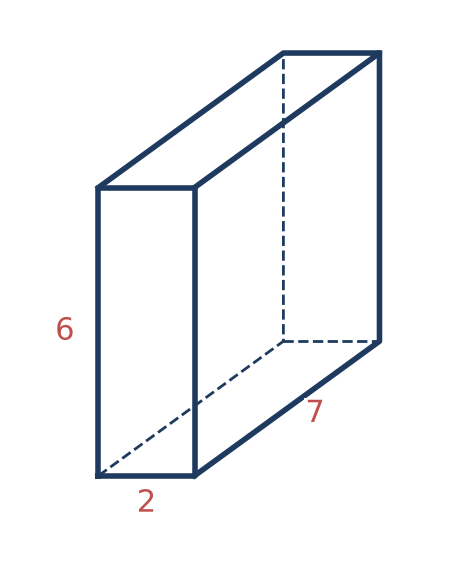
- A rectangular prism has three pairs of equal faces.
- The faces have areas 2 × 7 = 14, 2 × 6 = 12 and 7 × 6 = 42.
- So SA = 2 × (14 + 12 + 42) = 2 × 68 = 136.
- A (84): found the volume
- C (252): used the largest face for all six faces
- D (272): counted each face twice
Volume of cylinders
Method. Cylinder: V = πr²h; SA = r² + rh.
Worked example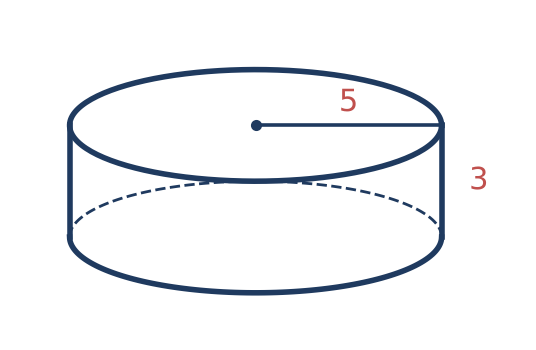
- V = πr²h.
- V = π × × 3.
- So V = .
- A (): forgot to square the radius
- B (): used the cone formula
- C (): found the lateral area rh
Volume of triangular prisms
Method. Prism: V = base area × length; use the legs for a right triangle.
Worked example- V = (area of base) × length.
- The base area is ½ × 3 × 4 = 6.
- So V = 6 × 15 = 90 cubic units.
- A (6): gave only the area of the triangular base
- B (21): added the length instead of multiplying
- C (30): used ⅓ as for a pyramid
Surface area of cylinders
Method. Cylinder: V = πr²h; SA = r² + rh.
Worked example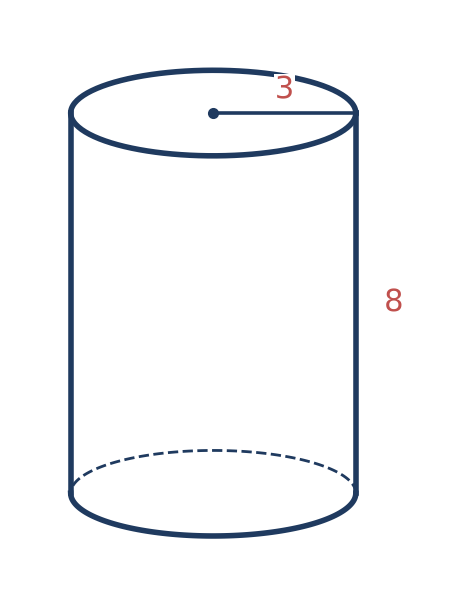
- SA = r² + rh.
- SA = × + × 3 × 8 = + .
- So SA = .
- A (): found only the lateral area
- C (): found the volume
- D (): used the diameter as the radius
Cones and pyramids
Method. Pyramid: V = ⅓ × base area × height.
Worked example- V = ⅓ × (base area) × height.
- The base area is = 36.
- So V = ⅓ × 36 × 16 = 192 cubic inches.
- A (32): did not square the base edge
- B (36): found only the area of the base
- C (128): used the perimeter of the base instead of its area
Spheres
Method. Sphere: V = πr³ and SA = r².
Worked example- V = πr³.
- V = × π × = × .
- So V = .
- B (): forgot the ⅓
- C (): cubed the diameter and dropped the
- D (): used the diameter as the radius
Scaling and volume
Method. Volume scales by ; area by .
Worked example- When lengths are multiplied by k, volume is multiplied by .
- So the new volume is 23 × = 23 × 8 = 184.
- A (46): multiplied the volume by the scale factor
- B (92): squared the scale factor
- C (138): multiplied by 3 times the scale factor
Solving for a dimension
Method. Substitute into the volume formula and solve for the unknown.
Worked example- V = πr²h.
- So = π × × 5.
- Divide by : = 9.
- So r = 3.
- B (): divided by 2h instead of taking a square root
- C (6): gave the diameter
- D (9): forgot to take the square root
Composite solids
Method. Find each part's volume and add.
Worked example- Cylinder: πr²h = π × × 12 = .
- Cone: ⅓πr²h = ⅓ × π × × 3 = .
- Total = + = .
- A (): subtracted the cone
- B (): left out the cone
- D (): forgot the ⅓ for the cone