Mathematical Reasoning: Study Guide
Mathematical reasoning questions ask which statement MUST be true or MUST be false, which example is a counterexample, or what follows logically; some are set in the history of mathematics. Test each choice carefully and look for one counterexample to rule a statement out.
Sets and Logic
Logic questions ask what MUST be true, what COULD be true, or which example shows a statement is false. A single counterexample disproves an "always" statement; a statement and its contrapositive are equivalent. Venn diagrams organize overlapping sets.
| Counterexample | |
| Contrapositive | |
| Converse (not equivalent) | |
| Inverse (not equivalent) | |
| Negation | |
| Union of two sets | |
| Union of three sets | |
| Complement |
Venn diagrams — two sets (neither)
Method. Total = A + B − both + neither.
Worked example- Students in at least one group = 22 + 53 − 15 = 60 (the 15 who do both were counted twice).
- Neither = 149 − 60 = 89.
- A (60): gave the number in at least one group
- B (74): did not subtract the students counted twice
- D (104): subtracted the overlap twice
Venn diagrams — read a diagram
Method. Name each region first, then add only the regions the question asks for.
Worked example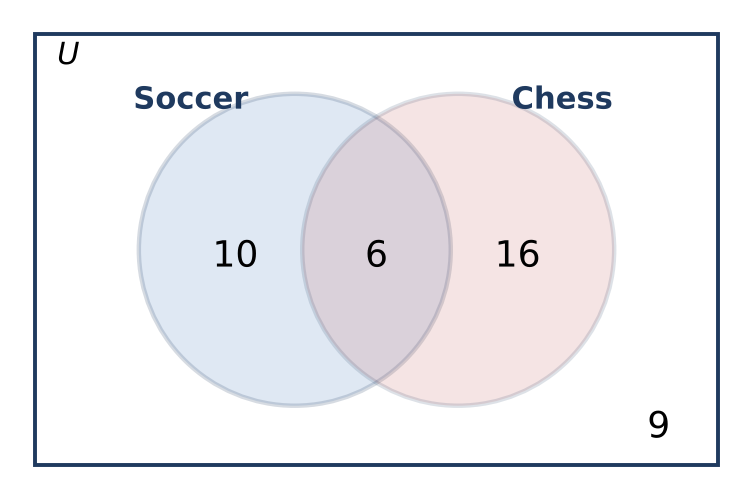
- Regions: only Soccer = 10, both = 6, only Chess = 16, neither = 9.
- Only Soccer: 10.
- A (6): gave the overlap
- C (16): gave everyone in Soccer
- D (32): gave everyone in at least one club
Set notation — operations
Method. ∩ = in both (AND); ∪ = in either (OR); A − B = in A only; A′ = not in A.
Worked example- A − B keeps the elements of A and removes any that are in B.
- {2, 4, 6, 13}.
- A ({3, 9, 11}): gave B − A
- B ({8, 10}): gave the intersection
- C ({2, 3, 4, 6, 9, 11, 13}): included the elements only in B
Logic — converse, inverse and contrapositive
Method. Converse swaps; inverse negates; contrapositive swaps and negates.
Worked example- For “If P, then Q”: converse = if Q then P.
- Inverse = if not P then not Q.
- Contrapositive = if not Q then not P.
- Here P = “a triangle is equilateral” and Q = “a triangle is isosceles”.
- So the contrapositive is “If a triangle is not isosceles, then it is not equilateral”.
- A (If a triangle is isosceles, then it is equilateral.): gave the converse
- B (If a triangle is not equilateral, then it is not isosceles.): gave the inverse
- C (If a triangle is equilateral, then it is isosceles.): repeated the original statement
Venn diagrams — three sets
Method. |A ∪ B ∪ C| = sum of singles − sum of pairs + triple.
Worked example- Inclusion–exclusion: at least one = 30 + 19 + 33 − 9 − 12 − 11 + 6 = 56.
- Students who like none = 70 − 56 = 14.
- A (8): added back the students in all three twice
- C (20): forgot to add back the students in all three
- D (56): gave the number in at least one group
Logic — what must be true
Method. Draw the facts as arrows (taller → shorter); a statement must be true only if there is a path of arrows from the first person to the second.
Worked example- Chain the facts from tallest to shortest.
- Every order that fits the facts has Dev above Ana.
- So “Dev is taller than Ana” must be true.
- The other statements are either possible but not certain, or impossible.
- A (Eli is taller than Ben.): chose a statement that could be true but is not certain
- C (Ana is taller than Eli.): chose a statement that could be true but is not certain
- D (Ana is taller than Dev.): chose a statement that must be false
Number properties — divisibility reasoning
Method. Test the smallest multiples of 2 (n = 2, 4, 6); a choice that fails even once cannot be the answer.
Worked example- Write n = 2k.
- Then 4n = 4(2k), which always contains a factor of 4.
- Each other choice fails for some multiple of 2.
- B ( + n): chose an expression that is not always divisible by 4 (it fails for n = 2)
- C (n + 1): chose an expression that is not always divisible by 4 (it fails for n = 2)
- D (n + 3): chose an expression that is not always divisible by 4 (it fails for n = 2)
Geometric Reasoning
Geometry questions on the CLT often ask what must be true from given facts. Use definitions and theorems step by step: parallel lines, congruent and similar triangles, properties of quadrilaterals, and the angle sums of polygons.
| Angle sum of a polygon | |
| Exterior angles | |
| Congruence | |
| Similarity | |
| Parallelogram properties |
Conditional statements
Method. Converse: swap. Inverse: negate. Contrapositive: swap and negate.
Worked example- The converse swaps the hypothesis and the conclusion.
- So the converse is “If an angle measures less than 90°, then it is acute.”.
- B (If an angle is not acute, then it does not measure less than 90°.): gave the inverse
- C (If an angle does not measure less than 90°, then it is not acute.): gave the contrapositive
- D (If an angle is acute, then it measures less than 90°.): repeated the original statement
Counterexamples
Method. Look for a value that meets the condition but breaks the conclusion.
Worked example- A counterexample makes the hypothesis true and the conclusion false.
- Test 42: it fits the condition of the claim but the conclusion fails.
- Each other choice either fails the condition or satisfies the conclusion.
- So 42 is the counterexample.
- A (5): chose 5, which is not a multiple of 6, so it does not meet the condition and cannot be a counterexample
- B (41): chose 41, which is not a multiple of 6, so it does not meet the condition and cannot be a counterexample
- D (63): chose 63 = 9 × 7, which is odd and not a multiple of 6, so it does not meet the condition and cannot be a counterexample