Number and Logic: Unit Study Guide
05.01 Number Properties
Number and Logic is about a quarter of CLT Quantitative Reasoning. This topic covers number properties: integers and parity, divisibility, primes, factors and multiples, GCF and LCM, ratios and percents.
Real Numbers and Integers
Real numbers are rational (fractions of integers, terminating or repeating decimals) or irrational. Know the sign rules, absolute value, and the properties of operations.
| Sign rule (× and ÷) | |
| Parity | |
| Absolute value | |
| Distance on a number line | |
| Rational numbers |
Odd and even — parity rules
Method. Test with small numbers: a = 2, b = 1 gives a × b = 2, which is even; check one more pair to be sure.
Worked example- Use the rules: even ± even = even, odd ± odd = even, odd ± even = odd.
- Even × anything = even, odd × odd = odd.
- Here a is even and b is odd.
- So a × b is always even.
- A (b × b): chose an expression that is always odd
- B (a + b): chose an expression that is always odd
- C (a + 1): chose an expression that is always odd
Evaluate an expression with a negative number
Method. Put every negative value in parentheses before squaring or multiplying.
Worked example- Substitute with parentheses.
- − 2 × (−3) = 9 − (−6).
- − 2 × (−3) = 9 + 6.
- So − 2 × (−3) = 15.
- A (−3): computed as a negative number
- B (3): used x as positive in the second term
- D (25): subtracted before squaring
Absolute value equation
Method. The solutions are 14 units on either side of 2: 2 ± 14.
Worked example- |x − 2| = 14 means x − 2 = 14 or x − 2 = −14.
- So x = 16 or x = −12.
- The lesser one is −12.
- B (2): gave the centre value instead of a solution
- C (12): subtracted a instead of adding it
- D (16): gave the other solution
Absolute value inequality
Method. 'Less than' → between (an 'and' interval); 'greater than' → outside (an 'or' pair). Centre −9, radius 11.
Worked example- |x − (−9)| > 11 means x is more than 11 units from −9: x − (−9) < −11 or x − (−9) > 11.
- Add (−9): x < −20 or x > 2.
- A (−20 < x < 2): reversed the inequality (gave the inside instead of the outside)
- B (x < −11 or x > 11): ignored the shift by −9
- D (x > 2): kept only one of the two inequalities
Rational and irrational numbers
Method. Rational = fraction of integers (includes integers, terminating and repeating decimals, square roots of perfect squares). Irrational = non-ending, non-repeating decimal.
Worked example- 0.999… can be written as a fraction of integers.
- So it is rational.
- Square roots of non-perfect squares, π and sums like 3 + are irrational.
- A (6 + ): chose an irrational number (its decimal never ends or repeats)
- B (π): chose an irrational number (its decimal never ends or repeats)
- C (): chose an irrational number (its decimal never ends or repeats)
Absolute value in algebra — simplify
Method. Try a number: x = −3 gives |x| − x = 6, and −2x also gives 6.
Worked example- When x < 0, |x| = −x.
- Substitute: (−x) − x = −2x.
- B (0): used |x| = x even though x < 0
- C (2x): got the sign of the whole result wrong
- D (−x): dropped the |x| term
Number properties — closure
Method. To reject an 'always' statement, one counterexample is enough; try 0, 1, −1, a fraction and .
Worked example- 'The product of two rational numbers is always rational.' holds for every choice of numbers.
- Each other statement has a counterexample.
- A (The square root of a whole number is always rational.): trusted a rule that fails: is irrational
- B (The product of a rational number and an irrational number is always irrational.): forgot the case 0 × = 0, which is rational
- C (The difference of two whole numbers is always a whole number.): trusted a rule that fails: 2 − 5 = −3 is not a whole number
Factors, Multiples and Primes
A prime has exactly two factors, 1 and itself. Write a number as a product of primes to find factors. The GCF is the largest number dividing both; the LCM is the smallest positive number that both divide into.
| Prime factorization | |
| GCF and LCM | |
| Number of factors | |
| Divisibility by 3 and 9 | |
| Divisibility by 4 | |
| Factor out the GCF |
Primes — count the primes
Method. Cross out the evens and the multiples of 3, 5 and 7; what is left in the range are the primes.
Worked example- List the primes in the range: 41, 43, 47, 53, 59.
- That is 5 primes.
- A (4): left out a prime
- C (6): counted a composite number as prime
- D (10): counted every odd number as prime
Factors — how many factors
Method. Write the prime factorization, add 1 to each exponent, and multiply: (4+1) = 5.
Worked example- List them in pairs: 1, 2, 4, 8, 16.
- That is 5 factors.
- A (1): counted only the prime factors
- B (3): counted factor pairs, not factors
- D (6): counted one factor twice
Divisibility — which number is divisible
Method. Rule for 8: last three digits divisible by 8.
Worked example- Use the divisibility rule for 8 (last three digits divisible by 8).
- 8,352 passes.
- The others leave remainders.
- A (2,533): failed the 8-rule: remainder 5
- B (3,067): failed the 8-rule: remainder 3
- C (4,049): failed the 8-rule: remainder 1
Prime factorization — write it
Method. Use a factor tree or divide by 2, 3, 5, 7 in order, writing each prime as you go.
Worked example- Divide by primes until you reach 1: 75 ÷ 3 = 25, 25 ÷ 5 = 5, 5 ÷ 5 = 1.
- So 75 = 3 × .
- A (3 × ): used one factor of 5 too many
- C (3 × 5): left out one copy of a repeated prime
- D (15 × 5): used 15, which is not prime
GCF — two numbers
Method. Euclid: 168 mod 144 … repeat until the remainder is 0; the last divisor is 24. Or divide both by common primes until nothing common is left.
Worked example- 144 = × and 168 = × 3 × 7.
- Take each common prime to the lower power: GCF = 24.
- A (6): multiplied only the distinct common primes
- B (12): stopped at a common factor that is not the greatest
- D (1008): found the LCM instead
LCM — two numbers
Method. LCM = 18 × 57 ÷ GCF = 1026 ÷ 3 = 342.
Worked example- 18 = 2 × and 57 = 3 × 19.
- Take every prime at its higher power: LCM = 342.
- A (3): found the GCF instead
- B (57): chose the larger number
- D (1026): multiplied the numbers
GCF/LCM — word problem
Method. LCM = 20 × 30 ÷ GCF = 600 ÷ 10 = 60.
Worked example- The time they meet again is a common multiple.
- The first is the LCM.
- LCM(20, 30) = 60.
- A (10): found the GCF instead
- B (50): added the two numbers
- D (600): multiplied the two numbers
LCM — three numbers
Method. Build the LCM prime by prime (highest power of each): multiply those powers.
Worked example- 4 = , 8 = , 11 = 11.
- Take the highest power of every prime: LCM = 88.
- A (8): used only two of the numbers
- C (176): found a common multiple that is not the least
- D (352): multiplied the three numbers
Factors — count from prime factorization
Method. Exponent-plus-one rule: 3 × 2 × 2 = 12.
Worked example- Add 1 to each exponent and multiply.
- (2+1) × (1+1) × (1+1) = 12.
- A (2): multiplied the exponents (forgot to add 1)
- B (4): added the exponents
- C (10): left out 1 and the number itself
Number theory — remainders and LCM
Method. LCM + remainder: 24 + 1.
Worked example- The number minus 1 is a multiple of every divisor.
- So it is a multiple of LCM(6, 8) = 24.
- Least number = 24 + 1 = 25.
- A (23): subtracted the remainder
- B (24): forgot to add the remainder
- D (49): found a number that works but is not the least
Number theory — units digit of a power
Method. Cycle 2, 4, 8, 6; use exponent mod 4 (0 means the last in the cycle).
Worked example- The units digits of 2, , , … repeat in a cycle of length 4: 2, 4, 8, 6.
- 192 ÷ 4 leaves remainder 0.
- So the position is 4.
- So 6.
- A (2): took remainder 0 to mean the first position of the cycle instead of the last, giving 2
- B (4): used the last digit of the exponent, 2, as the position instead of the remainder on division by 4, giving 4
- D (8): divided 192 by 4 and gave the units digit of the quotient 48, which is 8, instead of using the remainder
Ratios, Rates and Proportions
A ratio compares quantities; a proportion sets two ratios equal and is solved by cross-multiplying. Unit rates divide by the second quantity.
| Proportion | |
| Unit rate | |
| Scale | |
| Direct variation | |
| Inverse variation |
Unit rates — better buy
Method. Divide price by size for every choice and compare; ignore the total price.
Worked example- Find each price per oz: $5.22 ÷ 29 ≈ $0.180.
- $1.32 ÷ 12 ≈ $0.110.
- $2.99 ÷ 13 ≈ $0.230.
- $1.70 ÷ 17 ≈ $0.100.
- The lowest is 17 oz for $1.70.
- A (12 oz for $1.32): chose the lowest total price instead of the lowest price per unit
- C (29 oz for $5.22): chose the largest package without comparing unit prices
- D (13 oz for $2.99): chose the highest price per unit
Proportional relationships — find a value
Method. Set up equal ratios: = , so y = 6 × 10 ÷ 3 = 20.
Worked example- Proportional means y = kx.
- Find k: k = y ÷ x = 6 ÷ 3 = 2.
- Then y = 2 × 10 = 20.
- A (2): gave the constant of proportionality instead of y
- B (5): used x divided by y as the constant
- C (13): added the same amount to y as was added to x
Unit conversions with square and cubic units
Method. Square units use the factor squared ; cubic units use it cubed .
Worked example- One square yard is 3 × 3 = 9 square feet, because every dimension is converted.
- So 2 square yards = 2 × 9 = 18 square feet.
- A (): divided instead of multiplying
- B (6): multiplied by the length factor 3 only
- C (12): multiplied by 3 × 2 instead of 3 to the power 2
Speed — find the distance
Method. Distance = speed × time. Convert minutes to hours first: 15 minutes = hour.
Worked example- 15 minutes = = 0.25 hour.
- So the time is 4.25 hours.
- Distance = speed × time = 68 × 4.25 = 289 miles.
- A (16): divided the speed by the time
- B (272): ignored the minutes
- C (282.2): treated 4 hours 15 minutes as 4.15 hours
Direct variation
Method. y changes by the same factor as x: 17 ÷ 7 = , so y = 7 × = 17.
Worked example- Direct variation: y = kx.
- k = 7 ÷ 7 = 1.
- So y = 1 × 17 = 17.
- A (1): gave the constant of variation
- B (): used inverse variation instead of direct variation
- D (119): multiplied y by the new x without dividing by the old x
Inverse variation — work problems
Method. Multiply the given pair, then divide by the new value.
Worked example- Inverse variation: x × y stays constant.
- 2 × 30 = 60.
- So y = 60 ÷ 20 = 3.
- B (12): kept the sum of x and y constant
- C (60): gave the product xy (the constant) instead of y
- D (300): used direct variation instead of inverse variation
Inverse variation
Method. Multiply the given pair, then divide by the new value.
Worked example- Inverse variation: x × y stays constant.
- 8 × 5 = 40.
- So y = 40 ÷ 10 = 4.
- A (3): kept the sum of x and y constant
- C (6.25): used direct variation instead of inverse variation
- D (40): gave the product xy (the constant) instead of y
Sharing in a ratio
Method. Add the ratio numbers, find one part, then multiply.
Worked example- Total parts: 3 + 5 + 9 = 17.
- One part = $51 ÷ 17 = $3.
- The smallest share is 3 × $3 = $9.
- B ($15): gave the middle share
- C ($17): split the amount equally
- D ($27): gave the largest share
Ratios — find the total
Method. Total = boys × (total parts ÷ boy parts) = 14 × = 20.
Worked example- 7 parts are 14 boys.
- So one part is 14 ÷ 7 = 2.
- The club has 7 + 3 = 10 parts: 10 × 2 = 20 students.
- A (6): found the number of girls only
- B (17): added the girls' ratio number to the number of boys
- D (24): added the ratio total to the number of boys
Multi-step rate problems
Method. Find the per-minute rate first, convert all time to minutes, then multiply.
Worked example- Rate: 18 ÷ 2 = 9 pages per minute.
- Time: 3 × 60 + 12 = 192 minutes.
- Pages: 9 × 192 = 1,728.
- A (135): added the hours and minutes without converting
- B (1,620): ignored the extra minutes
- D (3,456): used 18 pages per minute instead of per 2 minutes
Dimensional analysis — rate conversions
Method. Multiply by conversion fractions so unwanted units cancel; check every unit is converted.
Worked example- 2 mL/min × 60 min/h × 24 h/day = 2,880 mL per day.
- ÷ 1,000 = 2.88 liters.
- A (0.12): found liters per hour, not per day
- C (28.8): used 100 milliliters in a liter
- D (2,880): did not convert milliliters to liters
Average speed for a round trip
Method. For equal distances, average speed = 2ab/(a + b) = 2 × 30 × 60 ÷ 90 = 40.
Worked example- Time out = 180 ÷ 30 = 6 h.
- Time back = 180 ÷ 60 = 3 h.
- Total distance 360 miles ÷ total time 9 h = 40 mph.
- B (45): averaged the two speeds
- C (60): used only the time for the first part of the trip
- D (120): used only the time for the return trip
Percents
Percent means per hundred. Convert to a decimal, then multiply; percent change compares the change with the original.
| Percent of | |
| Percent change | |
| Successive changes | |
| Reverse percent |
Percent increase and decrease
Method. New ÷ original = 2.5, so the change is 2.5 − 1 = +1.5 → 150%.
Worked example- Change = $500.00 − $200.00 = $300.00.
- Percent change = change ÷ original × 100 = 300 ÷ 200 × 100 = 150%.
- A (1.5%): did not multiply by 100
- B (60%): divided by the new value instead of the original
- D (300%): gave the amount of change as the percent
Discounts and sale prices
Method. Pay 70% of the price: 0.7 × $400.00 = $280.00.
Worked example- Discount = 30% of $400.00 = $120.00.
- Sale price = $400.00 − $120.00 = $280.00.
- A ($120.00): gave the discount instead of the sale price
- C ($370.00): subtracted 30 dollars instead of 30%
- D ($520.00): added the discount instead of subtracting
Tax and tips
Method. Multiply by 1.18 (118%) in one step: 1.18 × $36.50 = $43.07.
Worked example- Sales tax = 18% of $36.50 = 0.18 × $36.50 = $6.57.
- Total = $36.50 + $6.57 = $43.07.
- A ($6.57): gave the sales tax only, not the total
- B ($29.93): subtracted the sales tax instead of adding it
- D ($54.50): added 18 dollars instead of 18%
Simple interest
Method. One year's interest is $126.00; multiply by 6 years.
Worked example- Simple interest I = P × r × t.
- I = $2,100 × 0.06 × 6 = $126.00 × 6.
- So I = $756.00.
- A ($75.60): moved the decimal point one place too far left in the rate
- B ($126.00): found the interest for one year only
- D ($2,856.00): gave the total amount instead of the interest
Markup
Method. Multiply the cost by 1.4: $324.80.
Worked example- Markup = 40% of $232.00 = $92.80.
- Selling price = $232.00 + $92.80 = $324.80.
- A ($92.80): gave the markup only, not the selling price
- B ($272.00): added 40 dollars instead of 40%
- D ($9,280.00): used the percent without dividing by 100
Percent of a percent
Method. Multiply the decimals: 0.6 × 0.1 × 400 = 24.
Worked example- Work from the right: 10% of 400 = 40.
- Then 60% of 40 = 24.
- A (2.4): moved the decimal point one place too far left
- C (240): found only 60% of 400
- D (280): added the percents
Reverse percent — find the original
Method. Divide by the multiplier (1.5); do not take 50% of the new amount.
Worked example- The new amount is 150% of the original.
- So original = $300.00 ÷ 1.5 = $200.00.
- A ($150.00): subtracted 50% of the new price
- C ($250.00): subtracted 50 dollars
- D ($450.00): increased the new price again
Successive percent changes
Method. Multiply the multipliers: 1.25 × 0.5 = 0.625, then × $70.00 = $43.75.
Worked example- Increase: $70.00 × 1.25 = $87.50.
- Decrease that by 50%: $87.50 × 0.5 = $43.75.
- A ($35.00): applied only the decrease
- C ($52.50): added and subtracted the percents as if they apply to the same amount
- D ($87.50): applied only the increase
Percentage points versus percent change
Method. Percentage points = simple difference of the rates; percent change = that difference ÷ the original rate × 100.
Worked example- The rate changed by 14 percentage points.
- Percent change = 14 ÷ 7 × 100 = 200%.
- A (2%): did not multiply by 100
- B (14%): gave the change in percentage points, not the percent change
- C (28%): added the two rates
Mixtures — percent concentration
Method. Weighted average: (amount₁ × percent₁ + amount₂ × percent₂) ÷ total amount.
Worked example- Salt: 0.15 × 90 + 0.3 × 60 = 13.5 + 18 = 31.5 liters, in 150 liters.
- Percent = 31.5 ÷ 150 × 100 = 21%.
- B (22.5%): averaged the two percents without weighting
- C (24%): matched each percent with the wrong amount
- D (45%): added the two percents
Repeated percent growth
Method. 1,600 × = 1,600 × 3.375 = 5,400.
Worked example- Each year multiply by 1.5: 1,600 → 2,400 → 3,600 → 5,400.
- After 3 years: 5,400.
- A (2,400): applied the growth for one year only
- B (3,800): gave only the increase
- C (4,000): added the same amount each year (simple growth)
05.02 Mathematical Reasoning
Mathematical reasoning questions ask which statement MUST be true or MUST be false, which example is a counterexample, or what follows logically; some are set in the history of mathematics. Test each choice carefully and look for one counterexample to rule a statement out.
Sets and Logic
Logic questions ask what MUST be true, what COULD be true, or which example shows a statement is false. A single counterexample disproves an "always" statement; a statement and its contrapositive are equivalent. Venn diagrams organize overlapping sets.
| Counterexample | |
| Contrapositive | |
| Converse (not equivalent) | |
| Inverse (not equivalent) | |
| Negation | |
| Union of two sets | |
| Union of three sets | |
| Complement |
Venn diagrams — two sets (neither)
Method. Total = A + B − both + neither.
Worked example- Students in at least one group = 22 + 53 − 15 = 60 (the 15 who do both were counted twice).
- Neither = 149 − 60 = 89.
- A (60): gave the number in at least one group
- B (74): did not subtract the students counted twice
- D (104): subtracted the overlap twice
Venn diagrams — read a diagram
Method. Name each region first, then add only the regions the question asks for.
Worked example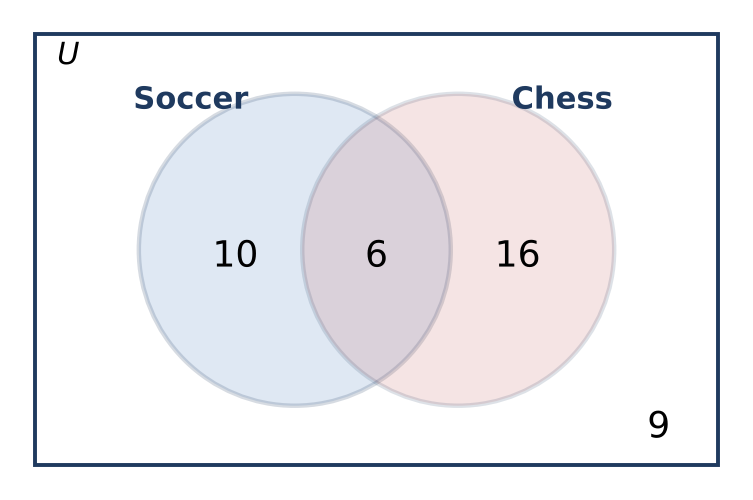
- Regions: only Soccer = 10, both = 6, only Chess = 16, neither = 9.
- Only Soccer: 10.
- A (6): gave the overlap
- C (16): gave everyone in Soccer
- D (32): gave everyone in at least one club
Set notation — operations
Method. ∩ = in both (AND); ∪ = in either (OR); A − B = in A only; A′ = not in A.
Worked example- A − B keeps the elements of A and removes any that are in B.
- {2, 4, 6, 13}.
- A ({3, 9, 11}): gave B − A
- B ({8, 10}): gave the intersection
- C ({2, 3, 4, 6, 9, 11, 13}): included the elements only in B
Logic — converse, inverse and contrapositive
Method. Converse swaps; inverse negates; contrapositive swaps and negates.
Worked example- For “If P, then Q”: converse = if Q then P.
- Inverse = if not P then not Q.
- Contrapositive = if not Q then not P.
- Here P = “a triangle is equilateral” and Q = “a triangle is isosceles”.
- So the contrapositive is “If a triangle is not isosceles, then it is not equilateral”.
- A (If a triangle is isosceles, then it is equilateral.): gave the converse
- B (If a triangle is not equilateral, then it is not isosceles.): gave the inverse
- C (If a triangle is equilateral, then it is isosceles.): repeated the original statement
Venn diagrams — three sets
Method. |A ∪ B ∪ C| = sum of singles − sum of pairs + triple.
Worked example- Inclusion–exclusion: at least one = 30 + 19 + 33 − 9 − 12 − 11 + 6 = 56.
- Students who like none = 70 − 56 = 14.
- A (8): added back the students in all three twice
- C (20): forgot to add back the students in all three
- D (56): gave the number in at least one group
Logic — what must be true
Method. Draw the facts as arrows (taller → shorter); a statement must be true only if there is a path of arrows from the first person to the second.
Worked example- Chain the facts from tallest to shortest.
- Every order that fits the facts has Dev above Ana.
- So “Dev is taller than Ana” must be true.
- The other statements are either possible but not certain, or impossible.
- A (Eli is taller than Ben.): chose a statement that could be true but is not certain
- C (Ana is taller than Eli.): chose a statement that could be true but is not certain
- D (Ana is taller than Dev.): chose a statement that must be false
Number properties — divisibility reasoning
Method. Test the smallest multiples of 2 (n = 2, 4, 6); a choice that fails even once cannot be the answer.
Worked example- Write n = 2k.
- Then 4n = 4(2k), which always contains a factor of 4.
- Each other choice fails for some multiple of 2.
- B ( + n): chose an expression that is not always divisible by 4 (it fails for n = 2)
- C (n + 1): chose an expression that is not always divisible by 4 (it fails for n = 2)
- D (n + 3): chose an expression that is not always divisible by 4 (it fails for n = 2)
Geometric Reasoning
Geometry questions on the CLT often ask what must be true from given facts. Use definitions and theorems step by step: parallel lines, congruent and similar triangles, properties of quadrilaterals, and the angle sums of polygons.
| Angle sum of a polygon | |
| Exterior angles | |
| Congruence | |
| Similarity | |
| Parallelogram properties |
Conditional statements
Method. Converse: swap. Inverse: negate. Contrapositive: swap and negate.
Worked example- The converse swaps the hypothesis and the conclusion.
- So the converse is “If an angle measures less than 90°, then it is acute.”.
- B (If an angle is not acute, then it does not measure less than 90°.): gave the inverse
- C (If an angle does not measure less than 90°, then it is not acute.): gave the contrapositive
- D (If an angle is acute, then it measures less than 90°.): repeated the original statement
Counterexamples
Method. Look for a value that meets the condition but breaks the conclusion.
Worked example- A counterexample makes the hypothesis true and the conclusion false.
- Test 42: it fits the condition of the claim but the conclusion fails.
- Each other choice either fails the condition or satisfies the conclusion.
- So 42 is the counterexample.
- A (5): chose 5, which is not a multiple of 6, so it does not meet the condition and cannot be a counterexample
- B (41): chose 41, which is not a multiple of 6, so it does not meet the condition and cannot be a counterexample
- D (63): chose 63 = 9 × 7, which is odd and not a multiple of 6, so it does not meet the condition and cannot be a counterexample