Quantitative Reasoning: Unit Study Guide
02.01 Word Problems
The Lower Level ISEE (students in grades 4–5 applying to grades 5–6) has a 38-question Quantitative Reasoning section in 35 minutes, all word problems, with four answer choices and no calculator. There is no penalty for a wrong answer, so answer every question. This topic covers reasoning with numbers in short word problems: whole-number operations, money and making change, elapsed time, unit rates and measurement, simple percents, graphs and tables, chance, and mean, median, mode and range.
Word Problems
Read the question, decide which operation the story calls for, solve, and check that the answer makes sense. Some problems take two steps, such as finding a total cost and then the change.
Key formulas| Put together | |
| Take apart or compare | |
| Equal groups | |
| Sharing equally | |
| Change | |
| Elapsed time | |
| Hours to minutes |
Money — making change
Method. Multiply first (total cost), then subtract from the amount paid.
Worked example- Total cost: 2 × $7 = $14.
- Change: $100 − $14 = $86.
- A ($14): gave the total cost instead of the change
- B ($79): counted one item too many
- D ($93): subtracted the price of only one ticket
Elapsed time
Method. Count whole hours first, then adjust by the minutes; an hour has 60 minutes, not 100.
Worked example- From 12:45 p.m. to 2:45 p.m. is 2 hours = 120 minutes.
- But 2:00 p.m. is 45 minutes before 2:45 p.m.
- So subtract 45 minutes.
- Total: 120 − 45 = 75 minutes.
- A (15): counted one hour too few
- C (120): counted only the whole hours
- D (135): counted one hour too many
Time and unit conversion
Method. Convert to one unit (minutes) before multiplying.
Worked example- Change each session to minutes: 2 h 20 min = 2 × 60 + 20 = 140 minutes.
- Multiply by 3 days: 140 × 3 = 420 minutes.
- A (140): forgot to multiply by the number of days
- B (380): multiplied only the hours by the number of days
- D (660): used 100 minutes in an hour
Unit price
Method. Find the cost of one, then multiply.
Worked example- Price of one: $84 ÷ 7 = $12.
- Cost of 6: 6 × $12 = $72.
- A ($12): gave the price of one bottle of juice
- B ($14): divided the total cost by 6
- D ($504): multiplied the cost of 7 by 6
Unit Rates
A rate tells how much for one unit: divide the total by the number of units. Once you know the amount for one, multiply to find the amount for any number.
Key formulas| Amount for one | |
| Amount for many | |
| Same price each |
Unit rates
Method. A unit rate is 'per 1': divide the total by the number of units.
Worked example- Unit rate = miles ÷ hours.
- Unit rate = 110 ÷ 2.
- So Unit rate = 55 miles per hour.
- B (108): subtracted the hours from the miles
- C (112): added the hours to the miles
- D (220): multiplied instead of dividing
Percents
Percent means out of 100: 25% means 25 out of every 100. Many percents are easy fractions, such as 50% = 1/2 and 25% = 1/4. To find a percent of a number, change the percent to a fraction, then find that fraction of the number.
Key formulas| Percent means out of 100 | |
| Easy percents | |
| Fraction to percent | |
| Percent to fraction | |
| Percent of a number | |
| 10% of a number | |
| Sale price | |
| Find the whole |
Fraction to percent
Method. Scale the fraction to a denominator of 100 if you can: = = 75%.
Worked example- Divide to get a decimal.
- Then multiply by 100: 3 ÷ 4 = 0.75, and 0.75 × 100 = 75%.
- A (0.75%): wrote the decimal as the percent (did not multiply by 100)
- B (3.4%): put a decimal point between the top and bottom numbers
- C (25%): used the other part (100% minus the answer)
Percent of a number
Method. 10% of 40 is 4, so 5% is half of that: 2.
Worked example- 5% means 5 out of every 100, which is .
- of 40 = 40 ÷ 20 = 2.
- So 2 students play the drums.
- B (5): gives the percent, 5, as the number of students
- C (8): divides 40 by 5 instead of finding 5 out of every 100
- D (38): finds the students who do not play the drums (95% of 40)
Percent of a number
Method. 10% of 160 = 16; half of 16 = 8; 16 + 8 = 24.
Worked example- 15% = 10% + 5%.
- 10% of 160 is 16, and 5% is half of that, 8.
- 16 + 8 = 24 students.
- B (136): found the amount left after taking the percent
- C (175): added the percent to the number
- D (240): moved the decimal point one place too far right
Measurement, Time and Money
To change a bigger unit to a smaller unit, multiply; to change a smaller unit to a bigger unit, divide. When you add lengths or times, regroup 12 inches as 1 foot and 60 minutes as 1 hour.
Key formulas| Length (US) | |
| Length (metric) | |
| Weight | |
| Capacity (US) | |
| Capacity (metric) | |
| Time | |
| Bigger unit to smaller unit | |
| Regroup | |
| Money |
Money
Method. Quarter 25¢, dime 10¢, nickel 5¢, penny 1¢.
Worked example- Find the value of each kind of coin.
- 2 × 25¢ = 50¢.
- 1 × 10¢ = 10¢.
- 2 × 5¢ = 10¢.
- 5 × 1¢ = 5¢.
- Total = 75¢ = $0.75.
- A ($0.10): counted every coin as one cent
- C ($0.80): mixed up the values of dimes and nickels
- D ($1.00): counted every coin as a dime
Converting units
Method. Big unit → small unit: multiply. Small → big: divide.
Worked example- There are 1,000 milliliters in 1 liter.
- So 11 liters = 11 × 1,000 = 11,000 milliliters.
- A (,000): divided instead of multiplying
- B (110): used 10 milliliters in one liter
- C (1,100): used 100 milliliters in one liter
Elapsed time
Method. Work backward: first the hours, then the minutes.
Worked example- Count back the whole hour: 9:00 A.M. − 1 h = 8:00 A.M.
- Count back 25 min: 8:00 A.M. − 25 min = 7:35 A.M.
- So the bus left at 7:35 A.M.
- B (8:25 A.M.): subtracted the smaller minutes from the larger (25 − 0 = 25) and then 9 − 1 = 8
- C (8:35 A.M.): borrowed 60 minutes but forgot to take 1 away from the hours (9 − 1 = 8, 60 − 25 = 35)
- D (10:25 A.M.): added the trip time instead of subtracting it
Adding measurements
Method. Add yards and feet separately (14 yd 4 ft), then trade 3 ft for 1 yd: 15 yd 1 ft.
Worked example- Add the feet: 2 + 2 = 4 ft.
- 1 yd = 3 ft, so 4 ft = 1 yd 1 ft.
- Add the yards: 9 + 5 + 1 = 15 yd.
- Together the pieces are 15 yd 1 ft long.
- A (4 yd 0 ft): subtracted the lengths instead of adding them
- B (14 yd 1 ft): regrouped 4 ft as 1 yd 1 ft but forgot to add the extra yard
- D (15 yd 4 ft): added an extra yard without taking 3 ft away from 4 ft
Graphs and Tables
Read the title, the labels and the key before you read any values. In a pictograph, multiply the number of symbols by what one symbol stands for. In a bar graph, read across from the top of each bar to the scale.
Key formulas| Pictograph | |
| Half a symbol | |
| Bar graph | |
| Line plot | |
| Total | |
| How many more |
Pictographs
Method. Count the symbols first, then multiply once by the key.
Worked example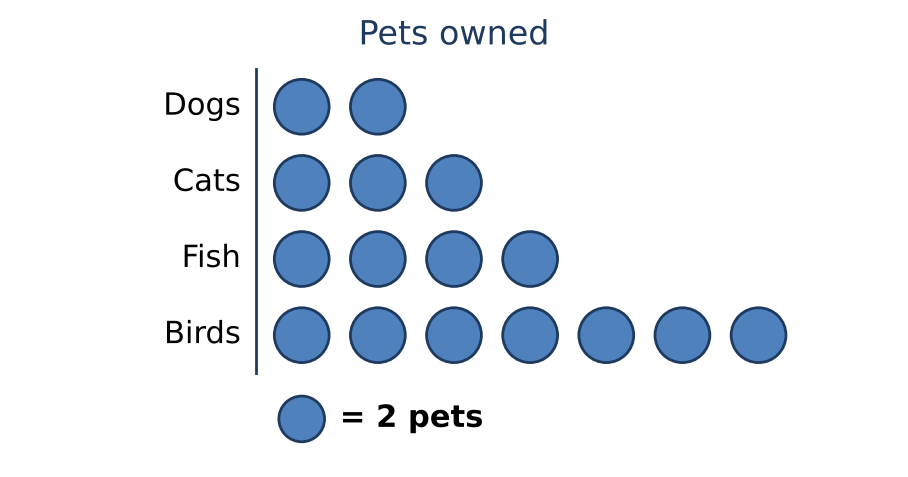
- Add the symbols.
- So 2 + 3 + 4 + 7 = 16.
- Multiply by the key.
- So 16 × 2 = 32.
- A (16): added the symbols without using the key
- B (24): left out Fish
- D (34): counted one symbol too many
Bar graphs
Method. Find the tallest and shortest bars, then subtract.
Worked example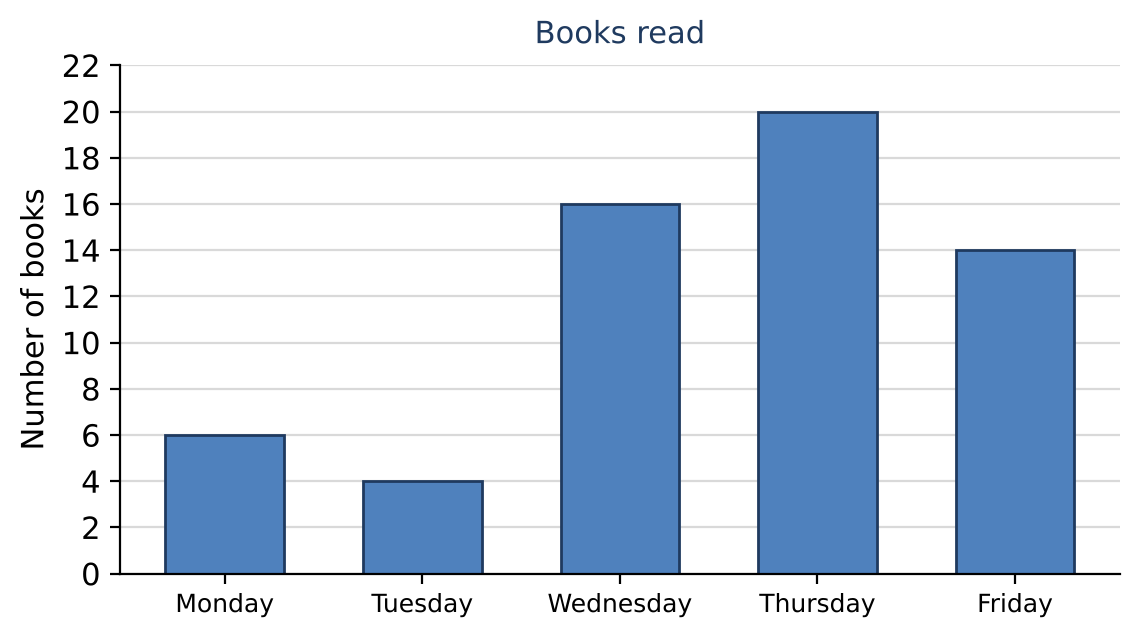
- The tallest bar is Thursday with 20.
- The shortest bar is Tuesday with 4.
- The difference is 20 − 4 = 16.
- A (4): gave the shortest bar only
- C (20): gave the tallest bar only
- D (24): added the tallest and shortest bars
Tables
Method. Only dogs and cats have legs: (7 + 3) × 4 = 40.
Worked example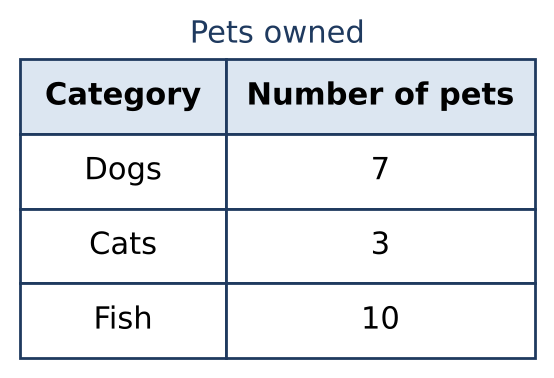
- From the table there are 7 dogs and 3 cats, so 7 + 3 = 10 pets have legs.
- Each has 4 legs: 10 × 4 = 40 legs.
- The 10 fish add 0 legs, so the pets have 40 legs in all.
- A (10): counts the dogs and cats instead of their legs (7 + 3)
- B (20): counts all the pets instead of their legs (7 + 3 + 10)
- C (28): counts the legs of the dogs only (7 × 4)
Line plots and dot plots
Method. Count the X's at 4 and to its right.
Worked example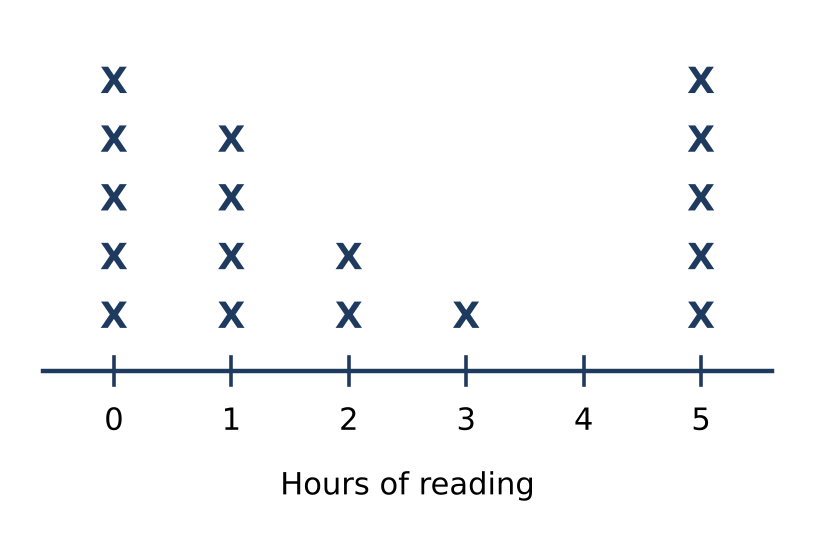
- At least 4 means 4 or more.
- Add the X's in the columns 4 through 5.
- So 0 + 5 = 5.
- B (6): also counted the column for 3
- C (12): counted the wrong side
- D (17): counted every X
Chance and Likelihood
Chance tells how likely something is to happen. Compare the number of objects of one kind with the total number of objects: if none are that kind it is impossible, and if all are that kind it is certain. The chance can be written as a fraction: the number of that kind over the total number.
Key formulas| Impossible | |
| Certain | |
| Likely | |
| Unlikely | |
| Equally likely | |
| Chance as a fraction | |
| Example |
Simple probability
Method. List the favorable outcomes and divide by the total number of outcomes.
Worked example- The favorable outcomes are 2, 4, 6, which is 3 out of 6.
- So the probability is = .
- A (): counted only one outcome
- B (): missed one outcome
- D (1): divided by the outcomes that do not count
Mean, Median, Mode and Range
The mean is the sum of the values divided by how many values there are. The median is the middle value after you put the values in order. The mode is the value that appears most often. The range is the greatest value minus the least value.
Key formulas| Mean | |
| Median | |
| Two middle values | |
| Mode | |
| Range | |
| Example: mean | |
| Example: the others |
Range
Method. Range = max − min; the order of the list does not matter.
Worked example- The range is greatest value − least value.
- The greatest value is 18 and the least is 2.
- So the range is 18 − 2 = 16.
- A (8): subtracted the first and last values as listed
- C (18): gave the greatest value
- D (20): added the greatest and least values
Mean
Method. Mean = sum of the values ÷ how many values there are.
Worked example- Add the values.
- So 23 + 6 + 24 + 3 = 56.
- Divide by the number of values, 4.
- So the mean is 56 ÷ 4 = 14.
- A (11.2): divided by one more than the count
- C (14.5): gave the median
- D (56): found the sum but did not divide