Linear Functions: Study Guide
A linear function changes by the same amount for every 1-unit change in its input. PSAT/NMSQT questions use function notation, tables and graphs, and ask what the slope and y-intercept mean in a real situation.
Linear Functions
A linear function has a constant rate of change. Use slope-intercept or point-slope form.
| Function form | |
| Slope | |
| Slope-intercept | |
| Point-slope | |
| Standard form |
Rate of change from a table
Method. Divide the change in y by the change in x — check the x-step, it may not be 1.
Worked example- Rate of change = (change in y) ÷ (change in x).
- From (−1, −9) to (1, −7): (−7 − (−9)) ÷ (1 − (−1)) = 2 ÷ 2 = 1.
- A (−1): made a sign error
- C (2): used the change in y without dividing by the change in x
- D (9): divided the first y-value by the first x-value
Initial value from a table
Method. Initial value = first y − rate × first x.
Worked example- Rate of change: (−11 − 1) ÷ 2 = −6.
- Going from x = 2 back to x = 0 is 2 units.
- So y changes by −6 × (−2) = 12.
- So y(0) = 1 + 12 = 13.
- A (−11): added the rate instead of subtracting it
- B (1): gave the first y-value in the table
- C (7): went back only one unit of x
Slope and intercept from a graph
Method. Slope = rise/run between two exact grid points; y-intercept = where the line crosses the y-axis.
Worked example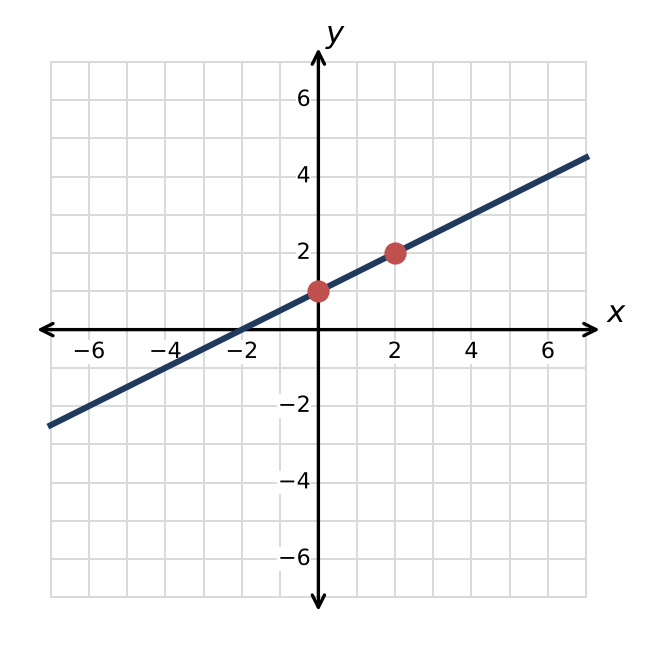
- The marked points are (0, 1) and (2, 2).
- So the slope is .
- The marked point (0, 1) is already on the y-axis.
- The line crosses the y−axis at (0, 1).
- A (−2): gave the x-intercept
- B (−1): misread the sign
- C (): gave the slope
Interpreting slope and intercept
Method. Coefficient of the input = rate per unit; constant = value at input 0.
Worked example- In a linear model output = (rate) × input + (starting value), the number multiplying w is the rate and the constant is the value when w = 0.
- 158 is the constant: when w = 0, A = 158.
- So it is the starting amount on the gift card.
- A (the number of dollars spent from the card each week): confused the starting amount with the rate
- B (the amount left after w weeks): described the output variable
- D (the number of weeks the card is used): described the input variable
Linear function from two points
Method. Slope from the two points, then b = y − mx with either point.
Worked example- Slope: (−16 − (−2)) ÷ (4 − (−3)) = −14 ÷ 7 = −2.
- Intercept: substitute (−3, −2) into y = −2x + b: −2 = 6 + b.
- So b = −8.
- The equation is y = −2x − 8.
- A (y = x − ): divided the change in x by the change in y
- C (y = −2x + 4): made a sign error finding the intercept
- D (y = 2x + 4): made a sign error in the slope
Comparing linear models
Method. Equal cost: difference in fees ÷ difference in rates.
Worked example- Set the costs equal: 10 + 13m = 41 + 12m.
- Subtract 12m and 10 from both sides: m = 31.
- So the plans cost the same after 31 months.
- A (): added the rates instead of subtracting them
- B (): added the fees and the rates
- D (413): gave the equal cost instead of the number of months
Arithmetic sequences as linear functions
Method. Arithmetic sequence = linear function of n with slope = common difference.
Worked example- The common difference is −6 − (−9) = 3.
- Term n = first term + (n − 1) × difference = −9 + 13 × 3 = 30.
- A (−126): multiplied the first term by n
- C (33): used n instead of n − 1
- D (42): forgot the first term
Solving with linear models
Method. Undo the model: subtract the start value, divide by the rate.
Worked example- Substitute H = 97: 97 = 7d + 55.
- Subtract 55: 42 = 7d.
- Divide by 7: d = 6.
- B (): ignored the constant
- C (): added the constant instead of subtracting it
- D (734): evaluated H at 97 instead of solving
Word Problems
Name the unknown, translate the words into an equation or inequality, solve, and answer the question that was asked, with units.
| Distance | |
| Work (combined rate) | |
| Mixture | |
| Consecutive integers | |
| Linear model | |
| At most / at least | |
| Mean |
Interpreting linear models
Method. Change in output = slope × change in input; the constant cancels.
Worked example- The coefficient 45 is the change in W for each increase of 1 in d.
- For an increase of 6: 45 × 6 = 270 grams.
- The constant 60 does not change.
- A (45): gave the increase for 1 unit, not 6
- C (330): added the starting value
- D (360): multiplied the starting value by 6