Linear Inequalities: Study Guide
Linear inequalities in one or two variables describe ranges of values or regions of the plane. PSAT/NMSQT questions ask you to solve them, write them from a context with a budget or limit, and decide which points satisfy a system of inequalities.
Inequalities
Solve like equations, but reverse the inequality sign when multiplying or dividing by a negative number. In two variables, the solutions of y > mx + b lie above the line; a system of inequalities is the overlap of the regions.
| Flip rule | |
| Compound | |
| Two variables | |
| Checking a point |
Solving inequalities
Method. Solve it like an equation; the sign flips only when you multiply or divide by a negative number.
Worked example- Subtract 4 on both sides: 5x ≤ 40.
- Divide by 5 (positive, so the sign stays): x ≤ 8.
- A (x ≥ 8): reversed the inequality sign without a reason
- B (x ≤ ): added the constant instead of subtracting it
- C (x < 8): changed whether the endpoint is included
Solving inequalities — negative coefficient
Method. Dividing (or multiplying) both sides by a negative number reverses the inequality.
Worked example- Subtract 13: −4x ≥ 40.
- Divide by −4 and reverse the sign (dividing by a negative): x ≤ −10.
- A (x ≥ −10): forgot to reverse the sign when dividing by a negative number
- B (x ≤ 10): dropped the negative sign of the coefficient but still reversed the sign
- C (x ≥ 10): divided by the positive number instead of the negative one
Inequalities with variables on both sides
Method. Collect x on one side; watch for dividing by a negative.
Worked example- Move the x-terms to the left: −13x ≤ −39.
- Divide by −13 and reverse the sign: x ≥ 3.
- A (x ≤ 3): forgot to reverse the sign after dividing by a negative
- B (x ≥ 39): added the x-terms instead of subtracting
- D (x ≥ ): used the wrong sign when moving the constant
Testing solutions of inequalities
Method. Substitute each choice, or solve once and compare.
Worked example- Solve: −3x ≤ −3.
- So x ≥ 1 (the sign reverses because we divide by a negative).
- Only 1 satisfies x ≥ 1.
- A (−5): chose a value on the wrong side (forgot that the sign reverses)
- B (−2): chose a value on the wrong side (forgot that the sign reverses)
- C (0): chose a value on the wrong side (forgot that the sign reverses)
Compound inequalities — and
Method. Treat the middle as the target and apply each step to all three parts.
Worked example- Do the same thing to all three parts.
- Subtract 2: −6 ≤ 2x ≤ 0.
- Divide by 2: −3 ≤ x ≤ 0.
- A (−2 ≤ x ≤ 1): divided all three parts but did not subtract the constant
- B (−6 ≤ x ≤ 0): subtracted the constant but did not divide
- D (−3 < x < 0): switched which endpoints are included
Greatest or least integer solution
Method. Solve, then step to the nearest integer on the allowed side (exclude the boundary for < or >).
Worked example- 2x ≤ 60.
- So x ≤ 30.
- The greatest integer that works is 30.
- A (29): stopped one integer short
- C (31): went one integer past the boundary
- D (32): added the constant instead of subtracting it
Inequality word problems
Method. Subtract the fixed fee, divide by the price, and round DOWN.
Worked example- Let n be the number of lessons: 33 + 9.5n ≤ 100.
- Then 9.5n ≤ 67.
- So n ≤ ≈ 7.05.
- The greatest whole number is 7.
- B (8): rounded up instead of down
- C (10): ignored the one-time fee
- D (14): added the fee to the budget
Two-variable inequalities — solutions
Method. Points that satisfy it lie below the line y = 3x + 3 (or on it).
Worked example- Substitute the point.
- For (2, 6), 3(2) + 3 = 9, and y = 6 ≤ 9 ✓.
- A ((−4, −1)): chose a point above the line
- B ((−5, −2)): chose a point above the line
- C ((−5, 2)): chose a point above the line
Two-variable inequalities — graphs
Method. Line: read the y-intercept and slope. Dashed → < or >; solid → ≤ or ≥. Above → y >; below → y <.
Worked example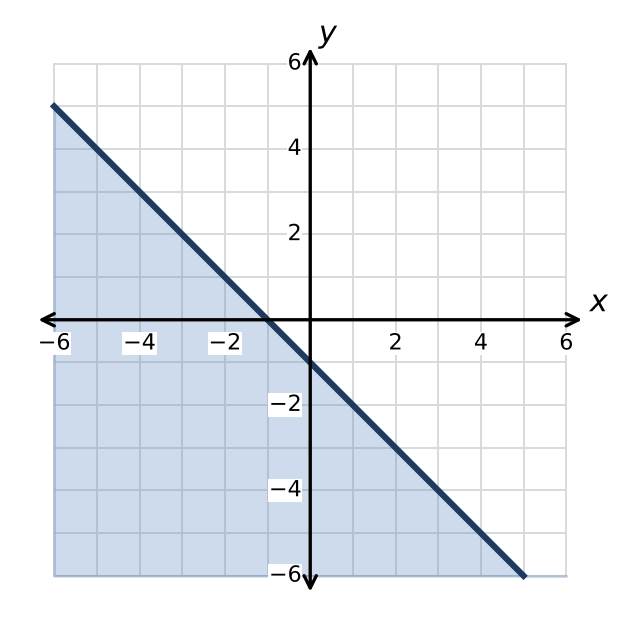
- The boundary passes through (0, −1) with slope −1.
- So it is y = −x − 1.
- It is solid (included) and the shading is below the line: y ≤ −x − 1.
- A (y < −x − 1): misread the dashed/solid boundary line
- C (y ≥ −x − 1): chose the wrong side of the line
- D (y ≤ x − 1): used the wrong sign for the slope
Systems of linear inequalities
Method. A solution of a system must satisfy every inequality; test each choice in both.
Worked example- Test (0, 5) in both.
- 5 > 4 ✓ and 5 > 3 ✓.
- A ((−5, 2)): checked only the first inequality
- C ((2, 6)): checked only the second inequality
- D ((1, −2)): chose a point that satisfies neither inequality
Word Problems
Name the unknown, translate the words into an equation or inequality, solve, and answer the question that was asked, with units.
| Distance | |
| Work (combined rate) | |
| Mixture | |
| Consecutive integers | |
| Linear model | |
| At most / at least | |
| Mean |
Writing inequalities from words
Method. “At most / no more than” → ≤; “at least” → ≥; “more than” → >; “less than” → <.
Worked example- Total spent = fee + price × rides = 5 + 4n.
- “At most” 75 means ≤ 75.
- So 5 + 4n ≤ 75.
- B (5 + 4n ≥ 75): reversed the inequality sign
- C (4n ≤ 75): left out the fixed fee
- D (5 + 4n < 75): changed whether the boundary is included
Inequalities in context
Method. Subtract the fixed cost, divide by the unit price, then round DOWN.
Worked example- Write the inequality: 4 + 2.5n ≤ 25.
- Subtract 4: 2.5n ≤ 21.
- Divide by 2.5: n ≤ = 8.4.
- n must be a whole number.
- So the greatest is 8.
- B (9): rounded up instead of down
- C (10): ignored the fixed fee
- D (11): added the fee instead of subtracting it