Advanced Math: Unit Study Guide
02.01 Equivalent Expressions
Equivalent expressions is part of Advanced Math (about 20% of the PSAT 8/9 Math section): adding, subtracting, multiplying and factoring polynomials, and rewriting expressions with exponents. Many questions ask which expression is equivalent to a given one.
Polynomial Expressions
Combine like terms, distribute, and use the special-product patterns. Factor by pulling out the GCF first, then look for patterns.
| Square of a sum | |
| Square of a difference | |
| Difference of squares | |
| FOIL | |
| Greatest common factor | |
| Factoring a trinomial |
Combining like terms
Method. Only terms with exactly the same variable part can be combined; keep each sign with its term.
Worked example- Group the terms: − and 3 make 2.
- Group the x-terms: 2x is the only x-term.
- Group the constants: 9 and 7 make 16.
- Write the result: 2 + 2x + 16.
- B (4 + 16): combined and x terms as if they were like terms
- C (−4 + 2x + 16): used the wrong sign for one term
- D (2 + 2x + 2): used the wrong sign for a constant
Distributive property
Method. Multiply the outside number by EVERY term inside, keeping the sign of the outside number.
Worked example- Distribute: −3(3x + 1) = −9x − 3 and 3(−9x − 7) = −27x − 21.
- Combine: −36x − 24.
- A (−36x − 10): multiplied only the first term in the second parentheses by 3
- C (18x + 18): subtracted the second product instead of adding
- D (−36x − 20): multiplied only the first term in the first parentheses by −3
Multiplying a monomial by a polynomial
Method. Multiply coefficients and ADD exponents for each term.
Worked example- 3 · 7x = 21 and 3 · 9 = 27.
- So the product is 21 + 27.
- B (21 + 9): multiplied 9 by but forgot to multiply it by 3
- C (21 + 27x): multiplied the constant term by x instead of by
- D (21 + 27x): multiplied each term by 3x instead of by 3: 3x(7x + 9) = 21 + 27x
Adding and subtracting polynomials
Method. Line up like terms (, x, constants); with subtraction, change every sign in the second polynomial.
Worked example- Distribute the minus sign to every term of the second polynomial.
- Then combine like terms: − + 2x + 5.
- B (− − 6x − 7): changed the sign of only the first term of the second polynomial
- C (−3 − 6x − 7): added instead of subtracting
- D (− + 7): combined the x-terms with the constants
Multiplying binomials
Method. First, Outer, Inner, Last — then combine the two middle terms.
Worked example- FOIL: first 4x·x = 4.
- Outer 4x·(−3) = −12x.
- Inner −9·x = −9x.
- Last −9·(−3) = 27.
- Total: 4 − 21x + 27.
- A (4 + 27): multiplied only the first terms and the last terms
- C (4 − 3x + 27): subtracted the outer and inner products
- D (4 − 21x − 27): made a sign error on the last term
Special products
Method. Use the patterns = ± 2pq + and (p + q)(p − q) = − .
Worked example- (p + q)(p − q) = − : − 9 = 9 − 9.
- The middle terms cancel.
- A (9 + 9): used + for the last term
- B (9 − 18x + 9): multiplied as if the expression were
- C (9x − 9): wrote as 9x instead of 9
Factoring — greatest common factor
Method. Find the largest number and the lowest power of x that divide every term.
Worked example- Every term contains 4x: 20 + 24 − 8x = 4x.
- The trinomial 5 + 6x − 2 has no common factor left.
- A (4): factored out only the number, not the variable
- C (2x): took out 2x instead of the greatest common factor 4x
- D (4x): did not divide the last term by 4
Factoring trinomials (leading coefficient 1)
Method. Product = c, sum = b; the signs of c and b tell you the signs of the two numbers.
Worked example- Find two numbers with product −54 and sum −3: −9 and 6.
- So − 3x − 54 = (x − 9)(x + 6).
- A ((x + 9)(x − 6)): used the wrong signs in both factors
- B ((x − 9)(x − 6)): used the wrong sign in one factor
- D ((x − 27)(x + 2)): chose a factor pair of −54 that does not add to −3
Factoring — difference of squares
Method. − = (p + q)(p − q); take out any common factor first.
Worked example- Take out the common factor 3: 3.
- 25 − 36 = − .
- So it factors as (5x + 6)(5x − 6).
- A (3(5x − 6)(5x − 6)): wrote a perfect square instead of a difference of squares
- C (3(5x + 6)(5x + 6)): used + in both factors
- D (3(25x + 6)(x − 6)): did not take the square root of the coefficient
Factoring trinomials (leading coefficient ≠ 1)
Method. Check the outer and inner products of each candidate against the middle coefficient.
Worked example- Use the ac-method: a·c = −840.
- Find two numbers with product −840 and sum 22: 42 and −20.
- Split the middle term and group: 24 + 22x − 35 = (6x − 5)(4x + 7).
- B ((6x + 7)(4x − 5)): placed the constants in the wrong factors
- C ((6x + 5)(4x − 7)): used the wrong signs in both factors
- D ((6x − 5)(4x − 7)): used the wrong sign in one factor
Factoring by grouping
Method. Pair the terms, factor each pair, then factor out the common binomial.
Worked example- Group the first two terms and the last two terms: + (−10x + 35).
- Factor out of the first group and −5 out of the second: (2x − 7) − 5(2x − 7).
- Factor out the common binomial (2x − 7): (2x − 7).
- A ((2x + 7)): made a sign error when factoring the first group
- B ((2x − 7)): made a sign error when factoring the second group
- D ((2x − 7)(x − 5)): wrote x instead of in the common factor
Exponents and Radicals
Exponents count repeated multiplication, and radicals undo powers. Questions in this topic test the exponent laws, negative and fractional exponents, simplifying square roots, and equations with a common base.
| Product rule | |
| Quotient rule | |
| Power rule | |
| Power of a product | |
| Zero exponent | |
| Negative exponent | |
| Fractional exponent | |
| Product of roots | |
| Rationalizing | |
| Common base |
Exponent laws — product rule
Method. Multiply numbers, add exponents of the same base.
Worked example- Same base.
- So add the exponents: · = .
- Answer: .
- A (): multiplied the exponents instead of adding them
- B (2): added the coefficients instead of multiplying them
- C (2): added the coefficients and multiplied the exponents
Exponent laws — quotient rule
Method. Divide numbers, subtract exponents (top minus bottom).
Worked example- Divide the coefficients: 6 ÷ 2 = 3.
- Same base.
- So subtract the exponents: 8 − 3 = 5.
- Answer: 3.
- A (3): added the exponents
- C (4): subtracted the coefficients instead of dividing
- D (3): subtracted the exponents in the wrong order
Exponent laws — power rule
Method. Power of a power: multiply exponents; the coefficient is raised to the power too.
Worked example- = (multiply the exponents).
- Answer: .
- A (): added the exponents instead of multiplying
- B (): raised the exponent to the power
- C (5): multiplied by the power instead of raising to it
Simplify square roots
Method. Find the largest perfect-square factor of the number under the root, then take its square root outside: = a.
Worked example- Find the largest perfect square factor of 20: 20 = 4 × 5.
- Then = × = 2, and 5 has no square factor left.
- A (4): took out the perfect square without taking its square root
- B (2 + ): split the root of a product into a sum of roots
- C (5): swapped the outside number and the number under the root sign
Exponent laws with fractional exponents
Method. The laws are the same for fraction exponents; add them with a common denominator.
Worked example- Same base.
- So add the exponents: + = 1.
- Answer: b.
- B (): multiplied the exponents instead of adding them
- C (): added the tops and the bottoms of the exponents
- D (): added the tops but multiplied the bottoms: = =
Equivalent exponential expressions — split the exponent
Method. An added constant in the exponent becomes a multiplied constant out front (subtracted → divided).
Worked example- Use bᵐ⁺ⁿ = bᵐ · bⁿ.
- = 4^x · .
- So = 64 · 4^x.
- A (4^x + 64): added instead of multiplying
- C (12 · 4^x): multiplied the base by the added number
- D (): multiplied the exponents
02.02 Nonlinear Equations and Functions
This skill covers simple nonlinear equations and functions, the heart of Advanced Math (about 20% of the PSAT 8/9 Math section). Solve quadratic equations (by factoring, square roots or the quadratic formula), absolute value equations, exponential equations with a common base, and systems that pair a line with a parabola. Connect quadratic and exponential functions to their graphs (vertex, intercepts, growth or decay), use function notation, and read values from tables and graphs. Key rules: for k ≥ 0, |u| = k means u = k or u = −k (if k < 0 there is no solution); if bᵐ = bⁿ with b > 0 and b ≠ 1, then m = n; the graph of y = a|x − h| + k is a V shape with its vertex at (h, k).
Quadratic Equations
Solve by factoring, square roots, completing the square or the quadratic formula. The discriminant tells how many real solutions there are.
| Standard form | |
| Zero-product property | |
| Quadratic formula | |
| Discriminant | |
| Number of real solutions | |
| Sum and product of roots | |
| Completing the square |
Square-root equations x² = k
Method. = k (k > 0) always has two solutions, ±.
Worked example- Take the square root of both sides, remembering both signs.
- x = ±.
- So x = ±8.
- A (x = 8): forgot the negative square root
- B (x = ±32): divided by 2 instead of taking the square root
- C (x = ±16): doubled the square root
Zero-product property
Method. Set each factor equal to 0; each root is the opposite of the number in its factor.
Worked example- A product is 0 only when a factor is 0.
- x + 1 = 0 gives x = −1.
- x + 12 = 0 gives x = −12.
- So x = −12 or x = −1.
- A (x = 1 or x = 12): used the numbers in the factors with their signs instead of the zeros
- B (x = −1 or x = 12): changed the sign of only one root
- C (x = −12 or x = 1): changed the sign of only the other root
Solving by factoring
Method. Get 0 on one side, factor, then set each factor to 0.
Worked example- Factor: (x + 10)(x + 5) = 0, since −10 × (−5) = 50 and −10 + (−5) = −15.
- Zero-product property: x = −10 or x = −5.
- A (x = 5 or x = 10): used the numbers from the factors without changing their signs
- C (x = −10 or x = 5): made a sign error on one root
- D (x = 1 or x = 50): chose a factor pair of 50 that does not add to 15
Square-root method
Method. Isolate the squared bracket, take the ± square root of both sides, then undo the shift inside the bracket.
Worked example- Take square roots: x + 2 = ± = ±2.
- Add −2 (move the constant): x = −2 ± 2.
- B (x = 2 ± 2): used the wrong sign for h
- C (x = −2 + 2): forgot the negative square root
- D (x = −14 or x = 10): forgot to take the square root
Solving by factoring (leading coefficient ≠ 1)
Method. Use the ac-method: find two numbers whose product is a·c and whose sum is b, split the middle term, then group.
Worked example- Factor: (x + 6)(5x + 7) = 0.
- Set each factor to 0: x + 6 = 0 gives x = −6.
- 5x + 7 = 0 gives x = −.
- B (x = or x = 6): solved each factor with the wrong sign
- C (x = −7 or x = −6): forgot to divide by the x-coefficient in each factor
- D (x = −7 or x = −): divided by the wrong coefficients
Completing the square
Method. Shortcut: + bx + c = 0 becomes = − c.
Worked example- Move the constant: + 2x = 9.
- Half of 2 is 1, and = 1.
- Add it to both sides: + 2x + 1 = 10.
- Write the left side as a square: = 10.
- A ( = −8): added the constant instead of subtracting it
- B ( = 13): used b instead of
- C ( = 10): used the wrong sign inside the square
The discriminant
Method. Sign of − 4ac: positive → 2, zero → 1, negative → 0 real solutions.
Worked example- Discriminant: − 4ac = − 4(1)(−8) = 144 − (−32) = 176.
- It is positive.
- So there are two distinct real solutions.
- A (no real solutions): thought the negative constant term makes the discriminant negative
- C (exactly one real solution): thought the discriminant was 0
- D (infinitely many real solutions): confused a quadratic with an identity
Quadratic word problems — area
Method. Write the area as width × (width + difference), set it equal to the area, and factor (or look for two numbers with that difference and product).
Worked example- Let w be the width: w(w + 10) = 336.
- So + 10w − 336 = 0.
- Factor: (w − 14)(w + 24) = 0.
- So w = 14 (a width cannot be negative).
- Length = 14 + 10 = 24.
- A (14): gave the width
- C (163): solved w + (w + d) = area
- D (168): halved the area
Quadratic word problems — projectile
Method. Set the height to 0, divide out the common factor, factor, and keep the positive root.
Worked example- Set h = 0: −16 + 96t + 256 = 0.
- Divide by −16: − 6t − 16 = 0, which factors as (t − 8)(t + 2) = 0.
- So t = 8 or t = −2.
- Time cannot be negative.
- So t = 8.
- A (2): gave the negative root without its sign as a time
- B (3): gave the time of maximum height
- D (16): divided the starting height by 16
Quadratic formula
Method. Compute the discriminant first, simplify its square root, then divide every term by 2a.
Worked example- a = 1, b = −10, c = −1.
- Discriminant: − 4ac = 100 − 4(1)(−1) = 104.
- x = = = , which simplifies to 5 ± .
- A (x = −5 ± ): used +b instead of −b
- C (x = 5 ± 2): used + 4ac in the discriminant
- D (x = 10 ± 2): divided by a instead of 2a
Sum and product of the roots
Method. Sum of the roots = − and product = — no need to solve.
Worked example- For ax² + bx + c = 0 the roots satisfy sum = − and product = .
- Here a = 3, b = −5, c = −10.
- So the sum is − = .
- A (−): gave the product instead of the sum
- B (−): forgot the negative sign in −
- C (): divided a by b and dropped the negative sign
Nonlinear Systems
Substitute the linear equation into the nonlinear one and solve the resulting equation (a quadratic, or two cases for an absolute value). The number of real solutions equals the number of intersection points, which you can also see by graphing both equations in Desmos.
| Line and parabola | |
| Intersections |
Linear–quadratic systems — solutions
Method. Set the two expressions for y equal, factor, then use the LINE to get each y.
Worked example- Substitute the line into the parabola: 2x + 4 = − − 2x + 4.
- Move everything to one side: − − 4x = 0.
- Factor: −x(x + 4) = 0.
- So x = 0 or x = −4.
- Find y from the line: x = 0 gives y = 4.
- x = −4 gives y = −4.
- The solutions are (−4, −4) and (0, 4).
- B ((−4, −4) and (4, 0)): swapped the x- and y-coordinates
- C ((0, 4) and (4, 12)): made a sign error when factoring
- D ((−4, −8) and (0, 0)): dropped the constant term when finding y
Linear–quadratic systems — sums of coordinates
Method. Set the two equations equal; for + px + q = 0 the sum of the x-values is −p, so you need not solve.
Worked example- Set the expressions equal: − 7x + 2 = −4x + 6.
- Move everything to one side: − 3x − 4 = 0.
- The sum of the roots of + px + q = 0 is −p.
- So x₁ + x₂ = 3.
- A (−4): gave the product of the x-values
- B (−3): used − with the wrong sign
- D (7): used −b from the parabola before subtracting the line
Systems with absolute value
Method. Solve each branch of the absolute value separately and keep only roots that lie on that branch.
Worked example- Split the absolute value at x = 3.
- Case x ≥ 3: x − 5 = 4.
- So x = 9, which satisfies x ≥ 3 ✓.
- Case x < 3: −x + 1 = 4.
- So x = −3, which satisfies x < 3 ✓.
- Find y from the line: x = −3 gives y = 4.
- x = 9 gives y = 4.
- The solutions are (−3, 4) and (9, 4).
- A ((−3, 4)): kept only one solution
- C ((9, 4)): kept only one solution
- D ((−9, 4) and (3, 4)): made a sign error in the x-coordinates
Absolute Value
Absolute value is distance from 0. Split |expression| = k into two equations; check that k is not negative.
| Equation | |
| Negative right side | |
| Two absolute values | |
| Vertex of y = a|x − h| + k |
Exponents and Radicals
Exponents count repeated multiplication, and radicals undo powers. Questions in this topic test the exponent laws, negative and fractional exponents, simplifying square roots, and equations with a common base.
| Product rule | |
| Quotient rule | |
| Power rule | |
| Power of a product | |
| Zero exponent | |
| Negative exponent | |
| Fractional exponent | |
| Product of roots | |
| Rationalizing | |
| Common base |
Exponential equation with a common base
Method. Write both sides as powers of the same base, then set the exponents equal (or graph both sides in Desmos and read the intersection).
Worked example- Write 9 as : 9^x = ^x = .
- So = , and the exponents must be equal: 2x = 8.
- x = 4.
- B (6): Used ^x = , adding the exponents instead of multiplying, so x + 2 = 8 and x = 6
- C (8): Set the exponents equal, x = 8, without first writing 9 as a power of 3
- D (16): Wrote 9^x as instead of , so = 8 and x = 16
Quadratic Functions
Parabolas: the vertex is the turning point, the axis of symmetry passes through it, and the sign of a tells whether the parabola opens up or down.
| Vertex form | |
| Axis of symmetry | |
| y-intercept | |
| Factored form | |
| Axis of symmetry from factored form | |
| Opens up (a > 0) | |
| Opens down (a < 0) |
Vertex form
Method. Vertex form: change the sign inside the parentheses, keep the sign of k.
Worked example- In vertex form f(x) = a + k the vertex is (h, k).
- Here x − 3 = x − (3).
- So h = 3, and k = −4.
- The vertex is (3, −4).
- A ((−3, −4)): used the sign inside the parentheses
- B ((3, 4)): used the wrong sign for k
- C ((−4, 3)): swapped the coordinates
Factored form and intercepts
Method. Factored form a(x − p)(x − q): zeros p and q, vertex halfway, y-intercept a·p·q.
Worked example- The y-intercept is the value of f at x = 0.
- Substitute x = 0: (0 + 7)(0 − 8) = 7 × (−8) = −56.
- B (−1): added the constants in the factors
- C (1): added the roots instead of multiplying
- D (56): made a sign error
Graphs of quadratic functions
Method. Read the vertex from the grid; check the direction and the step from the vertex for a.
Worked example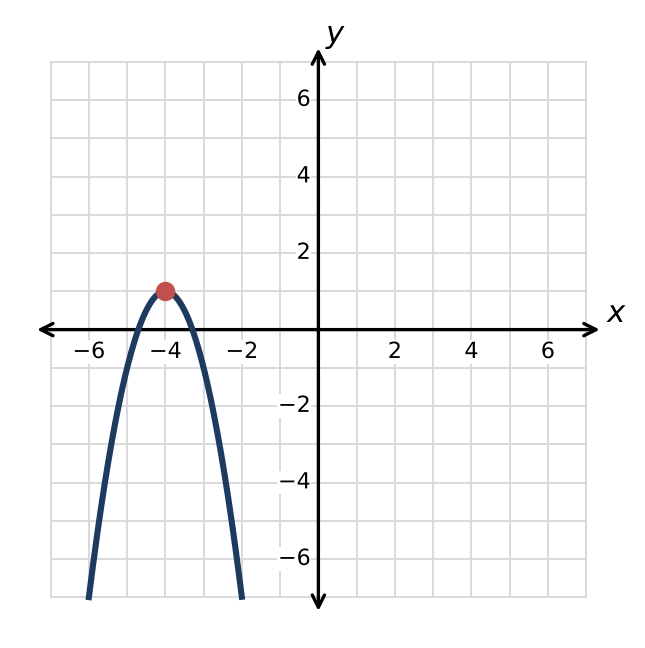
- The vertex is the turning point of the parabola: its highest point.
- Reading the grid, it is at x = −4, y = 1.
- So the vertex is (−4, 1).
- A ((1, −4)): swapped the coordinates
- C ((4, 1)): misread the sign of the x-coordinate
- D ((−4, −1)): misread the sign of the y-coordinate
Vertex and axis from standard form
Method. x-vertex = −; plug it back in for the y-coordinate.
Worked example- The x-coordinate of the vertex is − = − = 4.
- The y-coordinate is f(4) = 32 − 64 + 28 = −4.
- So the vertex is (4, −4).
- B ((−4, 124)): used instead of −
- C ((8, 28)): forgot the 2 in −
- D ((4, 28)): used c as the y-coordinate
Maximum and minimum values
Method. Maximum value = f, the y-coordinate of the vertex.
Worked example- a = −1 is negative.
- So the parabola opens down and has a maximum at the vertex.
- x = − = −3.
- f(−3) = −9 + 18 − 14 = −5.
- The maximum value is −5.
- A (−41): used the wrong sign for the x-coordinate of the vertex
- B (−14): gave the y-intercept
- D (−3): gave the x-value where the maximum occurs
Projectile models
Method. Time of max = −; max height = h of that time.
Worked example- The maximum is at the vertex.
- t = −.
- t = − = .
- So t = 2 seconds.
- B (4): used − instead of −
- C (10): divided b by 2 only
- D (20): gave the maximum height instead of the time
Area optimization
Method. Write area as a quadratic in one side; the maximum is at the vertex.
Worked example- Let each side touching the wall be w.
- The side parallel to the wall is 96 − 2w.
- A(w) = w(96 − 2w) = −2 + 96w.
- The vertex is at w = = 24.
- So the other side is 96 − 48 = 48.
- Area = 24 × 48 = 1152.
- A (24): gave the width instead of the area
- B (576): fenced all four sides
- D (2304): forgot that two widths are fenced
Second differences
Method. Quadratic ⇔ constant second differences; second difference = 2a for x-steps of 1.
Worked example- First differences: −3, −7, −11, −15.
- Second differences: all −4.
- The next first difference is −15 + (−4) = −19.
- So f(5) = −33 + (−19) = −52.
- A (−56): added the second difference twice
- C (−48): repeated the last first difference (treated it as linear)
- D (−37): added the second difference to the last value
Exponential Functions
Growth or decay by a constant factor each step. For f(x) = a·bˣ with a > 0, a base b > 1 means growth and 0 < b < 1 means decay; the y-intercept is (0, a).
| Exponential function | |
| Growth / decay | |
| Half-life | |
| Doubling | |
| Compound interest |
Repeated multiplication
Method. Growth by a factor each period: start × facto.
Worked example- Each hour multiplies the number by 3.
- After 6 hours: 10 × = 10 × 729 = 7290.
- A (180): multiplied by the factor once for each period (linear growth)
- B (2430): counted one period too few
- D (21870): counted one period too many
Growth patterns
Method. Term n = first term × rati.
Worked example- Each term is 2 times the one before.
- Term 8 is the first term multiplied by 2 a total of 7 times: 4 × = 4 × 128 = 512.
- A (56): multiplied instead of using an exponent
- B (96): continued with the last difference (linear pattern)
- C (128): forgot the first term
Evaluating exponential functions
Method. Raise the base to the power first, then multiply by the coefficient.
Worked example- Substitute x = −3: f(−3) = 2 × .
- First the power: = .
- Then multiply: 2 × = .
- A (): multiplied 2 and 3 before raising to the power
- C (): added the coefficient instead of multiplying
- D (54): used the wrong sign for the exponent
Growth and decay rates
Method. Factor b = 1 + r for growth, 1 − r for decay; rate = distance of b from 1.
Worked example- In f(t) = a · bᵗ, b > 1 means growth and 0 < b < 1 means decay.
- Here b = 1.02 is greater than 1.
- The rate is |b − 1| = |1.02 − 1| = 0.02 = 2%.
- So it is growth of 2% per year.
- B (decay of 2% per year): confused growth with decay
- C (growth of 102% per year): used the factor itself as the percent
- D (decay of 102% per year): used the factor as the percent and the wrong direction
Percent growth and decay
Method. Multiply by (1 ± r) once per year — never add r·t.
Worked example- Each year the value is multiplied by 1 + 0.2 = 1.2.
- After 2 years: $200 × = $200 × 1.44 = $288.
- A ($128): used the wrong direction of change
- B ($240): applied the change only once
- C ($280): used simple (linear) change instead of compounding
Doubling and half-life
Method. Count the periods (time ÷ period length), then multiply by 2 or that many times.
Worked example- The number of doubling periods is 40 ÷ 10 = 4.
- Value = 1600 × = 1600 × 16 = 25600.
- A (6400): multiplied by the number of periods
- B (12800): counted one period too few
- D (51200): counted one period too many
Exponential graphs
Method. Starting value = y at x = 0; base = (y at x = 1) ÷ (y at x = 0).
Worked example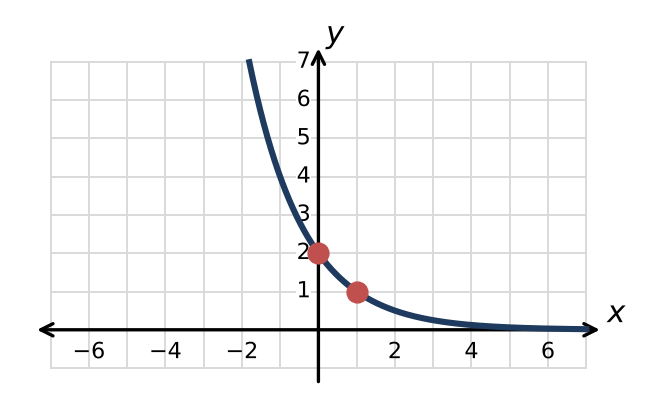
- The marked points are (0, 2) and (1, 1).
- For f(x) = a · bˣ, f(0) = a = 2.
- Then f(1) = a · b.
- So b = 1 ÷ 2 = .
- So f(x) = 2 · (0.5)ˣ.
- A (f(x) = 2 · 2ˣ): inverted the base (growth versus decay)
- C (f(x) = −x + 2): fitted a line through the two marked points
- D (f(x) = (0.5)ˣ): used the value at x = 1 as the starting value
Function Concepts
A function gives exactly one output for each input. Evaluate by substitution, solve f(x) = k, and read domain, range, intercepts and maximum or minimum values from a graph or table.
| Evaluate | |
| Solve f(x) = k | |
| x-intercept | |
| y-intercept | |
| Vertical line test |
Linear versus nonlinear
Method. Equal steps in x must give equal changes in y for a linear function.
Worked example- Find the change in y for each step of 1 in x: −4 − (−3) = −1, −7 − (−4) = −3, −12 − (−7) = −5, −19 − (−12) = −7.
- The changes are not all equal.
- So the function is nonlinear.
- A (Linear, because the x-values increase by 1): looked only at the x-values
- B (Linear, because y changes by −1 each time x increases by 1): used only the first change in y
- D (Linear, because each y-value is a whole number): thought whole-number outputs mean linear
Function notation — evaluating
Method. Put negative inputs in parentheses; square before multiplying by the coefficient.
Worked example- Substitute x = −3 with parentheses: f(−3) = 4 + 4(−3) − 1.
- Square first: = 9.
- Then 36 − 12 − 1 = 23.
- B (25): made a sign error with the constant
- C (47): evaluated f(3) instead of f(−3)
- D (131): multiplied by 4 before squaring
Reading key features from graphs
Method. Inputs are read on the x-axis, outputs on the y-axis.
Worked example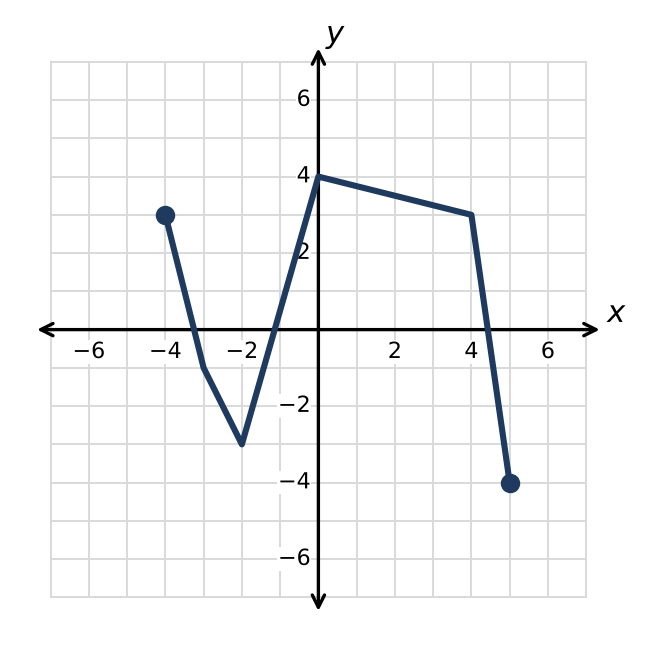
- The domain is the set of x-values the graph covers.
- The graph starts at x = −4 and ends at x = 5, with both endpoints included.
- So the domain is −4 ≤ x ≤ 5.
- A (−4 ≤ x ≤ 4): gave the y-values (range) instead of the x-values
- B (−4 < x < 5): left out the endpoints
- C (all real numbers): assumed the graph continues forever
Nonlinear patterns
Method. If the changes grow by a constant amount, compare the outputs with the square numbers.
Worked example- The changes in output are 3, 5, 7, which grow by 2.
- So the rule involves squaring.
- Compare with the squares: −1 = − 2, 2 = − 2, 7 = − 2, 14 = − 2.
- The rule is output = (input)² − 2.
- For 10: − 2 = 98.
- A (18): doubled the input instead of squaring it
- B (56): continued with the last change in y as if the function were linear
- C (68): added the next change in y once for every step
Range
Method. Range of a parabola = from the vertex y-value upward (a > 0) or downward (a < 0).
Worked example- The vertex form a + k has vertex (−3, 5).
- Since a = 2 is positive, the parabola opens up.
- So 5 is the least value.
- The range is y ≥ 5.
- B (y ≤ 5): reversed the direction of the parabola
- C (y ≥ −3): used the x-coordinate of the vertex
- D (y ≥ −5): used the wrong sign for the vertical shift