Linear Functions: Study Guide
Algebra is about 35% of SAT Math (13–15 of 44 questions). This topic covers linear functions f(x) = mx + b: slope as a rate of change, the initial value, building a function from a table, two points or a context, and interpreting slope and intercept in words with units.
Linear Functions
A linear function has a constant rate of change. Use slope-intercept or point-slope form.
Key formulas| Slope | |
| Slope-intercept | |
| Point-slope | |
| Standard form |
Rate of change from a table
Method. Divide the change in y by the change in x — check the x-step, it may not be 1.
Worked example- Rate of change = (change in y) ÷ (change in x).
- From (0, 5) to (3, 26): (26 − 5) ÷ (3 − 0) = 21 ÷ 3 = 7.
- A (−7): made a sign error
- B (): divided the change in x by the change in y
- D (21): used the change in y without dividing by the change in x
Initial value from a table
Method. Initial value = first y − rate × first x.
Worked example- Rate of change: (83 − 58) ÷ 5 = 5.
- Going from x = 10 back to x = 0 is 10 units.
- So y changes by 5 × (−10) = −50.
- So y(0) = 58 − 50 = 8.
- B (53): went back only one unit of x
- C (58): gave the first y-value in the table
- D (108): added the rate instead of subtracting it
Rate and initial value in context
Method. Two data points → rate = Δamount ÷ Δtime; initial value = amount − rate × time.
Worked example- Rate = (change in amount) ÷ (change in time).
- Rate = (70 − 43) ÷ (6 − 3) = 27 ÷ 3.
- So Rate = 9 centimeters per day.
- A (−9): made a sign error (ignored whether the amount went up or down)
- B (): divided the change in time by the change in amount
- D (27): gave the total change instead of the rate
Slope and intercept from a graph
Method. Slope = rise/run between two exact grid points; y-intercept = where the line crosses the y-axis.
Worked example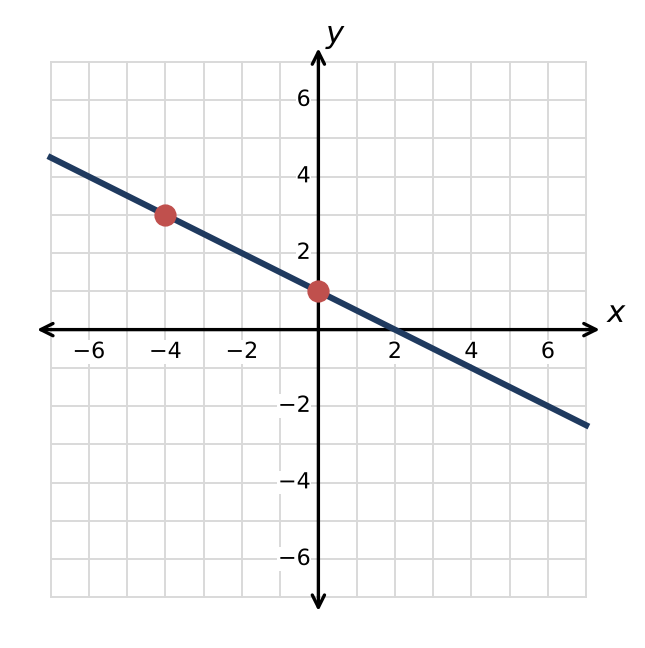
- The marked points are (−4, 3) and (0, 1).
- Slope = rise ÷ run = (1 − 3) ÷ (0 − (−4)) = −2 ÷ 4 = −.
- A (−2): used run over rise
- C (): made a sign error
- D (1): gave the y-intercept
Interpreting slope and intercept
Method. Coefficient of the input = rate per unit; constant = value at input 0.
Worked example- In a linear model output = (rate) × input + (starting value), the number multiplying w is the rate and the constant is the value when w = 0.
- 167 is the constant: when w = 0, A = 167.
- So it is the starting amount on the gift card.
- B (the number of dollars spent from the card each week): confused the starting amount with the rate
- C (the amount left after w weeks): described the output variable
- D (the number of weeks the card is used): described the input variable
Linear function from two points
Method. Slope from the two points, then b = y − mx with either point.
Worked example- Slope: (−23 − (−5)) ÷ (8 − 2) = −18 ÷ 6 = −3.
- Intercept: substitute (2, −5) into y = −3x + b: −5 = −6 + b.
- So b = 1.
- The equation is y = −3x + 1.
- A (y = x − ): divided the change in x by the change in y
- C (y = −3x − 11): made a sign error finding the intercept
- D (y = 3x − 11): made a sign error in the slope
Comparing linear models
Method. Equal cost: difference in fees ÷ difference in rates.
Worked example- Set the costs equal: 48 + 18m = 64 + 17m.
- Subtract 17m and 48 from both sides: m = 16.
- So the plans cost the same after 16 months.
- A (): added the fees and the rates:
- C (17): added 1 to the correct number of months
- D (336): gave the equal cost instead of the number of months
Arithmetic sequences as linear functions
Method. Arithmetic sequence = linear function of n with slope = common difference.
Worked example- The common difference 2 is the slope.
- Term n = −7 + (n − 1)(2) = 2n − 9.
- So f(n) = 2n − 9.
- A (f(n) = 2n − 7): used the first term as the constant
- B (f(n) = −7n + 2): swapped the first term and the difference
- C (f(n) = 2n − 5): added the difference instead of subtracting it
Solving with linear models
Method. Undo the model: subtract the start value, divide by the rate.
Worked example- Substitute C = 123: 123 = 15h + 63.
- Subtract 63: 60 = 15h.
- Divide by 15: h = 4.
- B (): ignored the constant
- C (): added the constant instead of subtracting it
- D (1908): evaluated C at 123 instead of solving
Linear Models in Context
In y = mx + b, m is the rate (change in y per unit of x, with units) and b is the starting value when x = 0.
Key formulas| Model | |
| Slope meaning |
Interpreting linear models
Method. Change in output = slope × change in input; the constant cancels.
Worked example- The coefficient 45 is the change in C for each increase of 1 in h.
- For an increase of 2: 45 × 2 = 90 dollars.
- The constant 50 does not change.
- A (45): gave the increase for 1 unit, not 2
- B (47): added 2 instead of multiplying
- D (140): added the starting value