Algebra: Unit Study Guide
- 01.01 Linear Equations in One Variable
- 01.02 Linear Functions
- 01.03 Linear Equations in Two Variables
- 01.04 Systems of Two Linear Equations
- 01.05 Linear Inequalities
01.01 Linear Equations in One Variable
Algebra is about 35% of SAT Math (13–15 of 44 questions). This topic covers solving linear equations in one variable: distributing, combining like terms, variables on both sides, fractions and decimals, and deciding whether an equation has one solution, no solution or infinitely many. SAT items often ask for the value of an expression such as 3x + 2 rather than x itself, so look for a shortcut before solving.
Linear Equations
Undo operations in reverse order, doing the same thing to both sides. Clear fractions first by multiplying by the common denominator, and check by substituting.
Key formulas| Inverse operations | |
| Clearing fractions | |
| Literal equations | |
| No solution | |
| Infinitely many solutions |
Multi-step equations — distributing
Method. Divide both sides by 2 first: x + 4 = 10, so x = 6.
Worked example- Distribute: 2x + 8 = 20.
- Subtract 8: 2x = 12.
- Divide by 2: x = 6.
- B (8): multiplied only x by 2
- C (12): forgot to divide by 2
- D (14): used the wrong sign when moving the constant
Variables on both sides
Method. Collect x-terms on one side and numbers on the other; then divide.
Worked example- Subtract 2x from both sides: 19x + 38 = −38.
- Subtract 38: 19x = −76.
- Divide by 19: x = −4.
- B (−): added the x-terms instead of subtracting
- C (0): added the constants instead of subtracting
- D (4): made a sign error moving the constants
Multi-step equations — combining like terms
Method. Distribute, combine like terms on each side, then solve the two-step equation.
Worked example- Distribute: 6x + 36 + 6x + 5 = 65.
- Combine like terms: 12x + 41 = 65.
- So 12x = 24 and x = 2.
- B (4): did not combine the x-terms
- C (): multiplied only x by 6
- D (): used the wrong sign when moving the constants
Number of solutions
Method. Compare x-coefficients first, then constants.
Worked example- Distribute the left side to get 3x + 27.
- Equal x-coefficients with different constants give no solution.
- Identical sides give infinitely many.
- Different x-coefficients give exactly one.
- 3(x + 9) = 3x + 31 has no solution.
- A (3(x + 9) = 3x + 27): chose an equation that has infinitely many solutions
- B (3(x + 9) = 5x + 29): chose an equation that has exactly one solution
- C (3(x + 9) = 5x + 23): chose an equation that has exactly one solution
Solving for an expression
Method. No need to find x: 18x − 2 = 3(6x − 2) + 4 = 3(4) + 4 = 16.
Worked example- x = = 1.
- Then 18x − 2 = 18(1) − 2 = 16.
- A (1): gave x instead of the value of the expression
- B (12): forgot the change to the constant (multiplied the equation by 3 only)
- D (18): left out the constant term
Equations from word problems — ages
Method. Take away the difference and share equally: (32 − 4) ÷ 2 = 14 for Leo; add 4 for Maya.
Worked example- Let Leo be L.
- Then Maya is L + 4, and L + (L + 4) = 32.
- So 2L = 28 and L = 14.
- Maya is 18.
- A (14): gave Leo's age
- B (16): ignored the difference in ages and split the sum equally
- D (28): forgot to divide by 2
Equations from word problems — perimeter
Method. Half the perimeter is length + width = 40: 5w = 40, so w = 8.
Worked example- Let the width be w.
- Length = 4w.
- Perimeter: 2w + 2(4w) = 80.
- So 10w = 80 and w = 8.
- Length = 32.
- B (16): used the perimeter as one length plus one width
- C (32): gave the length
- D (40): gave half the perimeter
Parameters — infinitely many solutions
Method. Infinitely many solutions ⇔ both sides are the same expression; match the constants.
Worked example- Distribute: 5x + 25 = 5x + m.
- The x-terms already match.
- So the equation is true for every x exactly when the constants match: m = 10 + 15 = 25.
- A (−25): changed the sign of the answer
- B (−5): used the wrong sign for the constant
- C (17): did not multiply 2 by 5
Solving equations with letters
Method. Treat the letters as numbers and undo each operation in reverse order.
Worked example- Subtract cx from both sides and add b to both sides: ax − cx = d + b.
- Factor out x: x(a − c) = d + b.
- Since a ≠ c, divide by a − c: x = .
- B (x = ): subtracted b instead of adding it
- C (x = ): added the x-coefficients instead of subtracting
- D (x = ): subtracted the x-coefficients in the wrong order
Linear models — when are two costs equal?
Method. Difference in fixed fees ÷ difference in rates = 22 ÷ 1 = 22.
Worked example- Set the costs equal: 22 + 1.5m = 44 + 0.5m.
- Then (1.5 − 0.5)m = 44 − 22.
- So m = 22.
- A (11): added the per-unit rates instead of subtracting
- C (44): divided by B's per-unit rate only
- D (66): added the fixed fees instead of subtracting
Parameters — no solution
Method. No solution ⇔ same x-coefficient on both sides and different constants.
Worked example- Collect x-terms: (k − (−8))x = 9.
- Since 9 ≠ 0, there is no solution exactly when the x-coefficient is 0: k = −8.
- B (0): thought k = 0 makes the equation have no solution
- C (8): changed the sign of the coefficient
- D (9): set k equal to the difference of the constants
Parameters — matching coefficients
Method. Identical sides: match the x-coefficients and the constants.
Worked example- Distribute the left side: 12x + 31.
- For the equation to hold for every x, the coefficients and the constants must match: a = 12 and b = 31.
- So a + b = 43.
- A (−19): subtracted b instead of adding
- B (21): did not multiply 2 by 12
- C (31): gave only b
Equations from Words
Name the unknown, translate each phrase into algebra, solve, and answer the question that was asked.
Key formulas| Consecutive integers | |
| Consecutive even or odd | |
| Translate |
Consecutive integers
Method. The middle (average) is 62 ÷ 4; step out from the middle.
Worked example- Let the smallest be n.
- The 4 consecutive integers are n, n + 1, n + 2, n + 3.
- Their sum: 4n + 6 = 62.
- Subtract 6: 4n = 56.
- Divide: n = 14.
- The smallest is 14.
- A (13): counted one step too far
- C (15): added 1 to the smallest number
- D (17): gave the largest number
Writing equations from words
Method. Fixed amount = constant; per-unit amount = coefficient of x.
Worked example- The fee is paid once: 60.
- The rate is paid for each of the x months: 45x.
- Total cost = fee + rate × x.
- So 60 + 45x = 555.
- A (45(60 + x) = 555): multiplied the fee by the rate
- B (45 + 60x = 555): swapped the fixed fee and the rate
- C (45x = 555 + 60): added the fee to the total instead of to the cost
01.02 Linear Functions
Algebra is about 35% of SAT Math (13–15 of 44 questions). This topic covers linear functions f(x) = mx + b: slope as a rate of change, the initial value, building a function from a table, two points or a context, and interpreting slope and intercept in words with units.
Linear Functions
A linear function has a constant rate of change. Use slope-intercept or point-slope form.
Key formulas| Slope | |
| Slope-intercept | |
| Point-slope | |
| Standard form |
Rate of change from a table
Method. Divide the change in y by the change in x — check the x-step, it may not be 1.
Worked example- Rate of change = (change in y) ÷ (change in x).
- From (0, 5) to (3, 26): (26 − 5) ÷ (3 − 0) = 21 ÷ 3 = 7.
- A (−7): made a sign error
- B (): divided the change in x by the change in y
- D (21): used the change in y without dividing by the change in x
Initial value from a table
Method. Initial value = first y − rate × first x.
Worked example- Rate of change: (83 − 58) ÷ 5 = 5.
- Going from x = 10 back to x = 0 is 10 units.
- So y changes by 5 × (−10) = −50.
- So y(0) = 58 − 50 = 8.
- B (53): went back only one unit of x
- C (58): gave the first y-value in the table
- D (108): added the rate instead of subtracting it
Rate and initial value in context
Method. Two data points → rate = Δamount ÷ Δtime; initial value = amount − rate × time.
Worked example- Rate = (change in amount) ÷ (change in time).
- Rate = (70 − 43) ÷ (6 − 3) = 27 ÷ 3.
- So Rate = 9 centimeters per day.
- A (−9): made a sign error (ignored whether the amount went up or down)
- B (): divided the change in time by the change in amount
- D (27): gave the total change instead of the rate
Slope and intercept from a graph
Method. Slope = rise/run between two exact grid points; y-intercept = where the line crosses the y-axis.
Worked example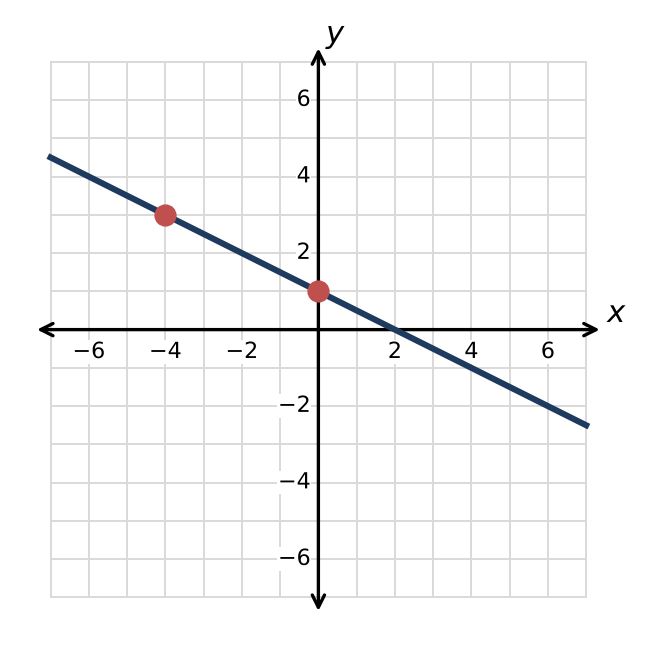
- The marked points are (−4, 3) and (0, 1).
- Slope = rise ÷ run = (1 − 3) ÷ (0 − (−4)) = −2 ÷ 4 = −.
- A (−2): used run over rise
- C (): made a sign error
- D (1): gave the y-intercept
Interpreting slope and intercept
Method. Coefficient of the input = rate per unit; constant = value at input 0.
Worked example- In a linear model output = (rate) × input + (starting value), the number multiplying w is the rate and the constant is the value when w = 0.
- 167 is the constant: when w = 0, A = 167.
- So it is the starting amount on the gift card.
- B (the number of dollars spent from the card each week): confused the starting amount with the rate
- C (the amount left after w weeks): described the output variable
- D (the number of weeks the card is used): described the input variable
Linear function from two points
Method. Slope from the two points, then b = y − mx with either point.
Worked example- Slope: (−23 − (−5)) ÷ (8 − 2) = −18 ÷ 6 = −3.
- Intercept: substitute (2, −5) into y = −3x + b: −5 = −6 + b.
- So b = 1.
- The equation is y = −3x + 1.
- A (y = x − ): divided the change in x by the change in y
- C (y = −3x − 11): made a sign error finding the intercept
- D (y = 3x − 11): made a sign error in the slope
Comparing linear models
Method. Equal cost: difference in fees ÷ difference in rates.
Worked example- Set the costs equal: 48 + 18m = 64 + 17m.
- Subtract 17m and 48 from both sides: m = 16.
- So the plans cost the same after 16 months.
- A (): added the fees and the rates:
- C (17): added 1 to the correct number of months
- D (336): gave the equal cost instead of the number of months
Arithmetic sequences as linear functions
Method. Arithmetic sequence = linear function of n with slope = common difference.
Worked example- The common difference 2 is the slope.
- Term n = −7 + (n − 1)(2) = 2n − 9.
- So f(n) = 2n − 9.
- A (f(n) = 2n − 7): used the first term as the constant
- B (f(n) = −7n + 2): swapped the first term and the difference
- C (f(n) = 2n − 5): added the difference instead of subtracting it
Solving with linear models
Method. Undo the model: subtract the start value, divide by the rate.
Worked example- Substitute C = 123: 123 = 15h + 63.
- Subtract 63: 60 = 15h.
- Divide by 15: h = 4.
- B (): ignored the constant
- C (): added the constant instead of subtracting it
- D (1908): evaluated C at 123 instead of solving
Linear Models in Context
In y = mx + b, m is the rate (change in y per unit of x, with units) and b is the starting value when x = 0.
Key formulas| Model | |
| Slope meaning |
Interpreting linear models
Method. Change in output = slope × change in input; the constant cancels.
Worked example- The coefficient 45 is the change in C for each increase of 1 in h.
- For an increase of 2: 45 × 2 = 90 dollars.
- The constant 50 does not change.
- A (45): gave the increase for 1 unit, not 2
- B (47): added 2 instead of multiplying
- D (140): added the starting value
01.03 Linear Equations in Two Variables
Algebra is about 35% of SAT Math (13–15 of 44 questions). This topic covers lines in the coordinate plane: slope from two points or a graph, slope-intercept, point-slope and standard form, intercepts, and parallel and perpendicular lines.
Equations of Lines
Find the slope, then use a point to write the equation. Parallel lines share slopes; perpendicular slopes are negative reciprocals.
Key formulas| Slope | |
| Slope-intercept | |
| Point-slope | |
| Standard form | |
| Intercepts | |
| Parallel lines | |
| Perpendicular lines |
Slope from two points
Method. Rise over run: change in y on top, change in x below, both in the same order.
Worked example- Slope = .
- Slope = = −.
- So Slope = 5.
- A (−5): subtracted the coordinates in opposite orders
- B (): divided the change in x by the change in y
- C (1): added the coordinates instead of subtracting
Slope from a graph
Method. The line rises from left to right, so the slope is positive; count rise ÷ run between the dots.
Worked example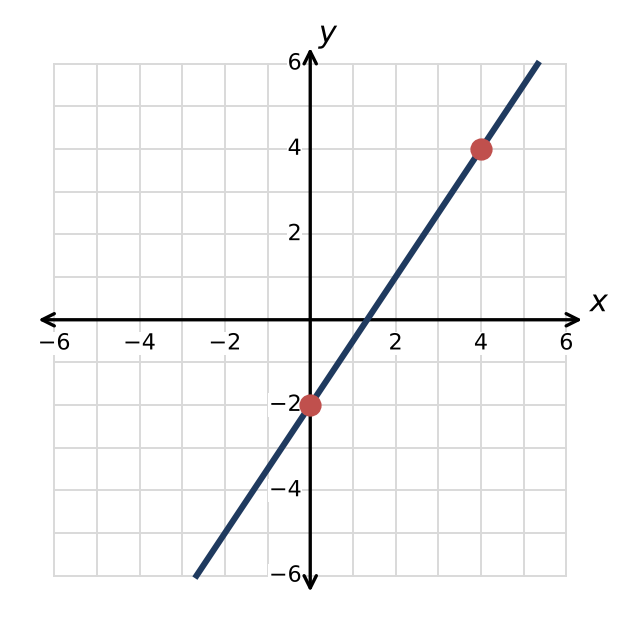
- The marked points are (0, −2) and (4, 4).
- Slope = = .
- A (−): read the direction of the line the wrong way
- B (): divided run by rise
- D (3): gave the rise for a run of 2 (3 units) without dividing by the run
Slope as a rate of change
Method. The rate is the slope: Δ(amount)/Δ(time).
Worked example- Rate = change in amount ÷ change in time.
- Rate = = .
- So Rate = 30 pages per minute.
- B (): divided the second amount by its time (ignored the starting amount)
- C (): added the amounts and the times
- D (40): divided the first amount by its time (ignored the starting amount)
Equation of a line from its graph
Method. Read b where the line meets the y-axis; count rise/run for m.
Worked example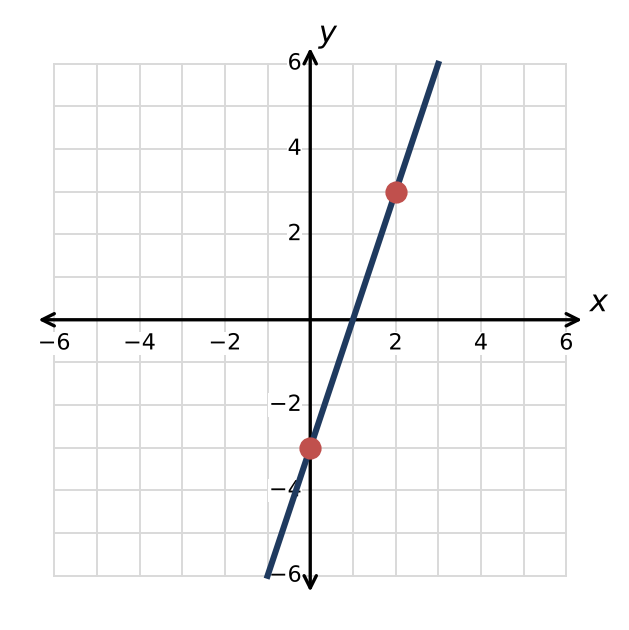
- The line crosses the y-axis at (0, −3).
- So b = −3.
- Between the marked points (0, −3) and (2, 3) the slope is 3.
- Equation: y = 3x − 3.
- B (y = −3x − 3): used the wrong sign for the slope
- C (y = x − 3): used run over rise for the slope
- D (y = 3x + 3): used the wrong sign for the y-intercept
Points on a line
Method. Plug each x-value into the equation and compare the y-value.
Worked example- Substitute x = −3: y = (−3) − 7 = −3.
- So (−3, −3) is on the line.
- A ((−3, 11)): used the wrong sign for the y-intercept
- B ((−3, −11)): used the wrong sign for the slope
- C (): swapped the roles of m and b
Point-slope form
Method. b = y₁ − m·x₁ = 9 − (8) = 5.
Worked example- Point-slope: y − 9 = (x − 8).
- Distribute and solve for y: y = x − 4 + 9 = x + 5.
- A (y = x + 13): used the wrong sign when solving for b
- B (y = x − 5): solved for b with both signs reversed
- C (y = x + 9): used the y-coordinate of the point as the y-intercept
Equation through two points
Method. Find m from the two points, then b from either point.
Worked example- Slope: = −2.
- Then b = −18 − (−2)(6) = −6.
- Equation: y = −2x − 6.
- A (y = −x − 15): used run over rise for the slope
- C (y = 2x − 30): used the wrong sign for the slope
- D (y = −2x − 30): used the wrong sign when solving for b
Slope from standard form
Method. For Ax + By = C the slope is −.
Worked example- Solve for y: y = 3x − 2.
- The slope is the coefficient of x, so the slope is 3.
- A (−3): forgot the negative sign in − (used = −)
- B (−2): gave the y-intercept instead of the slope
- C (): used − instead of −: − =
Parallel lines
Method. Keep the slope; find the new b from the point.
Worked example- Parallel lines have equal slopes: m = 1.
- b = −3 − (1)(−6) = 3.
- Equation: y = x + 3.
- B (y = −x − 9): used the perpendicular slope
- C (y = x − 5): copied the original line
- D (y = x − 9): used the wrong sign when solving for b
Parallel and perpendicular — classifying
Method. Put both in y = mx + b and compare m (and b).
Worked example- Rewrite the second line: y = −x − 5, slope −1, y-intercept −5.
- The first has slope −1, y-intercept −5.
- Equal slopes and equal intercepts: the same line.
- A (parallel): compared only the slopes and ignored the intercepts
- B (perpendicular): thought the slopes multiply to −1
- C (neither parallel nor perpendicular): missed that the slopes are equal
Intercepts of a line
Method. Cover-up method: hide the y-term to get the x-intercept, hide the x-term to get the y-intercept.
Worked example- x-intercept: set y = 0, −6x = −48, x = 8.
- y-intercept: set x = 0, −8y = −48, y = 6.
- B (x-intercept (6, 0), y-intercept (0, 8)): swapped the two intercepts
- C (x-intercept (−8, 0), y-intercept (0, −6)): made a sign error on both intercepts
- D (x-intercept (−6, 0), y-intercept (0, −8)): used the coefficients as the intercepts
Linear models — interpreting coefficients
Method. The coefficient of the input variable is the rate (dollars per month); the constant term is the starting (fixed) amount.
Worked example- In C = 50m + 35, the number 50 multiplies m, so it is the slope: the change in C when m increases by 1.
- The number 35 is the value of C when m = 0, the one-time fee.
- So 50 is the cost, in dollars, for each additional month.
- A (the one-time fee, in dollars, charged at the start): mixed up the slope and the y-intercept
- B (the total cost, in dollars, for one month): confused the monthly rate with the total cost for one month, which is 50 + 35 = 85
- C (the number of months in the membership): confused the coefficient with the input variable m
Perpendicular lines
Method. Flip the slope and change its sign; then find b from the point.
Worked example- Perpendicular slopes are opposite reciprocals: − = .
- b = 8 − (−12) = 24.
- Equation: y = x + 24.
- A (y = x + 17): used only the opposite sign (not the reciprocal)
- B (y = −x − 8): used only the reciprocal (not the opposite sign)
- D (y = −x − 1): used the same slope (parallel, not perpendicular)
01.04 Systems of Two Linear Equations
Algebra is about 35% of SAT Math (13–15 of 44 questions). This topic covers systems of two linear equations: substitution, elimination, reading the solution from a graph, and the number of solutions (one, none or infinitely many). Desmos can show the intersection, but the parameter questions need algebra.
Systems of Linear Equations
Solve by substitution or elimination, or read the intersection on a graph (Desmos). Compare slopes to count solutions: different slopes give one solution, same slope with different intercepts gives none, and the same line gives infinitely many.
Key formulas| Elimination | |
| Substitution | |
| One solution | |
| No solution | |
| Infinitely many solutions | |
| No solution (coefficients) | |
| Infinitely many (coefficients) |
Systems — substitution
Method. When one equation already gives y, substitute it straight into the other.
Worked example- Substitute y = x + 1 into the second equation: 4x + 4(x + 1) = −84.
- So 8x + 4 = −84.
- So x = −11.
- Then y = 1(−11) + 1 = −10.
- A ((−10, −11)): swapped x and y
- C ((−11, −12)): used the wrong sign for b when finding y
- D ((−10, −9)): used the wrong sign for the constant after substituting
Systems — elimination
Method. Scale the equations so one variable has opposite (or equal) coefficients, then add (or subtract).
Worked example- Multiply the first equation by 6 and the second by 2.
- Then subtract to eliminate y: (−30 − (−2))x = 240 − 128.
- So −28x = 112 and x = −4.
- Substitute into the first equation: −5(−4) + 2y = 40.
- So y = 10.
- A ((10, −4)): swapped x and y
- B ((4, 10)): found y = 10 correctly but solved −28x = 112 with a sign error, x = 4
- D ((−4, −10)): isolated y in 20 + 2y = 40 as 2y = 20 − 40 = −20 (sign error), so y = −10
Systems — checking a solution
Method. Test each choice in BOTH equations; one failure rules it out.
Worked example- A solution must make both equations true.
- (7, 5): 5(7) + (−1)(5) = 30 ✓ and 1(7) + 2(5) = 17 ✓.
- B ((6, 0)): checked only the first equation
- C ((1, 8)): checked only the second equation
- D ((5, 7)): swapped the coordinates of the solution
Systems — number of solutions
Method. Compare slopes : different → one solution; same slope, different intercept → none; identical lines → infinitely many.
Worked example- Compare the equations: the second is 3 times the first.
- So they are the same line — infinitely many solutions.
- A (no solution): thought equal slopes always mean no solution
- B (exactly one solution): thought different-looking equations must cross once
- D (exactly two solutions): thought two lines can meet at two points
Number of solutions — equivalent forms
Method. Multiply y = x − by 15: 15y = 10x − 25, which is the second equation rearranged.
Worked example- Expand the first equation: y = x − + 1 = x − .
- Solve the second equation for y: 15y = 10x − 25, so y = x − .
- Both equations describe the same line.
- So the system has infinitely many solutions.
- A (Zero): expanded (x − 4) as x − 4, getting y = x − 3: same slope but a different intercept, so parallel lines
- B (Exactly one): solved the second equation as y = x − (inverted the coefficient ratio), so the slopes looked different
- C (Exactly two): treated the system as if two lines could meet in two points
Systems — parameter for no solution
Method. Same slope, different intercept ⇒ no solution: match the coefficient ratio.
Worked example- No solution means parallel lines: the x- and y-coefficients must be in the same ratio while the constants are not.
- The y-coefficients give the ratio = 2.
- So k = 2 × (−1) = −2.
- The constants 5 and 2 × 4 = 8 differ.
- So the lines are parallel.
- B (−1): matched the coefficient without scaling
- C (1): added the scale factor instead of multiplying: −1 + 2 = 1
- D (2): made a sign error in the matching coefficient
Systems — parameter for infinitely many solutions
Method. Infinitely many solutions ⇔ one equation is a constant multiple of the other.
Worked example- The second equation must be a multiple of the first.
- Its x-coefficient is 12 = −2 × (−6).
- So the factor is −2 and c = −2 × (−5) = 10.
- A (−10): made a sign error when scaling
- B (−7): added the scale factor instead of multiplying
- C (−5): did not scale the constant
Systems — finding an expression directly
Method. Combine the equations so the coefficients of x and y become opposite; then divide.
Worked example- Subtract the second equation from the first: 5x − 5y = −5, which is 5(x − y) = −5.
- So x − y = −1.
- (Here x = 3 and y = 4.)
- B (3): gave x only
- C (7): found x + y instead
- D (71): added the equations but did not divide
Systems from Word Problems
Write one equation for each total (number of items, total value), then solve by elimination or substitution.
Key formulas| Two totals |
Systems from word problems
Method. If all 182 were child tickets: 910; each adult ticket adds 5, so adults = (1390 − 910) ÷ 5.
Worked example- Let x = adult tickets and y = child tickets.
- Then x + y = 182 and 10x + 5y = 1390.
- Substitute y = 182 − x: 10x + 5(182 − x) = 1390.
- So 5x + 910 = 1390, 5x = 480, and x = 96.
- Then y = 182 − 96 = 86.
- The number of child tickets is 86.
- A (43): assumed all 182 tickets were adult ($1,820), then divided the $430 difference by the $10 adult price instead of the $5 price difference
- C (91): split the tickets equally
- D (96): gave the number of adult tickets
01.05 Linear Inequalities
Algebra is about 35% of SAT Math (13–15 of 44 questions). This topic covers linear inequalities in one and two variables: solving and graphing, reversing the inequality sign when multiplying or dividing by a negative number, compound inequalities, and writing an inequality from a context.
Linear Inequalities
Solve like an equation, but reverse the sign when you multiply or divide by a negative number. A two-variable inequality is a half-plane: test a point to decide which side is shaded; a solid boundary means ≤ or ≥.
Key formulas| Flip rule | |
| Compound (and) | |
| Two variables | |
| Test a point |
Solving inequalities — negative coefficient
Method. Dividing (or multiplying) both sides by a negative number reverses the inequality.
Worked example- Add 15: −11x > −121.
- Divide by −11 and reverse the sign (dividing by a negative): x < 11.
- A (x > 11): forgot to reverse the sign when dividing by a negative number
- B (x < −11): dropped the negative sign of the coefficient but still reversed the sign
- C (x > −11): divided by the positive number instead of the negative one
Inequalities with variables on both sides
Method. Collect x on one side; watch for dividing by a negative.
Worked example- Move the x-terms to the left: 13x > 26.
- Divide by 13: x > 2.
- A (x < 2): reversed the sign without dividing by a negative
- C (x < −): subtracted 8x from both sides instead of adding it: −3x > 26, so x < −
- D (x > ): used the wrong sign when moving the constant
Compound inequalities — and
Method. Treat the middle as the target and apply each step to all three parts.
Worked example- Do the same thing to all three parts.
- Add 2: 2 < 2x ≤ 12.
- Divide by 2: 1 < x ≤ 6.
- B (0 < x ≤ 5): divided all three parts by 2 but did not add 2 first (0 < x ≤ 5)
- C (2 < x ≤ 12): added 2 to all three parts but did not divide by 2 (2 < x ≤ 12)
- D (1 ≤ x < 6): switched which endpoints are included
Compound inequalities — or
Method. “Or” keeps everything from both parts; “and” keeps only the overlap.
Worked example- Solve each part.
- 3x − 7 < −22 gives x < −5.
- 2x + 1 > 3 gives x > 1.
- With “or”, the solution is either part: x < −5 or x > 1.
- A (−5 < x < 1): took the values between the endpoints instead of outside them
- B (x > −5 or x < 1): reversed both inequality signs
- D (x ≤ −5 or x ≥ 1): included the endpoints
Greatest or least integer solution
Method. Solve, then step to the nearest integer on the allowed side (exclude the boundary for < or >).
Worked example- 5x ≤ 110.
- So x ≤ 22.
- The greatest integer that works is 22.
- A (21): stopped one integer short
- C (23): went one integer past the boundary
- D (28): added the constant instead of subtracting it
Inequality word problems
Method. Subtract the fixed fee, divide by the price, and round DOWN.
Worked example- Let n be the number of rides: 34 + 16n ≤ 148.
- Then 16n ≤ 114.
- So n ≤ ≈ 7.12.
- The greatest whole number is 7.
- A (2): added the fee to the price of each one
- C (8): rounded up instead of down
- D (9): ignored the one-time fee
Two-variable inequalities — solutions
Method. Points that satisfy it lie above the line y = 3x − 2 (or on it).
Worked example- Substitute the point.
- For (−4, 5), 3(−4) − 2 = −14, and y = 5 ≥ −14 ✓.
- B ((3, −2)): chose a point below the line
- C ((0, −4)): chose a point below the line
- D ((4, −6)): chose a point below the line
Two-variable inequalities — graphs
Method. Line: read the y-intercept and slope. Dashed → < or >; solid → ≤ or ≥. Above → y >; below → y <.
Worked example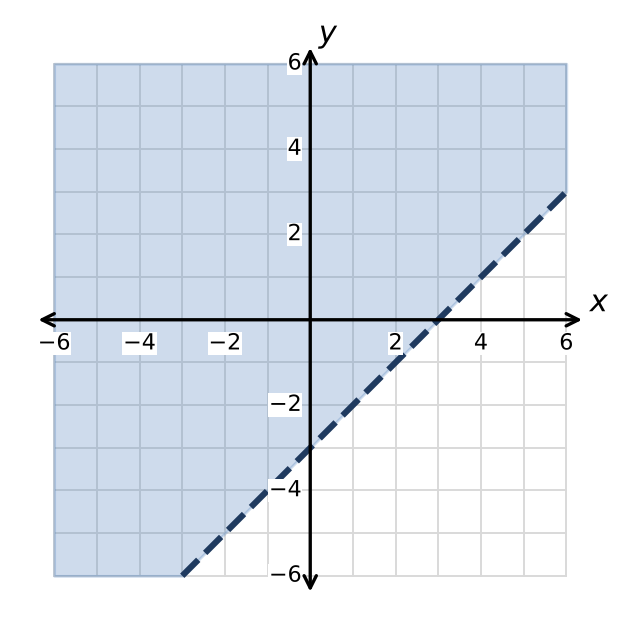
- The boundary passes through (0, −3) with slope 1.
- So it is y = x − 3.
- It is dashed (not included) and the shading is above the line: y > x − 3.
- A (y ≥ x − 3): misread the dashed/solid boundary line
- B (y < x − 3): chose the wrong side of the line
- C (y > −x − 3): used the wrong sign for the slope
Systems of linear inequalities
Method. A solution of a system must satisfy every inequality; test each choice in both.
Worked example- Test (−3, −1) in both.
- −1 ≥ −1 ✓ and −1 < 5 ✓.
- B ((2, 6)): checked only the first inequality
- C ((1, −4)): checked only the second inequality
- D ((3, −6)): chose a point that satisfies neither inequality
Inequalities in Context
"At least" means ≥, "at most" or "no more than" means ≤. Round to a whole number in the direction the situation allows.
Key formulas| At least | |
| At most / no more than | |
| Budget |
Writing inequalities from words
Method. “At most / no more than” → ≤; “at least” → ≥; “more than” → >; “less than” → <.
Worked example- Total spent = fee + price × rides = 12 + 7n.
- “More than” 120 means > 120.
- So 12 + 7n > 120.
- A (12 + 7n < 120): reversed the inequality sign
- B (7n > 120): left out the fixed fee
- C (12 + 7n ≥ 120): changed whether the boundary is included