Advanced Math: Unit Study Guide
- 02.01 Equivalent Expressions
- 02.02 Nonlinear Equations in One Variable
- 02.03 Systems of Linear and Nonlinear Equations
- 02.04 Quadratic Functions
- 02.05 Exponential Functions
- 02.06 Polynomial, Rational, Radical and Absolute-Value Functions
- 02.07 Function Notation, Composition and Transformations
- 02.08 Modeling with Nonlinear Functions
02.01 Equivalent Expressions
Advanced Math is about 35% of SAT Math (13–15 of 44 questions). This topic covers rewriting expressions in equivalent forms: polynomial arithmetic and factoring, exponent laws and rational exponents, radicals, and rational expressions. The SAT often asks which expression is equivalent to a given one.
Polynomial Expressions
Combine like terms, distribute, and use the special-product patterns. To factor, take out the GCF first, then look for a trinomial pattern or a difference of squares. Equivalent-form questions often hide a factor or a quotient.
Key formulas| Square of a sum | |
| Square of a difference | |
| Difference of squares | |
| FOIL | |
| Trinomial | |
| Division |
Distributive property
Method. Multiply the outside number by EVERY term inside, keeping the sign of the outside number.
Worked example- Distribute: 6(−x − 7) = −6x − 42 and −5(−8x − 2) = 40x + 10.
- Combine: 34x − 32.
- B (34x − 44): multiplied only the first term in the second parentheses by −5
- C (−46x − 52): did not distribute the negative sign
- D (34x + 3): multiplied only the first term in the first parentheses by 6
Multiplying a monomial by a polynomial
Method. Multiply coefficients and ADD exponents for each term.
Worked example- 5 · 7x = 35 and 5 · −9 = −45.
- So the product is 35 − 45.
- A (35 − 9): multiplied −9 by but dropped the coefficient 5, so the second term became −9
- B (35 − 45x): multiplied the constant term by x instead of by
- D (35 − 45): multiplied by 5 instead of 5, so each power of x is one too low
Adding and subtracting polynomials
Method. Line up like terms (, x, constants); with subtraction, change every sign in the second polynomial.
Worked example- Distribute the minus sign to every term of the second polynomial.
- Then combine like terms: 4 + 3x − 3.
- A (4 − x + 1): changed the sign of only the first term of the second polynomial
- B (−6 − x + 1): added instead of subtracting
- D (4 − x − 3): did not change the sign of the x-term of the second polynomial
Multiplying binomials
Method. First, Outer, Inner, Last — then combine the two middle terms.
Worked example- FOIL: first 2x·6x = 12.
- Outer 2x·(−6) = −12x.
- Inner −5·6x = −30x.
- Last −5·(−6) = 30.
- Total: 12 − 42x + 30.
- B (12 + 30): multiplied only the first terms and the last terms
- C (12 + 18x + 30): subtracted the outer and inner products
- D (12 − 42x − 30): made a sign error on the last term
Special products
Method. Use the patterns = ± 2pq + and (p + q)(p − q) = − .
Worked example- = + 2pq + with p = 4x, q = −3.
- 16 + 2(4x)(−3) + 9 = 16 − 24x + 9.
- A (16 + 9): squared each term and forgot the middle term
- C (16 − 12x + 9): used ab instead of 2ab for the middle term
- D (16 + 24x + 9): used the wrong sign for the middle term
Factoring — greatest common factor
Method. Find the largest number and the lowest power of x that divide every term.
Worked example- Every term contains 6: 30 − 36 + 18 = 6.
- The trinomial 5 − 6x + 3 has no common factor left.
- A (6): dropped the last term, treating 18 ÷ 6 as 0 instead of 3
- B (6(5x − 6)): factored out , which does not divide 18, and lost the 18 term
- D (6): did not divide the last term by 6
Factoring trinomials (leading coefficient 1)
Method. Product = c, sum = b; the signs of c and b tell you the signs of the two numbers.
Worked example- Find two numbers with product 6 and sum 5: 3 and 2.
- So + 5x + 6 = (x + 3)(x + 2).
- B ((x − 3)(x − 2)): used the wrong signs in both factors
- C ((x + 3)(x − 2)): used the wrong sign in one factor
- D ((x − 3)(x + 2)): used the wrong sign in the other factor
Factoring — difference of squares
Method. − = (p + q)(p − q); take out any common factor first.
Worked example- Take out the common factor 3: 3.
- 25 − 36 = − .
- So it factors as (5x + 6)(5x − 6).
- A (3(5x − 6)(5x − 6)): wrote a perfect square instead of a difference of squares
- C (3(5x + 6)(5x + 6)): used + in both factors
- D (3(25x + 6)(x − 6)): did not take the square root of the coefficient
Factoring trinomials (leading coefficient ≠ 1)
Method. Check the outer and inner products of each candidate against the middle coefficient.
Worked example- Use the ac-method: a·c = 336.
- Find two numbers with product 336 and sum 40: 28 and 12.
- Split the middle term and group: 16 + 40x + 21 = (4x + 3)(4x + 7).
- A ((4x − 3)(4x − 7)): used the wrong signs in both factors
- C ((4x + 3)(4x − 7)): used the wrong sign in one factor
- D ((16x + 3)(x + 7)): put the whole leading coefficient in one factor
Factoring by grouping
Method. Pair the terms, factor each pair, then factor out the common binomial.
Worked example- Group the first two terms and the last two terms: + (−5x + 25).
- Factor out of the first group and −5 out of the second: (x − 5) − 5(x − 5).
- Factor out the common binomial (x − 5): (x − 5).
- A ((x + 5)): made a sign error when factoring the first group
- C ((x − 5)): made a sign error when factoring the second group
- D ((x − 5)(x − 5)): wrote x instead of in the common factor
Factoring — sum and difference of cubes
Method. SOAP: Same sign, Opposite sign, Always Positive.
Worked example- 8 − 1 = − .
- Use − = (p − q): (2x − 1).
- B ((2x − 1)): used the same sign in the middle of the trinomial
- C ((2x + 1)): used the wrong sign in the binomial
- D ((2x − 1)): used 2ab in the trinomial (as for a square)
Polynomial division
Method. Synthetic division uses the zero of the divisor, x = 1.
Worked example- Synthetic division with 1: bring down −1, multiply by 1 and add down the columns.
- Quotient − + x − 1, remainder 0.
- A (− + 3x − 5 + ): used −1 instead of 1 in synthetic division
- B (− − x − 1): made a sign error in the second coefficient of the quotient
- C (− + 2x − 2 + ): copied the first three coefficients as the quotient
Exponents and Radicals
Rewrite with the exponent laws; a rational exponent m/n means the nth root raised to the mth power.
Key formulas| Product rule | |
| Quotient rule | |
| Power rule | |
| Power of a product | |
| Zero exponent | |
| Negative exponent | |
| Fractional exponent | |
| Product of roots | |
| Rationalizing |
Exponent laws — product rule
Method. Multiply numbers, add exponents of the same base.
Worked example- Multiply the coefficients: 4 × 3 = 12.
- Same base.
- So add the exponents: · = .
- Answer: 12.
- B (12): multiplied the exponents instead of adding them
- C (7): added the coefficients instead of multiplying them
- D (7): added the coefficients and multiplied the exponents
Exponent laws — quotient rule
Method. Divide numbers, subtract exponents (top minus bottom).
Worked example- Divide the coefficients: 6 ÷ 3 = 2.
- Same base.
- So subtract the exponents: 13 − 5 = 8.
- Answer: 2.
- A (2): added the exponents
- B (3): subtracted the coefficients instead of dividing
- C (2): subtracted the exponents in the wrong order
Exponent laws — power rule
Method. Power of a power: multiply exponents; the coefficient is raised to the power too.
Worked example- Raise each factor to the power 4: = 16 and = (multiply the exponents).
- Answer: 16.
- A (16): added the exponents instead of multiplying
- B (2): did not raise the coefficient to the power
- C (8): multiplied the coefficient by the exponent
Simplify square roots
Method. Divide 294 by perfect squares from largest to smallest (49, 36, 25, 16, …) until one divides evenly.
Worked example- Find the largest perfect square factor of 294: 294 = 49 × 6.
- Then = × = 7, and 6 has no square factor left.
- A (7 + ): split the root of a product into a sum of roots
- C (6): swapped the outside number and the number under the root sign
- D (49): took out the perfect square without taking its square root
Operations with radicals
Method. · = ; then pull out the largest square factor.
Worked example- Multiply under one root: · = .
- Simplify: 75 = 25 × 3.
- So = 5.
- A (): added the numbers under the root signs
- C (5): divided 75 by 5 instead of by 25 when taking = 5 outside the root
- D (25): took out the perfect square without taking its square root
Rationalize the denominator
Method. Use = a: multiply the top by and divide by 6.
Worked example- Multiply top and bottom by .
- = 6.
- So = .
- A (): inverted the fraction, writing
- B (1): cancelled the root sign as if were 6
- D (6): multiplied only the top by the root
Exponent laws with fractional exponents
Method. The laws are the same for fraction exponents; add them with a common denominator.
Worked example- Same base.
- So add the exponents: + = .
- Answer: .
- A (): multiplied the exponents instead of adding them
- B (): added the tops and the bottoms of the exponents
- C (): used a common bottom but did not rename the tops
Equivalent exponential forms — same exponent
Method. Same exponent → multiply bases; same base → add exponents.
Worked example- When the exponents are the same, multiply the bases: aˣ · bˣ = (ab)ˣ.
- So 2^x · 11^x = (2 · 11)^x = 22^x.
- B (13^x): added the bases
- C (): multiplied the bases and added the exponents
- D (): used one base as an exponent
Equivalent exponential expressions — split the exponent
Method. An added constant in the exponent becomes a multiplied constant out front (subtracted → divided).
Worked example- Use bᵐ⁺ⁿ = bᵐ · bⁿ.
- = 2^x · .
- So = 4 · 2^x.
- A (2^x + 4): added instead of multiplying
- B (): multiplied the exponents
- C (4^x): raised the constant to the x power
Equivalent exponential forms — rewrite the base
Method. Compute once; that number becomes the new base.
Worked example- Use .
- = ^t.
- So = (1.331)^t.
- A ((3.3)^t): multiplied the growth factor by the exponent
- B ((1.3)^t): multiplied the percent by the exponent (simple instead of compound)
- C (3(1.1)^t): moved the exponent in front as a coefficient
Rational Expressions
Factor, cancel common factors, and note excluded values (inputs that make a denominator zero).
Key formulas| Excluded values | |
| Multiply | |
| Divide | |
| Add |
Excluded values
Method. Set the denominator equal to 0 and solve; ignore the numerator.
Worked example- A rational expression is undefined where its denominator is 0.
- Factor the denominator: + 16x + 63 = (x + 9)(x + 7).
- It is 0 at x = −9 and x = −7.
- So x ≠ −9 and x ≠ −7.
- B (x ≠ 7 and x ≠ 9): used the numbers in the factors instead of the zeros
- C (x ≠ −4): used the zero of the numerator
- D (x ≠ −9): found only one excluded value
Multiplying and dividing rational expressions
Method. Factor every numerator and denominator completely, then cancel common factors before multiplying.
Worked example- Factor the second fraction: (x − 8).
- Multiply numerators and denominators and cancel (x − 8) and (x − 4): .
- A (): multiplied by the reciprocal of the second fraction (divided instead)
- B (): inverted the result
- D (): cancelled the wrong pair of factors: struck out (x − 4) in the numerator together with (x + 8) in the denominator
Simplifying rational expressions
Method. Factor top and bottom completely, then cancel common FACTORS (never individual terms).
Worked example- Factor the numerator: 2 − 24x + 70 = 2(x − 5)(x − 7).
- Factor the denominator: − 8x + 15 = (x − 5)(x − 3).
- Cancel the common factor (x − 5): 2.
- A (2): used the wrong signs after cancelling
- C (2): made a sign error in the denominator
- D (2): inverted the fraction
Adding and subtracting rational expressions
Method. Use the common denominator (x + p)(x + q): ± = [a(x + q) ± b(x + p)] / [(x + p)(x + q)].
Worked example- The common denominator is (x + 1)(x − 3) = − 2x − 3.
- Rewrite: 3(x − 3) − 5(x + 1) over − 2x − 3.
- Expand the numerator: 3x − 9 − (5x + 5) = −2x − 14.
- Result: .
- B (): combined the numerators, 3 − 5 = −2, without using a common denominator
- C (): combined the numerators, 3 − 5 = −2, and added the denominators
- D (): used the wrong sign for the second numerator
02.02 Nonlinear Equations in One Variable
Advanced Math is about 35% of SAT Math (13–15 of 44 questions). This topic covers solving nonlinear equations in one variable: quadratics (factoring, square roots, completing the square, the quadratic formula, the discriminant), radical, rational and absolute-value equations, and exponential equations with a common base. Always check for extraneous solutions.
Quadratic Equations
Solve by factoring, square roots, completing the square or the quadratic formula. The discriminant tells how many real solutions there are.
Key formulas| Standard form | |
| Quadratic formula | |
| Discriminant | |
| Sum and product of roots | |
| Completing the square |
Square-root equations x² = k
Method. Isolate first; then = k (k > 0) always has two solutions, ±.
Worked example- Add 7 to both sides: 2 = 50.
- Divide both sides by 2: = 25.
- Take the square root of both sides, remembering both signs: x = ±.
- So x = ±5.
- A (x = 5): forgot the negative square root
- B (x = ±3): subtracted 7 instead of adding it, so 2 = 36 and = 18
- D (x = ±25): remembered the ± sign but did not take the square root of = 25, giving x = ±25
Zero-product property
Method. Never divide both sides by an expression that can be 0; move everything to one side and factor.
Worked example- Move everything to one side: x(x − 5) − 3(x − 5) = 0.
- Factor out (x − 5): (x − 5)(x − 3) = 0.
- A product is 0 only when a factor is 0: x − 5 = 0 or x − 3 = 0.
- So x = 3 or x = 5.
- A (x = −5 or x = −3): used the numbers in the factors with their signs instead of the zeros
- B (x = 0 or x = 5): set x = 0 and x − 5 = 0 from the left side only, ignoring the right side
- D (x = 3): divided both sides by x − 5 and lost the solution x = 5
Solving by factoring
Method. Get 0 on one side, factor, then set each factor to 0.
Worked example- Factor: (x − 4)(x − 10) = 0, since 4 × 10 = 40 and 4 + 10 = 14.
- Zero-product property: x = 4 or x = 10.
- A (x = −10 or x = −4): used the numbers from the factors without changing their signs
- B (x = −10 or x = 4): made a sign error on one root
- C (x = −40 or x = −1): chose a factor pair of 40 that does not add to −14
Square-root method
Method. Isolate the squared bracket, take the ± square root of both sides, then undo the shift inside the bracket.
Worked example- Take square roots: x − 3 = ± = ±9.
- Add 3 (move the constant): x = −6 or x = 12.
- B (x = −12 or x = 6): used the wrong sign for h
- C (x = 12): forgot the negative square root
- D (x = −78 or x = 84): forgot to take the square root
Quadratic word problems — area
Method. Look for two numbers 2 apart whose product is 323: 17 and 19.
Worked example- Let w be the width: w(w + 2) = 323.
- So + 2w − 323 = 0.
- Factor: (w − 17)(w + 19) = 0.
- So w = 17 (a width cannot be negative).
- Length = 17 + 2 = 19.
- B (19): gave the length
- C (321): subtracted the difference from the area
- D (323): gave the area
Completing the square
Method. Shortcut: + bx + c = 0 becomes = − c.
Worked example- Move the constant: − 8x = −9.
- Half of −8 is −4, and = 16.
- Add it to both sides: − 8x + 16 = 7.
- Write the left side as a square: = 7.
- A ( = 25): added the constant instead of subtracting it
- C ( = 55): used b instead of
- D ( = 7): used the wrong sign inside the square
Sum and product of the roots
Method. Vieta: sum = −, product = — no need to solve.
Worked example- For ax² + bx + c = 0 the roots satisfy sum = − and product = .
- Here a = 1, b = −9, c = 15.
- So the product is = 15.
- A (−15): used −
- B (): divided a by c
- C (9): gave the sum instead of the product
The discriminant
Method. Sign of − 4ac: positive → 2, zero → 1, negative → 0 real solutions.
Worked example- Discriminant: − 4ac = − 4(2)(11) = 64 − 88 = −24.
- It is negative.
- So there are no real solutions.
- A (exactly one real solution): thought the discriminant was 0
- C (two distinct real solutions): made a sign error in − 4ac
- D (infinitely many real solutions): confused a quadratic with an identity
Solving by factoring (leading coefficient ≠ 1)
Method. Use the ac-method (or test rational roots ±(factors of c)/(factors of a)).
Worked example- Factor: (x + 2)(2x + 1) = 0.
- Set each factor to 0: x + 2 = 0 gives x = −2.
- 2x + 1 = 0 gives x = −.
- A (x = or x = 2): solved each factor with the wrong sign
- B (x = −2 or x = −1): forgot to divide by the x-coefficient in 2x + 1 = 0
- C (x = −): kept only the root from the factor 2x + 1
Quadratic formula
Method. Compute the discriminant first, simplify its square root, then divide every term by 2a.
Worked example- a = 1, b = −10, c = −9.
- Discriminant: − 4ac = 100 − 4(1)(−9) = 136.
- x = = = , which simplifies to 5 ± .
- B (x = −5 ± ): used +b instead of −b
- C (x = 10 ± 2): divided by a instead of 2a
- D (x = 10 ± ): divided only the square-root term by 2a
Parameters — exactly one solution
Method. Exactly one real solution ⇔ − 4ac = 0.
Worked example- One real solution means the discriminant is 0: − 4(1)(4) = 0.
- So = 16 and k = 4 (positive).
- A (2): halved the answer
- C (8): set k = 2ac
- D (16): forgot to take the square root
Quadratic word problems — projectile
Method. Set the height to 0, divide out the common factor, factor, and keep the positive root.
Worked example- Set h = 0: −16 + 32t + 128 = 0.
- Divide by −16: − 2t − 8 = 0, which factors as (t − 4)(t + 2) = 0.
- So t = 4 or t = −2.
- Time cannot be negative.
- So t = 4.
- A (1): gave the time of maximum height
- B (2): gave the negative root without its sign as a time
- D (8): divided the starting height by 16
Equations quadratic in form
Method. Substitute u for the repeated expression, solve the quadratic in u, then convert back to x.
Worked example- Let u = : − 52u + 576 = 0.
- So (u − 16)(u − 36) = 0 and u = 16 or u = 36.
- Then = 16 gives x = ±4 and = 36 gives x = ±6.
- B (x = 4 or x = 6): kept only the positive square roots
- C (x = 16 or x = 36): solved for but did not take square roots
- D (x = −36 or x = −16): used the wrong signs and forgot the square roots
Radical Equations
Isolate the radical, raise both sides to the matching power, solve, and always check: squaring can create extraneous solutions.
Key formulas| Square both sides | |
| Cube both sides | |
| Rational exponent, m odd | |
| Rational exponent, m even (k > 0) |
Solving square-root equations
Method. Square both sides to remove the radical, then solve the linear equation and check.
Worked example- Square both sides: x − 16 = 25.
- Add 16: x = 41.
- A (x = 9): subtracted 16 instead of adding it: x = 25 − 16
- B (x = 21): did not square the right side: x − 16 = 5
- C (x = 26): doubled 5 instead of squaring it: x − 16 = 10
Radical equations — isolate first
Method. Isolate the radical before squaring; a square root can never equal a negative number.
Worked example- Isolate the radical: = −1 − 5 = −6.
- A square root is never negative.
- So there is no solution.
- (Squaring would give x = 44, but + 5 = 11 ≠ −1, so it is extraneous.)
- A (x = 2): did not square after isolating the radical
- B (x = 9): ignored the + 5 and squared −1, so x − 8 = 1
- C (x = 44): squared −6 and accepted the extraneous root
Cube-root equations
Method. Cube both sides; cube roots of negative numbers are allowed, so there is no extraneous check for sign.
Worked example- Cube both sides: x − 10 = = −64.
- Add 10: x = −54.
- So x = −54.
- B (x = −2): multiplied by 3 instead of cubing
- C (x = 6): did not cube the right side
- D (x = 26): squared instead of cubing
Equations with two radicals
Method. Square both sides, solve, then make sure the expressions under the roots are not negative.
Worked example- Square both sides: 2x + 9 = x − 8.
- Then x = −17.
- Check: at x = −17 the radicands are 2(−17) + 9 = −25 and −17 − 8 = −25, both negative.
- So the square roots are not real — no solution.
- A (x = −): added the x-coefficients instead of subtracting
- B (x = 1): added the constants instead of subtracting
- C (x = 17): made a sign error moving the constants
Radical models
Method. Isolate the square root first, then square.
Worked example- Substitute: 20 = 4.
- Divide by 4: = 5.
- Square: L = 25 centimeters.
- B (80): multiplied 20 by 4 instead of dividing and did not square
- C (100): squared 20 but not the coefficient 4: 400 = 4L
- D (256): subtracted 4 instead of dividing, so = 16
Radical equations — extraneous solutions
Method. Squaring can create extra roots — always substitute back into the ORIGINAL equation.
Worked example- Square both sides: x + 9 = = + 6x + 9.
- Rearrange: + 5x = 0.
- Factor: x(x + 5) = 0.
- So x = −5 or x = 0.
- Check x = −5: the right side x + 3 = −2 is negative, but a square root cannot be negative.
- So it is extraneous.
- Check x = 0: = 3 ✓.
- A (x = −5 or x = 0): kept the extraneous solution
- C (x = −5): kept only the extraneous solution
- D (no solution): rejected both solutions
Rational-exponent equations
Method. Undo by raising both sides to the reciprocal power : take the cube root, then square.
Worked example- Raise both sides to the reciprocal power : x = .
- = 3, so = = 9.
- So x = 9.
- A (3): took the cube root of 27 but did not square
- C (18): multiplied 27 by instead of raising it to the power
- D (729): squared 27 but did not take the cube root
Rational Equations
Multiply both sides by the LCD, solve, and reject any solution that makes a denominator zero.
Key formulas| Clear denominators | |
| Extraneous | |
| Work together |
Rational equations — work problems
Method. Together time = (product)/(sum) = = .
Worked example- Rates add: + = of the job per hour.
- Time = 1 ÷ = hours.
- B (13): averaged the two times
- C (14): subtracted the times
- D (26): added the two times
Solving rational equations
Method. Clear the fractions by multiplying by the LCD (or cross-multiply), solve, then check the excluded values.
Worked example- Cross-multiply: (x + 4)(x − 4) = (5)(13) = 65.
- Expand and move everything to one side: − 81 = 0.
- Factor: (x + 9)(x − 9) = 0.
- So x = −9 or x = 9.
- Neither value makes x − 4 = 0.
- So both are valid.
- A (x = −9): kept only one solution
- B (x = −4 or x = 4): set each factor to zero instead of cross-multiplying
- C (x = −): multiplied by 5 instead of cross-multiplying and dropped x − 4: 5(x + 4) = 13
Extraneous solutions
Method. After solving, always test each answer in the original denominators.
Worked example- The denominators are equal.
- So set the numerators equal (x ≠ −4): + x = 12.
- Move everything to one side: + x − 12 = 0.
- Factor: (x + 4)(x − 3) = 0.
- So x = −4 or x = 3.
- Reject x = −4: it makes the denominator 0 (extraneous).
- The only solution is x = 3.
- A (x = −4 or x = 3): kept the extraneous solution
- C (x = −4): kept only the extraneous solution
- D (no solution): rejected the valid solution as well
Absolute-Value Equations
Isolate the absolute value, then split |u| = k into u = k or u = −k. If k is negative there is no solution.
Key formulas| Equation | |
| Tolerance |
Absolute-value equations
Method. |stuff| = c > 0 → stuff = c or stuff = −c; c = 0 → one solution; c < 0 → none.
Worked example- Split into two cases.
- Case 1: x + 12 = 12.
- So x = 0.
- Case 2: x + 12 = −12.
- So x = −24.
- Solutions: x = −24 or x = 0.
- A (x = 0): forgot the negative case
- B (x = 0 or x = 24): used x − 12 instead of x + 12 inside the bars
- C (no solution): confused |x + 12| = 12 with |x + 12| = −12, which has no solution
Absolute-value equations — isolate first
Method. Isolate the absolute value first (undo + and ×), then split into ± cases.
Worked example- Subtract 4: 5|x + 8| = 40.
- Divide by 5: |x + 8| = 8.
- So x + 8 = ±8.
- So x = 0 or x = −16.
- A (x = −48 or x = 32): subtracted 4 but did not divide by 5
- B (x = 0 or x = 16): used the wrong sign for the shift inside the bars
- C (x = 0): forgot the second case
Equations with two absolute values
Method. |x − a| = |x − b| ⇒ x = .
Worked example- Equal distances from 3 and −2 means x is the midpoint.
- Algebra: either x − 3 = x − (−2) (impossible since 3 ≠ −2) or x − 3 = −(x − (−2)).
- So 2x = 1 and x = .
- A (x = ): subtracted instead of adding
- B (x = −2 or x = 3): gave the two points instead of the midpoint
- D (x = 1): forgot to divide by 2
Absolute value in context — tolerance
Method. Tolerance problems: |measurement − target| ≤ allowed error.
Worked example- “At most 3 away from 193” means the distance |m − 193| is at most 3.
- |m − 193| ≤ 3.
- B (|m − 3| ≤ 193): swapped the target and the tolerance
- C (|m + 193| ≤ 3): used + inside the bars
- D (|m − 193| ≥ 3): used ≥ (outside) instead of ≤
Exponential Equations
Write both sides with the same base, then set the exponents equal.
Key formulas| Same base | |
| Rewrite the base |
Solve exponential equations with a common base
Method. Count how many times you divide 3,125 by 5 to reach 1 (5), then subtract 2.
Worked example- Write 3,125 as a power of 5: 3,125 = .
- Equal bases → equal exponents: x + 2 = 5.
- So x = 3.
- B (5): set x equal to the whole exponent of the right side
- C (623): divided the right side by the base and subtracted
- D (3123): subtracted from the right side instead of comparing exponents
02.03 Systems of Linear and Nonlinear Equations
Advanced Math is about 35% of SAT Math (13–15 of 44 questions). This topic covers systems that include a curve: a line with a parabola or circle, two parabolas, and reading solutions from a graph. The discriminant tells how many intersection points there are.
Nonlinear Systems
Substitute the linear equation into the nonlinear one and solve the resulting quadratic. The number of real solutions equals the number of intersection points.
Key formulas| Line and parabola | |
| Intersections | |
| Line and circle | |
| Two parabolas |
Linear–quadratic systems — solutions
Method. Set the two expressions for y equal, factor, then use the LINE to get each y.
Worked example- Substitute the line into the parabola: 3x = − x − 5.
- Move everything to one side: − 4x − 5 = 0.
- Factor: (x + 1)(x − 5) = 0.
- So x = −1 or x = 5.
- Find y from the line: x = −1 gives y = −3.
- x = 5 gives y = 15.
- The solutions are (−1, −3) and (5, 15).
- B ((−5, −15) and (1, 3)): made a sign error when factoring
- C ((5, 15)): kept only one solution
- D ((−3, −1) and (15, 5)): swapped the x- and y-coordinates
Line–circle systems
Method. Substitute the line into the circle, solve the quadratic, then get y from the line.
Worked example- Substitute y = 2x into the circle: + = 20.
- Expand: 5 − 20 = 0.
- Divide by 5: − 4 = 0.
- The roots are x = −2 and x = 2.
- Find y from the line: x = −2 gives y = −4.
- x = 2 gives y = 4.
- The solutions are (−2, −4) and (2, 4).
- B ((−2, −4)): kept only one solution
- C ((2, 4)): kept only one solution
- D ((−4, −2) and (4, 2)): swapped the x- and y-coordinates
Solving systems graphically
Method. Solutions are the crossing points of the two graphs — read them from the grid.
Worked example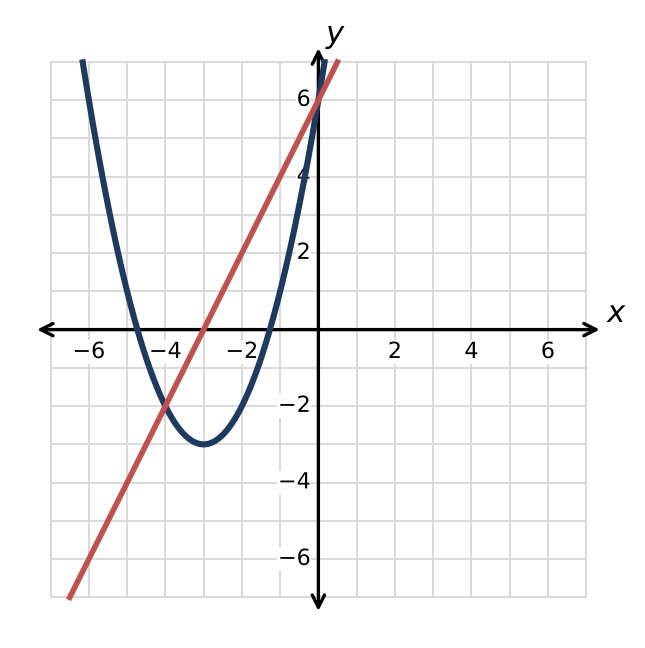
- A solution of the system is a point where the parabola and the line cross.
- The graphs cross at (−4, −2) and (0, 6).
- Of the choices, only (0, 6) is one of these points.
- A ((−3, −3)): picked the vertex of the parabola
- C ((6, 0)): swapped the x- and y-coordinates
- D ((0, −6)): misread the sign of the y-coordinate
Linear–quadratic systems — sums of coordinates
Method. Set the two expressions for y equal and write + px + q = 0; the sum of its roots is −p, so you do not need to solve.
Worked example- Set the expressions equal: + 3x − 5 = 4x + 1.
- Move everything to one side: − x − 6 = 0.
- The sum of the roots of + px + q = 0 is −p.
- So x₁ + x₂ = 1.
- A (−6): gave the product of the x-values
- B (−3): used −b from the parabola before subtracting the line
- C (−1): used − with the wrong sign
Tangency — discriminant
Method. The line y = mx + k meets y = + px + q once when + (p − m)x + (q − k) = 0 has discriminant 0, so k = q − .
Worked example- Substitute: + 2x + 4 = k.
- Move everything to one side: + 2x + (4 − k) = 0.
- Tangent means exactly one solution.
- So the discriminant is 0: − 4(4 − k) = 0.
- So 4 − 16 + 4k = 0.
- Solve: 4k = 12.
- So k = 3.
- A (0): left out the 4 in − 4ac
- B (2): used 2 instead of 4 in − 4ac
- D (5): made a sign error solving the discriminant equation
Quadratic–quadratic systems
Method. Subtract one equation from the other to get a single quadratic in x.
Worked example- Set the two expressions equal: − 13x + 18 = − − 3x + 6.
- Move everything to one side: 2 − 10x + 12 = 0.
- Divide by 2: − 5x + 6 = 0.
- Factor: (x − 2)(x − 3) = 0.
- So x = 2 or x = 3.
- Find y from the first equation: x = 2 gives y = −4.
- x = 3 gives y = −12.
- The solutions are (2, −4) and (3, −12).
- B ((−3, 66) and (−2, 48)): made a sign error when factoring
- C ((2, −4)): kept only one solution
- D ((−12, 3) and (−4, 2)): swapped the x- and y-coordinates
Systems with absolute value
Method. Solve each branch of the absolute value separately and keep only roots that lie on that branch.
Worked example- Split the absolute value at x = 1.
- Case x ≥ 1: x − 4 = −x − 1.
- So x = 2, which satisfies x ≥ 1 ✓.
- Case x < 1: −x − 2 = −x − 1.
- So x = −2, which satisfies x < 1 ✓.
- Find y from the line: x = −2 gives y = 0.
- x = 2 gives y = −2.
- The solutions are (−2, 0) and (2, −2).
- A ((−2, 0)): kept only one solution
- B ((2, −2)): kept only one solution
- D ((−2, −2) and (2, 0)): made a sign error in the x-coordinates
Systems with exponential equations
Method. Substitute u = 3ˣ to get a quadratic; keep only the positive root.
Worked example- Set the two expressions equal: 9ˣ = 8 · 3ˣ + 9.
- Let u = 3ˣ.
- So 9ˣ = : − 8u − 9 = 0.
- Factor: (u − 9)(u + 1) = 0.
- So u = 9 or u = −1.
- Since 3ˣ > 0, u = −1 is impossible.
- So 3ˣ = 9, which gives x = 2, and y = = 81.
- The solution is (2, 81).
- B ((9, 81)): gave the value of 3ˣ as x
- C ((2, 9)): gave 3ˣ instead of y
- D ((81, 2)): swapped the x- and y-coordinates
02.04 Quadratic Functions
Advanced Math is about 35% of SAT Math (13–15 of 44 questions). This topic covers quadratic functions in standard, vertex and factored form: vertex, axis of symmetry, maximum or minimum, zeros, the y-intercept, transformations, and projectile and area models.
Quadratic Functions
Parabolas: the vertex is the turning point, the axis of symmetry passes through it, and the sign of a tells the direction.
Key formulas| Vertex form | |
| Axis of symmetry | |
| Factored form | |
| Max/min |
Vertex form
Method. Vertex form: change the sign inside the parentheses, keep the sign of k.
Worked example- In vertex form f(x) = a + k the vertex is (h, k).
- Here x + 3 = x − (−3).
- So h = −3, and k = 5.
- The vertex is (−3, 5).
- A ((3, 5)): used the sign inside the parentheses
- B ((−3, −5)): used the wrong sign for k
- D ((5, −3)): swapped the coordinates
Factored form and intercepts
Method. Factored form a(x − p)(x − q): zeros p and q, vertex halfway, y-intercept a·p·q.
Worked example- The zeros are x = −7 and x = 6.
- The vertex lies halfway between them: (−7 + 6) ÷ 2 = −.
- A (−): subtracted the zeros
- B (−1): added the zeros without halving
- D (): used the signs shown in the factors
Graphs of quadratic functions
Method. Read the vertex from the grid; check the direction and the step from the vertex for a.
Worked example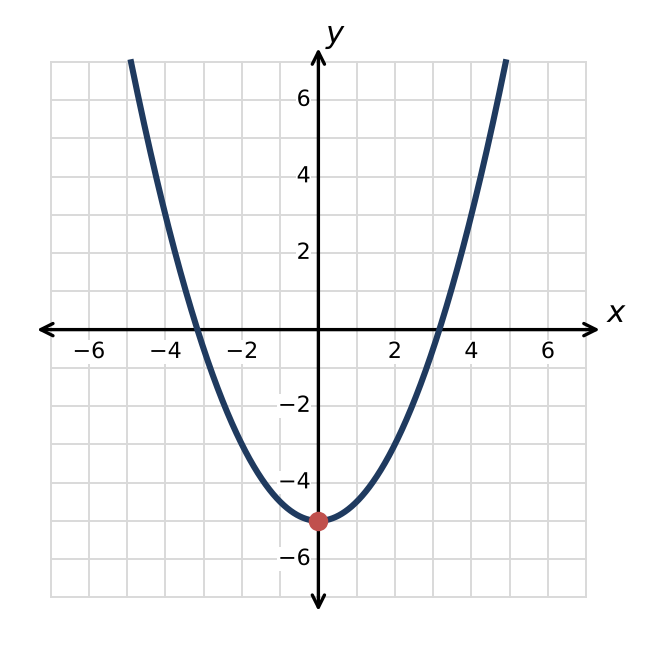
- The parabola opens up.
- So its minimum is at the vertex (0, −5).
- The minimum value is the y-coordinate: −5.
- A (−6): misread the grid by one unit
- C (0): gave the x-value where the minimum occurs
- D (5): misread the sign
Projectile models
Method. Time of max = −; max height = h(t) at that time.
Worked example- The maximum is at the vertex: t = − = − = 3 seconds.
- h(3) = −16 + 96(3) + 6 = −144 + 288 + 6 = 150.
- A (3): gave the time of the maximum instead of the height
- B (6): used t = instead of t =
- D (294): forgot the −16 term
Maximum and minimum values
Method. Maximum value = f, the y-coordinate of the vertex.
Worked example- a = −3 is negative.
- So the parabola opens down and has a maximum at the vertex.
- x = − = −4.
- f(−4) = −48 + 96 − 49 = −1.
- The maximum value is −1.
- A (−49): gave the y-intercept
- B (−4): gave the x-value where the maximum occurs
- D (1): made a sign error
Transformations of quadratics
Method. Inside the square: opposite direction (x − h shifts right). Outside: same direction.
Worked example- A shift 3 right replaces x with x − 3.
- A shift 3 down adds −3.
- So g(x) = − 3.
- B (g(x) = − 3): used the wrong direction for the horizontal shift
- C (g(x) = + 3): used the wrong direction for the vertical shift
- D (g(x) = − − 3): added a reflection that is not there
Average rate of change
Method. For ax² + bx + c the average rate from p to q equals a(p + q) + b.
Worked example- Average rate of change = (f(6) − f(0)) ÷ (6 − 0).
- f(6) = 76 and f(0) = −2.
- So (76 − (−2)) ÷ 6 = 78 ÷ 6 = 13.
- A (−13): subtracted in the wrong order
- B (): divided the change in x by the change in f
- C (): added the function values
Vertex and axis from standard form
Method. x-vertex = −; plug it back in for the y-coordinate.
Worked example- The x-coordinate of the vertex is − = − = 3.
- The y-coordinate is f(3) = 27 − 54 + 28 = 1.
- So the vertex is (3, 1).
- A ((−3, 109)): used instead of −
- B ((6, 28)): forgot the 2 in −
- D ((3, 28)): used c as the y-coordinate
Area optimization
Method. Write area as a quadratic in one side; the maximum is at the vertex.
Worked example- Let each side touching the wall be w.
- The side parallel to the wall is 160 − 2w.
- A(w) = w(160 − 2w) = −2 + 160w.
- The vertex is at w = = 40.
- So the other side is 160 − 80 = 80.
- Area = 40 × 80 = 3200.
- A (40): gave the width instead of the area
- B (80): gave the length instead of the area
- C (1600): fenced all four sides
Parameters and the discriminant
Method. For + bx + c, one x-intercept means − 4c = 0, so c = (a perfect-square trinomial).
Worked example- Exactly one x-intercept means the discriminant is 0: − 4(1)(c) = 0.
- So 100 − 4c = 0 and c = = 25.
- A (5): found = 5 but did not square it
- C (50): used 2 instead of 4 in − 4ac: 100 − 2c = 0
- D (100): left out the 4 in − 4ac: 100 − c = 0
02.05 Exponential Functions
Advanced Math is about 35% of SAT Math (13–15 of 44 questions). This topic covers exponential functions f(x) = a·bˣ: growth versus decay, percent growth and decay a(1 ± r)ᵗ, compound interest, doubling and half-life, changing time units, and telling linear from exponential change.
Exponential Functions
Growth or decay by a constant factor each step. The base b > 1 grows, 0 < b < 1 decays; the y-intercept is a.
Key formulas| Exponential function | |
| Growth / decay | |
| Half-life | |
| Doubling |
Evaluating exponential functions
Method. Raise the base to the power first, then multiply by the coefficient.
Worked example- Substitute x = −2: f(−2) = −2 × .
- First the power: = .
- Then multiply: −2 × = −.
- B (−): used one power too many: −2 × = −
- C (): multiplied −2 and 4 before raising to the power: =
- D (16): multiplied by the exponent instead of raising to a power: −2 × 4 × (−2)
Growth and decay rates
Method. Factor b = 1 + r for growth, 1 − r for decay; rate = distance of b from 1.
Worked example- In f(t) = a · bᵗ, b > 1 means growth and 0 < b < 1 means decay.
- Here b = 0.92 is less than 1.
- The rate is |b − 1| = |0.92 − 1| = 0.08 = 8%.
- So it is decay of 8% per year.
- A (growth of 8% per year): confused growth with decay
- B (decay of 92% per year): used the factor itself as the percent
- D (growth of 92% per year): used the factor as the percent and the wrong direction
Percent growth and decay
Method. Multiply by (1 ± r) once per year — never add r·t.
Worked example- Each year the value is multiplied by 1 − 0.2 = 0.8.
- After 2 years: $5,000 × = $5,000 × 0.64 = $3,200.
- A ($3,000): used simple (linear) change instead of compounding
- C ($4,000): applied the change only once
- D ($7,200): used the wrong direction of change
Doubling and half-life
Method. Count the periods (time ÷ period length), then multiply by 2 or that many times.
Worked example- The number of doubling periods is 90 ÷ 30 = 3.
- Value = 300 × = 300 × 8 = 2400.
- A (900): multiplied by the number of periods: 300 × 3
- B (1200): counted one period too few: 300 ×
- C (1800): multiplied by 2 × 3 = 6 instead of = 8
Linear versus exponential models
Method. Constant difference → linear; constant ratio → exponential.
Worked example- Differences in y: 12, 36, 108.
- Ratios: 3, 3, 3.
- The ratios are constant (3).
- So the function is exponential with starting value 6: y = 6 · 3ˣ.
- A (Linear, y = 6 + 12x): used only the first difference
- B (Exponential, y = 3 · 6ˣ): swapped the starting value and the ratio
- D (Linear, y = 6 + 3x): treated the constant ratio as a constant difference
Exponential graphs
Method. Starting value = y at x = 0; base = (y at x = 1) ÷ (y at x = 0).
Worked example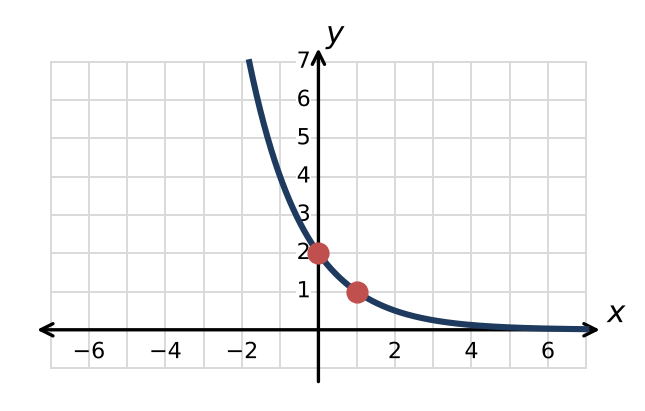
- The marked points are (0, 2) and (1, 1).
- For f(x) = a · bˣ, f(0) = a = 2.
- Then f(1) = a · b.
- So b = 1 ÷ 2 = .
- So f(x) = 2 · (0.5)ˣ.
- A (f(x) = 2 · 2ˣ): inverted the base (growth versus decay)
- C (f(x) = −x + 2): fitted a line through the two marked points
- D (f(x) = (0.5)ˣ): used the value at x = 1 as the starting value
Geometric sequences as exponential functions
Method. Geometric sequence = exponential function of n: a · .
Worked example- First term a = 8.
- Common ratio r = 24 ÷ 8 = 3.
- Term 7 = 8 × = 8 × 729 = 5832.
- A (144): multiplied instead of using an exponent
- B (729): forgot the first term
- D (17496): used n instead of n − 1
Compound interest
Method. Rate per period = ; number of periods = n·t.
Worked example- Compound interest: A = P with P = 5000, r = 0.04 and n = 2 periods per year.
- Each period the rate is , and there are 2t periods in t years.
- So A = 5,000.
- A (5,000): did not divide the rate by the number of periods
- B (5,000ᵗ): did not multiply the time by the number of periods
- D (5,000): multiplied the rate and divided the time
Changing time units
Method. Per-month factor = (yearly factor)^.
Worked example- Let m be the monthly growth factor.
- There are 12 months in a year.
- So = 1.05.
- So m = , and Q can be written 500 · .
- A (): divided the yearly factor by 12
- B (1 + ): divided the yearly rate by 12
- C (): raised the factor to the power 12
Exponential functions from two points
Method. Ratio of outputs = ; then take the root.
Worked example- Divide the outputs: f(3) ÷ f(1) = = .
- So = 250 ÷ 10 = 25.
- Take the root: b = 5 (b > 0).
- A (): inverted the ratio
- C (25): did not take the root of the ratio
- D (120): found the linear slope instead of the growth factor
Compound Interest and Depreciation
Money that grows or shrinks by a fixed percent each period is an exponential function. Divide the annual rate by the number of periods per year and multiply the years by that number.
Key formulas| Compound interest | |
| Annual growth | |
| Depreciation | |
| Simple interest |
Compound interest
Method. Multiply by the growth factor once per year: $200.00 → $208.00 → $216.32.
Worked example- A = P.
- A = 200 = 200 × 1.0816.
- So A = $216.32.
- A ($216.00): used simple interest instead of compound interest
- C ($233.28): doubled the rate
- D ($416.00): multiplied by the growth factor times the number of years instead of using an exponent
Compound interest — compounding periods
Method. Rate per period = 8% ÷ 2; number of periods = 2 × 8 = 16.
Worked example- A = P with n = 2.
- A = 5,800.
- A = 5,800.
- So A ≈ $10,863.29.
- B ($11,297.82): compounded for one half-year period too many (17 periods)
- C ($11,749.74): compounded for one year too many (18 periods)
- D ($19,870.47): did not divide the rate by 2
Simple versus compound interest
Method. The only extra is interest on the first year's interest: 10% of $380.00 = $38.00.
Worked example- Simple: 2 × 0.1 × 3,800 = $760.00.
- Compound: 3,800 − 3,800 = $798.00.
- Difference: $38.00.
- A ($19.00): halved the difference
- C ($380.00): gave one year's interest
- D ($760.00): gave the simple interest for two years
02.06 Polynomial, Rational, Radical and Absolute-Value Functions
Advanced Math is about 35% of SAT Math (13–15 of 44 questions). This topic covers polynomial, rational, radical and absolute-value functions: zeros and factors, behavior at a zero, end behavior, the remainder theorem, asymptotes and undefined values, domains, and graphs of radical and absolute-value functions.
Polynomial Functions
Zeros come from factors; the degree and leading coefficient set the end behavior; even multiplicity touches the axis, odd multiplicity crosses.
Key formulas| Factor theorem | |
| Remainder theorem | |
| End behavior |
Zeros and factors
Method. Zero of (x − r) is r — flip the sign you see.
Worked example- A product is 0 exactly when one of its factors is 0.
- Set each factor to 0: (x + 5) = 0 gives x = −5.
- x = 0 gives x = 0.
- (x − 4) = 0 gives x = 4.
- The zeros are −5, 0, 4.
- A (−4, 0, 5): used the signs shown in the factors
- C (0, 4, 5): changed the sign of one zero
- D (−5, 0): missed one zero
Behavior at zeros
Method. Odd multiplicity → crosses (3 → crosses with a flat bend); even → touches and turns.
Worked example- The factor (x + 3) appears 1 time.
- So x = −3 is a zero of multiplicity 1.
- That is odd multiplicity 1.
- So the sign of f changes and the graph crosses.
- A (The graph touches the x-axis and turns around there.): used the wrong rule for the multiplicity
- B (The graph crosses the x-axis and flattens there.): used the wrong rule for the multiplicity
- D (The graph does not meet the x-axis there.): missed that the factor makes f(x) = 0
Remainder theorem
Method. Remainder of p(x) ÷ (x − k) is p(k) — no long division needed.
Worked example- By the Remainder Theorem, the remainder when p(x) is divided by x − 2 is p(2).
- Compute p(2) = −32 + 4 − 4 − 7 = −39.
- B (−32): left out the constant term
- C (−12): added the coefficients (p(1))
- D (33): evaluated p(−2) instead of p(2)
Factor theorem
Method. x − k is a factor exactly when p(k) = 0, so solve p(k) = 0 for c.
Worked example- x + 2 is a factor exactly when p(−2) = 0 (Factor Theorem).
- p(−2) = 16 + 4 + 4 + c = 24 + c.
- Set it to 0: c = −24.
- B (−20): dropped the x-term
- C (16): used x = 2 instead of x = −2
- D (24): made a sign error
Polynomial graphs
Method. Zeros from the x-intercepts, multiplicity from cross/touch, sign from the right end.
Worked example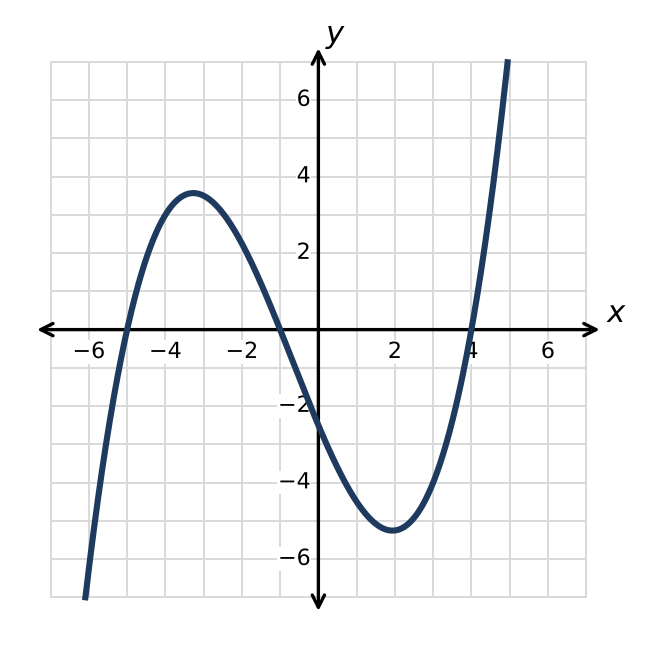
- The graph meets the x-axis at x = −5, −1, 4.
- At x = −5 it crosses.
- So (x + 5) has odd power 1.
- At x = −1 it crosses.
- So (x + 1) has odd power 1.
- At x = 4 it crosses.
- So (x − 4) has odd power 1.
- The right end goes up.
- So the leading coefficient is positive.
- So f(x) = (x + 5)(x + 1)(x − 4).
- A (f(x) = (x − 5)(x − 1)(x + 4)): used the zeros with the wrong signs
- B (f(x) = (x + 5)(x + 1)(x − 4)): missed whether the graph rises or falls on the right
- D (f(x) = (x + 1)(x − 4)): treated a crossing zero as a repeated zero
End behavior
Method. Leading term only: even degree → ends match; positive coefficient → right end up.
Worked example- End behavior is set by the leading term 6.
- The degree 3 is odd.
- So the two ends go opposite ways.
- The coefficient 6 is positive.
- So the right end goes up.
- So: As x → ∞, f(x) → ∞, and as x → −∞, f(x) → −∞.
- A (As x → ∞, f(x) → −∞, and as x → −∞, f(x) → ∞): ignored the sign of the leading coefficient
- B (As x → ∞, f(x) → ∞, and as x → −∞, f(x) → ∞): treated degree 3 as even
- C (As x → ∞, f(x) → −∞, and as x → −∞, f(x) → −∞): ignored the sign and treated degree 3 as even
Rational Functions
Vertical asymptotes come from zeros of the denominator that do not cancel; canceled factors give holes; compare degrees for the horizontal asymptote.
Key formulas| Vertical asymptote | |
| Horizontal asymptote, deg N < deg D | |
| Horizontal asymptote, equal degrees | |
| Horizontal asymptote, deg N > deg D | |
| Hole |
Undefined values
Method. Undefined ⇔ denominator = 0 (the numerator does not matter).
Worked example- A rational function is undefined where its denominator is 0.
- Factor: + 12x + 35 = (x + 5)(x + 7).
- (x + 5)(x + 7) = 0 when x = −5 or x = −7.
- So f is undefined at x = −7 and x = −5.
- A (x = 5 and x = 7): used the signs shown in the factors
- B (x = −): set the numerator equal to 0
- C (x = −5): found only one value
Horizontal asymptotes
Method. Equal degrees → ratio of leading coefficients; bottom-heavy → y = 0.
Worked example- Numerator and denominator both have degree 2.
- So the horizontal asymptote is the ratio of the leading coefficients: y = = .
- A (y = ): divided the constant terms
- B (y = 2): divided the leading coefficients upside down
- D (y = 0): thought the asymptote is always y = 0
Vertical asymptotes
Method. Vertical asymptote: zero of the denominator that does not cancel.
Worked example- A vertical asymptote occurs where the denominator is 0 but the numerator is not.
- (x + 1) = 0 gives x = −1, and the numerator there is −3 × (−8) = 24 ≠ 0.
- So the vertical asymptote is x = −1.
- A (x = 7): used the zero of the numerator
- B (x = 1): used the sign shown in the factor
- D (y = −3): gave the horizontal asymptote
Domain of rational functions
Method. Factor the denominator; exclude its zeros.
Worked example- Exclude the x-values that make the denominator 0.
- Factor: − 2x = (x − 2)x, which is 0 at x = 2 and x = 0.
- So the domain is all real numbers except 0 and 2.
- A (all real numbers except −2 and 0): used the opposite signs
- B (all real numbers except −2): excluded the zero of the numerator
- C (all real numbers): forgot that the denominator cannot be 0
Graphs of rational functions
Method. Vertical asymptote = the dashed vertical line; horizontal = the level the branches approach.
Worked example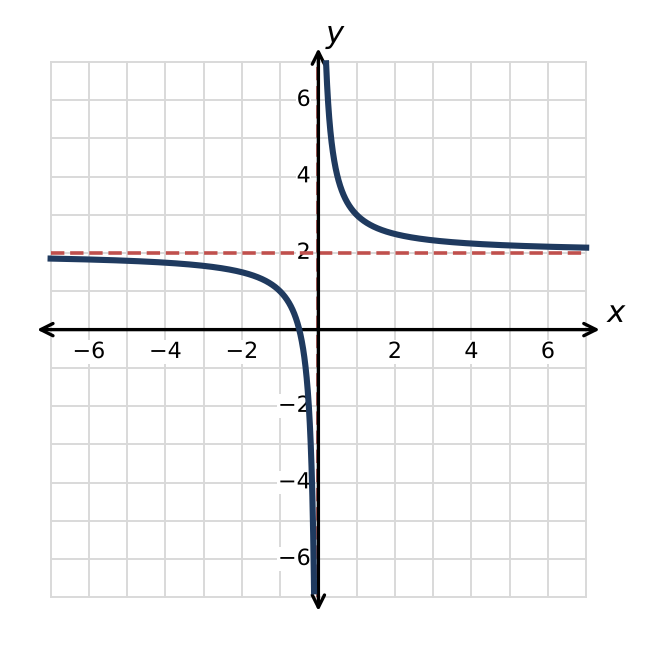
- The vertical dashed line is x = 0 (the graph never crosses it).
- The horizontal dashed line is y = 2 (the graph levels off toward it).
- So the asymptotes are x = 0 and y = 2.
- B (x = 2 and y = 0): swapped the asymptotes
- C (x = 0 and y = −2): misread the sign of the horizontal asymptote
- D (x = 0 and y = 3): used a point on the curve for the horizontal asymptote
Absolute-Value Graphs
y = a|x − h| + k is a V with vertex (h, k); it opens up when a > 0 and down when a < 0.
Key formulas| Vertex form | |
| Direction |
Graphs of absolute-value functions — vertex
Method. Vertex = (value that makes the inside 0, the constant added outside).
Worked example- y = a|x − h| + k has vertex (h, k).
- Here the inside is zero at x = 7, and then y = −1.
- Vertex: (7, −1).
- B ((−7, −1)): used the sign inside the bars as the x-coordinate
- C ((−1, 7)): swapped the coordinates
- D ((7, 1)): used the wrong sign for the vertical shift
Graphs of absolute-value functions — equation
Method. Read the vertex for h and k; the slope of the right-hand side gives a (negative if the V opens down).
Worked example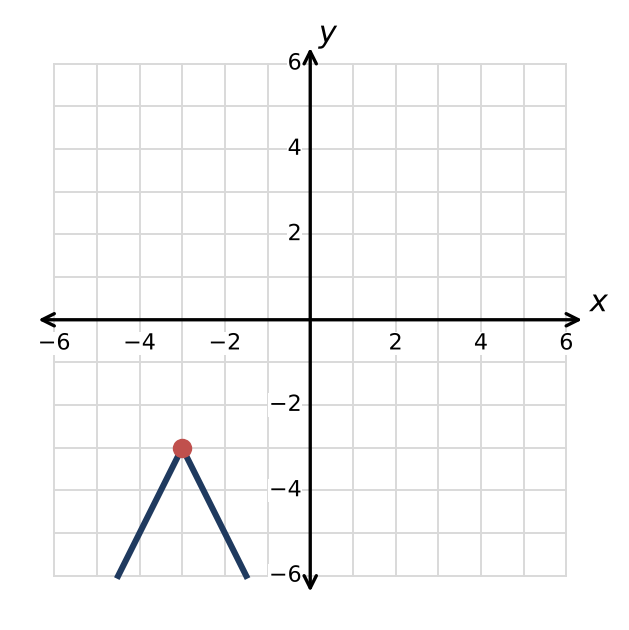
- The vertex is at (−3, −3).
- So the equation has the form y = a|x + 3| − 3.
- The graph opens down, and moving 1 unit right from the vertex changes y by −2.
- So a = −2.
- Equation: y = −2|x + 3| − 3.
- A (y = −2|x − 3| − 3): used the wrong sign for the horizontal shift
- B (y = −2|x + 3| + 3): used the wrong sign for the vertical shift
- D (y = 2|x + 3| − 3): missed whether the V opens up or down
02.07 Function Notation, Composition and Transformations
Advanced Math is about 35% of SAT Math (13–15 of 44 questions). This topic covers function notation and transformations: evaluating f(a) and solving f(x) = k, reading values from graphs and tables, domain and range, piecewise functions, and shifts, reflections and stretches of graphs.
Function Notation
f(a) is the output when the input is a; solving f(x) = k asks for the inputs that give output k. Read values from graphs and tables, and find the domain and range from the graph or the formula.
Key formulas| Evaluate | |
| Solve | |
| Composition | |
| Domain | |
| Piecewise |
Function notation — evaluating
Method. Put negative inputs in parentheses; square before multiplying by the coefficient.
Worked example- Substitute x = −5 with parentheses: f(−5) = − 4(−5) − 7.
- Square first: = 25.
- Then 25 + 20 − 7 = 38.
- A (−12): squared −5 as −25
- B (−2): evaluated f(5) instead of f(−5)
- C (3): doubled instead of squaring
Function notation — solving f(x) = k
Method. f(x) = k asks for the INPUT; undo the operations in reverse order.
Worked example- Set f(x) = 5: x + 2 = 5.
- Subtract 2: x = 3.
- Divide by : x = 9.
- A (1): multiplied instead of dividing
- C (13): divided before subtracting the constant
- D (21): moved the constant with the wrong sign
Domain
Method. Square roots: inside ≥ 0. Fractions: denominator ≠ 0.
Worked example- A fraction is undefined when its denominator is 0: x + 7 = 0 when x = −7.
- Every other real number is allowed.
- B (all real numbers except 7): used the wrong sign for the excluded value
- C (x > −7): treated the denominator like a square root
- D (all real numbers): forgot that the denominator cannot be 0
Piecewise functions
Method. First pick the piece whose condition the input satisfies (watch < versus ≤ at the boundary).
Worked example- Decide which piece applies: x = −4 satisfies x ≤ −2.
- So use f(x) = 5x + 2.
- Substitute: f(−4) = 5(−4) + 2 = −18.
- A (−32): added the two pieces
- C (−14): used the wrong piece
- D (18): made a sign error
Reading key features from graphs
Method. Inputs are read on the x-axis, outputs on the y-axis.
Worked example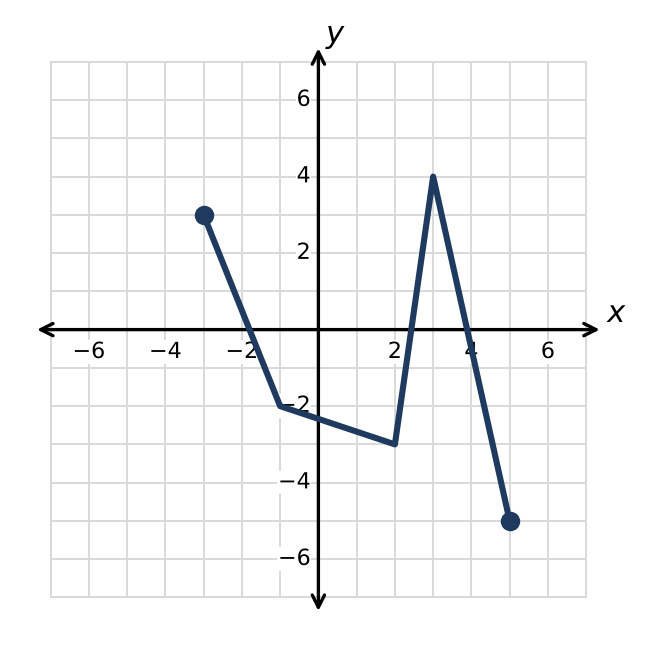
- The maximum value is the y-coordinate of the highest point on the graph.
- That point is (3, 4).
- So the maximum value is 4.
- A (−5): gave the minimum instead
- B (−4): misread the sign
- C (3): gave the x-value where the maximum occurs
Range
Method. Range of a parabola = from the vertex y-value upward (a > 0) or downward (a < 0).
Worked example- The vertex form a + k has vertex (3, −9).
- Since a = −2 is negative, the parabola opens down.
- So −9 is the greatest value.
- The range is y ≤ −9.
- A (y ≥ −9): reversed the direction of the parabola
- B (y ≤ 3): used the x-coordinate of the vertex
- C (y ≤ 9): used the wrong sign for the vertical shift
Function notation — expressions
Method. Substitute the whole expression for x with parentheses, then expand.
Worked example- Replace every x with (x + 4): f(x + 4) = − + 3(x + 4) − 8.
- Expand: = + 8x + 16.
- So f(x + 4) = − − 8x − 16 + 3x + 12 − 8.
- Combine like terms: − − 5x − 12.
- B (− + 3x − 4): added 4 to the output instead of the input
- C (− + 3x − 12): squared (x + 4) as + 16
- D (− − 5x − 24): replaced x only in the squared term
Function Transformations
Changes inside the function move the graph horizontally (opposite direction); changes outside move it vertically.
Key formulas| Shift | |
| Reflect | |
| Stretch |
Describing transformations
Method. x − h → right h; + k → up k.
Worked example- Inside the function, x − 4 moves the graph right 4 (the opposite of the sign).
- Outside, − 2 moves it down 2.
- So the graph moves 4 units right and 2 units down.
- A (4 units left and 2 units down): moved the wrong way horizontally
- B (4 units right and 2 units up): moved the wrong way vertically
- C (4 units left and 2 units up): reversed both directions
Writing transformed functions
Method. Horizontal shifts go inside with the opposite sign; vertical shifts and reflections go outside.
Worked example- Reflecting across the x-axis puts a minus sign in front.
- A shift 4 right replaces x with x − 4.
- A shift 2 up adds 2 at the end.
- So g(x) = − + 2.
- A (g(x) = − + 2): used the wrong sign for the horizontal shift
- C (g(x) = − − 2): used the wrong sign for the vertical shift
- D (g(x) = + 2): missed the reflection
Transforming points
Method. Inside f: opposite direction / divide x; outside f: same direction / multiply y.
Worked example- f(x + 5) shifts the graph 5 units left (x-coordinate − 5), and + 2 shifts it 2 up.
- So (−1, 1) moves to (−1 − 5, 1 + 2) = (−6, 3).
- A ((4, 3)): moved the wrong way horizontally
- C ((−6, −1)): moved the wrong way vertically
- D ((4, −1)): reversed both shifts
Composition — expressions
Method. Substitute the whole inner function, in parentheses, for x in the outer function.
Worked example- f(g(x)) replaces x in f with g(x).
- − + 3 = − + 5.
- A ( − 6x + 7): composed in the wrong order
- C ( − x + 1): added the two functions
- D (− + 3 + 2x − 6): multiplied the two functions
02.08 Modeling with Nonlinear Functions
Advanced Math is about 35% of SAT Math (13–15 of 44 questions). This topic covers choosing and interpreting nonlinear models: linear, quadratic or exponential, the meaning of each parameter with units, and how a model increases or decreases and changes over an interval.
Choosing a Model
Constant change is linear, constant percent change is exponential, and a single maximum or minimum suggests a quadratic. Interpret every parameter with units.
Key formulas| Linear | |
| Exponential | |
| Quadratic |
Choosing a model type
Method. Constant amount → linear; constant factor/percent → exponential; rise-then-fall or area → quadratic.
Worked example- In this situation the quantity is multiplied by a constant factor (a constant percent change) for each equal step.
- That is the defining feature of an exponential model.
- A (linear): treated an exponential situation as linear
- B (quadratic): treated an exponential situation as quadratic
- C (constant (no change)): thought the quantity does not change
Choosing a model from data
Method. Constant differences → linear; constant ratios → exponential; a single turning point → quadratic.
Worked example- First differences: −3, −3, −3, −3.
- Second differences: 0, 0, 0.
- Ratios: , , , .
- The first differences are constant.
- So the data are linear.
- A (quadratic): thought any curved pattern is quadratic
- B (exponential): thought any non-constant change is exponential
- D (none of these): did not test differences or ratios
Interpreting model parameters
Method. a·bᵗ: a = start, b = factor per period. mx + b: m = rate, b = start.
Worked example- In C = mn + b, m is the change in C for each 1-unit increase in n.
- So 29 is the cost for each additional unit.
- B (the fixed cost): confused the slope with the intercept
- C (the total cost): described the output
- D (the number of units): described the input
Rates of Change and Increasing Intervals
The average rate of change over an interval is the slope between its endpoints. A function is increasing where its graph rises from left to right; a parabola changes direction at its vertex.
Key formulas| Average rate of change | |
| Increasing / decreasing | |
| Parabola with vertex (h, k) |
Increasing and decreasing intervals
Method. Read left to right; intervals are x-values.
Worked example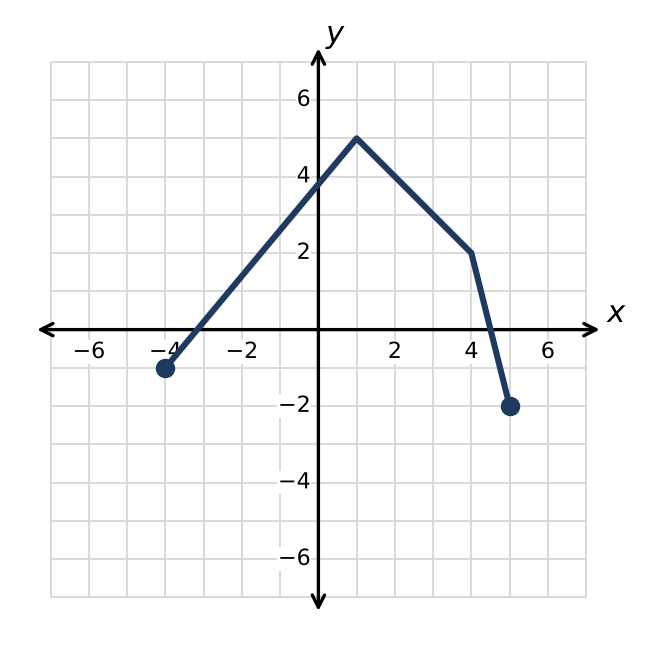
- f is increasing where the graph goes up from left to right.
- Reading the graph, it goes up from x = −4 (y = −1) to x = 1 (y = 5).
- So f is increasing on −4 < x < 1.
- A (1 < x < 5): chose an interval where f is decreasing
- B (−1 < x < 5): used y-values instead of x-values
- C (−4 < x < 5): used the whole domain
Average rate of change from tables
Method. AROC = Δy ÷ Δx between the two given points only.
Worked example- Use only the two given points (2, 8) and (4, 32).
- Change in f: 32 − 8 = 24.
- Change in x: 4 − 2 = 2.
- Average rate of change: 24 ÷ 2 = 12.
- A (): divided the change in x by the change in y
- C (20): averaged the two outputs
- D (24): did not divide by the change in x
Average rate of change from formulas
Method. Evaluate f at both endpoints, then (difference in f) ÷ (difference in x).
Worked example- f(1) = 1 and f(−2) = −8.
- Average rate of change = (1 − (−8)) ÷ (1 − (−2)) = 9 ÷ 3 = 3.
- A (−): added the function values instead of subtracting them: (1 + (−8)) ÷ 3 = −
- B (): divided the change in x by the change in f
- C (1): used only the right endpoint
Increasing and decreasing — quadratics
Method. Split at the vertex x = −; a > 0 means down-then-up.
Worked example- The vertex is at x = − = 5.
- Since a = 3 is positive, the parabola opens up: it decreases to the left of the vertex and increases to the right.
- So f is decreasing for x < 5.
- A (x > 5): chose the side where the opposite happens
- C (x < −5): used the wrong sign for the vertex
- D (x < 4): used the y-coordinate of the vertex
Comparing rates of change
Method. Compute Δf ÷ Δx for each interval — the widths may differ.
Worked example- Average rates of change: [−1, 1]: (−3 − (−1)) ÷ 2 = −1.
- [−1, 0]: (0 − (−1)) ÷ 1 = 1.
- [2, 4]: (24 − (−4)) ÷ 2 = 14.
- [3, 5]: (65 − 3) ÷ 2 = 31.
- The greatest is 31, on 3 ≤ x ≤ 5.
- A (−1 ≤ x ≤ 1): chose an interval with a smaller average rate
- B (−1 ≤ x ≤ 0): chose an interval with a smaller average rate
- C (2 ≤ x ≤ 4): chose an interval with a smaller average rate