Circles: Practice Paper 1
Choose one answer for each question, then select Check my answers. Every question has a full worked solution.
1.
Quadrilateral ABCD is inscribed in a circle, and ∠A measures 125°. What is the measure of ∠C, in degrees?
Show solution
AnswerA — 55
Step-by-step
- Opposite angles of a quadrilateral inscribed in a circle are supplementary.
- So ∠C = 180° − 125° = 55°.
Fast methodInscribed angle = ½ arc; central angle = arc; opposite angles of a cyclic quadrilateral add to 180°.
Quick check125 + 55 = 180, so ∠A and ∠C are supplementary ✓.
Why the other choices are wrong
- B (125): thought opposite angles are equal
- C (235): subtracted from 360°
- D (250): doubled the angle
2.
What is radians in degrees?
Show solution
AnswerD — 240
Step-by-step
- Multiply by .
- × = × 180 = 240°.
Fast methodDegrees → radians: × . Radians → degrees: × .
Quick check240 × = ✓.
Why the other choices are wrong
- A (): gave the coefficient of π
- B (120): multiplied by 90 instead of 180
- C (135): divided 180 by the coefficient
3.
A sector of a circle with radius 12 has a central angle of 40°. What is the area of the sector?
Show solution
AnswerC —
Step-by-step
- Sector area = (central angle ÷ 360°) × πr².
- So the area is × π × = × = .
Fast methodSector = × area of the circle.
Quick check ÷ = = ✓.
Why the other choices are wrong
- A (): forgot to square the radius
- B (): found the arc length
- D (): gave the whole area
4.
What are the center and radius of the circle + = 36?
Show solution
AnswerD — center (4, −2), radius 6
Step-by-step
- The standard form is + = , with center (h, k) and radius r.
- Here h = 4, k = −2 and = 36.
- So the center is (4, −2) and the radius is = 6.
Fast methodCenter: flip the signs inside the parentheses. Radius: square root of the right side.
Quick checkthe point (4 + 6, −2) is on the circle because = 36 ✓.
Why the other choices are wrong
- A (center (−4, 2), radius 6): reversed the signs of the center
- B (center (4, −2), radius 36): gave as the radius
- C (center (−4, 2), radius 36): reversed the signs and gave as the radius
5.
In a circle with radius 17, a central angle of 270° intercepts an arc. What is the length of the arc?
Show solution
AnswerC —
Step-by-step
- Arc length = (central angle ÷ 360°) × r.
- So the arc length is × × 17 = × = .
Fast methodArc = × circumference.
Quick check ÷ = = ✓.
Why the other choices are wrong
- A (): found the other arc
- B (): used πr instead of r
- D (): found the sector area
6.
A chord is 12 units from the center of a circle with radius 37. What is the length of the chord?
Show solution
AnswerB — 70
Step-by-step
- The perpendicular from the center bisects the chord, forming a right triangle with hypotenuse 37 and leg 12.
- Half the chord is = = 35.
- So the chord is 2 × 35 = 70.
Fast methodHalf-chord² + distance² = radius².
Quick check + = 1369 = ✓.
Why the other choices are wrong
- A (35): gave half the chord
- C (74): gave the diameter
- D (2): added the squares
7.
A circle has radius 15. What is the length of the arc intercepted by a central angle of radians?
Show solution
AnswerB —
Step-by-step
- For an angle in radians, arc length s = rθ.
- So s = 15 × = .
Fast methodRadians: s = rθ and A = ½θ.
Quick check ÷ 15 = , the angle ✓.
Why the other choices are wrong
- A (): forgot to multiply by the radius
- C (): used the diameter
- D (): found the sector area
8.
A circle has an area of square units. What is its circumference, in units?
Show solution
AnswerA —
Step-by-step
- A = πr² = .
- So = 81 and r = 9.
- The circumference is C = r = × 9 = units.
Fast methodFind the radius first, then use the other formula.
Quick checka radius of 9 gives A = and C = ✓.
Why the other choices are wrong
- B (): used times the diameter
- C (): gave the area
- D (): doubled the area value
9.
In the xy-plane, the point (a, 2a), where a > 0, lies on the circle + = 10. What is the value of a?
Show solution
AnswerA — 1 +
Step-by-step
- Substitute: + = 10.
- = 4, so 5 = 10 and = 2.
- a = 1 + or a = 1 − ; since a > 0, a = 1 + .
Fast methodFactor 2a − 2 = 2(a − 1) so the equation becomes 5 = 10.
Quick checka ≈ 2.414 gives + ≈ 2 + 8 = 10 ✓
Why the other choices are wrong
- B (1 + ): rewrote as 2 instead of 4
- C (3): forgot to take the square root: a − 1 = 2
- D (1 + ): left out the term
10.
A circle with center O has radius 6. Points A and B lie on the circle, and the measure of angle AOB is radians. What is the area of the region bounded by chord AB and minor arc AB?
Show solution
AnswerB — − 9
Step-by-step
- Sector AOB has area θ = (36) = .
- OA = OB = 6 and angle AOB = 60°, so triangle AOB is equilateral with area (36) = 9.
- Region = sector − triangle = − 9.
Fast methodSector minus equilateral triangle 9.
Quick check − 9 ≈ 18.85 − 15.59 = 3.26, a small positive area less than the sector's ✓
Why the other choices are wrong
- A ( − 18): used (6)(6) for the triangle, as if angle AOB were a right angle
- C ( − 9): used θ without the factor for the sector
- D ( + 9): added the triangle's area instead of subtracting it
11.
In the xy-plane, a circle has its center on the x-axis and passes through the points (1, 4) and (7, 2). What is the radius of the circle?
Show solution
AnswerB — 2
Step-by-step
- Let the center be (h, 0). Both points are the same distance from it: + 16 = + 4.
- 1 − 2h + + 16 = 49 − 14h + + 4, so 12h = 36 and h = 3.
- = + = 20, so r = = 2.
Fast methodSet the squared distances from (h, 0) equal; the terms cancel, giving h = 3.
Quick check + = 16 + 4 = 20 = ✓
Why the other choices are wrong
- A (3): gave the x-coordinate of the center
- C (2): used the distance between the two given points
- D (20): gave instead of r
12.
In the xy-plane, the point (k, 3) lies inside the circle with equation + = 25. Which of the following is a possible value of k?
Show solution
AnswerD — 4
Step-by-step
- A point is inside the circle when its distance from the center (2, −1) is less than 5: + < 25.
- < 9, so −3 < k − 2 < 3, which means −1 < k < 5.
- Of the choices, only 4 is in this interval.
Fast methodSubstitute y = 3 to get < 9, so −1 < k < 5.
Quick check + = 4 + 16 = 20 < 25 ✓
Why the other choices are wrong
- A (−3): used for the x-part, reversing the sign of the center's x-coordinate
- B (−2): used for the y-part, reversing the sign of the center's y-coordinate
- C (−1): chose a point on the circle, not inside it
13.
In the xy-plane, a circle has center (4, −1) and is tangent to the y-axis. Which of the following is an equation of the circle?
Show solution
AnswerD — + − 8x + 2y + 1 = 0
Step-by-step
- Tangent to the y-axis means the radius equals the distance from (4, −1) to the y-axis, which is 4.
- + = 16.
- − 8x + 16 + + 2y + 1 = 16, so + − 8x + 2y + 1 = 0.
Fast methodRadius = |x-coordinate of center| = 4; expand + = 16.
Quick check(0, −1) gives 0 + 1 − 0 − 2 + 1 = 0, the point of tangency is on the circle ✓
Why the other choices are wrong
- A ( + + 8x − 2y + 1 = 0): reversed the signs of the center's coordinates
- B ( + − 8x + 2y + 13 = 0): used r = 4 instead of = 16
- C ( + − 8x + 2y + 16 = 0): used radius 1, as if the circle were tangent to the x-axis
14.
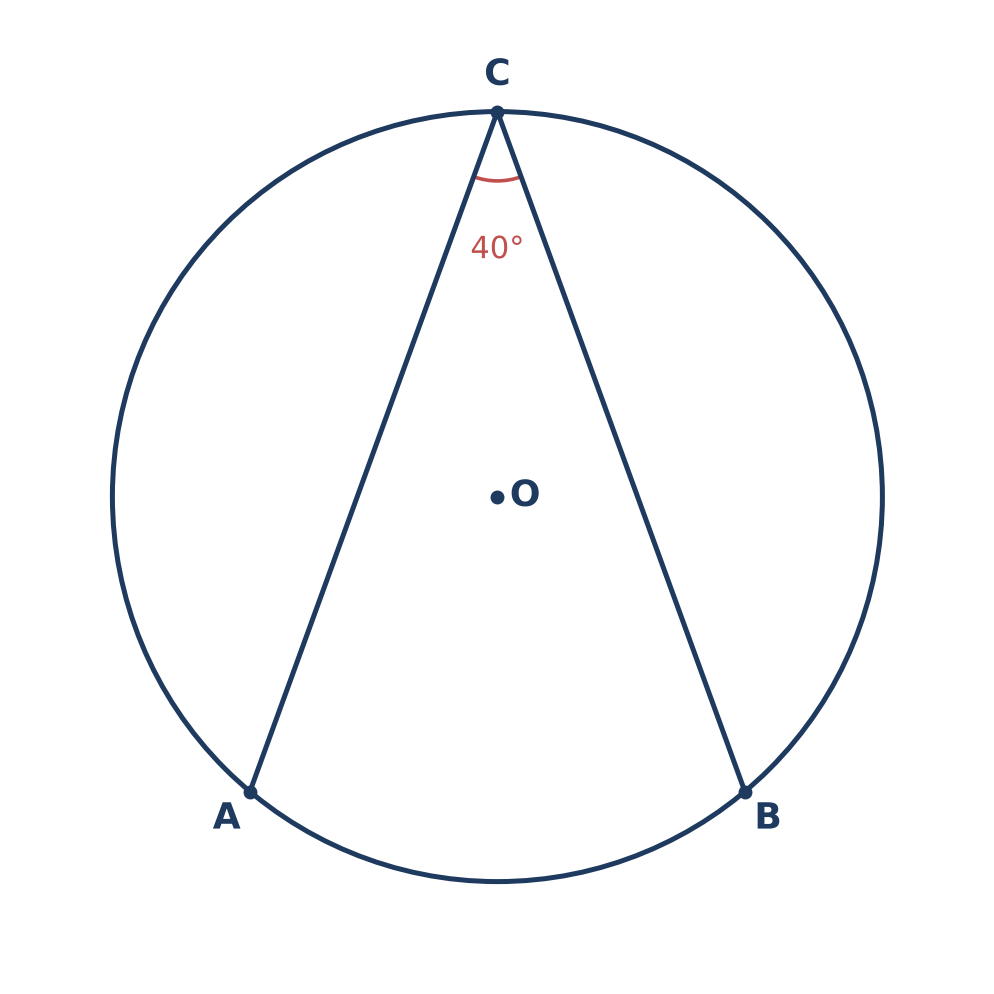
In the figure, points A, B, and C lie on the circle with center O, and the radius of the circle is 18. The measure of angle ACB is 40°. What is the length of minor arc AB?
Show solution
AnswerC —
Step-by-step
- Angle ACB is an inscribed angle, so the central angle AOB is 2 × 40° = 80°.
- Minor arc AB = = = .
Fast methodDouble the inscribed angle, then take of the circumference .
Quick check = and (360°) = 80° = 2 × 40° ✓
Why the other choices are wrong
- A (): used half of the inscribed angle, 20°, as the central angle
- B (): used the inscribed angle 40° as the central angle
- D (): found the major arc
15.
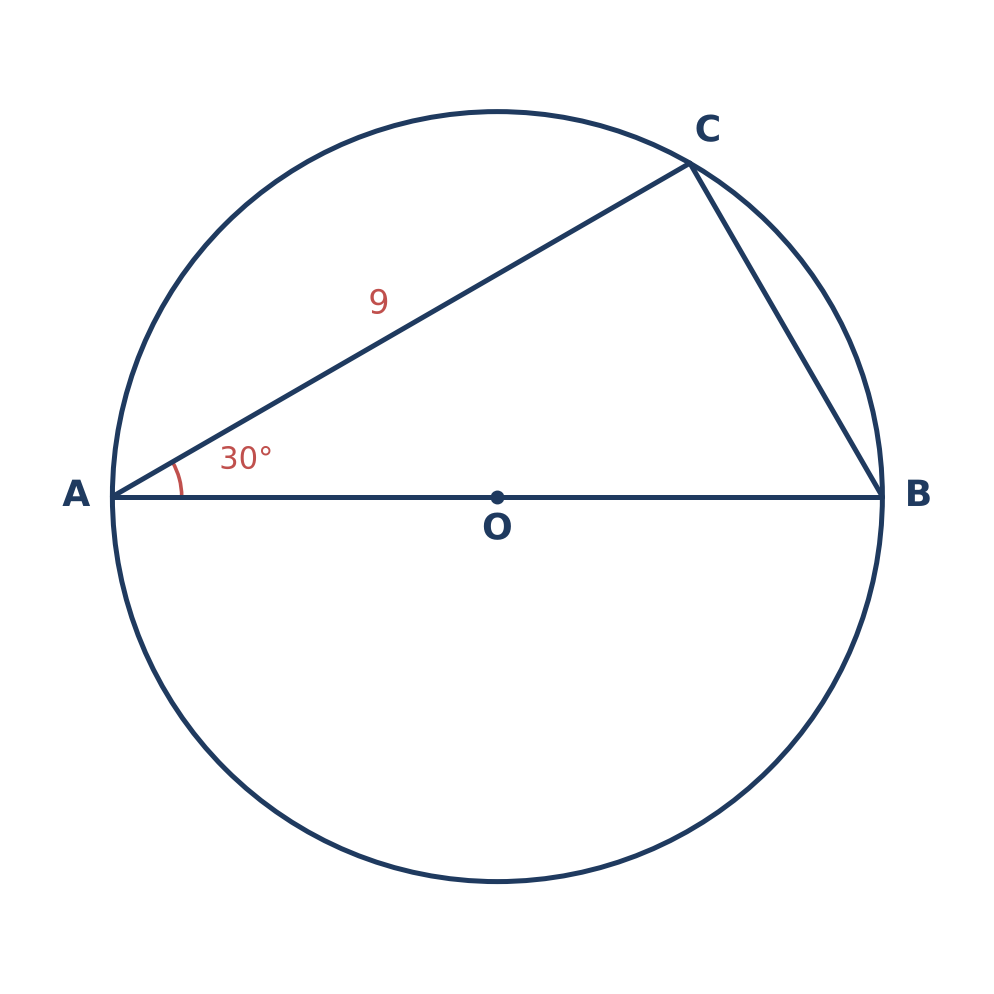
In the figure, AB is a diameter of the circle with center O, and point C lies on the circle. The measure of angle CAB is 30°, and AC = 9. What is the area of the circle?
Show solution
AnswerD —
Step-by-step
- An angle inscribed in a semicircle is a right angle, so angle ACB = 90°.
- In 30°-60°-90° triangle ACB, AC = 9 is opposite 60°, so AB = = 6.
- The radius is 3, so the area is π = .
Fast methodAngle C = 90°; AB = AC ÷ cos 30° = 6, so r = 3 and = 27.
Quick checkBC = 3 and + = 81 + 27 = 108 = ✓
Why the other choices are wrong
- A (6): found the circumference instead of the area
- B (): treated AC as the hypotenuse, so AB = 9 cos 30°
- C (): used AC = 9 as the diameter
16.
In the xy-plane, a square is inscribed in the circle with equation + + 6x − 10y + 2 = 0, so that all four vertices of the square lie on the circle. What is the area of the square?
Show solution
AnswerC — 64
Step-by-step
- Complete the square: + = −2 + 9 + 25, so + = 32.
- The radius is = 4, so the diameter is 8.
- A diagonal of an inscribed square is a diameter of the circle, so the diagonal is 8.
- A square with diagonal d has side = 8 = 8, so its area is = 64.
Fast methodArea of a square = (diagonal)²/2 = = 2 = 2(32) = 64.
Quick checkthe vertices (−3 ± 4, 5 ± 4) satisfy + = 32, and the side from (−7, 1) to (1, 1) is 8, so the area is 64 ✓
Why the other choices are wrong
- A (16): used the radius, 4, as the diagonal of the square
- B (32): used the radius, 4, as the side length of the square
- D (128): used the diameter, 8, as the side length of the square
17.
In the xy-plane, the graph of 2 + 2 − 6x + 10y − 1 = 0 is a circle. What is the length of the radius of the circle?
Show solution
AnswerA — 3
Step-by-step
- Divide by 2: + − 3x + 5y − = 0.
- Complete the squares: − + − = .
- + = + + = 9.
- = 9, so r = 3.
Fast methodDivide by 2 first, then = + + = 9.
Quick checkthe point = gives 2 + 2 − 27 − 25 − 1 = 53 − 53 = 0 ✓
Why the other choices are wrong
- B (): divided the x- and y-terms by 2 but kept the constant −1
- C (): did not divide the equation by 2 before completing the square
- D (9): gave instead of r
18.
The number t satisfies < t < π, and sin t = . What is the value of cos(t + π)?
Show solution
AnswerD —
Step-by-step
- On the unit circle, the angle t (in radians) ends at the point (cos t, sin t).
- sin²t + cos²t = 1, so cos²t = 1 − = and cos t = ±.
- Because < t < π, the point is in Quadrant II, where x is negative: cos t = −.
- Adding π radians is half a turn, which moves the point to the opposite end of the diameter, (−cos t, −sin t).
- So cos(t + π) = −cos t = − = .
Fast methodQuadrant II gives cos t = −; half a turn changes the sign of both coordinates, so cos(t + π) = .
Quick checkt ≈ 2.7468 radians gives sin t ≈ 0.3846 = and cos(t + π) ≈ 0.9231 = ✓
Why the other choices are wrong
- A (−): found cos t = − but did not move half a turn around the circle (this is cos t, not cos(t + π))
- B (−): gave −sin t, the y-coordinate of the opposite point, instead of its x-coordinate
- C (): gave sin t, the y-coordinate of the original point
19.
A disk rotates about its center at a constant rate. Point A is 3 centimeters from the center, and point B is 8 centimeters from the center. In 2 seconds, point A travels centimeters along its circular path. How far, in centimeters, does point B travel along its circular path in 5 seconds?
Show solution
AnswerD —
Step-by-step
- Every point of the disk turns through the same angle. In 2 seconds A turns through θ = arc/radius = radians.
- So the disk turns at = radians per second.
- In 5 seconds the disk turns through 5 = radians.
- Point B travels 8 = centimeters.
Fast methodDistance scales with radius and with time: × × = .
Quick check ÷ 8 = radians in 5 s and ÷ 3 = radians in 2 s, both radians per second ✓
Why the other choices are wrong
- A (): found A's distance in 5 seconds, , but multiplied by instead of
- B (): gave the distance point A travels in 5 seconds
- C (): gave the distance point B travels in 2 seconds, not 5 seconds
20.
In the xy-plane, the line y = x + b, where b is a positive constant, is tangent to the circle + = 18. What is the value of b?
Show solution
AnswerC — 6
Step-by-step
- Substitute y = x + b: + = 18, so 2 + 2bx + − 18 = 0.
- Tangent means exactly one solution, so the discriminant is 0: − 4(2) = 0.
- 4 − 8 + 144 = 0, so = 36.
- b > 0, so b = 6.
Fast methodSet the discriminant of 2 + 2bx + − 18 = 0 to zero; or note the line meets the circle at (−3, 3).
Quick checkb = 6 gives 2 + 12x + 18 = 2 = 0, one point (−3, 3), and 9 + 9 = 18 ✓
Why the other choices are wrong
- A (3): divided the radius by instead of multiplying
- B (3): assumed b equals the radius
- D (18): set b equal to = 18