Circles: Study Guide
Geometry and Trigonometry is about 15% of SAT Math (5–7 of 44 questions). This topic covers circles: circumference, area, arc length and sector area in degrees and radians, central and inscribed angles, tangent lines, the equation of a circle and completing the square, and radian measure and unit-circle values.
Circles
Circumference and area use π; arcs and sectors are the fraction θ/360 (or θ/2π) of the whole circle. An inscribed angle is half its central angle, a tangent is perpendicular to the radius, and completing the square gives the center and radius of a circle.
Key formulas| Circumference | |
| Area | |
| Arc length | |
| Sector area | |
| Inscribed angle | |
| Tangent | |
| Equation | |
| Complete the square |
Working backward with circles
Method. Find the radius first, then use the other formula.
Worked example- C = r = .
- So r = 13.
- The area is A = πr² = π × = square units.
- A (): forgot to square the radius
- B (): gave the circumference
- D (): used the diameter as the radius
Semicircles and quarter circles
Method. Take the right fraction of the full circle, then add any straight edges.
Worked example- The whole circle has area π × = .
- A quarter circle is one fourth of that: ÷ 4 = square inches.
- A (): used the circumference formula: ÷ 4
- C (): found the area of a half circle
- D (): gave the area of the whole circle
Arc length
Method. Arc = × circumference.
Worked example- Arc length = (central angle ÷ 360°) × r.
- So the arc length is × × 9 = × = .
- B (): found the other arc
- C (): gave the whole circumference
- D (): found the sector area
Sector area
Method. Sector = × area of the circle.
Worked example- Sector area = (central angle ÷ 360°) × πr².
- So the area is × π × = × = .
- A (): forgot to square the radius
- B (): found the arc length
- D (): gave the whole area
Inscribed and central angles
Method. Inscribed angle = ½ arc; central angle = arc; opposite angles of a cyclic quadrilateral add to 180°.
Worked example- An inscribed angle is half its intercepted arc.
- So the angle is 46° ÷ 2 = 23°.
- B (46): used the arc measure
- C (92): doubled instead of halving
- D (157): found the supplement
Tangent lines
Method. Radius ⊥ tangent, so use the Pythagorean theorem.
Worked example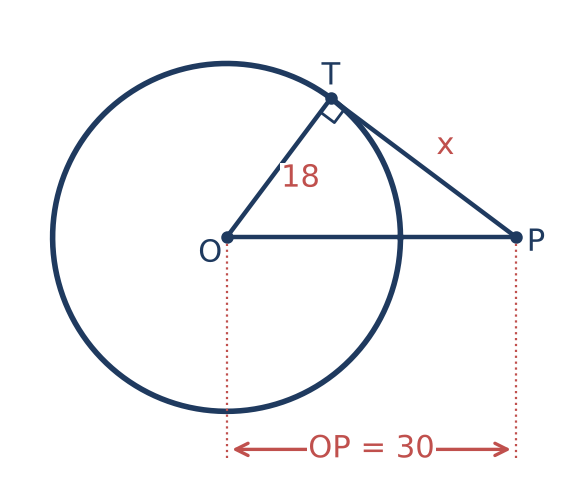
- A tangent is perpendicular to the radius at the point of tangency.
- So the triangle is a right triangle with hypotenuse 30.
- = − = 900 − 324 = 576.
- So x = 24.
- B (6): added the squares
- C (48): added the lengths
- D (576): forgot to take the square root
Equation of a circle
Method. Center: flip the signs inside the parentheses. Radius: square root of the right side.
Worked example- The standard form is + = , with center (h, k) and radius r.
- Here h = −2, k = 6 and = 16.
- So the center is (−2, 6) and the radius is = 4.
- A (center (2, −6), radius 4): reversed the signs of the center
- B (center (−2, 6), radius 16): gave as the radius
- C (center (2, −6), radius 16): reversed the signs and gave as the radius
Arc length and sector area in radians
Method. Radians: s = rθ and A = ½θ.
Worked example- For an angle in radians, arc length s = rθ.
- So s = 12 × = .
- A (): forgot to multiply by the radius
- C (): used the diameter
- D (): found the sector area
Chords
Method. Half-chord² + distance² = radius².
Worked example- The perpendicular from the center bisects the chord, forming a right triangle with hypotenuse 29 and leg 20.
- Half the chord is = = 21.
- So the chord is 2 × 21 = 42.
- A (18): subtracted the lengths and doubled: 2(29 − 20) = 18
- B (21): gave half the chord
- D (2): added the squares
Completing the square for circles
Method. For + + Dx + Ey + F = 0: = + − F.
Worked example- Complete the square in x and in y.
- + = −6 + 25 + 4 = 23.
- So = 23 and r = .
- A (1): added half of each coefficient without squaring
- C (): added the squares of the full coefficients
- D (23): gave as the radius
Radians and the Unit Circle
Convert between degrees and radians with 180° = π radians. A point on the unit circle at angle θ is (cos θ, sin θ); know the special angles and the signs in each quadrant.
Key formulas| Degrees to radians | |
| Point | |
| Special values | |
| Signs (ASTC) |
Radian and degree measure
Method. Degrees → radians: × . Radians → degrees: × .
Worked example- Multiply by .
- 45 × = radians.
- A (): dropped the π
- B (): divided by 360 instead of 180
- D (): divided 180 by 45 instead of 45 by 180, so the coefficient of π became 4
Unit-circle values
Method. Point on the unit circle = (cos θ, sin θ).
Worked example- On the unit circle, the point at 45° is . cos is the x-coordinate and sin is the y-coordinate.
- So sin 45° = .
- A (0): gave sin 0°
- B (): gave sin 30°
- D (): gave sin 60°