Geometry and Trigonometry: Unit Study Guide
- 04.01 Area and Volume
- 04.02 Lines, Angles and Triangles
- 04.03 Right Triangles and Trigonometry
- 04.04 Circles
04.01 Area and Volume
Geometry and Trigonometry is about 15% of SAT Math (5–7 of 44 questions). This topic covers area and perimeter of plane figures (including composite and shaded regions), volume and surface area of prisms, cylinders, cones, pyramids and spheres, and how area and volume change when lengths are scaled. The SAT reference sheet gives the main formulas.
Area and Perimeter
Area measures square units inside a figure; perimeter adds the side lengths. Split composite figures into simple shapes.
Key formulas| Rectangle | |
| Triangle | |
| Parallelogram | |
| Trapezoid | |
| Circle |
Area of parallelograms and trapezoids
Method. Parallelogram: base × height. Trapezoid: average the two bases, then multiply by the height.
Worked example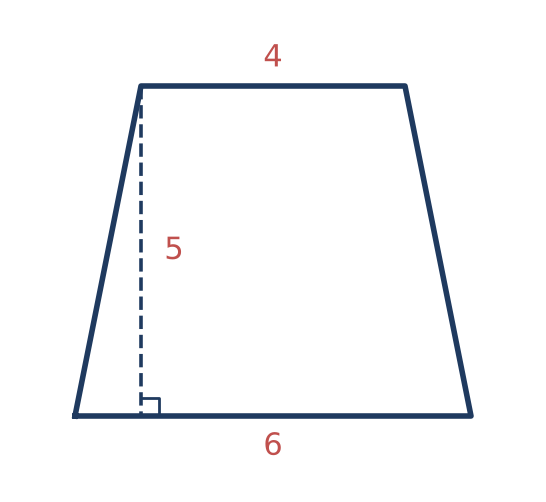
- Area of a trapezoid = ½ × (base₁ + base₂) × height.
- So A = ½ × (4 + 6) × 5 = ½ × 10 × 5 = 25.
- A (20): used only the shorter base
- C (30): used only the longer base
- D (50): forgot to multiply by ½
Composite figures
Method. Split the figure into rectangles or subtract the missing corner.
Worked example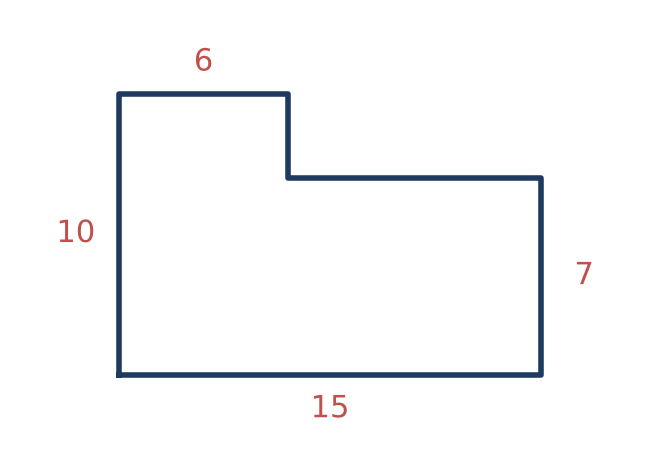
- Think of the figure as a 15 × 10 rectangle with a 9 × 3 corner removed (9 = 15 − 6 and 3 = 10 − 7).
- The big rectangle is 15 × 10 = 150.
- The corner is 9 × 3 = 27.
- So the area is 150 − 27 = 123.
- A (42): multiplied the two short sides
- B (50): found the perimeter
- D (150): did not remove the missing corner
Area and perimeter with algebra
Method. Write the formula with the unknown, then solve.
Worked example- Area = ½ × base × height = ½ × 6x × x = 3.
- So 3 = 48, = 16 and x = 4.
- B (4): multiplied by ½ twice
- C (16): forgot to take the square root
- D (24): gave the base
Scaling and area
Method. Area scales by ; length ratio is the square root of the area ratio.
Worked example- The area ratio is the square of the length ratio.
- So the length ratio is = 5, that is 5 : 1.
- A ( : 1): took the square root twice
- C (25 : 2): halved the area ratio
- D (25 : 1): gave the area ratio
Shaded regions
Method. Shaded area = outer area − inner area.
Worked example- The square's diagonal is the diameter, 10.
- A square with diagonal d has area ÷ 2 = 100 ÷ 2 = 50.
- Circle area = π × = .
- Shaded area = − 50.
- A ( − 100): used the side of a square with side equal to the diameter
- B ( − 25): used for the square's area
- C (50): gave the area of the square
Area in the coordinate plane
Method. Use a horizontal or vertical side as the base, or box the figure and subtract.
Worked example- Two vertices have y = 4.
- So that side is horizontal with length 7 − (−7) = 14.
- The height is the vertical distance from the third vertex: |8 − 4| = 4.
- So A = ½ × 14 × 4 = 28.
- A (9): added the base and height, then multiplied by ½: ½ × (14 + 4) = 9
- C (56): forgot to multiply by ½
- D (77): used a horizontal distance as the height
Volume and Surface Area
Volume measures cubic units; prisms and cylinders use base area × height, pyramids and cones take one third of that.
Key formulas| Prism / cylinder | |
| Pyramid / cone | |
| Sphere | |
| Rectangular box | |
| Cylinder surface |
Surface area of prisms
Method. Cube: V = and SA = 6.
Worked example- A cube has 6 square faces, each with area = 25.
- So SA = 6 × 25 = 150.
- A (25): found the area of one face
- B (100): counted only four faces
- C (125): found the volume
Volume of cylinders
Method. Cylinder: V = πr²h; SA = r² + rh.
Worked example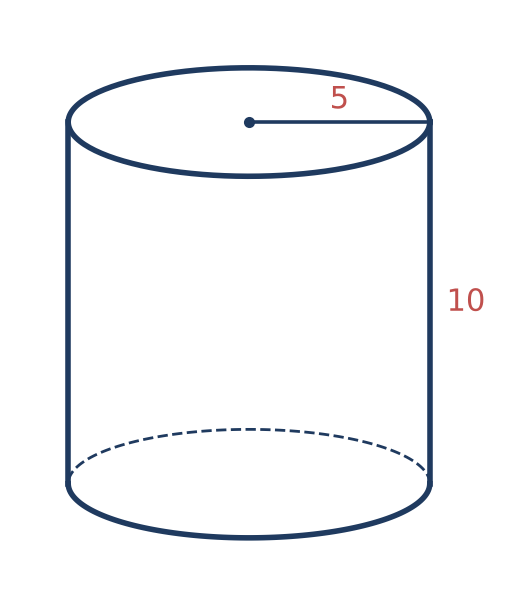
- V = πr²h.
- V = π × × 10.
- So V = .
- A (): found the lateral area rh
- C (): multiplied by an extra 2
- D (): used the diameter as the radius
Volume of triangular prisms
Method. Prism: V = base area × length; use the legs for a right triangle.
Worked example- V = (area of base) × length.
- The base area is ½ × 9 × 12 = 54.
- So V = 54 × 6 = 324 cubic units.
- A (54): gave only the area of the triangular base
- B (216): found the lateral area
- D (648): forgot the ½ in the triangle's area
Surface area of cylinders
Method. Cylinder: V = πr²h; SA = r² + rh.
Worked example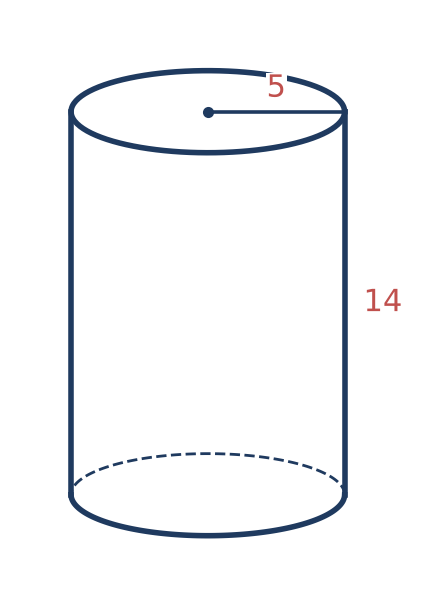
- SA = r² + rh.
- SA = × + × 5 × 14 = + .
- So SA = .
- B (): counted the curved surface twice
- C (): found the volume
- D (): used the diameter as the radius
Cones and pyramids
Method. Cone: V = ⅓πr²h; height is perpendicular, not the slant.
Worked example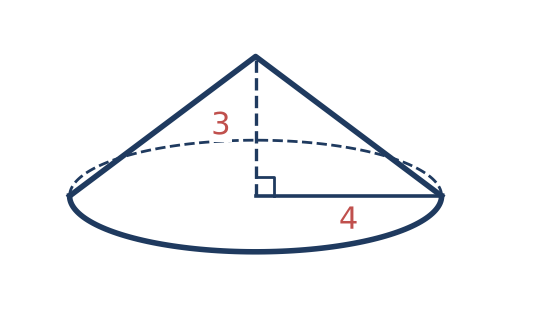
- V = ⅓πr²h.
- V = ⅓ × π × × 3 = ⅓ × .
- So V = .
- B (): used the slant height as the height
- C (): forgot the ⅓
- D (): used the diameter as the radius
Spheres
Method. Sphere: V = πr³ and SA = r².
Worked example- SA = r².
- SA = 4 × π × .
- So SA = .
- A (): found the area of a great circle
- C (): cubed the radius instead of squaring it
- D (): used the diameter as the radius
Solving for a dimension
Method. Substitute into the volume formula and solve for the unknown.
Worked example- V = πr²h.
- So = π × × h = h.
- Divide both sides by : h = 11.
- A (): used the diameter as the radius
- B (): used r² for the base
- D (22): forgot to square the radius
Scaling and volume
Method. Volume scales by ; area by .
Worked example- When lengths are multiplied by k, volume is multiplied by .
- So the new volume is 23 × = 23 × 8 = 184.
- A (46): multiplied the volume by the scale factor
- B (92): squared the scale factor
- C (138): multiplied by 3 times the scale factor
Composite solids
Method. Find each part's volume and add.
Worked example- Cylinder: πr²h = π × × 8 = .
- Cone: ⅓πr²h = ⅓ × π × × 12 = .
- Total = + = .
- A (): left out the cone
- C (): forgot the ⅓ for the cone
- D (): used the diameter as the radius of the cone
04.02 Lines, Angles and Triangles
Geometry and Trigonometry is about 15% of SAT Math (5–7 of 44 questions). This topic covers angle relationships: vertical, supplementary and complementary angles, parallel lines cut by a transversal, the triangle angle sum and exterior angles, angles in polygons, similar triangles and the triangle inequality.
Lines and Angles
Angle pairs: complementary add to 90°, supplementary to 180°, vertical angles are equal. With parallel lines, corresponding and alternate angles are equal.
Key formulas| Complementary | |
| Supplementary | |
| Vertical angles | |
| Around a point | |
| Parallel lines | |
| Same-side interior angles | |
| Polygon angle sums |
Parallel lines and transversals
Method. Parallel lines: all acute angles are equal, all obtuse angles are equal, and an acute + an obtuse = 180°.
Worked example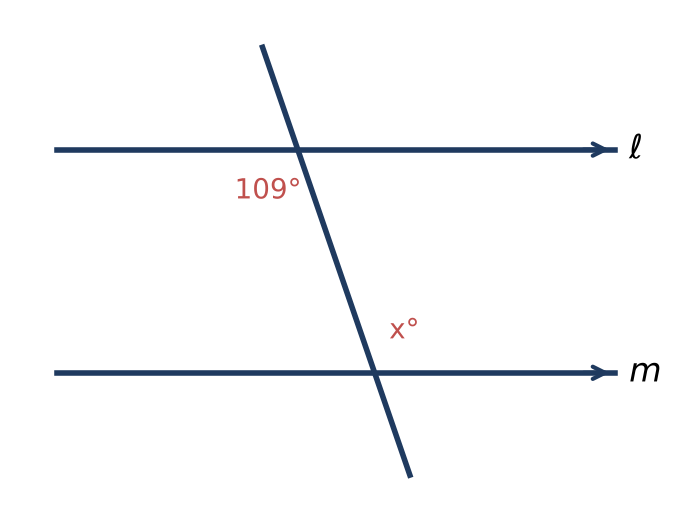
- The angle marked 109° and the angle marked x° are alternate interior angles.
- With parallel lines, alternate interior angles are equal.
- So x = 109.
- A (38): doubled the given angle and subtracted 180°: 2(109) − 180 = 38
- B (71): assumed the angles are supplementary
- D (251): subtracted from 360°
Angle relationships with algebra
Method. Write the angle relationship as an equation, then solve.
Worked example- Supplementary angles add to 180°: (7x + 11) + (3x + 9) = 180.
- So 10x + 20 = 180, 10x = 160 and x = 16.
- B (18): ignored the constants
- C (20): moved the constants with the wrong sign
- D (123): gave an angle instead of x
Angles in polygons
Method. Interior sum (n − 2)·180°; exterior sum always 360°.
Worked example- Each exterior angle is 180° − 144° = 36°.
- The exterior angles add to 360°.
- So n = 360 ÷ 36 = 10.
- A (5): divided 180° by the exterior angle
- B (8): gave n − 2
- D (12): added 2 instead of subtracting
Parallel lines with algebra
Method. Decide equal or supplementary first, then solve the linear equation.
Worked example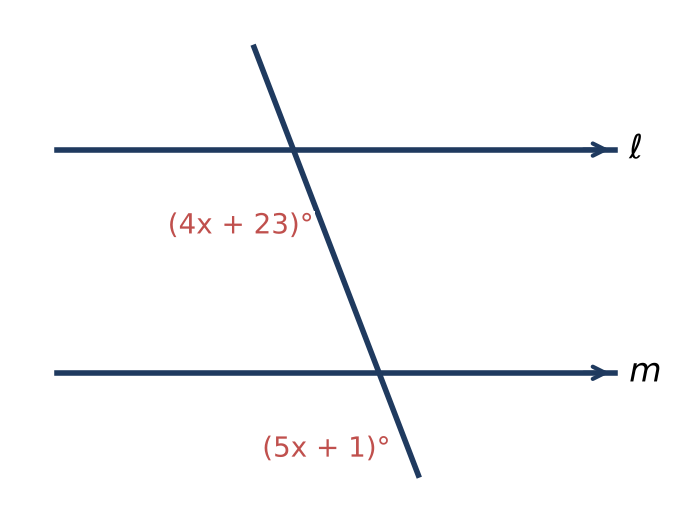
- The two angles are corresponding angles.
- So they are equal: (4x + 23) = (5x + 1).
- Solving gives x = 22.
- So the angles are 111° and 111°.
- A (): assumed the angles are supplementary
- C (24): moved the constants with the wrong sign
- D (111): gave the angle instead of x
Triangles
The angles of a triangle add to 180°, an exterior angle equals the two remote interior angles, and similar triangles have equal angles and proportional sides.
Key formulas| Angle sum | |
| Exterior angle | |
| Similar triangles | |
| Triangle inequality | |
| Congruence |
Triangle angle problems
Method. Add the three expressions, set the sum equal to 180 and solve.
Worked example- The angles add to 180°.
- So 8x − 4 = 180.
- Then 8x = 184.
- So x = 23.
- A (17): gave the first angle instead of x
- B (22): moved the constants with the wrong sign
- C (): ignored the constants
Exterior angles of a triangle
Method. Exterior angle = sum of the two remote interior angles.
Worked example- An exterior angle equals the sum of the two remote interior angles.
- So 62° + x = 118°, and x = 118 − 62 = 56°.
- B (62): gave the adjacent interior angle
- C (118): subtracted the known angle from 180°
- D (180): added instead of subtracting
Similar triangles
Method. Find the scale factor from one known pair, then multiply.
Worked example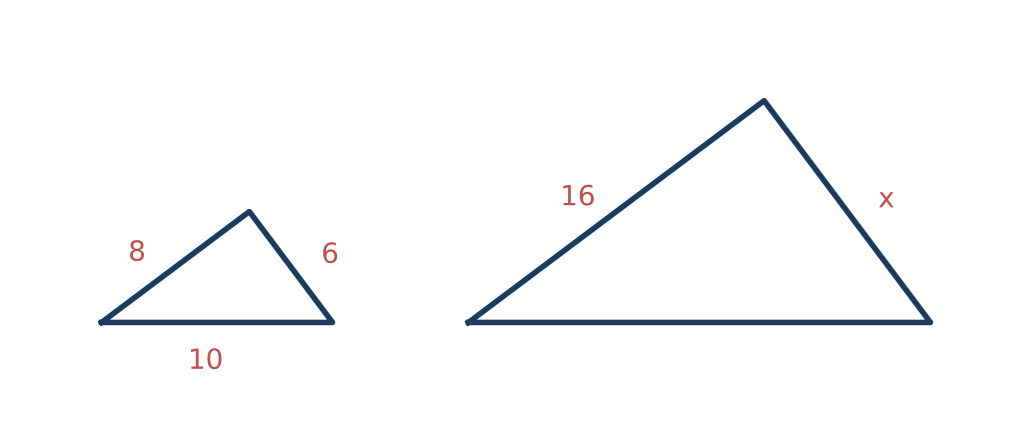
- The triangles are similar.
- So corresponding sides are proportional.
- The scale factor from the first triangle to the second is 16 ÷ 8 = 2.
- So x = 6 × 2 = 12.
- A (3): divided by the scale factor
- C (14): added the difference instead of multiplying by the scale factor
- D (16): gave the known side of the second triangle
Triangle inequality
Method. Third side: difference < x < sum.
Worked example- The third side must be strictly between 24 − 14 = 10 and 14 + 24 = 38.
- Only 16 lies strictly between 10 and 38.
- A (9): allowed a side shorter than the difference
- B (10): allowed the third side to equal the difference
- D (38): allowed the third side to equal the sum
Similar triangles in context
Method. Height ÷ shadow is constant at one time of day.
Worked example- The sun's rays make similar right triangles.
- So height ÷ shadow is the same for both.
- = .
- So x = 7 × 18 ÷ 2 = 63.
- A (): set up the proportion upside down
- B (23): added the difference instead of using a ratio
- D (126): multiplied without dividing
04.03 Right Triangles and Trigonometry
Geometry and Trigonometry is about 15% of SAT Math (5–7 of 44 questions). This topic covers right triangles: the Pythagorean theorem and its converse, special right triangles (30-60-90 and 45-45-90), sine, cosine and tangent, sin x = cos(90° − x), and angles of elevation and depression.
Right-Triangle Trigonometry
SOH-CAH-TOA relates the sides of a right triangle to its acute angles.
Key formulas| Sine | |
| Cosine | |
| Tangent | |
| Cofunction |
Trigonometric ratios
Method. Sketch a triangle from the given ratio, find the third side, then read the new ratio.
Worked example- Since cos A = = adjacent/hypotenuse, build a triangle with those two sides.
- The third side comes from the Pythagorean theorem: the sides are 21 (opposite), 20 (adjacent) and 29 (hypotenuse).
- So sin A = opposite/hypotenuse = .
- A (): subtracted cos A from 1
- B (): gave cos A again
- D (): took the reciprocal
Complementary angles
Method. sin x = cos y when x + y = 90°.
Worked example- For complementary angles, sin x = cos(90° − x).
- So cos x° = sin 14° means x + 14 = 90.
- So x = 76.
- A (14): set the angles equal
- C (104): added 90°
- D (166): used supplementary angles
Angles of elevation and depression
Method. Draw the right triangle, label the angle, then choose SOH, CAH or TOA.
Worked example- Use tan 48° = height ÷ 21.
- So height = 21 × tan 48° ≈ 23.3.
- A (14.1): used cosine instead of tangent
- B (15.6): used sine instead of tangent
- C (18.9): divided by tan instead of multiplying
Exact values for special angles
Method. Use the 1 : : 2 and 1 : 1 : triangles.
Worked example- In a 30°-60°-90° triangle with sides 1, and 2, the side opposite 60° is .
- So tan 60° = .
- A (): gave the value of tan 30°
- B (): gave the value of cos 30°
- C (): took the reciprocal of
Right Triangles
The Pythagorean theorem links the sides of a right triangle; the special right triangles have fixed side ratios (on the SAT reference sheet).
Key formulas| Pythagorean theorem | |
| Converse | |
| 45-45-90 | |
| 30-60-90 |
Pythagorean theorem
Method. Recognize the triple 9–40–41.
Worked example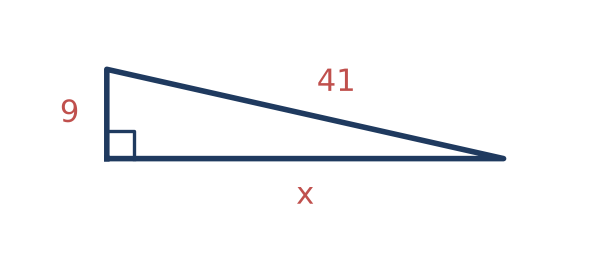
- By the Pythagorean theorem, + = .
- So = 1681 − 81 = 1600, and x = = 40.
- A (32): subtracted the sides
- C (): added the squares instead of subtracting
- D (1600): forgot to take the square root
Converse of the Pythagorean theorem
Method. + vs (c longest): equal → right, greater → acute, less → obtuse.
Worked example- Compare the square of the longest side with the sum of the squares of the other two sides.
- + = 625 and = 625.
- They are equal.
- So the triangle is right.
- A (acute): thought + is greater than
- C (obtuse): thought + is less than
- D (not a triangle): thought the sides cannot form a triangle
Special right triangles
Method. 45°-45°-90°: 1 : 1 : . 30°-60°-90°: 1 : : 2.
Worked example- In a 30°-60°-90° triangle the sides are in the ratio 1 : : 2 (shorter leg : longer leg : hypotenuse).
- The longer leg is 3.
- So the shorter leg is 3.
- B (3): found the shorter leg 3, then multiplied by as in a 45°-45°-90° triangle
- C (3): gave the longer leg instead
- D (6): gave the hypotenuse instead
04.04 Circles
Geometry and Trigonometry is about 15% of SAT Math (5–7 of 44 questions). This topic covers circles: circumference, area, arc length and sector area in degrees and radians, central and inscribed angles, tangent lines, the equation of a circle and completing the square, and radian measure and unit-circle values.
Circles
Circumference and area use π; arcs and sectors are the fraction θ/360 (or θ/2π) of the whole circle. An inscribed angle is half its central angle, a tangent is perpendicular to the radius, and completing the square gives the center and radius of a circle.
Key formulas| Circumference | |
| Area | |
| Arc length | |
| Sector area | |
| Inscribed angle | |
| Tangent | |
| Equation | |
| Complete the square |
Working backward with circles
Method. Find the radius first, then use the other formula.
Worked example- C = r = .
- So r = 13.
- The area is A = πr² = π × = square units.
- A (): forgot to square the radius
- B (): gave the circumference
- D (): used the diameter as the radius
Semicircles and quarter circles
Method. Take the right fraction of the full circle, then add any straight edges.
Worked example- The whole circle has area π × = .
- A quarter circle is one fourth of that: ÷ 4 = square inches.
- A (): used the circumference formula: ÷ 4
- C (): found the area of a half circle
- D (): gave the area of the whole circle
Arc length
Method. Arc = × circumference.
Worked example- Arc length = (central angle ÷ 360°) × r.
- So the arc length is × × 9 = × = .
- B (): found the other arc
- C (): gave the whole circumference
- D (): found the sector area
Sector area
Method. Sector = × area of the circle.
Worked example- Sector area = (central angle ÷ 360°) × πr².
- So the area is × π × = × = .
- A (): forgot to square the radius
- B (): found the arc length
- D (): gave the whole area
Inscribed and central angles
Method. Inscribed angle = ½ arc; central angle = arc; opposite angles of a cyclic quadrilateral add to 180°.
Worked example- An inscribed angle is half its intercepted arc.
- So the angle is 46° ÷ 2 = 23°.
- B (46): used the arc measure
- C (92): doubled instead of halving
- D (157): found the supplement
Tangent lines
Method. Radius ⊥ tangent, so use the Pythagorean theorem.
Worked example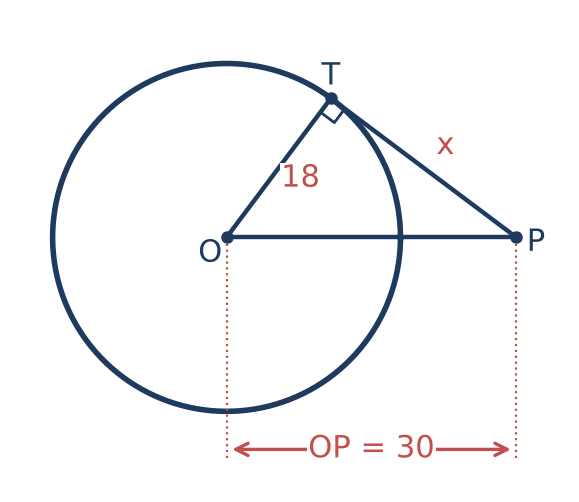
- A tangent is perpendicular to the radius at the point of tangency.
- So the triangle is a right triangle with hypotenuse 30.
- = − = 900 − 324 = 576.
- So x = 24.
- B (6): added the squares
- C (48): added the lengths
- D (576): forgot to take the square root
Equation of a circle
Method. Center: flip the signs inside the parentheses. Radius: square root of the right side.
Worked example- The standard form is + = , with center (h, k) and radius r.
- Here h = −2, k = 6 and = 16.
- So the center is (−2, 6) and the radius is = 4.
- A (center (2, −6), radius 4): reversed the signs of the center
- B (center (−2, 6), radius 16): gave as the radius
- C (center (2, −6), radius 16): reversed the signs and gave as the radius
Arc length and sector area in radians
Method. Radians: s = rθ and A = ½θ.
Worked example- For an angle in radians, arc length s = rθ.
- So s = 12 × = .
- A (): forgot to multiply by the radius
- C (): used the diameter
- D (): found the sector area
Chords
Method. Half-chord² + distance² = radius².
Worked example- The perpendicular from the center bisects the chord, forming a right triangle with hypotenuse 29 and leg 20.
- Half the chord is = = 21.
- So the chord is 2 × 21 = 42.
- A (18): subtracted the lengths and doubled: 2(29 − 20) = 18
- B (21): gave half the chord
- D (2): added the squares
Completing the square for circles
Method. For + + Dx + Ey + F = 0: = + − F.
Worked example- Complete the square in x and in y.
- + = −6 + 25 + 4 = 23.
- So = 23 and r = .
- A (1): added half of each coefficient without squaring
- C (): added the squares of the full coefficients
- D (23): gave as the radius
Radians and the Unit Circle
Convert between degrees and radians with 180° = π radians. A point on the unit circle at angle θ is (cos θ, sin θ); know the special angles and the signs in each quadrant.
Key formulas| Degrees to radians | |
| Point | |
| Special values | |
| Signs (ASTC) |
Radian and degree measure
Method. Degrees → radians: × . Radians → degrees: × .
Worked example- Multiply by .
- 45 × = radians.
- A (): dropped the π
- B (): divided by 360 instead of 180
- D (): divided 180 by 45 instead of 45 by 180, so the coefficient of π became 4
Unit-circle values
Method. Point on the unit circle = (cos θ, sin θ).
Worked example- On the unit circle, the point at 45° is . cos is the x-coordinate and sin is the y-coordinate.
- So sin 45° = .
- A (0): gave sin 0°
- B (): gave sin 30°
- D (): gave sin 60°