Number Sense and Operations: Practice Paper 1
Choose one answer for each question, then select Check my answers. Every question has a full worked solution.
1.
How many feet are in 12 yards?
Show solution
AnswerC — 36
Step-by-step
- Each yard is 3 feet.
- Going from a larger unit to a smaller unit, multiply: 12 × 3 = 36 feet.
Fast methodLarger unit → smaller unit: multiply by 3.
Quick check36 ÷ 3 = 12 yards, the amount given.
Why the other choices are wrong
- A (4): divided instead of multiplying
- B (15): added instead of multiplying: 12 + 3 = 15
- D (120): used 10 feet per yard instead of 3
- E (360): put an extra zero on the answer
2.
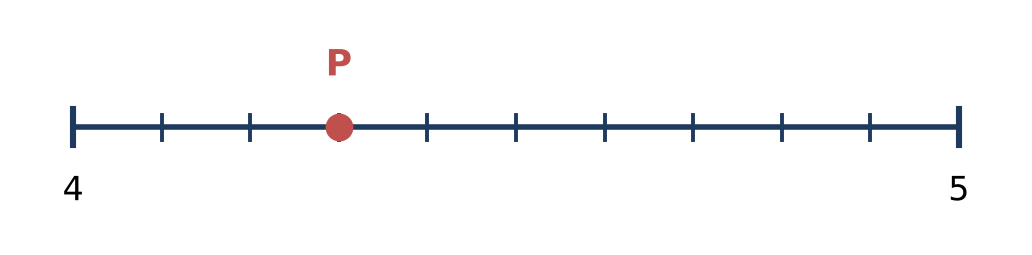
On the number line, what decimal does point P show?
Show solution
AnswerA — 4.3
Step-by-step
- From 4 to 5 there are 10 equal spaces.
- So each space is (5 − 4) ÷ 10 = 0.1.
- P is 3 spaces past 4: 4 + 3 × 0.1 = 4.3.
Fast methodFind the size of one space (0.1), then count spaces from the left end.
Quick checkP is 7 spaces before 5: 5 − 7 × 0.1 = 4.3.
Why the other choices are wrong
- B (4.4): counted tick marks (including the first one) instead of spaces
- C (4.7): counted the spaces back from the right end
- D (7): read each space as ten times its size
- E (43): left out the decimal point: 4.3 written as 43
3.
What is of 18?
Show solution
AnswerA — 12
Step-by-step
- Find one part first: 18 ÷ 3 = 6.
- So of 18 is 6.
- Then take 2 of those parts: 2 × 6 = 12.
Fast methodDivide by the bottom, multiply by the top: 18 ÷ 3 × 2 = 12.
Quick check12 is less than 18 because is less than 1, and 12 × 3 = 2 × 18.
Why the other choices are wrong
- B (24): added one part to the whole instead of taking two parts: 18 + 6 = 24
- C (27): divided by the top number and multiplied by the bottom
- D (30): added the part to the whole
- E (36): multiplied by the top number only
4.
Priya gave away 25 stickers and has 27 stickers left. How many stickers did Priya have at the start?
Show solution
AnswerC — 52
Step-by-step
- Start − given away = left.
- So start = left + given away.
- Add: 27 + 25 = 52 stickers.
Fast methodDecide the operation from the story (share → divide, equal rows → multiply, gave away → work backward by adding).
Quick checkworking forward, 52 − 25 = 27 stickers left ✓.
Why the other choices are wrong
- A (2): subtracted instead of adding
- B (25): gave the number given away
- D (412): wrote the ones sum without regrouping: 2 + 2 = 4 tens, 5 + 7 = 12 ones, written 412
- E (675): multiplied the two numbers
5.
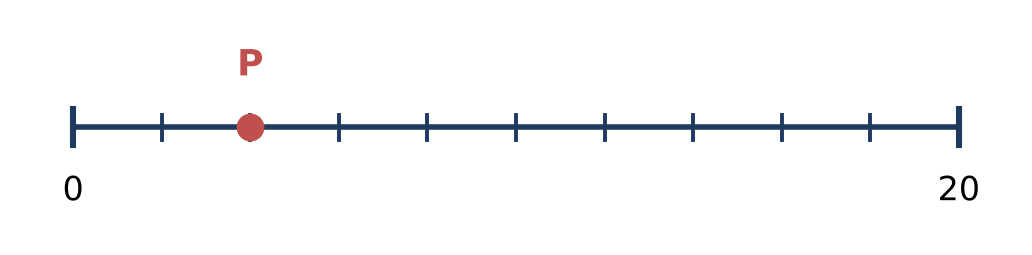
On the number line, what number does point P show?
Show solution
AnswerB — 4
Step-by-step
- From 0 to 20 there are 10 equal spaces.
- So each space is 20 ÷ 10 = 2.
- P is 2 spaces from 0: 2 × 2 = 4.
Fast methodFind the value of one space (2), then multiply by the number of spaces to P (2).
Quick checkP is 8 spaces before 20: 20 − 16 = 4.
Why the other choices are wrong
- A (2): counted the tick marks without using the scale
- C (6): counted tick marks (including the one at 0) instead of spaces
- D (16): counted the spaces back from the right end
- E (20): gave the number at the right end of the number line
6.
Solve for x: = 13
Show solution
AnswerD — 78
Step-by-step
- Multiply both sides by 6.
- x = 13 × 6.
- So x = 78.
Fast methodDo the inverse operation to both sides in one step.
Quick check78 ÷ 6 = 13, which matches the right side.
Why the other choices are wrong
- A (): divided instead of multiplying
- B (7): subtracted instead of multiplying
- C (19): added instead of multiplying
- E (84): multiplied, then added 6 more: 13 × 6 + 6 = 84
7.
A train travels 125 miles in 5 hours at a steady speed. How many miles does it travel per hour?
Show solution
AnswerA — 25
Step-by-step
- Unit rate = miles ÷ hours.
- Unit rate = 125 ÷ 5.
- So Unit rate = 25 miles per hour.
Fast methodA unit rate is 'per 1': divide the total by the number of units.
Quick check25 miles per hour × 5 hours = 125 miles, the distance given.
Why the other choices are wrong
- B (50): gave the miles in 2 hours instead of 1: 2 × 25 = 50
- C (120): subtracted the hours from the miles
- D (130): added the hours to the miles
- E (625): multiplied instead of dividing
8.
Ava buys 3 sandwiches that cost $3 each and pays with a $50 bill. How much change should Ava get?
Show solution
AnswerB — $41
Step-by-step
- Total cost: 3 × $3 = $9.
- Change: $50 − $9 = $41.
Fast methodMultiply first (total cost), then subtract from the amount paid.
Quick checkcost plus change = $9 + $41 = $50, the amount paid ✓.
Why the other choices are wrong
- A ($9): gave the total cost instead of the change
- C ($44): counted one item too few
- D ($47): subtracted the price of only one sandwich
- E ($59): added instead of subtracting: $50 + $9 = $59
9.
Which rule turns each input into its output? Input: 6, 7, 10. Output: 18, 20, 26.
Show solution
AnswerE — Multiply by 2, then add 6
Step-by-step
- Test the rule on every pair.
- 6 → 6 × 2 + 6 = 18.
- 7 → 7 × 2 + 6 = 20.
- 10 → 10 × 2 + 6 = 26.
- All three pairs match.
Fast methodTest each choice on ALL pairs, not just the first one.
Quick checkthe input 10 gives 10 × 2 + 6 = 26, the last output ✓.
Why the other choices are wrong
- A (Add 2): used the change in the outputs as the rule
- B (Add 6, then multiply by 2): did the operations in the wrong order
- C (Multiply by 6, then add 2): swapped the two numbers in the rule
- D (Multiply by 3): checked only the first pair: 6 × 3 = 18
10.
What is 26.71 + 15.1?
Show solution
AnswerD — 41.81
Step-by-step
- Line up the decimal points and add zeros so both numbers have 2 decimal places: 26.71 + 15.10.
- Add place by place from the right, carrying as needed: 41.81.
Fast methodAdd the whole parts (26 + 15 = 41) and the decimal parts (0.71 + 0.1 = 0.81), then combine: 41.81.
Quick checkEstimate: about 27 + 15 = 42; 41.81 is close.
Why the other choices are wrong
- A (4.181): put the decimal point one place too far left
- B (11.61): subtracted instead of adding
- C (28.22): lined up the last digits instead of the decimal points
- E (418.1): put the decimal point one place too far right
11.
Which fraction is the least?
Show solution
AnswerC —
Step-by-step
- and are each more than , so neither is the least.
- Compare with : = and = , so is less than .
- Compare with : = , and has the same top as but a bigger bottom, so is less than .
- So is the least.
Fast methodCompare each fraction with and with 1 first; for close ones cross-multiply: > when a × d > b × c.
Quick checkCross-multiply and : 2 × 4 = 8 and 9 × 1 = 9; 8 < 9, so < ✓.
Why the other choices are wrong
- A (): chose the fraction with the least bottom number
- B (): chose the greatest fraction instead of the least
- D (): chose the fraction with the greatest bottom number
- E (): chose the fraction with the least top number
12.
What is 6 × ?
Show solution
AnswerD —
Step-by-step
- 6 × means 6 groups of .
- Multiply the whole number by the top: 6 × 3 = 18.
- So the product is , which simplifies to .
Fast methodWrite 6 as and multiply straight across: = = .
Quick checkRepeated addition: + + + + + = = .
Why the other choices are wrong
- A (): multiplied only the bottom
- B (): multiplied both the top and the bottom by the whole number
- C (): added the whole number to the top
- E (8): flipped the fraction before multiplying
13.
A ribbon is 10 meters long. Leo cuts off 7.3 meters. How many meters of ribbon are left?
Show solution
AnswerA — 2.7
Step-by-step
- Meters left = 10 − 7.3.
- Write 10 as 10.0, line up the decimal points and regroup: 10.0 − 7.3 = 2.7 meters.
Fast methodCount up from 7.3: 0.7 more makes 8, then 2 more makes 10; 0.7 + 2 = 2.7.
Quick checkAdd back: 7.3 + 2.7 = 10, the whole ribbon ✓.
Why the other choices are wrong
- B (3): subtracted only the whole numbers and left out the tenths: 10 − 7 = 3
- C (3.3): subtracted the whole numbers but added the tenths: 3 + 0.3 = 3.3
- D (3.7): regrouped for the tenths but did not take 1 from the ones: 3 + 0.7 = 3.7
- E (17.3): added instead of subtracting: 10 + 7.3 = 17.3
14.
5 comic books cost $8.75. At the same price each, how much do 3 comic books cost?
Show solution
AnswerB — $5.25
Step-by-step
- Price of one: $8.75 ÷ 5 = $1.75.
- Cost of 3: 3 × $1.75 = $5.25.
Fast methodFind the cost of one, then multiply.
Quick check$5.25 ÷ 3 = $1.75, the same price as $8.75 ÷ 5 ✓.
Why the other choices are wrong
- A ($1.75): gave the price of one comic book
- C ($7.00): found the cost of 4 comic books: 4 × $1.75 = $7.00
- D ($8.75): gave the cost of 5 comic books
- E ($26.25): multiplied the cost of 5 by 3
15.
In the table, every output comes from its input by the same rule. Input: 1, 2, 3, 4. Output: 14, 19, 24, 29. What is the output when the input is 6?
Show solution
AnswerE — 39
Step-by-step
- Each time the input goes up by 1, the output goes up by 5.
- So the rule multiplies by 5.
- Input 1 gives 14 = 5 × 1 + 9.
- So the rule is: multiply by 5.
- Then add 9.
- For input 6: 5 × 6 + 9 = 39.
Fast methodFind how much the output grows per 1 input (the multiplier), then fix the starting amount.
Quick checkthe rule gives 14, 19, 24, 29 for inputs 1, 2, 3, 4, matching the table ✓.
Why the other choices are wrong
- A (15): added instead of multiplying
- B (19): used only the first pair to make an adding rule: 1 + 13 = 14, so 6 + 13 = 19
- C (30): used only the multiplication part of the rule
- D (34): found only the next output
16.
In a jar, of the marbles are blue. There are 18 blue marbles. How many marbles are in the jar in all?
Show solution
AnswerE — 30
Step-by-step
- of the marbles is 18 marbles, so of the marbles is 18 ÷ 3 = 6 marbles.
- All of the marbles is , so 5 × 6 = 30 marbles.
Fast methodDivide by the top number to find one fifth, then multiply by 5.
Quick check of 30 is 3 × 6 = 18 ✓
Why the other choices are wrong
- A (6): found of the marbles and stopped
- B (12): gave the number of marbles that are not blue
- C (21): added 3 to 18
- D (23): added 5 to 18
17.
How many prime numbers are there from 40 to 60, including 40 and 60?
Show solution
AnswerB — 5
Step-by-step
- List the primes in the range: 41, 43, 47, 53, 59.
- That is 5 primes.
Fast methodCross out the evens and the multiples of 3, 5 and 7; what is left in the range are the primes.
Quick checkEach listed number has no factor of 2, 3, 5 or 7 (except itself).
Why the other choices are wrong
- A (4): left out a prime
- C (6): counted a composite number as prime
- D (7): counted 51 and 57 as primes
- E (10): counted every odd number as prime
18.
A number pattern starts 4, 11, 18, 25, … and the same amount is added each time. What is the 10th number in the pattern?
Show solution
AnswerC — 67
Step-by-step
- Each number is 7 more than the one before it.
- From the 1st number to the 10th number there are 9 jumps of 7.
- 9 × 7 = 63, and 4 + 63 = 67.
Fast methodStart at 4 and add 9 jumps of 7.
Quick checkThe 4th number is 4 + 3 × 7 = 25, which matches the pattern, so the 10th is 4 + 9 × 7 = 67 ✓
Why the other choices are wrong
- A (60): added only 8 jumps of 7
- B (63): multiplied 9 × 7 but forgot the starting 4
- D (70): multiplied 10 × 7 and forgot the starting 4
- E (74): added 10 jumps of 7 instead of 9
19.
Which of the following is equal to 6 × 48?
Show solution
AnswerA — 6 × 40 + 6 × 8
Step-by-step
- Break 48 into 40 + 8.
- 6 groups of 48 is 6 groups of 40 plus 6 groups of 8.
- So 6 × 48 = 6 × 40 + 6 × 8 = 240 + 48 = 288.
Fast methodSplit 48 into tens and ones and multiply each part by 6.
Quick check6 × 48 = 288 and 240 + 48 = 288 ✓
Why the other choices are wrong
- B (6 × 40 + 8): multiplied only the 40 by 6 and just added the 8 (gives 248)
- C (6 × 4 + 6 × 8): used 4 instead of 40 for the tens part (gives 72)
- D (6 × 40 × 8): multiplied the two parts together instead of adding them (gives 1,920)
- E (6 × 50 − 2): rounded 48 up to 50 but took away only 2 instead of 6 × 2 (gives 298)
20.
If a is an odd whole number and b is an even whole number, which expression must be even?
Show solution
AnswerD — a + 1
Step-by-step
- Use the rules: even ± even = even, odd ± odd = even, odd ± even = odd.
- Even × anything = even, odd × odd = odd.
- Here a is odd and b is even.
- So a + 1 is always even.
Fast methodTest with small numbers: a = 1, b = 2 gives a + 1 = 2, which is even; check one more pair to be sure.
Quick checkWith a = 3 and b = 4: a + 1 = 4, also even.
Why the other choices are wrong
- A (a + b): chose an expression that is always odd
- B (a × a): chose an expression that is always odd
- C (3a): chose an expression that is always odd
- E (a + 2): chose an expression that is always odd