Measurement and Geometry: Practice Paper 1
Choose one answer for each question, then select Check my answers. Every question has a full worked solution.
1.
How many degrees are in a full turn?
Show solution
AnswerE — 360°
Step-by-step
- A full turn is 360°.
- So a full turn is 360°, the whole way around.
Fast methodFull turn 360°, half 180°, quarter 90°.
Quick checkfour quarter turns make 4 × 90° = 360°, a full turn ✓.
Why the other choices are wrong
- A (45°): used an eighth turn instead
- B (90°): used a quarter turn instead
- C (180°): used a half turn instead
- D (270°): used a three-quarter turn instead
2.
A square has sides of 12 centimeters. What is its perimeter, in centimeters?
Show solution
AnswerD — 48
Step-by-step
- A square has 4 equal sides.
- So P = 4 × 12 = 48 centimeters.
Fast methodSquare: P = 4s and A = .
Quick check48 ÷ 4 = 12, the side length ✓.
Why the other choices are wrong
- A (16): added 4 instead of multiplying
- B (24): added only two sides
- C (36): left out one side
- E (144): found the area instead of the perimeter: 12 × 12 = 144
3.
Sam has 5 quarters, 6 dimes and 2 pennies. How much money does Sam have?
Show solution
AnswerE — $1.87
Step-by-step
- Find the value of each kind of coin.
- 5 × 25¢ = 125¢.
- 6 × 10¢ = 60¢.
- 2 × 1¢ = 2¢.
- Total = 187¢ = $1.87.
Fast methodQuarter 25¢, dime 10¢, nickel 5¢, penny 1¢.
Quick check125 + 60 + 2 = 187 cents ✓.
Why the other choices are wrong
- A ($0.13): counted every coin as one cent
- B ($1.27): left out the dimes
- C ($1.57): mixed up the values of dimes and nickels
- D ($1.85): left out the pennies
4.
A shape has 4 sides that are all the same length, but none of its angles are right angles. What is the shape?
Show solution
AnswerE — rhombus
Step-by-step
- The shape has 4 sides, so it is a quadrilateral.
- A square also has 4 equal sides, but its angles are right angles.
- A quadrilateral with 4 equal sides and no right angles is a rhombus.
Fast method4 equal sides → square or rhombus; no right angles → rhombus.
Quick checkA rhombus has 4 equal sides and its angles do not have to be right angles ✓
Why the other choices are wrong
- A (square): forgot that a square must have 4 right angles
- B (rectangle): chose a shape that has 4 right angles
- C (trapezoid): chose a shape whose sides do not have to be equal
- D (pentagon): chose a shape with 5 sides
5.
A triangle has sides of length 5, 13, 13. Which word best describes it?
Show solution
AnswerB — isosceles
Step-by-step
- Equilateral triangles have 3 equal sides, isosceles triangles have 2 equal sides, and scalene triangles have no equal sides.
- The sides form a triangle because 5 + 13 > 13.
- Here exactly two sides are equal.
- So the triangle is isosceles.
Fast methodCount how many side lengths are equal.
Quick checkthe lengths 5, 13, 13 contain exactly one repeated value ✓.
Why the other choices are wrong
- A (equilateral): thought a triangle with sides 5, 13, 13 is equilateral
- C (right triangle): thought a triangle with sides 5, 13, 13 is right
- D (scalene): thought a triangle with sides 5, 13, 13 is scalene
- E (not a triangle): thought the sides cannot form a triangle
6.
A rectangle is 13 centimeters long and 3 centimeters wide. What is its area, in square centimeters?
Show solution
AnswerC — 39
Step-by-step
- Area = length × width.
- So A = 13 × 3 = 39 square centimeters.
Fast methodPerimeter adds all four sides; area multiplies length by width.
Quick check39 ÷ 3 = 13, the length ✓.
Why the other choices are wrong
- A (16): added the length and the width: 13 + 3 = 16
- B (32): found the perimeter
- D (78): doubled the area
- E (169): squared the length
7.
A triangle has angles of 84°, 45°, 51°. What kind of triangle is it?
Show solution
AnswerD — acute triangle
Step-by-step
- A triangle is right if one angle is 90°, obtuse if one angle is more than 90°, and acute if all three angles are less than 90°.
- The largest angle is 84°.
- So it is an acute triangle.
Fast methodLook only at the largest angle.
Quick check84 + 45 + 51 = 180, and the largest angle is 84° ✓.
Why the other choices are wrong
- A (right triangle): thought a triangle with angles 84°, 45°, 51° is right
- B (obtuse triangle): thought a triangle with angles 84°, 45°, 51° is obtuse
- C (equiangular triangle): thought a triangle with angles 84°, 45°, 51° is equiangular
- E (isosceles triangle): thought a triangle with angles 84°, 45°, 51° is isosceles
8.
A train leaves at 4:55 and arrives at 7:45 the same morning. How long is the trip?
Show solution
AnswerB — 2 h 50 min
Step-by-step
- Count whole hours: 4:55 to 6:55 is 2 h.
- Then 6:55 to 7:45 is 50 min.
- So the trip takes 2 h 50 min.
Fast methodCount whole hours first, then the leftover minutes.
Quick check4:55 plus 2 h 50 min is 7:45 ✓.
Why the other choices are wrong
- A (2 h 45 min): left out the 5 minutes from 4:55 to 5:00
- C (3 h 10 min): subtracted the smaller minutes from the larger
- D (2 h 90 min): treated an hour as 100 minutes
- E (3 h 50 min): forgot to borrow an hour
9.
How many edges does a square pyramid have?
Show solution
AnswerC — 8
Step-by-step
- The square base has 4 edges.
- Each of the 4 corners of the base is joined to the top point by an edge: 4 more edges.
- 4 + 4 = 8 edges.
Fast methodBase edges + slanted edges = 4 + 4.
Quick checkA square pyramid has 5 faces, 5 corners, and 8 edges ✓
Why the other choices are wrong
- A (4): counted only the edges of the square base
- B (5): counted the faces instead of the edges
- D (12): used the number of edges of a cube
- E (16): counted each edge twice
10.
A triangle has a perimeter of 30 centimeters. Two of its sides are each 11 centimeters long. How long is the third side?
Show solution
AnswerA — 8 cm
Step-by-step
- The two equal sides together are 11 + 11 = 22 cm.
- The third side is 30 − 22 = 8 cm.
Fast method30 − 22 = 8.
Quick check8 + 11 + 11 = 30 ✓
Why the other choices are wrong
- B (10 cm): divided the perimeter by 3
- C (19 cm): subtracted only one of the 11 cm sides
- D (22 cm): added the two equal sides and stopped
- E (41 cm): added 11 to 30
11.
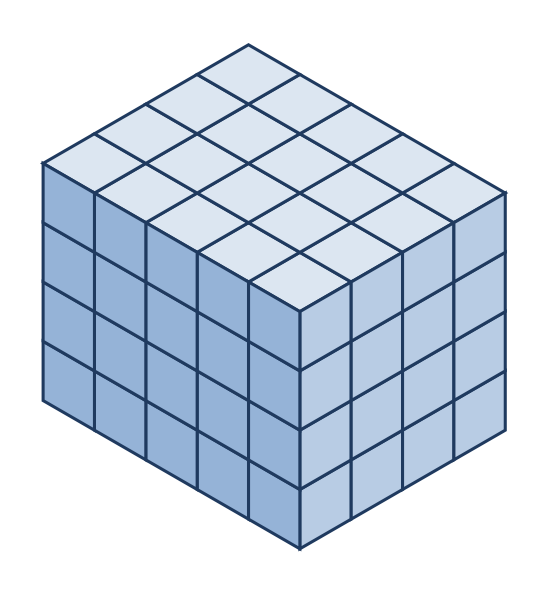
The solid shown is built from unit cubes with no gaps. How many unit cubes does it contain?
Show solution
AnswerD — 80
Step-by-step
- Each layer is 4 by 5.
- So it has 4 × 5 = 20 cubes.
- There are 4 layers.
- So the solid has 20 × 4 = 80 cubes.
Fast methodCubes in one layer × number of layers.
Quick check4 × 5 × 4 = 80, the same count ✓.
Why the other choices are wrong
- A (13): added the three edge counts
- B (20): counted only the top layer
- C (44): counted only the cubes that can be seen
- E (100): counted one layer too many: 20 × 5 = 100
12.
Which of these lengths is the longest?
Show solution
AnswerE — 3 feet 1 inch
Step-by-step
- Change each length to inches. 2 feet = 24 inches, 1 yard = 36 inches, 3 feet 1 inch = 36 + 1 = 37 inches.
- Compare: 24, 30, 35, 36, and 37 inches.
- The longest is 3 feet 1 inch.
Fast methodChange everything to inches and pick the largest number.
Quick check37 inches is more than 36 inches (1 yard) and more than 35 inches ✓
Why the other choices are wrong
- A (2 feet): thought feet are always longer than inches, without changing units
- B (30 inches): thought 30 inches was more than 3 feet
- C (35 inches): picked the largest number shown without changing units
- D (1 yard): thought a yard is longer than 3 feet 1 inch
13.
The figure shows a craft stick placed above a centimeter ruler. How long is the craft stick?

Show solution
AnswerB — 8 cm
Step-by-step
- The stick starts at the 3 cm mark and ends at the 11 cm mark.
- Its length is 11 − 3 = 8 centimeters.
Fast methodSubtract the starting mark from the ending mark.
Quick checkCounting the spaces from 3 to 11 gives 8 spaces of 1 cm ✓
Why the other choices are wrong
- A (3 cm): read only where the stick starts
- C (9 cm): counted the marks from 3 to 11 instead of the spaces
- D (11 cm): read only where the stick ends
- E (14 cm): added the two marks
14.
What is the smaller angle between the hour hand and the minute hand of a clock at 9:00?
Show solution
AnswerC — 90°
Step-by-step
- The 12 hour marks split 360° into 12 parts of 30°.
- At 9:00 the hands are 3 hour marks apart.
- So the smaller angle is 3 × 30° = 90°.
Fast methodEach hour mark on a clock is 360° ÷ 12 = 30°; count the marks between the hands.
Quick check12 × 30° = 360° ✓, and 3 marks give 90°.
Why the other choices are wrong
- A (45°): used 15° per hour mark: 3 × 15° = 45°
- B (60°): counted one hour mark too few: 2 × 30° = 60°
- D (120°): counted one hour mark too many: 4 × 30° = 120°
- E (270°): measured the reflex angle: 360° − 90° = 270°
15.
Add 2 lb 10 oz and 3 lb 15 oz.
Show solution
AnswerC — 6 lb 9 oz
Step-by-step
- Add the smaller units: 10 + 15 = 25 oz, which is 1 lb 9 oz because 1 lb = 16 oz.
- Add the larger units: 2 + 3 + 1 = 6 lb.
- So the sum is 6 lb 9 oz.
Fast methodRegroup every 16 oz as 1 lb.
Quick checkin oz, 42 + 63 = 105, and 6 × 16 + 9 = 105 ✓.
Why the other choices are wrong
- A (1 lb 5 oz): subtracted instead of adding: 3 lb 15 oz − 2 lb 10 oz = 1 lb 5 oz
- B (5 lb 9 oz): regrouped but forgot to add the extra larger unit
- D (7 lb 5 oz): regrouped as if 1 lb = 10 oz: 25 oz = 2 lb 5 oz, so 2 + 3 + 2 = 7 lb 5 oz
- E (6 lb 25 oz): added an extra larger unit without regrouping
16.
A rectangular rug has an area of 48 square feet. The rug is 8 feet long. What is the perimeter of the rug?
Show solution
AnswerB — 28 feet
Step-by-step
- The width times 8 must be 48, so the width is 48 ÷ 8 = 6 feet.
- Perimeter = 8 + 6 + 8 + 6 = 28 feet.
Fast methodWidth = 48 ÷ 8 = 6; perimeter = 2 × (8 + 6).
Quick check8 × 6 = 48 square feet, and 8 + 6 + 8 + 6 = 28 ✓
Why the other choices are wrong
- A (14 feet): added the length and width only once
- C (40 feet): subtracted 8 from 48
- D (56 feet): added 48 and 8
- E (112 feet): used 48 as a side length: 2 × (48 + 8)
17.
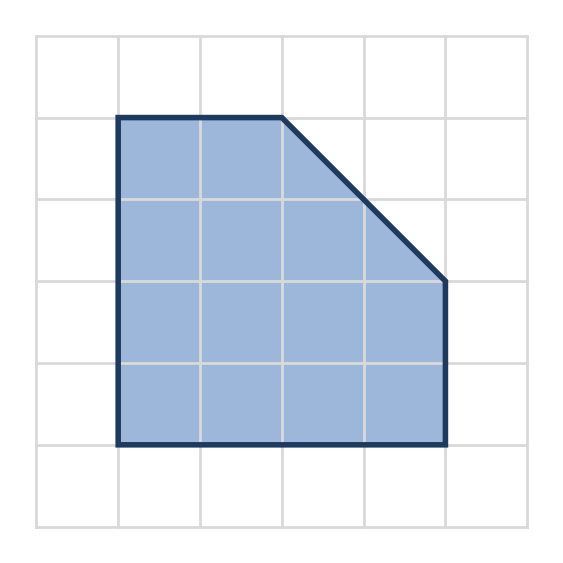
In the figure, each small square has an area of 1 square unit. What is the area of the shaded shape?
Show solution
AnswerE — 14 square units
Step-by-step
- Count the whole shaded squares: 13.
- Count the half squares: 2. Two halves make 1 whole square.
- Area = 13 + 1 = 14 square units.
Fast methodWhole squares plus half the number of half squares.
Quick checkThe shape is a 4-by-4 square (16) with a corner triangle of 2 square units cut off: 16 − 2 = 14 ✓
Why the other choices are wrong
- A (2 square units): counted only the half squares
- B (8 square units): counted only the bottom 4-by-2 rectangle
- C (12 square units): counted only the bottom 4-by-2 and left 2-by-2 rectangles
- D (13 square units): left out the half squares
18.
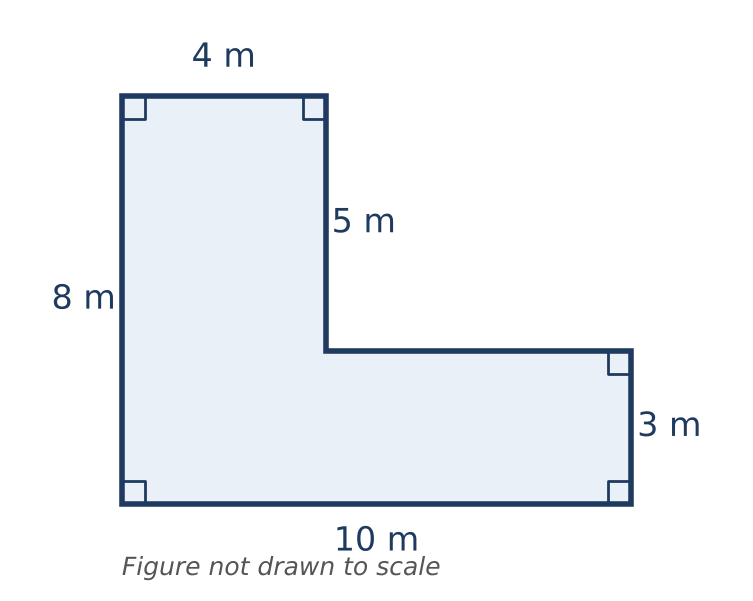
In the figure, all of the corners are right angles. What is the area of the figure?
Show solution
AnswerE — 50 square meters
Step-by-step
- Split the figure with a line across at the height of the 3 m side.
- Bottom rectangle: 10 m by 3 m, so its area is 10 × 3 = 30 square meters.
- Top rectangle: 4 m by 5 m, so its area is 4 × 5 = 20 square meters.
- Total area: 30 + 20 = 50 square meters.
Fast methodSplit into a 10 × 3 rectangle and a 4 × 5 rectangle and add the areas.
Quick checkBig 10 × 8 rectangle = 80, minus the missing 6 × 5 corner = 30, gives 50 ✓
Why the other choices are wrong
- A (20 square meters): found only the top rectangle
- B (30 square meters): found only the bottom rectangle
- C (36 square meters): found the perimeter instead of the area
- D (40 square meters): multiplied the top side by the bottom side, 4 × 10
19.
Jake has only dimes and nickels. He has 9 coins worth 65 cents in all. How many dimes does he have?
Show solution
AnswerA — 4
Step-by-step
- If all 9 coins were nickels, they would be worth 9 × 5 = 45 cents.
- 65 − 45 = 20 cents more is needed. Each dime is worth 5 cents more than a nickel.
- 20 ÷ 5 = 4, so 4 of the coins are dimes (and 5 are nickels).
Fast methodGuess and check: 4 dimes (40¢) + 5 nickels (25¢) = 65¢ with 9 coins.
Quick check4 dimes + 5 nickels = 9 coins, and 40 + 25 = 65 cents ✓
Why the other choices are wrong
- B (5): gave the number of nickels
- C (6): found 6 dimes and 1 nickel, which make 65 cents but use only 7 coins
- D (9): gave the total number of coins
- E (13): divided 65 by 5
20.
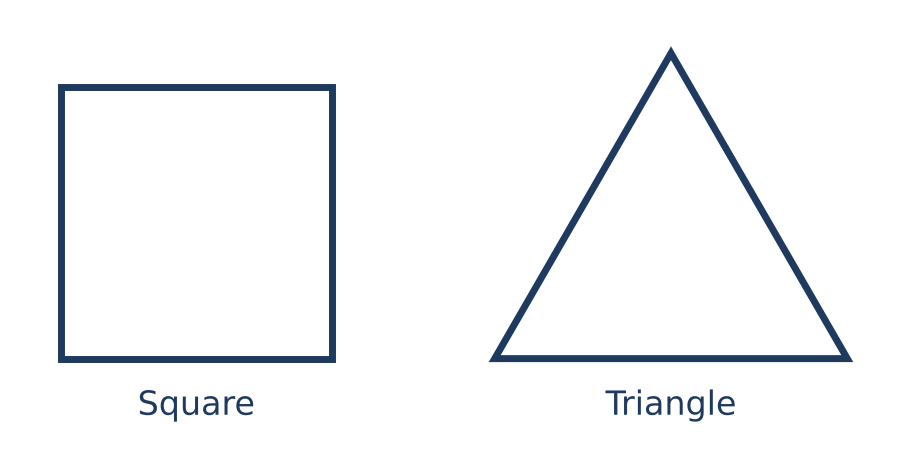
Rosa bends a 36-inch piece of wire to make a square, as shown in the figure. Then she straightens the wire and uses all of it to make a triangle with 3 sides of the same length. How many inches longer is each side of the triangle than each side of the square?
Show solution
AnswerA — 3
Step-by-step
- The square uses all 36 inches on 4 equal sides: 36 ÷ 4 = 9 inches per side.
- The triangle uses all 36 inches on 3 equal sides: 36 ÷ 3 = 12 inches per side.
- 12 − 9 = 3 inches longer.
Fast methodSame 36 inches: 36 ÷ 3 = 12 and 36 ÷ 4 = 9, so the difference is 3.
Quick checkSquare 4 × 9 = 36 and triangle 3 × 12 = 36, both use the whole wire ✓
Why the other choices are wrong
- B (9): gave the side of the square
- C (12): gave the side of the triangle
- D (21): added the two side lengths
- E (24): subtracted one triangle side from 36