Measurement and Geometry: Study Guide
The Elementary Level SSAT (grades 3–4) has one 30-question Quantitative section, 30 minutes, with five answer choices and no calculator. There is no penalty for a wrong answer, so answer every question. This topic covers measurement and geometry: units of length, weight, capacity and time, money, perimeter and area of rectangles and squares, angles, triangles, counting cubes for volume, and the radius and diameter of a circle.
- Measurement, Time and Money
- Perimeter and Area
- Lines and Angles
- Triangles
- Solid Shapes and Volume
- Circles
Measurement, Time and Money
To change a bigger unit to a smaller unit, multiply; to change a smaller unit to a bigger unit, divide. When you add lengths or times, regroup 12 inches as 1 foot and 60 minutes as 1 hour.
Key formulas| Length (US) | |
| Length (metric) | |
| Weight | |
| Capacity | |
| Time | |
| Bigger unit to smaller unit | |
| Regroup | |
| Money |
Money
Method. Add the prices, then subtract from the amount paid.
Worked example- Total cost: $5.25 + $12.50 = $17.75.
- Change: $20.00 − $17.75 = $2.25.
- B ($3.25): made a borrowing error of one dollar
- C ($7.50): subtracted only the book: $20.00 − $12.50 = $7.50
- D ($14.75): subtracted only the notebook
- E ($17.75): gave the total cost
Converting units
Method. Big unit → small unit: multiply. Small → big: divide.
Worked example- There are 1,000 meters in 1 kilometer.
- So 7 kilometers = 7 × 1,000 = 7,000 meters.
- A (70): used 10 meters in one kilometer
- B (700): used 100 meters in one kilometer
- C (1,007): added instead of multiplying
- E (70,000): put an extra zero on the answer
Elapsed time
Method. Add minutes first; every 60 minutes becomes 1 hour.
Worked example- Add the minutes: 44 + 35 = 79 minutes, which is 1 hour and 19 minutes.
- Add the hours: 3 + 0 + 1 = 4.
- So the class ends at 4:19.
- A (3:09): subtracted 35 minutes instead of adding: 3:44 − 0:35 = 3:09
- B (3:19): forgot to carry the extra hour
- C (3:44): added only the hours
- E (5:19): carried one hour too many
Adding measurements
Method. Regroup every 12 in as 1 ft.
Worked example- Add the smaller units: 2 + 11 = 13 in, which is 1 ft 1 in because 1 ft = 12 in.
- Add the larger units: 9 + 7 + 1 = 17 ft.
- So the sum is 17 ft 1 in.
- A (1 ft 3 in): subtracted instead of adding: 9 ft 2 in − 7 ft 11 in = 1 ft 3 in
- B (16 ft 1 in): regrouped but forgot to add the extra larger unit
- D (17 ft 3 in): regrouped as if 1 ft = 10 in: 13 in = 1 ft 3 in, so 17 ft 3 in
- E (17 ft 13 in): added an extra larger unit without regrouping
Perimeter and Area
Perimeter is the distance around a shape: add the lengths of all its sides. Area is the number of unit squares that cover a shape; for a rectangle, multiply the length by the width. Area is measured in square units.
Key formulas| Perimeter | |
| Rectangle | |
| Square | |
| Shape made of rectangles | |
| Units |
Area of rectangles and squares
Method. Square: P = 4s and A = .
Worked example- Area of a square = side × side.
- So A = 11 × 11 = 121 square meters.
- A (11): gave the side length instead of the area: 11
- B (22): doubled the side
- C (33): added three sides
- D (44): found the perimeter
Perimeter of rectangles and squares
Method. Square: P = 4s and A = .
Worked example- A square has 4 equal sides.
- So P = 4 × 10 = 40 meters.
- A (14): added 4 instead of multiplying
- B (20): added only two sides
- C (30): left out one side
- E (100): found the area instead of the perimeter: 10 × 10 = 100
Lines and Angles
Angles are measured in degrees. A right angle is 90°, like the corner of a square. An acute angle is less than 90°, an obtuse angle is between 90° and 180°, and a straight angle is 180°. A full turn is 360°.
Key formulas| Acute angle | |
| Right angle | |
| Obtuse angle | |
| Straight angle | |
| Turns | |
| Clock face | |
| Lines |
Types of angles
Method. Compare with 90° and 180°.
Worked example- An angle is acute if it is less than 90°, right if it is exactly 90°, obtuse if it is between 90° and 180°, straight if it is exactly 180°, and reflex if it is between 180° and 360°.
- 143° is between 90° and 180°.
- So the angle is obtuse.
- A (acute): thought a 143° angle is acute
- B (right): thought a 143° angle is right
- D (straight): thought a 143° angle is straight
- E (reflex): thought a 143° angle is reflex
Angles as turns
Method. Full turn 360°, half 180°, quarter 90°.
Worked example- A full turn is 360°.
- A quarter turn is 360° ÷ 4 = 90°.
- B (120°): used a third of a turn instead
- C (180°): used a half turn instead
- D (270°): used a three-quarter turn instead
- E (360°): used a full turn instead
Angles on a clock
Method. Each hour mark on a clock is 360° ÷ 12 = 30°; count the marks between the hands.
Worked example- The 12 hour marks split 360° into 12 parts of 30°.
- At 1:00 the hands are 1 hour mark apart.
- So the smaller angle is 1 × 30° = 30°.
- A (6°): used 6° per hour (the minute-hand rate)
- B (15°): used 15° per hour mark
- D (60°): used 60° per hour mark (60 minutes in an hour): 1 × 60° = 60°
- E (330°): measured the reflex angle
Triangles
Name a triangle by its sides or by its angles. By sides it is equilateral, isosceles or scalene; by angles it is acute, right or obtuse.
Key formulas| Equilateral | |
| Isosceles | |
| Scalene | |
| Acute triangle | |
| Right triangle | |
| Obtuse triangle | |
| Perimeter |
Classifying triangles by sides
Method. Count how many side lengths are equal.
Worked example- Equilateral triangles have 3 equal sides, isosceles triangles have 2 equal sides, and scalene triangles have no equal sides.
- The sides form a triangle because 8 + 9 > 15.
- Here no two sides are equal.
- So the triangle is scalene.
- A (right): thought a triangle with sides 8, 15, 9 is right
- C (equilateral): thought a triangle with sides 8, 15, 9 is equilateral
- D (isosceles): thought a triangle with sides 8, 15, 9 is isosceles
- E (not a triangle): thought the sides cannot form a triangle
Classifying triangles by angles
Method. Look only at the largest angle.
Worked example- A triangle is right if one angle is 90°, obtuse if one angle is more than 90°, and acute if all three angles are less than 90°.
- The largest angle is 87°.
- So it is an acute triangle.
- A (right triangle): thought a triangle with angles 87°, 48°, 45° is right
- B (isosceles triangle): thought a triangle with angles 87°, 48°, 45° is isosceles
- D (obtuse triangle): thought a triangle with angles 87°, 48°, 45° is obtuse
- E (equiangular triangle): thought a triangle with angles 87°, 48°, 45° is equiangular
Solid Shapes and Volume
Volume is the number of unit cubes that fill a solid. Count the cubes in one layer, then multiply by the number of layers. Remember the hidden cubes that hold up the ones you can see.
Key formulas| Count by layers | |
| Example | |
| Cube | |
| Units |
Volume by counting cubes
Method. Cubes in one layer × number of layers.
Worked example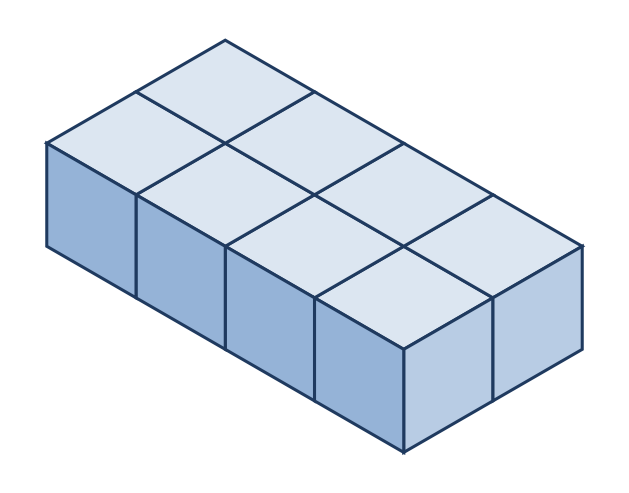
- Each layer is 2 by 4.
- So it has 2 × 4 = 8 cubes.
- There is 1 layer.
- So the solid has 8 × 1 = 8 cubes.
- A (7): added the three edge counts
- C (12): counted the edges around the top face: 2 + 4 + 2 + 4 = 12
- D (16): counted one layer too many
- E (28): counted the square faces on the outside
Circles
Every point on a circle is the same distance from its center. The radius goes from the center to the circle. The diameter goes across the circle through the center, so it is twice as long as the radius.
Key formulas| Diameter | |
| Radius | |
| Example |
Radius and diameter
Method. Diameter = 2 × radius; radius = diameter ÷ 2.
Worked example- The radius is half the diameter.
- So the radius is 10 ÷ 2 = 5 inches.
- B (8): subtracted 2 from the diameter
- C (10): gave the diameter instead of the radius: 10
- D (12): added 2 to the diameter
- E (20): doubled the diameter instead of halving it