Quantitative: Unit Study Guide
03.01 Number Sense and Operations
The Elementary Level SSAT (grades 3–4) has one 30-question Quantitative section, 30 minutes, with five answer choices and no calculator. There is no penalty for a wrong answer, so answer every question. This topic covers number sense: place value and whole numbers on a number line, odd and even numbers, adding, subtracting, multiplying and dividing whole numbers, simple fractions, tenths and hundredths with money, factors, multiples and primes, word problems, input and output rules, and missing numbers in number sentences.
Whole Numbers, Place Value, Odd and Even
Each place in a whole number is worth 10 times the place to its right. On a number line, first find what one space is worth, then count the spaces. Odd and even numbers follow simple rules when you add, subtract or multiply.
Key formulas| Place value | |
| Round to the nearest ten | |
| Number line | |
| Even and odd | |
| Add or subtract | |
| Multiply | |
| Order does not matter | |
| Fact family |
Whole numbers on a number line
Method. Find the value of one space (2), then multiply by the number of spaces to P (8).
Worked example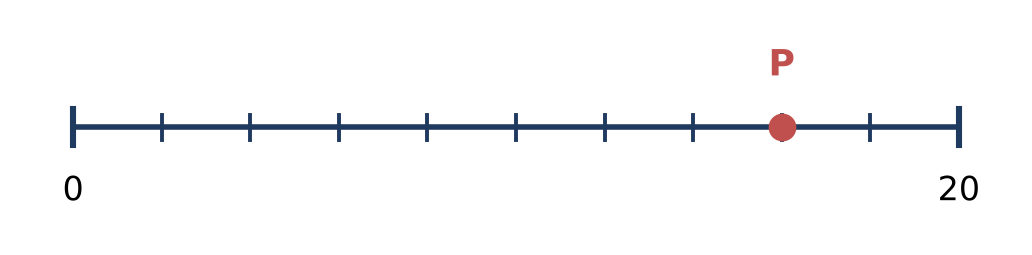
- From 0 to 20 there are 10 equal spaces.
- So each space is 20 ÷ 10 = 2.
- P is 8 spaces from 0: 8 × 2 = 16.
- A (4): counted the spaces back from the right end
- B (8): counted the tick marks without using the scale
- C (10): added instead of multiplying: 8 + 2 = 10
- E (18): counted tick marks (including the one at 0) instead of spaces
Odd and even — parity rules
Method. Test with small numbers: a = 2, b = 1 gives a × b = 2, which is even; check one more pair to be sure.
Worked example- Use the rules: even ± even = even, odd ± odd = even, odd ± even = odd.
- Even × anything = even, odd × odd = odd.
- Here a is even and b is odd.
- So a × b is always even.
- A (b × b): chose an expression that is always odd
- B (a + b): chose an expression that is always odd
- C (a + 1): chose an expression that is always odd
- E (b + 2): chose an expression that is always odd
Fractions
A fraction names equal parts of a whole: the bottom number tells how many equal parts the whole has, and the top number tells how many parts are taken. Multiply or divide the top and bottom by the same number to get an equal fraction. When the bottom numbers are the same, add or subtract only the top numbers.
Key formulas| Parts of a fraction | |
| Equivalent fractions | |
| Simplest form | |
| One whole | |
| Same bottom number | |
| Compare: same bottom | |
| Compare: same top | |
| Mixed number | |
| Fraction of a number | |
| Whole number times a fraction |
Fraction models — bar
Method. Top number = shaded parts (1); bottom number = all equal parts (4).
Worked example
- The bar is cut into 4 equal parts and 1 of them is shaded.
- A fraction is shaded parts over all equal parts.
- So the shaded fraction is .
- B (): compared shaded parts to unshaded parts
- C (): named the unshaded part
- D (1): gave only the number of shaded parts
- E (4): flipped the fraction (total parts over shaded parts)
Fraction models — circle
Method. Top number = shaded parts (4); bottom number = all equal parts (7).
Worked example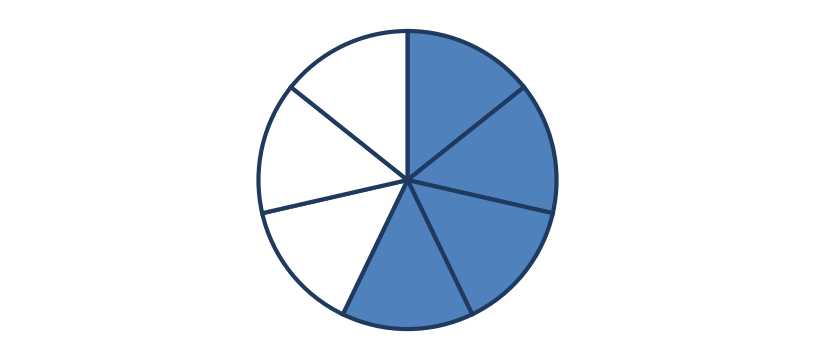
- The circle is cut into 7 equal parts and 4 of them are shaded.
- A fraction is shaded parts over all equal parts.
- So the shaded fraction is .
- A (): named the unshaded part
- C (): compared unshaded parts to shaded parts
- D (): compared shaded parts to unshaded parts
- E (): flipped the fraction (total parts over shaded parts)
Fractions on a number line
Method. Count the spaces between 0 and 1 for the bottom number (3), then count spaces from 0 to P for the top number (1).
Worked example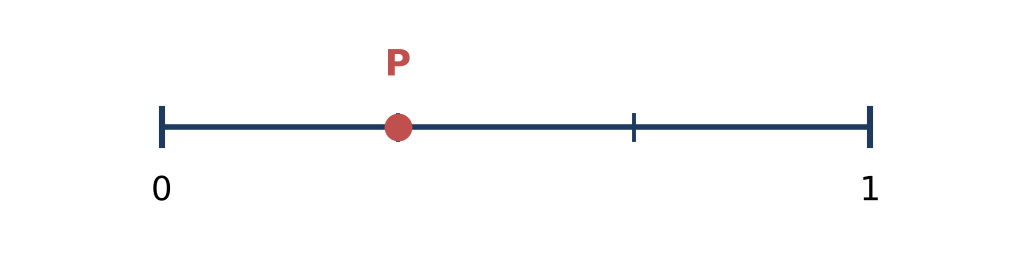
- The distance from 0 to 1 is cut into 3 equal spaces.
- So each space is .
- Point P is 1 space to the right of 0.
- So P shows .
- A (): counted all the tick marks (including 0 and 1) for the bottom number:
- C (): counted tick marks (including the one at 0) instead of spaces
- D (): counted the spaces back from 1
- E (3): flipped the fraction
Equivalent fractions — missing number
Method. Find what the known part was multiplied by, then multiply the other part by the same number.
Worked example- The bottom changes from 5 to 15.
- So it was multiplied by 15 ÷ 5 = 3.
- Multiply the top by the same number: 4 × 3 = 12.
- So = .
- A (3): wrote the multiplier instead of the new top
- B (7): added the multiplier to the top
- D (14): added the same amount to the top as to the bottom
- E (20): multiplied the top by the old bottom: 4 × 5 = 20
Equivalent fractions — choose
Method. Cross-multiply to test a choice: 3 × 8 = 24 and 4 × 6 = 24; equal products mean equal fractions.
Worked example- Equivalent fractions come from multiplying the top and the bottom by the same number.
- 3 × 2 = 6 and 4 × 2 = 8.
- So = .
- A (): multiplied only the bottom
- C (): added the same number to the top and the bottom
- D (): multiplied the top but added to the bottom
- E (): multiplied only the top
Add — like denominators
Method. Same bottom → add only the tops: 1 + 2 = 3 over 7.
Worked example- The bottom numbers are the same.
- So the parts are the same size (7ths).
- Add the top numbers and keep the bottom: 1 + 2 = 3.
- So .
- A (): multiplied the bottom numbers
- B (): subtracted instead of adding
- C (): added the bottom numbers too
- D (): multiplied the top numbers instead of adding them: 1 × 2 = 2, so
Add — like denominators (word problem)
Method. Same-size parts: 2 + 3 = 5 parts of size .
Worked example- Putting the two amounts together means add.
- Both amounts are in 8ths.
- So add the tops and keep the bottom: + = .
- A (): subtracted instead of adding: − =
- B (): added the bottom numbers too
- D (): multiplied the top numbers
- E (): flipped the answer (bottom over top)
Subtract — like denominators
Method. Same bottom → subtract only the tops: 3 − 1 = 2 over 5.
Worked example- The bottom numbers are the same.
- So subtract the top numbers and keep the bottom: 3 − 1 = 2.
- So .
- A (): multiplied the bottom numbers
- C (): gave one whole minus the answer
- D (): added instead of subtracting
- E (2): subtracted the top numbers and left out the bottom number: 3 − 1 = 2
Fraction of a whole number
Method. Divide by the bottom, multiply by the top: 20 ÷ 5 × 1 = 4.
Worked example- Find one part first: 20 ÷ 5 = 4.
- So of 20 is 4.
- Then take 1 of those parts: 1 × 4 = 4.
- B (10): found one half instead of one fifth: 20 ÷ 2 = 10
- C (16): found the part that is left instead
- D (20): multiplied by the top number only
- E (24): added the part to the whole
Simplest form
Method. Divide top and bottom by any common factor, and keep going until no common factor is left (here → … → ).
Worked example- The greatest common factor of 4 and 6 is 2.
- Divide the top and the bottom by 2: 4 ÷ 2 = 2 and 6 ÷ 2 = 3.
- So = , and 2 and 3 share no factor other than 1.
- A (): divided only the top
- B (): subtracted the same amount from the top and the bottom
- C (): subtracted 1 from the top and the bottom: 4 − 1 = 3 and 6 − 1 = 5
- E (): flipped the fraction
Compare fractions
Method. Compare each fraction with and with 1 first; for close ones cross-multiply: > when a × d > b × c.
Worked example- Rename each fraction with the common denominator 168: = , = , = , = , = .
- The greatest top number now shows the greatest fraction, .
- A (): chose the least fraction instead of the greatest
- B (): chose the fraction with the least bottom number
- D (): chose the fraction with the greatest top number
- E (): chose the fraction with the greatest bottom number
Multiply — fraction × whole number
Method. Write 4 as and multiply straight across: = = 2.
Worked example- 4 × means 4 groups of .
- Multiply the whole number by the top: 4 × 1 = 4.
- So the product is , which simplifies to 2.
- A (): multiplied both the top and the bottom by the whole number
- C (): added the whole number to the top
- D (): added instead of multiplying: 4 + =
- E (8): flipped the fraction before multiplying
Fraction of a whole number (word problem)
Method. Divide by the bottom, multiply by the top: 6 ÷ 3 × 1 = 2.
Worked example- Find one part first: 6 ÷ 3 = 2.
- So of 6 is 2.
- Then take 1 of those parts: 1 × 2 = 2.
- B (4): found the part that is left instead
- C (6): multiplied by the top number only
- D (8): added the part to the whole
- E (18): multiplied by the bottom number instead of dividing: 6 × 3 = 18
Decimals and Money
The first place after the decimal point is tenths and the second is hundredths. Money uses hundredths: $3.25 means 3 dollars and 25 cents. Line up the decimal points to compare, add or subtract decimals.
Key formulas| Place value | |
| Tenths and hundredths | |
| Same value | |
| Compare | |
| Add or subtract | |
| Money | |
| Making change |
Decimal place value — name the place
Method. Count 1 digit to the right of the decimal point: 5.
Worked example- Places to the right of the decimal point are tenths, hundredths, thousandths, …
- In 397.51, the tenths place is the first digit after the point, which is 5.
- A (1): used the place one to the right
- B (3): used the hundreds place
- D (7): used the ones place
- E (9): used the tens place (left of the decimal point)
Decimals on a number line
Method. Find the size of one space (0.1), then count spaces from the left end.
Worked example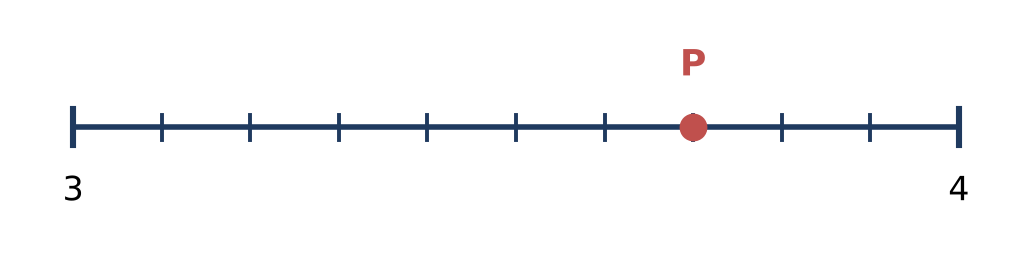
- From 3 to 4 there are 10 equal spaces.
- So each space is (4 − 3) ÷ 10 = 0.1.
- P is 7 spaces past 3: 3 + 7 × 0.1 = 3.7.
- A (3.07): read each space as one tenth of its size
- B (3.3): counted the spaces back from the right end
- D (3.8): counted tick marks (including the first one) instead of spaces
- E (4): gave the number at the right end of the number line
Decimal place value — value of a digit
Method. Write 9, then put a zero in every place between it and the decimal point: 0.9.
Worked example- In 54.912 the digit 9 is 1 place to the right of the decimal point, which is the tenths place.
- Its value is 9 tenths = 0.9.
- A (0.009): used the place two to the right
- B (0.09): used the place one to the right
- D (9): gave the digit itself, not its value
- E (90): mixed up the tenths place with the tens place: 9 × 10 = 90
Compare decimals
Method. Line the decimals up at the decimal point and compare place by place from the left; extra digits do not make a decimal larger.
Worked example- Write every decimal with the same number of decimal places by adding zeros: 1.251 = 1.251, 1.8 = 1.800, 1.3 = 1.300, 1.24 = 1.240.
- Now compare digit by digit from the left.
- The least is 1.24.
- B (1.251): chose the decimal with the most digits after the point
- C (1.3): compared the digits after the point as whole numbers
- D (1.42): swapped the tenths and hundredths digits of the least decimal (1.24 read as 1.42)
- E (1.8): chose the greatest decimal instead of the least
Add decimals
Method. Add the whole parts (6 + 5 = 11) and the decimal parts (0.4 + 0.3 = 0.7), then combine: 11.7.
Worked example- Line up the decimal points: 6.4 + 5.3.
- Add place by place from the right, carrying as needed: 11.7.
- A (1.1): subtracted instead of adding
- B (1.17): put the decimal point one place too far left
- C (11.07): wrote the tenths sum 7 in the hundredths place: 11 + 0.07 = 11.07
- E (117): put the decimal point one place too far right
Decimals in money — making change
Method. Count up from $6.10: to the next dollar is $0.90, then $3 more to reach $10; total $3.90.
Worked example- Change = amount paid − price = $10.00 − $6.10.
- Line up the decimal points and regroup: $10.00 − $6.10 = $3.90.
- B ($4.00): subtracted only the dollars and left out the cents: 10 − 6 = 4
- C ($4.10): subtracted the dollars but added the cents
- D ($4.90): regrouped but did not take 1 from the dollars
- E ($16.10): subtracted the smaller digit from the larger in each place instead of regrouping
Factors, Multiples and Primes
A factor divides a number with no remainder, and factors come in pairs that multiply to the number. The multiples of a number are that number times 1, 2, 3, and so on. A prime number has exactly two factors, 1 and itself; 1 is not prime.
Key formulas| Factor pairs | |
| Multiples | |
| Prime | |
| Composite | |
| Divisible by 2, 5 or 10 | |
| Divisible by 3 or 9 |
Multiples — nth multiple
Method. Multiply: 10 × 11 = 110.
Worked example- The 11th multiple of 10 is 11 × 10 = 110.
- A (21): added instead of multiplying
- B (90): gave the 9th multiple
- C (100): gave the 10th multiple
- E (120): gave the 12th multiple
Multiples — least multiple above
Method. Divide 24 by 5, take the whole part, add 1, and multiply back.
Worked example- 24 ÷ 5 = 4 remainder 4.
- So 5 × 4 = 20 is below 24.
- The next multiple is 5 × 5 = 25.
- A (20): gave the multiple just below
- C (29): added the number to the starting number
- D (30): went one multiple too far
- E (35): went two multiples too far: 5 × 7 = 35
Primes — which is prime
Method. Test the small primes 2, 3, 5, 7 only (any composite below 100 has one of them as a factor): digit sum for 3, last digit for 2 and 5, and 7 by trial.
Worked example- A prime has exactly two factors, 1 and itself.
- 43 has no factor other than 1 and 43.
- 9 = 3 × 3.
- 49 = 7 × 7.
- 57 = 3 × 19.
- A (9): overlooked that 9 = 3 × 3
- B (39): overlooked that 39 = 3 × 13
- D (49): overlooked that 49 = 7 × 7
- E (57): overlooked that 57 = 3 × 19
Factors — list all factors
Method. Find factor pairs from 1 upward and stop when the pairs meet at about .
Worked example- Test each whole number from 1 up: factors come in pairs.
- The factor pairs of 36 are 1 × 36, 2 × 18, 3 × 12, 4 × 9, 6 × 6.
- All factors: 1, 2, 3, 4, 6, 9, 12, 18, 36.
- A (1, 2, 3, 6, 9, 12, 18, 36): left out the factor 4
- B (1, 2, 3, 4, 5, 6, 9, 12, 18, 36): included 5, which is not a factor
- C (1, 2, 3, 36): listed only the prime factors, 1 and the number
- D (1, 2, 3, 4, 9, 12, 18, 36): left out the factor 6 because it pairs with itself (6 × 6)
Factors — how many factors
Method. List factor pairs from 1 upward: 1 × 24, 2 × 12, 3 × 8, 4 × 6. Four pairs give 8 factors.
Worked example- List them in pairs: 1, 2, 3, 4, 6, 8, 12, 24.
- That is 8 factors.
- A (2): counted only the prime factors
- B (4): counted factor pairs, not factors
- C (6): left out 1 and the number itself
- D (7): left out the number itself (24) when listing factors
Divisibility — which number is divisible
Method. Rule for 9: digit sum divisible by 9.
Worked example- Use the divisibility rule for 9 (digit sum divisible by 9).
- 7,956 passes.
- The others leave remainders.
- A (1,315): failed the 9-rule: remainder 1
- B (2,478): failed the 9-rule: remainder 3
- C (4,873): failed the 9-rule: remainder 4
- E (8,346): failed the 9-rule: remainder 3 (it passes only the 3-rule)
Primes — count the primes
Method. Cross out the evens and the multiples of 3, 5 and 7; what is left in the range are the primes.
Worked example- List the primes in the range: 31, 37.
- That is 2 primes.
- A (1): left out a prime
- C (3): counted a composite number as prime
- D (4): counted every number ending in 1, 3, 7 or 9 as prime: 31, 33, 37, 39
- E (5): counted every odd number as prime
Word Problems
Read the question, decide which operation the story calls for, solve, and check that the answer makes sense. Some problems take two steps, such as finding a total cost and then the change.
Key formulas| Put together | |
| Take apart or compare | |
| Equal groups | |
| Sharing equally | |
| Change | |
| Elapsed time | |
| Hours to minutes |
One-step story problems
Method. Decide the operation from the story (share → divide, equal rows → multiply, gave away → work backward by adding).
Worked example- “5 more than 59” means add.
- Add: 59 + 5 = 64 pages.
- A (5): gave only the difference
- B (54): subtracted instead of adding
- C (59): gave Dev's number
- D (63): counted on 5 starting with 59 itself: 59, 60, 61, 62, 63
Money — making change
Method. Multiply first (total cost), then subtract from the amount paid.
Worked example- Total cost: 4 × $3.25 = $13.
- Change: $20 − $13 = $7.
- B ($8): left out the cents: 4 × $3 = $12 and $20 − $12 = $8
- C ($10.25): counted one item too few
- D ($13): gave the total cost instead of the change
- E ($16.75): subtracted the price of only one sandwich
Elapsed time
Method. Count whole hours first, then adjust by the minutes; an hour has 60 minutes, not 100.
Worked example- From 2:45 p.m. to 4:45 p.m. is 2 hours = 120 minutes.
- But 4:15 p.m. is 30 minutes before 4:45 p.m.
- So subtract 30 minutes.
- Total: 120 − 30 = 90 minutes.
- B (120): counted only the whole hours
- C (130): wrote 1 hour 30 minutes as the number 130
- D (150): counted one hour too many
- E (170): subtracted the clock times as if they were ordinary numbers
Time and unit conversion
Method. Convert to one unit (minutes) before multiplying.
Worked example- Change each session to minutes: 1 h 15 min = 1 × 60 + 15 = 75 minutes.
- Multiply by 7 days: 75 × 7 = 525 minutes.
- A (75): forgot to multiply by the number of days
- B (105): multiplied only the minutes by the number of days: 15 × 7 = 105
- C (112): added the hours and minutes as if they were the same unit
- D (435): multiplied only the hours by the number of days
Unit price
Method. Find the cost of one, then multiply.
Worked example- Price of one: $24 ÷ 6 = $4.
- Cost of 3: 3 × $4 = $12.
- A ($8): divided the total cost by 3
- C ($18): subtracted the number of bottles from the cost: $24 − 6 = $18
- D ($24): gave the cost of 6 bottles of juice
- E ($72): multiplied the cost of 6 by 3
Unit Rates and Measurement Conversions
A rate tells how much for one unit: divide the total by the number of units. Once you know the amount for one, multiply to find the amount for any number. To change a bigger unit to a smaller unit, multiply.
Key formulas| Amount for one | |
| Amount for many | |
| Same price each | |
| Capacity | |
| Bigger unit to smaller unit |
Unit rates
Method. A unit rate is 'per 1': divide the total by the number of units.
Worked example- Unit rate = miles ÷ hours.
- Unit rate = 160 ÷ 4.
- So Unit rate = 40 miles per hour.
- B (156): subtracted the hours from the miles
- C (160): gave the total miles instead of the miles per hour
- D (164): added the hours to the miles
- E (640): multiplied instead of dividing
Measurement conversions
Method. Larger unit → smaller unit: multiply by 2.
Worked example- Each quart is 2 pints.
- Going from a larger unit to a smaller unit, multiply: 8 × 2 = 16 pints.
- A (4): divided instead of multiplying
- C (32): used 4 pints per quart instead of 2
- D (80): used 10 pints per quart instead of 2
- E (160): put an extra zero on the answer
Input and Output Rules
A rule changes every input into an output in the same way. Do the steps of the rule in order. To find a rule, see how the outputs change when the inputs go up by 1, then check the rule on every pair.
Key formulas| Use a rule | |
| Growing pattern | |
| Find the rule | |
| Check |
Input–output rules
Method. Do the steps in the order written: multiply first, then add or subtract.
Worked example- Follow the rule in order.
- Multiply: 6 × 8 = 48.
- Then add 4: 48 + 4 = 52.
- A (10): only added
- B (18): added 8 instead of multiplying, then added 4: 6 + 8 + 4 = 18
- C (32): multiplied by 4 and added 8
- D (48): only multiplied
Input–output tables
Method. Find how much the output grows per 1 input (the multiplier), then fix the starting amount.
Worked example- Each time the input goes up by 1, the output goes up by 5.
- So the rule multiplies by 5.
- Input 1 gives 5 = 5 × 1.
- So the rule is: multiply by 5.
- For input 7: 5 × 7 = 35.
- A (12): added instead of multiplying
- B (25): found only the next output
- D (40): found the output for 8 instead of 7: 8 × 5 = 40
- E (55): added the step to the last output once for each unit of the input
Finding the rule
Method. Test each choice on ALL pairs, not just the first one.
Worked example- Test the rule on every pair.
- 5 → 5 × 5 + 7 = 32.
- 6 → 6 × 5 + 7 = 37.
- 8 → 8 × 5 + 7 = 47.
- All three pairs match.
- A (Multiply by 6, then add 2): checked only the first pair
- C (Multiply by 5): forgot the adding step: 5 × 5 = 25, not 32
- D (Add 5): used the change in the outputs as the rule
- E (Add 7, then multiply by 5): did the operations in the wrong order
Missing Numbers in Number Sentences
A letter or a box can stand for a missing number. Undo the operation to find it: subtraction undoes addition, and division undoes multiplication. Check by putting the number back into the sentence.
Key formulas| Missing number added | |
| Missing number subtracted from | |
| Missing factor | |
| Missing number divided | |
| Check |
One-step equations
Method. Do the inverse operation to both sides in one step.
Worked example- Subtract 5 from both sides.
- x = 19 − 5.
- So x = 14.
- A (−14): made a sign error
- B (5): gave the number added to x
- D (19): forgot to move the constant
- E (24): added instead of subtracting
03.02 Measurement and Geometry
The Elementary Level SSAT (grades 3–4) has one 30-question Quantitative section, 30 minutes, with five answer choices and no calculator. There is no penalty for a wrong answer, so answer every question. This topic covers measurement and geometry: units of length, weight, capacity and time, money, perimeter and area of rectangles and squares, angles, triangles, counting cubes for volume, and the radius and diameter of a circle.
Measurement, Time and Money
To change a bigger unit to a smaller unit, multiply; to change a smaller unit to a bigger unit, divide. When you add lengths or times, regroup 12 inches as 1 foot and 60 minutes as 1 hour.
Key formulas| Length (US) | |
| Length (metric) | |
| Weight | |
| Capacity | |
| Time | |
| Bigger unit to smaller unit | |
| Regroup | |
| Money |
Money
Method. Add the prices, then subtract from the amount paid.
Worked example- Total cost: $5.25 + $12.50 = $17.75.
- Change: $20.00 − $17.75 = $2.25.
- B ($3.25): made a borrowing error of one dollar
- C ($7.50): subtracted only the book: $20.00 − $12.50 = $7.50
- D ($14.75): subtracted only the notebook
- E ($17.75): gave the total cost
Converting units
Method. Big unit → small unit: multiply. Small → big: divide.
Worked example- There are 1,000 meters in 1 kilometer.
- So 7 kilometers = 7 × 1,000 = 7,000 meters.
- A (70): used 10 meters in one kilometer
- B (700): used 100 meters in one kilometer
- C (1,007): added instead of multiplying
- E (70,000): put an extra zero on the answer
Elapsed time
Method. Add minutes first; every 60 minutes becomes 1 hour.
Worked example- Add the minutes: 44 + 35 = 79 minutes, which is 1 hour and 19 minutes.
- Add the hours: 3 + 0 + 1 = 4.
- So the class ends at 4:19.
- A (3:09): subtracted 35 minutes instead of adding: 3:44 − 0:35 = 3:09
- B (3:19): forgot to carry the extra hour
- C (3:44): added only the hours
- E (5:19): carried one hour too many
Adding measurements
Method. Regroup every 12 in as 1 ft.
Worked example- Add the smaller units: 2 + 11 = 13 in, which is 1 ft 1 in because 1 ft = 12 in.
- Add the larger units: 9 + 7 + 1 = 17 ft.
- So the sum is 17 ft 1 in.
- A (1 ft 3 in): subtracted instead of adding: 9 ft 2 in − 7 ft 11 in = 1 ft 3 in
- B (16 ft 1 in): regrouped but forgot to add the extra larger unit
- D (17 ft 3 in): regrouped as if 1 ft = 10 in: 13 in = 1 ft 3 in, so 17 ft 3 in
- E (17 ft 13 in): added an extra larger unit without regrouping
Perimeter and Area
Perimeter is the distance around a shape: add the lengths of all its sides. Area is the number of unit squares that cover a shape; for a rectangle, multiply the length by the width. Area is measured in square units.
Key formulas| Perimeter | |
| Rectangle | |
| Square | |
| Shape made of rectangles | |
| Units |
Area of rectangles and squares
Method. Square: P = 4s and A = .
Worked example- Area of a square = side × side.
- So A = 11 × 11 = 121 square meters.
- A (11): gave the side length instead of the area: 11
- B (22): doubled the side
- C (33): added three sides
- D (44): found the perimeter
Perimeter of rectangles and squares
Method. Square: P = 4s and A = .
Worked example- A square has 4 equal sides.
- So P = 4 × 10 = 40 meters.
- A (14): added 4 instead of multiplying
- B (20): added only two sides
- C (30): left out one side
- E (100): found the area instead of the perimeter: 10 × 10 = 100
Lines and Angles
Angles are measured in degrees. A right angle is 90°, like the corner of a square. An acute angle is less than 90°, an obtuse angle is between 90° and 180°, and a straight angle is 180°. A full turn is 360°.
Key formulas| Acute angle | |
| Right angle | |
| Obtuse angle | |
| Straight angle | |
| Turns | |
| Clock face | |
| Lines |
Types of angles
Method. Compare with 90° and 180°.
Worked example- An angle is acute if it is less than 90°, right if it is exactly 90°, obtuse if it is between 90° and 180°, straight if it is exactly 180°, and reflex if it is between 180° and 360°.
- 143° is between 90° and 180°.
- So the angle is obtuse.
- A (acute): thought a 143° angle is acute
- B (right): thought a 143° angle is right
- D (straight): thought a 143° angle is straight
- E (reflex): thought a 143° angle is reflex
Angles as turns
Method. Full turn 360°, half 180°, quarter 90°.
Worked example- A full turn is 360°.
- A quarter turn is 360° ÷ 4 = 90°.
- B (120°): used a third of a turn instead
- C (180°): used a half turn instead
- D (270°): used a three-quarter turn instead
- E (360°): used a full turn instead
Angles on a clock
Method. Each hour mark on a clock is 360° ÷ 12 = 30°; count the marks between the hands.
Worked example- The 12 hour marks split 360° into 12 parts of 30°.
- At 1:00 the hands are 1 hour mark apart.
- So the smaller angle is 1 × 30° = 30°.
- A (6°): used 6° per hour (the minute-hand rate)
- B (15°): used 15° per hour mark
- D (60°): used 60° per hour mark (60 minutes in an hour): 1 × 60° = 60°
- E (330°): measured the reflex angle
Triangles
Name a triangle by its sides or by its angles. By sides it is equilateral, isosceles or scalene; by angles it is acute, right or obtuse.
Key formulas| Equilateral | |
| Isosceles | |
| Scalene | |
| Acute triangle | |
| Right triangle | |
| Obtuse triangle | |
| Perimeter |
Classifying triangles by sides
Method. Count how many side lengths are equal.
Worked example- Equilateral triangles have 3 equal sides, isosceles triangles have 2 equal sides, and scalene triangles have no equal sides.
- The sides form a triangle because 8 + 9 > 15.
- Here no two sides are equal.
- So the triangle is scalene.
- A (right): thought a triangle with sides 8, 15, 9 is right
- C (equilateral): thought a triangle with sides 8, 15, 9 is equilateral
- D (isosceles): thought a triangle with sides 8, 15, 9 is isosceles
- E (not a triangle): thought the sides cannot form a triangle
Classifying triangles by angles
Method. Look only at the largest angle.
Worked example- A triangle is right if one angle is 90°, obtuse if one angle is more than 90°, and acute if all three angles are less than 90°.
- The largest angle is 87°.
- So it is an acute triangle.
- A (right triangle): thought a triangle with angles 87°, 48°, 45° is right
- B (isosceles triangle): thought a triangle with angles 87°, 48°, 45° is isosceles
- D (obtuse triangle): thought a triangle with angles 87°, 48°, 45° is obtuse
- E (equiangular triangle): thought a triangle with angles 87°, 48°, 45° is equiangular
Solid Shapes and Volume
Volume is the number of unit cubes that fill a solid. Count the cubes in one layer, then multiply by the number of layers. Remember the hidden cubes that hold up the ones you can see.
Key formulas| Count by layers | |
| Example | |
| Cube | |
| Units |
Volume by counting cubes
Method. Cubes in one layer × number of layers.
Worked example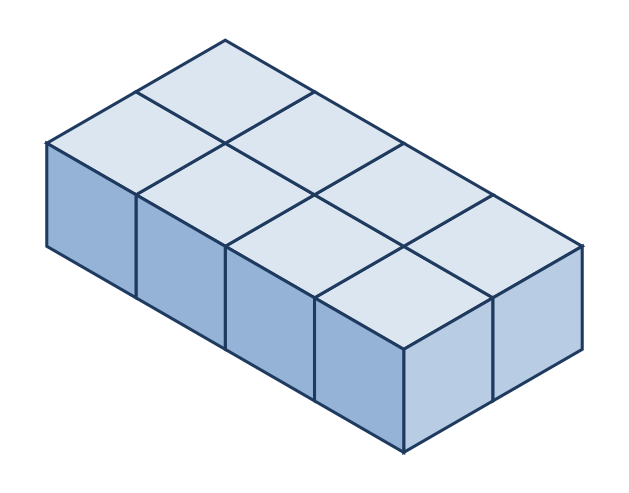
- Each layer is 2 by 4.
- So it has 2 × 4 = 8 cubes.
- There is 1 layer.
- So the solid has 8 × 1 = 8 cubes.
- A (7): added the three edge counts
- C (12): counted the edges around the top face: 2 + 4 + 2 + 4 = 12
- D (16): counted one layer too many
- E (28): counted the square faces on the outside
Circles
Every point on a circle is the same distance from its center. The radius goes from the center to the circle. The diameter goes across the circle through the center, so it is twice as long as the radius.
Key formulas| Diameter | |
| Radius | |
| Example |
Radius and diameter
Method. Diameter = 2 × radius; radius = diameter ÷ 2.
Worked example- The radius is half the diameter.
- So the radius is 10 ÷ 2 = 5 inches.
- B (8): subtracted 2 from the diameter
- C (10): gave the diameter instead of the radius: 10
- D (12): added 2 to the diameter
- E (20): doubled the diameter instead of halving it
03.03 Data
The Elementary Level SSAT (grades 3–4) has one 30-question Quantitative section, 30 minutes, with five answer choices and no calculator. There is no penalty for a wrong answer, so answer every question. This topic covers data: reading pictographs, bar graphs, tables and line plots, finding the mode, median and range of a small set of numbers, and describing how likely an event is.
Graphs and Tables
Read the title, the labels and the key before you read any values. In a pictograph, multiply the number of symbols by what one symbol stands for. In a bar graph, read across from the top of each bar to the scale.
Key formulas| Pictograph | |
| Half a symbol | |
| Bar graph | |
| Line plot | |
| Total | |
| How many more |
Pictographs
Method. Count the symbols first, then multiply once by the key.
Worked example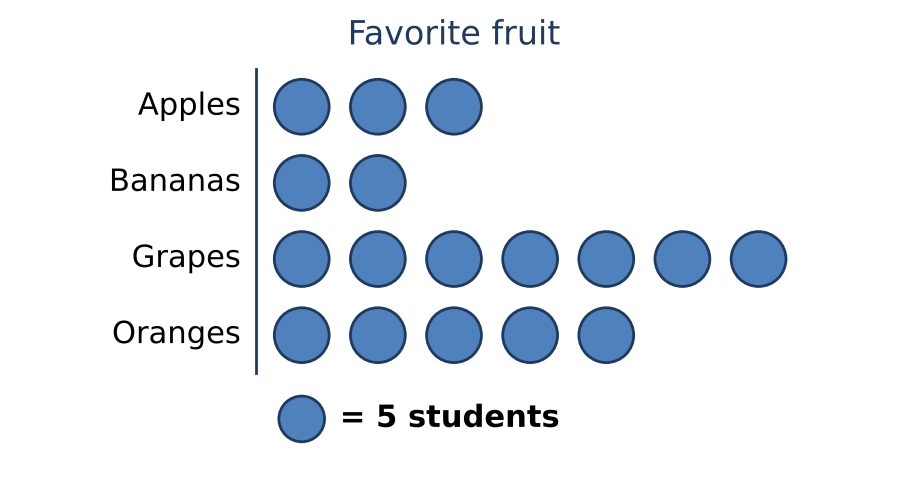
- Count the symbols for Oranges, which gives 5.
- Multiply by the key.
- So 5 × 5 = 25.
- A (5): counted the symbols without using the key
- B (15): read the row for Apples
- C (20): missed one symbol
- E (35): read the row for Grapes: 7 × 5 = 35
Bar graphs
Method. Find the tallest and shortest bars, then subtract.
Worked example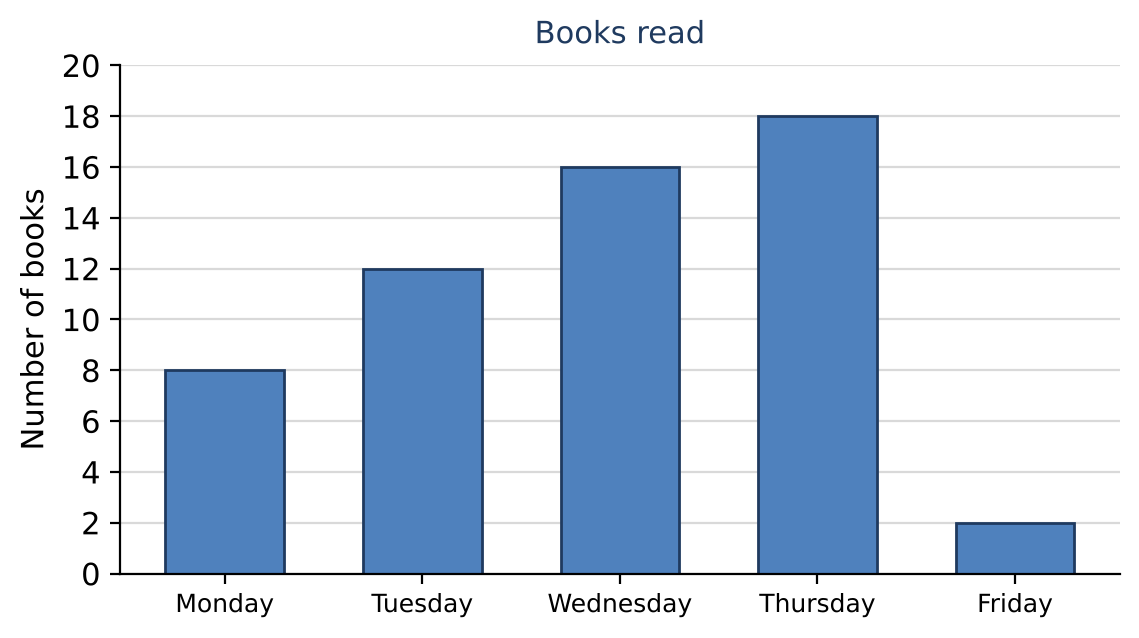
- The tallest bar is Thursday with 18.
- The shortest bar is Friday with 2.
- The difference is 18 − 2 = 16.
- A (2): gave the shortest bar only
- B (6): used the first and last bars (Monday and Friday): 8 − 2 = 6
- C (10): used the second-shortest bar
- D (14): used the second-tallest bar
Tables
Method. Add the rows, pairing numbers that make easy tens.
Worked example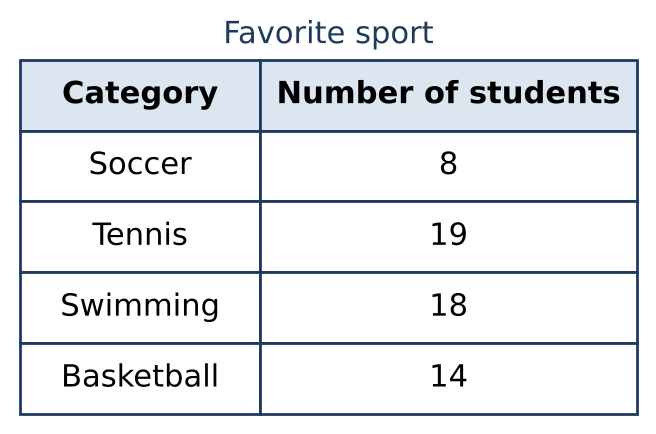
- Add every row.
- So 8 + 19 + 18 + 14 = 59.
- A (45): left out Basketball
- B (51): left out Soccer
- D (69): carried 3 tens instead of 2 from the ones column (8 + 9 + 8 + 4 = 29), giving 69
- E (78): added Tennis twice: 8 + 19 + 19 + 18 + 14 = 78
Line plots and dot plots
Method. Count every X; the numbers on the line are not the count.
Worked example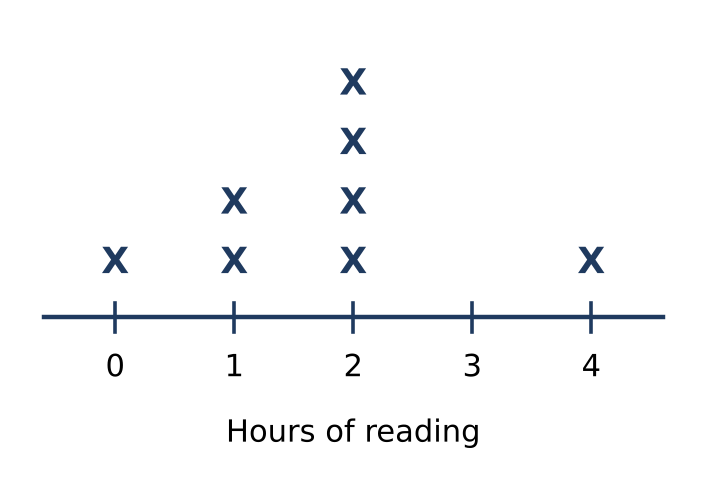
- Each X is one of the students.
- Add the X's in every column.
- So 1 + 2 + 4 + 0 + 1 = 8.
- A (5): counted the columns instead of the X's
- B (7): left out the column for 0
- D (10): added the numbers on the line: 0 + 1 + 2 + 3 + 4 = 10
- E (14): added up the hours instead of the students
Mode, Median and Range
The mode is the value that appears most often. The median is the middle value after you put the values in order. The range is the greatest value minus the least value.
Key formulas| Mode | |
| Median | |
| Range | |
| Example |
Mode
Method. On a line plot the mode is under the tallest stack.
Worked example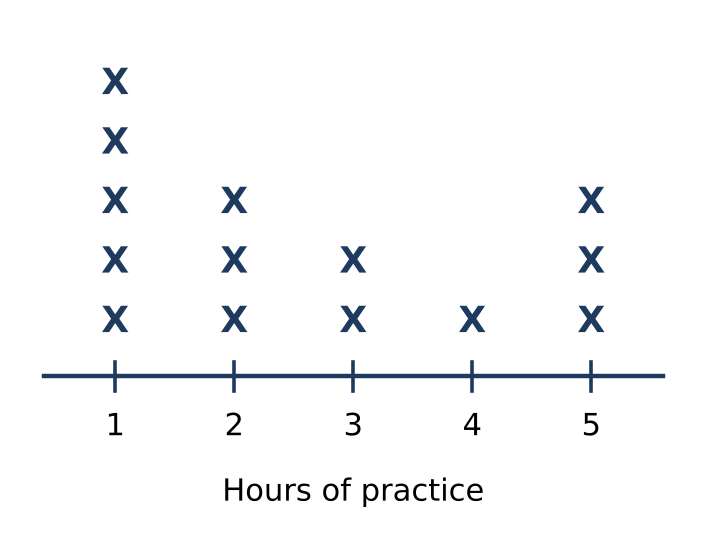
- The mode is the value with the most X's.
- The column for 1 has 5 X's, more than any other column.
- So the mode is 1.
- B (2): chose 2, the first of the columns with 3 X's (a next-tallest stack) instead of the tallest
- C (3): chose the middle value of the number line (1 to 5)
- D (4): gave the range
- E (5): gave the number of X's in the tallest column
Chance and Likelihood
Chance tells how likely something is to happen. Compare the number of objects of one kind with the total number of objects: if none are that kind it is impossible, and if all are that kind it is certain. The chance can be written as a fraction: the number of that kind over the total number.
Key formulas| Impossible | |
| Certain | |
| Likely | |
| Unlikely | |
| Equally likely | |
| Chance as a fraction | |
| Example |
Likelihood
Method. 0 = impossible, below = unlikely, = equally likely, above = likely, 1 = certain.
Worked example- The probability of green is = 1.
- A probability of 1 means certain.
- A (impossible): thought a possible event cannot happen
- B (unlikely): thought the chance is below one half
- C (likely): thought the chance is above one half but not certain
- E (equally likely as not): thought the chance is exactly one half