Algebra: Study Guide
The Middle Level SSAT (grades 5–7) has two 25-question Quantitative sections, 30 minutes each, with five answer choices and no calculator. A wrong answer loses ¼ point, so guess only after eliminating choices. This topic covers early algebra: solving simple equations and inequalities, number patterns and input–output rules, and ratios, rates and proportions in word problems.
- Solving Equations
- Inequalities
- Ratios, Rates and Proportions
- Word Problems
- Patterns and Input–Output Rules
Solving Equations
Undo operations in reverse order, doing the same thing to both sides. Distribute and combine like terms first; if the variable is on both sides, move it to one side. Check by substituting your answer.
Key formulas| Two-step equation | |
| Example | |
| Distribute first | |
| Variable on both sides | |
| Fractions | |
| Check |
Two-step equations
Method. Undo addition/subtraction first, then multiplication.
Worked example- Add 9 on both sides: 12x = −72.
- Divide by 12: x = −6.
- A (−864): multiplied by the coefficient instead of dividing
- B (−72): forgot to divide by the coefficient
- C (−): subtracted the constant instead of adding it
- D (−): ignored the constant: x = −81 ÷ 12 = −
Multi-step equations — distributing
Method. Divide both sides by 2 first: x + 4 = 10, so x = 6.
Worked example- Distribute: 2x + 8 = 20.
- Subtract 8: 2x = 12.
- Divide by 2: x = 6.
- B (8): multiplied only x by 2
- C (10): found x + 4 instead of x: 20 ÷ 2 = 10
- D (12): forgot to divide by 2
- E (14): used the wrong sign when moving the constant
Equations with fractions
Method. Multiply every term by 9 to clear the fraction: x − 54 = −63, so x = −9.
Worked example- Add 6: = −1.
- Multiply by 9: x = −9.
- A (−117): subtracted the constant instead of adding it
- B (−57): multiplied by the denominator before moving the constant but not on every term
- D (−1): added 6 but forgot to multiply by 9: x = −1
- E (−): divided by the denominator instead of multiplying
Variables on both sides
Method. Collect x-terms on one side and numbers on the other; then divide.
Worked example- Subtract 14x from both sides: −21x + 4 = −122.
- Subtract 4: −21x = −126.
- Divide by −21: x = 6.
- A (−18): added the x-terms instead of subtracting
- B (): added the constants instead of subtracting
- D (9): ignored the x-term on the left side: 4 = 14x − 122, x = 126 ÷ 14 = 9
- E (18): ignored the x-term on the right side
Equations with decimals
Method. Multiply every term by 10 to clear the decimals, then solve.
Worked example- Subtract 5.8: 0.6x = 4.8.
- Divide by 0.6: x = 8.
- A (0.8): misplaced the decimal point when dividing (one place too far left)
- B (2.88): multiplied by the coefficient instead of dividing
- C (4.2): subtracted the coefficient instead of dividing: 4.8 − 0.6 = 4.2
- D (4.8): forgot to divide by the coefficient
Multi-step equations — combining like terms
Method. Distribute, combine like terms on each side, then solve the two-step equation.
Worked example- Distribute: 8x + 24 − 2x + 9 = 15.
- Combine like terms: 6x + 33 = 15.
- So 6x = −18 and x = −3.
- A (−18): forgot to divide by the x-coefficient
- C (−): did not combine the x-terms
- D (−): added the x-terms instead of subtracting: 10x + 33 = 15, x = −
- E (): multiplied only x by 8
Inequalities
An inequality compares two amounts with <, >, ≤ or ≥. Solve it like an equation, but reverse the sign when you multiply or divide both sides by a negative number. On a number line an open dot means the number is not included and a closed dot means it is.
Key formulas| Symbols | |
| Solve | |
| Flip rule | |
| Between |
Choose the value that satisfies a one-step inequality
Method. Test the choices: 4 × 6 = 24, which is less than 28; 4 × 7 = 28 is not less than 28.
Worked example- Divide both sides of 4n < 28 by 4: n < 7.
- Of the choices, only 6 is less than 7.
- B (7): treated < as ≤ and chose the boundary value 28 ÷ 4 = 7
- C (8): reversed the inequality to n > 7 and chose the next whole number, 8
- D (24): subtracted 4 from 28 instead of dividing by 4
- E (32): added 4 to 28 instead of dividing by 4
Greatest whole-number solution of a two-step inequality
Method. Undo in reverse order: 16 + 5 = 21, 21 ÷ 3 = 7, so x < 7 and the greatest whole number is 6.
Worked example- Add 5 to both sides: 3x < 21.
- Divide both sides by 3: x < 7.
- The greatest whole number less than 7 is 6.
- A (3): subtracted 5 from 16 instead of adding: 3x < 11, so x is at most 3
- C (7): solved 3x < 21 to get 7 but kept the boundary value, which does not satisfy <
- D (10): divided 16 by 3 before adding 5: x < + 5 = 10
- E (20): forgot to divide by 3: the greatest whole number less than 21
Greatest whole number from an at-most word inequality
Method. Take out the admission first: $50 − $8 = $42, and $42 ÷ $3 = 14 tickets.
Worked example- Let t be the number of ride tickets. Total cost: 8 + 3t, and "at most $50" means 8 + 3t ≤ 50.
- Subtract 8: 3t ≤ 42.
- Divide by 3: t ≤ 14, so the greatest number of tickets is 14.
- A (8): divided $50 by $3 first to get 16 tickets, then subtracted 8
- B (13): treated "at most" as "less than": 3t < 42 gives at most 13
- D (16): ignored the $8 admission: 3t ≤ 50 gives 16
- E (19): added the admission instead of subtracting: 3t ≤ 58 gives 19
Ratios, Rates and Proportions
A ratio compares two quantities; a proportion sets two ratios equal and is solved by cross-multiplying. A unit rate is the amount for one unit. Convert units by multiplying by a fraction equal to 1, and remember that square units use the conversion squared.
Key formulas| Proportion | |
| Unit rate | |
| Proportional relationship | |
| Scale | |
| Unit conversion | |
| Square units | |
| Density |
Ratios in context
Method. Write the two counts in the order asked, then simplify.
Worked example- First find the number of cats: 30 − 27 = 3.
- The ratio of cats to dogs is 3:27.
- Divide both by 3: 1:9.
- A (1:27): divided only the cats by 3 when simplifying: 3:27 → 1:27
- B (1:10): compared cats to all pets: 3:30 = 1:10
- D (9:10): compared dogs to all pets: 27:30 = 9:10
- E (9:1): reversed the order of the ratio
Measurement conversions
Method. Larger unit → smaller unit: multiply by 36.
Worked example- Each yard is 36 inches.
- Going from a larger unit to a smaller unit, multiply: 12 × 36 = 432 inches.
- A (): divided instead of multiplying
- B (48): added the conversion factor instead of multiplying
- C (120): used 10 inches per yard instead of 36
- E (1,296): changed yards to feet, then multiplied by 36 instead of 12: 12 × 3 × 36 = 1,296
Proportional relationships — find a value
Method. Set up equal ratios: = , so y = 35 × 30 ÷ 14 = 75.
Worked example- Proportional means y = kx.
- Find k: k = y ÷ x = 35 ÷ 14 = 2.5.
- Then y = 2.5 × 30 = 75.
- A (2.5): gave the constant of proportionality instead of y
- B (12): used x divided by y as the constant
- C (51): added the same amount to y as was added to x
- E (87.5): multiplied the constant by the old y instead of the new x: 2.5 × 35 = 87.5
Proportional relationships — constant from a graph
Method. Read any labelled point (x, y) on the line and divide y by x.
Worked example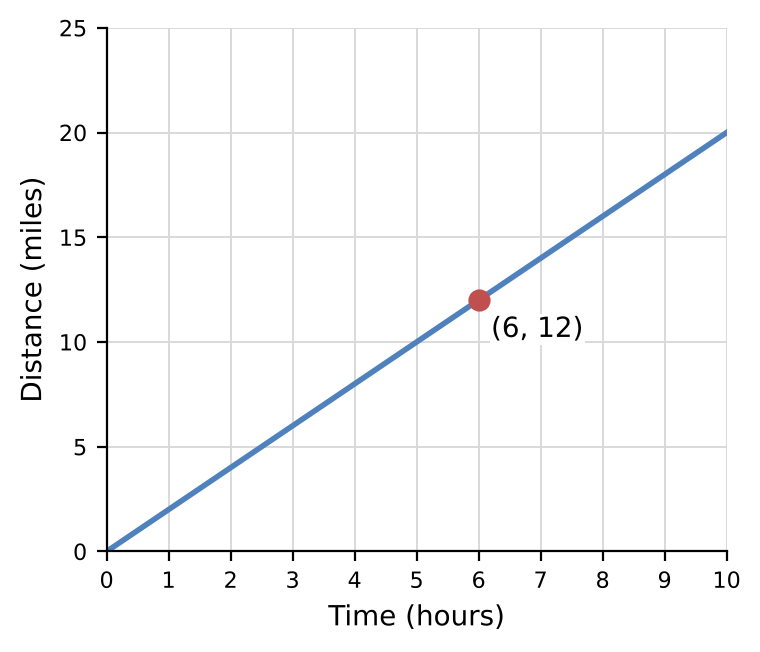
- The line passes through the origin and the point (6, 12).
- k = y ÷ x = 12 ÷ 6 = 2.
- B (6): subtracted the coordinates
- C (12): gave the y-value of the point
- D (18): added the coordinates: 6 + 12 = 18
- E (72): multiplied the coordinates
Scale drawings and maps
Method. Map → real: multiply by the scale; real → map: divide by the scale.
Worked example- Each centimeter stands for 50 km.
- So multiply: 4.8 × 50 = 240 km.
- A (0.096): divided by the scale instead of multiplying
- B (54.8): added the scale to the map distance
- D (600): treated the 0.8 as 8: 4 × 50 + 8 × 50 = 600
- E (2,400): put an extra zero on the answer
Speed — find the distance
Method. Change the minutes to hours first: 1 hour 30 minutes = 1.5 hours, so distance = 72 × 1.5 = 108 miles.
Worked example- 30 minutes = = 0.5 hour.
- So the time is 1.5 hours.
- Distance = speed × time = 72 × 1.5 = 108 miles.
- A (72): ignored the minutes
- B (93.6): treated 1 hour 30 minutes as 1.30 hours: 72 × 1.3 = 93.6
- D (144): rounded 1 hour 30 minutes up to 2 hours: 72 × 2 = 144
- E (2,232): treated the 30 minutes as 30 hours: 72 × (1 + 30) = 72 × 31 = 2,232
Unit conversions with square and cubic units
Method. Square units use the factor squared ; cubic units use it cubed .
Worked example- One square foot is 12 × 12 = 144 square inches, because every dimension is converted.
- So 4 square feet = 4 × 144 = 576 square inches.
- A (): divided instead of multiplying
- B (48): multiplied by the length factor 12 only
- C (96): doubled the length factor instead of squaring it: 4 × 12 × 2 = 96
- E (6,912): used the cubic factor instead of the square factor
Density
Method. Density = mass ÷ volume; check by multiplying density × volume to get the mass.
Worked example- Density = mass ÷ volume.
- Density = 249.2 ÷ 28.
- So Density = 8.9 grams per cubic centimeter.
- B (89): misplaced the decimal point in the quotient: 2,492 ÷ 28 = 89
- C (221.2): subtracted volume from mass
- D (277.2): added mass and volume
- E (6,977.6): multiplied mass by volume
Word Problems
Name the unknown, translate the words into an equation, solve, and answer the question that was asked, with units.
Key formulas| Distance | |
| Moving toward each other | |
| Total from an average | |
| Consecutive integers | |
| Working together | |
| Change |
Money — making change
Method. Multiply first (total cost), then subtract from the amount paid.
Worked example- Total cost: 5 × $6.87 = $34.35.
- Change: $100 − $34.35 = $65.65.
- A ($34.35): gave the total cost instead of the change
- C ($70.00): dropped the cents from the price: $100 − 5 × $6 = $70.00
- D ($72.52): counted one item too few
- E ($93.13): subtracted the price of only one pen
Time and unit conversion
Method. 45 minutes = hour = 0.75 hour, so 1.75 × 6 = 10.5 hours.
Worked example- Change each session to minutes: 1 h 45 min = 60 + 45 = 105 minutes.
- Multiply by 6 days: 105 × 6 = 630 minutes.
- Change to hours: 630 ÷ 60 = 10.5 hours.
- A (6): ignored the minutes: 1 × 6 = 6
- B (6.3): found 630 minutes, then used 100 minutes in an hour: 630 ÷ 100 = 6.3
- C (8.7): treated 1 hour 45 minutes as 1.45 hours: 1.45 × 6 = 8.7
- E (630): gave the total in minutes, not hours
Unit price
Method. Find the cost of one, then multiply.
Worked example- Price of one: $29.60 ÷ 8 = $3.70.
- Cost of 10: 10 × $3.70 = $37.
- A ($2.96): divided the total cost by 10
- B ($3.70): gave the price of one bottle of juice
- C ($29.60): gave the cost of 8 bottles of juice
- D ($33.30): added the price of only one more bottle: $29.60 + $3.70 = $33.30
Simple interest
Method. Simple interest I = P × r × t with r as a decimal; total = P + I.
Worked example- Interest: I = Prt = $4,000 × 0.06 × 2 = $480.
- Total: $4,000 + $480 = $4,480.
- A ($480): gave only the interest
- C ($4,494.40): used compound interest
- D ($8,800): used 0.6 instead of 0.06 for the rate: $4,000 + $4,000 × 0.6 × 2 = $8,800
- E ($52,000): used the rate as a whole number instead of a percent
Consecutive integers
Method. The middle (average) is 200 ÷ 5; step out from the middle.
Worked example- Let the smallest be n.
- The 5 consecutive integers are n, n + 1, n + 2, n + 3, n + 4.
- Their sum: 5n + 10 = 200.
- Subtract 10: 5n = 190.
- Divide: n = 38.
- The smallest is 38.
- A (37): counted one step too far
- C (39): gave the second-smallest number
- D (40): gave the average (middle value)
- E (42): gave the largest number
Averages
Method. New score = new average + (number of old tests) × (rise in average) = 81 + 4 × 2.
Worked example- Current total: 4 × 79 = 316.
- Needed total for 5 tests: 5 × 81 = 405.
- Next score: 405 − 316 = 89.
- A (8): used 4 tests instead of 5 for the new total: 4 × 81 − 4 × 79 = 8
- B (10): multiplied the gap by 5
- C (81): gave the target average
- D (83): averaged the old average and the new score only
Distance, rate and time
Method. Distance = rate × time; opposite directions or toward each other → add speeds, same direction → subtract.
Worked example- Moving toward each other, the gap closes at 8 + 4 = 12 miles per hour.
- Time = distance ÷ rate: 18 ÷ 12 = 1.5 hours.
- B (2.25): used only Tom's speed
- C (3): divided by the average speed instead of the sum of the speeds
- D (4.5): subtracted the speeds instead of adding
- E (6): subtracted the combined speed from the distance: 18 − 12 = 6
Age problems
Method. Add the same number of years to BOTH ages before setting up the multiple.
Worked example- Let Carlos's age now be b.
- So Ava is 4b.
- In 20 years: 4b + 20 = 2(b + 20).
- Expand: 4b + 20 = 2b + 40.
- Subtract 2b and 20: 2b = 20.
- Divide: b = 10.
- B (20): stopped at 2b = 20 and did not divide by 2
- C (30): gave Carlos's age in 20 years
- D (40): gave Ava's age instead of Carlos's
- E (60): gave Ava's age in 20 years
Work problems
Method. Together time = (product)/(sum) of the two times.
Worked example- Leo does of the job per hour and Dev does .
- Together: + = of the job per hour.
- Time = 1 ÷ = 5 hours.
- A (0.2): gave the combined rate (jobs per hour) instead of the time
- C (18): averaged the two times
- D (24): subtracted the two times: 30 − 6 = 24
- E (36): added the two times
Patterns and Input–Output Rules
In an input–output table the same rule turns every input into its output. Look at how the output changes when the input goes up by 1; test your rule on every pair. Some patterns grow by a different amount each time, so check the differences.
Key formulas| Constant change | |
| Example | |
| Test the rule | |
| Changing differences |
Finding the rule
Method. Test each choice on ALL pairs, not just the first one.
Worked example- Test the rule on every pair.
- 5 → 5 × 4 + 2 = 22.
- 8 → 8 × 4 + 2 = 34.
- 9 → 9 × 4 + 2 = 38.
- All three pairs match.
- A (Multiply by 3, then add 7): checked only the first pair
- B (Add 17): checked only the first pair and used the difference: 22 − 5 = 17
- D (Add 12): used the change in the outputs as the rule
- E (Add 2, then multiply by 4): did the operations in the wrong order
Input–output tables
Method. Find how much the output grows per 1 input (the multiplier), then fix the starting amount.
Worked example- Each time the input goes up by 1, the output goes up by 3.
- So the rule starts by multiplying the input by 3.
- Input 1 gives 6 = 3 × 1 + 3, so the rule then adds 3.
- The rule is: multiply by 3, then add 3.
- For input 10: 3 × 10 + 3 = 33.
- A (15): used only the first pair (6 − 1 = 5) and added 5: 10 + 5 = 15
- B (18): found only the next output
- C (30): used only the multiplication part of the rule
- E (45): added the step to the last output once for each unit of the input: 15 + 3 × 10 = 45
Nonlinear patterns
Method. If the changes grow by a constant amount, compare the outputs with the square numbers.
Worked example- The changes in output are 3, 5, 7, which grow by 2.
- So the rule involves squaring.
- Compare with the squares: −1 = − 2, 2 = − 2, 7 = − 2, 14 = − 2.
- The rule is output = (input)² − 2.
- For 10: − 2 = 98.
- A (18): doubled the input instead of squaring it
- B (56): continued with the last change in y as if the function were linear
- C (68): added the next change in y once for every step
- E (100): forgot to subtract 2: = 100