Geometry and Measurement: Practice Paper 1
Choose one answer for each question, then select Check my answers. Every question has a full worked solution.
1.
Two interior angles of a triangle measure 39° and 25°. What is the measure of the exterior angle at the third vertex, in degrees?
Show solution
AnswerC — 64
Step-by-step
- An exterior angle equals the sum of the two remote interior angles.
- So the exterior angle is 39° + 25° = 64°.
Fast methodExterior angle = sum of the two remote interior angles.
Quick checkthe interior angle at the third vertex is 180 − 64 = 116, and 116 + 64 = 180 ✓.
Why the other choices are wrong
- A (14): subtracted the two angles
- B (26): subtracted the sum from 90° instead of 180°: 90 − 64 = 26
- D (116): gave the interior angle at the third vertex
- E (296): subtracted from 360°
2.
What is the image of (8, 2) after a reflection across the y-axis?
Show solution
AnswerE — (−8, 2)
Step-by-step
- A reflection across the y-axis follows the rule (x, y) → (−x, y).
- So (8, 2) → (−8, 2).
Fast methodx-axis: negate y. y-axis: negate x. Origin: negate both. y = x: swap.
Quick checkreflecting (−8, 2) across the y-axis again gives back (8, 2) ✓.
Why the other choices are wrong
- A ((8, −2)): reflected across the x-axis instead
- B ((−8, −2)): reflected across the origin instead
- C ((2, 8)): reflected across the line y = x instead
- D ((−2, 8)): rotated 90° counterclockwise instead
3.
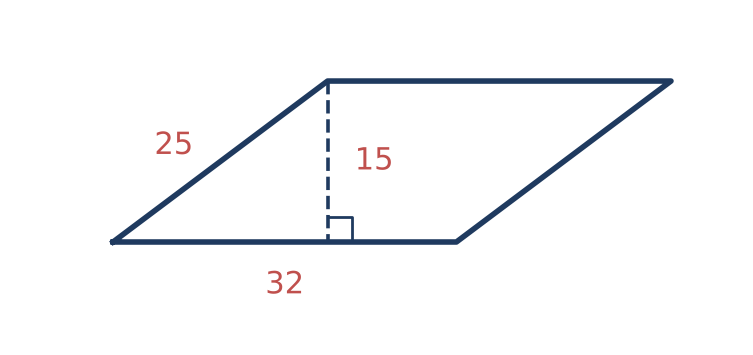
What is the perimeter of the parallelogram shown?
Show solution
AnswerD — 114
Step-by-step
- A parallelogram has two pairs of equal sides: 32 and 25.
- The height is not a side.
- So P = 2 × (32 + 25) = 114.
Fast methodParallelogram: A = base × height; P uses the slanted sides.
Quick check32 + 25 + 32 + 25 = 114 ✓.
Why the other choices are wrong
- A (57): added only two sides
- B (72): added the three labeled lengths
- C (94): used the height instead of the slanted side
- E (144): doubled all three labeled lengths, including the height: 2 × (32 + 25 + 15) = 144
4.
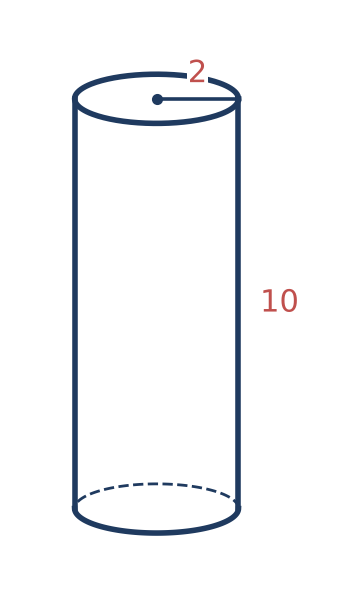
What is the volume of the cylinder shown? Give your answer in terms of π.
Show solution
AnswerC —
Step-by-step
- V = πr²h.
- V = π × × 10.
- So V = .
Fast methodCylinder: V = πr²h; SA = r² + rh.
Quick checkthe base area is π × = , and × 10 = ✓.
Why the other choices are wrong
- A (): used the cone formula ⅓πr²h: ⅓ × π × × 10 =
- B (): forgot to square the radius
- D (): multiplied by an extra 2
- E (): used the diameter as the radius
5.
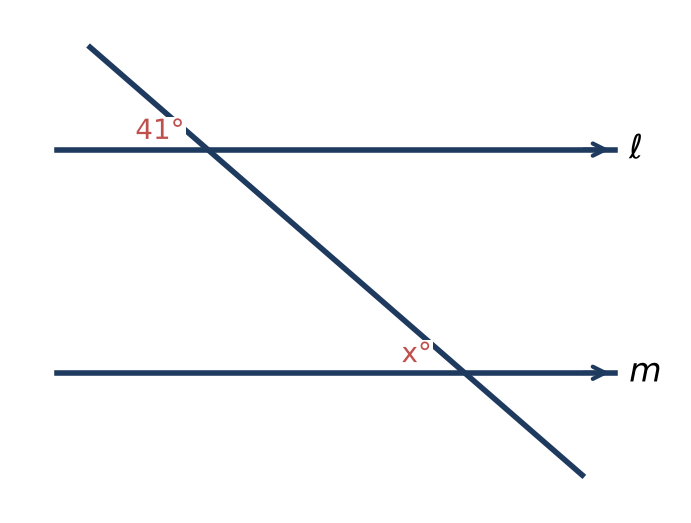
In the figure, lines ℓ and m are parallel. What is the value of x?
Show solution
AnswerA — 41
Step-by-step
- The angle marked 41° and the angle marked x° are corresponding angles.
- With parallel lines, corresponding angles are equal.
- So x = 41.
Fast methodParallel lines: all acute angles are equal, all obtuse angles are equal, and an acute + an obtuse = 180°.
Quick checkboth marked angles lie on the same side of the transversal and on the same side of their parallel line, so they are corresponding and equal: x = 41 ✓.
Why the other choices are wrong
- B (49): used complementary angles
- C (82): doubled the angle: 2 × 41 = 82
- D (139): assumed the angles are supplementary
- E (319): subtracted from 360°
6.
What is the measure of the supplement of a 44° angle?
Show solution
AnswerE — 136°
Step-by-step
- Supplementary angles add to 180°.
- The supplement of 44° is 180° − 44° = 136°.
Fast methodComplement → 90° − angle; supplement → 180° − angle.
Quick check44° + 136° = 180°, as required ✓.
Why the other choices are wrong
- A (44°): gave the same angle
- B (46°): used the complement instead of the supplement
- C (92°): subtracted the angle from its supplement: 136° − 44° = 92°
- D (134°): added 90° to the angle: 44° + 90° = 134°
7.
Two angles measure (4x − 2)° and (5x + 29)°. The angles are complementary. What is the measure of the first angle, in degrees?
Show solution
AnswerC — 26
Step-by-step
- Complementary angles add to 90°: (4x − 2) + (5x + 29) = 90.
- So 9x + 27 = 90, 9x = 63 and x = 7.
- The first angle is 4(7) − 2 = 26°.
Fast methodWrite the angle relationship as an equation, then solve.
Quick checkthe angles are 26° and 64°, which add to 90° ✓.
Why the other choices are wrong
- A (7): gave x instead of the angle
- B (20): ignored the order of operations: computed 4(x − 2) = 4 × 5 = 20
- D (28): forgot the constant
- E (64): gave the other angle
8.
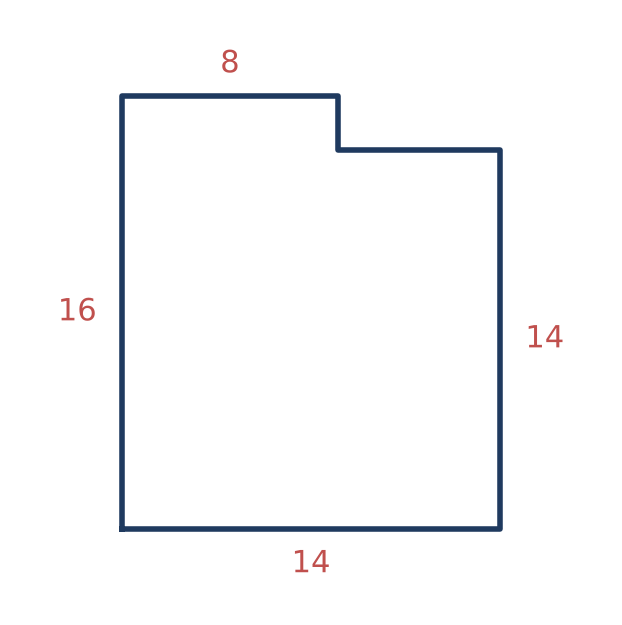
The figure shown is made of rectangles, and all corners are right angles. What is its area, in square units?
Show solution
AnswerB — 212
Step-by-step
- Think of the figure as a 14 × 16 rectangle with a 6 × 2 corner removed (6 = 14 − 8 and 2 = 16 − 14).
- The big rectangle is 14 × 16 = 224.
- The corner is 6 × 2 = 12.
- So the area is 224 − 12 = 212.
Fast methodSplit the figure into rectangles or subtract the missing corner.
Quick checksplit another way, 8 × 16 + 6 × 14 = 128 + 84 = 212 ✓.
Why the other choices are wrong
- A (60): found the perimeter
- C (216): added the corner's sides instead of multiplying: 224 − (6 + 2) = 216
- D (224): did not remove the missing corner
- E (236): added the corner instead of subtracting
9.
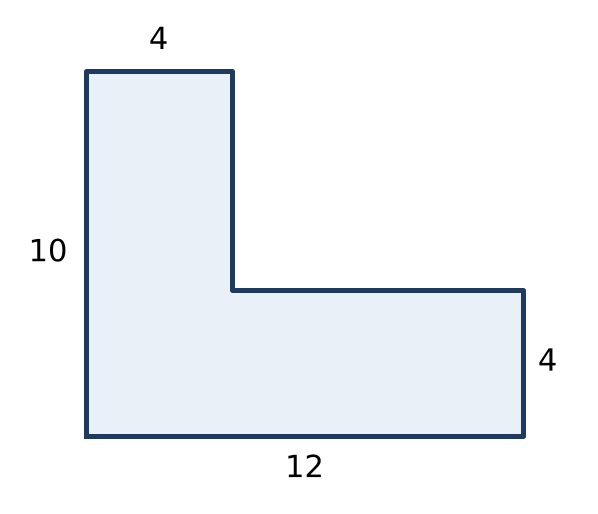
In the figure, all angles are right angles. What is the perimeter of the figure?
Show solution
AnswerD — 44
Step-by-step
- The missing horizontal side is 12 − 4 = 8.
- The missing vertical side is 10 − 4 = 6.
- Perimeter = 12 + 4 + 8 + 6 + 4 + 10 = 44.
Fast methodAll right angles: the horizontal sides add to 2 × 12 and the vertical sides add to 2 × 10, so the perimeter is 2 × (12 + 10) = 44.
Quick checkHorizontal: 12 = 4 + 8 ✓ and vertical: 10 = 4 + 6, total 24 + 20 = 44 ✓
Why the other choices are wrong
- A (30): added only the four labeled sides
- B (36): found the missing vertical side (6) but missed the missing horizontal side (8)
- C (38): found the missing horizontal side (8) but missed the missing vertical side (6)
- E (72): found the area instead of the perimeter
10.
A quarter circle has a radius of 12 inches. Using 3.14 for π, what is its area, in square inches?
Show solution
AnswerB — 113.04
Step-by-step
- The whole circle has area 3.14 × = 452.16.
- A quarter circle is one fourth of that: 452.16 ÷ 4 = 113.04 square inches.
Fast methodTake the right fraction of the full circle, then add any straight edges.
Quick check4 × 113.04 = 452.16, the full circle's area ✓.
Why the other choices are wrong
- A (18.84): used the circumference formula for the quarter circle: 2 × 3.14 × 12 ÷ 4 = 18.84
- C (226.08): found the area of a half circle
- D (339.12): found the area of the rest of the circle (three quarters): 452.16 × = 339.12
- E (452.16): gave the area of the whole circle
11.
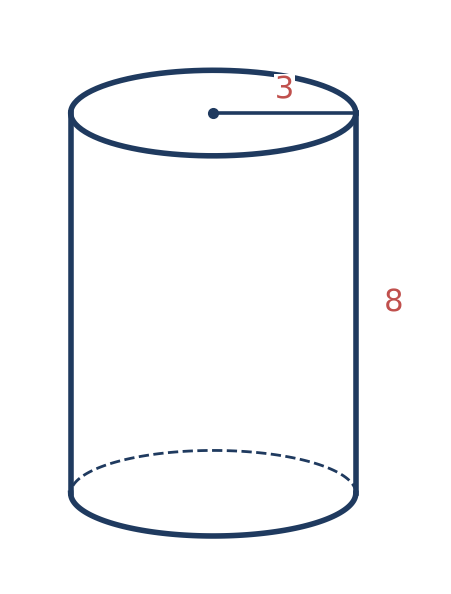
What is the total surface area of the cylinder shown? Give your answer in terms of π.
Show solution
AnswerB —
Step-by-step
- SA = r² + rh.
- SA = × + × 3 × 8 = + .
- So SA = .
Fast methodCylinder: V = πr²h; SA = r² + rh.
Quick checktwo bases 2 × = ; the curved side unrolls to a by 8 rectangle, ; + = ✓.
Why the other choices are wrong
- A (): found only the lateral area
- C (): found the volume
- D (): used r² for the bases: × + = + =
- E (): used the diameter as the radius
12.
A rectangular patio is 12 feet long and 15 feet wide. What is the area of the patio in square yards? (3 feet = 1 yard)
Show solution
AnswerA — 20
Step-by-step
- Convert each side to yards: 12 feet = 4 yards and 15 feet = 5 yards.
- Area = 4 × 5 = 20 square yards.
Fast methodChange the sides to yards first (4 by 5), then multiply.
Quick check180 square feet ÷ 9 square feet per square yard = 20 ✓
Why the other choices are wrong
- B (60): divided the area in square feet by 3 instead of by 9 (1 square yard = 9 square feet)
- C (180): gave the area in square feet and did not convert
- D (540): multiplied by 3 instead of dividing
- E (1,620): multiplied by 9 instead of dividing
13.
A circle has a circumference of units. What is its area, in square units?
Show solution
AnswerD —
Step-by-step
- C = r = .
- So r = 6.
- The area is A = πr² = π × = square units.
Fast methodFind the radius first, then use the other formula.
Quick checka radius of 6 gives C = and A = ✓.
Why the other choices are wrong
- A (): forgot to square the radius
- B (): gave the circumference
- C (): halved the area formula (semicircle): π × ÷ 2 =
- E (): used the diameter as the radius
14.
A prism has a right-triangle base with legs 6 and 8 and hypotenuse 10. The prism is 7 units long. What is its volume, in cubic units?
Show solution
AnswerB — 168
Step-by-step
- V = (area of base) × length.
- The base area is ½ × 6 × 8 = 24.
- So V = 24 × 7 = 168 cubic units.
Fast methodPrism: V = base area × length; use the legs for a right triangle.
Quick check168 ÷ 7 = 24 = ½ × 6 × 8 ✓.
Why the other choices are wrong
- A (24): gave only the area of the triangular base
- C (210): used the hypotenuse as a leg
- D (240): multiplied the base area by the hypotenuse instead of the length: 24 × 10 = 240
- E (336): forgot the ½ in the triangle's area
15.
The angles of a triangle measure (3x + 27)°, (x + 25)° and (x − 7)°. What is the value of x?
Show solution
AnswerB — 27
Step-by-step
- The angles add to 180°.
- So 5x + 45 = 180.
- Then 5x = 135.
- So x = 27.
Fast methodAdd the three expressions, set the sum equal to 180 and solve.
Quick checkthe angles are 108, 52, 20, which add to 180 ✓.
Why the other choices are wrong
- A (9): used 90° for the angle sum
- C (36): forgot to subtract the constants: 5x = 180, so x = 36
- D (45): moved the constants with the wrong sign
- E (63): used 360° for the angle sum
16.
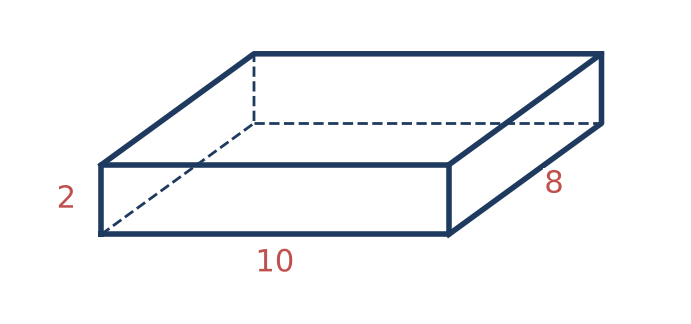
What is the surface area of the rectangular prism shown?
Show solution
AnswerE — 232
Step-by-step
- A rectangular prism has three pairs of equal faces.
- The faces have areas 10 × 8 = 80, 10 × 2 = 20 and 8 × 2 = 16.
- So SA = 2 × (80 + 20 + 16) = 2 × 116 = 232.
Fast methodSA = 2(lw + lh + wh): add the three different faces, then double.
Quick checkthe six faces are 80, 80, 20, 20, 16 and 16, which add to 232 ✓.
Why the other choices are wrong
- A (116): forgot to double each face
- B (160): found the volume
- C (196): doubled only the top and bottom
- D (200): left out one pair of faces: 2 × (80 + 20) = 200
17.
A rectangular sandbox is 6 feet long and 4 feet wide. It is filled with sand to a depth of 9 inches. Sand is sold in bags that each hold 1.5 cubic feet. How many bags are needed?
Show solution
AnswerA — 12
Step-by-step
- 9 inches = = 0.75 foot.
- Volume = 6 × 4 × 0.75 = 18 cubic feet.
- Bags = 18 ÷ 1.5 = 12.
Fast method6 × 4 = 24 square feet; of that is 18 cubic feet; 18 ÷ 1.5 = 12.
Quick check12 bags × 1.5 = 18 cubic feet = 6 × 4 × ✓
Why the other choices are wrong
- B (16): ignored the depth and divided 6 × 4 = 24 by 1.5
- C (18): gave the volume in cubic feet instead of the number of bags
- D (27): multiplied the volume by 1.5 instead of dividing
- E (144): used 9 inches as 9 feet
18.
A gift box shaped like a rectangular prism has a volume of 60 cubic inches. A second box has 3 times the length, 2 times the width, and half the height of the first box. What is the volume of the second box, in cubic inches?
Show solution
AnswerC — 180
Step-by-step
- Volume = length × width × height, so each change multiplies the volume.
- The new volume is 60 × 3 × 2 × = 60 × 3 = 180 cubic inches.
Fast methodThe factors multiply to 3 × 2 × = 3, so the volume triples: 180.
Quick checkExample: 5 × 4 × 3 = 60 becomes 15 × 8 × 1.5 = 180 ✓
Why the other choices are wrong
- A (30): applied only the change in height
- B (90): left out the change in width
- D (360): forgot to halve the height
- E (720): doubled the height instead of halving it
19.
The measures of the four angles of a quadrilateral are in the ratio 2 : 3 : 3 : 4. What is the measure of the largest angle?
Show solution
AnswerD — 120°
Step-by-step
- The angles of a quadrilateral add to 360°.
- There are 2 + 3 + 3 + 4 = 12 parts, so one part is 360° ÷ 12 = 30°.
- The largest angle is 4 parts: 4 × 30° = 120°.
Fast method360 × = 120.
Quick check60° + 90° + 90° + 120° = 360° ✓
Why the other choices are wrong
- A (30°): gave the size of one part, 360° ÷ 12
- B (60°): gave the smallest angle
- C (90°): gave one of the two middle angles
- E (160°): added only 2 + 3 + 4 = 9 parts, counting the repeated 3 once
20.
A bicycle wheel has a diameter of 21 inches. Using for π, how many complete turns does the wheel make when the bicycle travels 66 feet?
Show solution
AnswerA — 12
Step-by-step
- One turn moves the bicycle one circumference: × 21 = 66 inches.
- 66 feet = 66 × 12 = 792 inches.
- Turns = 792 ÷ 66 = 12.
Fast methodOne turn is 66 inches, so 66 feet (= 12 × 66 inches) takes 12 turns.
Quick check12 turns × 66 inches = 792 inches = 66 feet ✓
Why the other choices are wrong
- B (24): used π × radius (33 inches) for the distance in one turn
- C (66): gave the circumference in inches instead of the number of turns
- D (144): multiplied the number of turns by 12 again
- E (792): gave the distance in inches