Geometry and Measurement: Study Guide
The Middle Level SSAT (grades 5–7) has two 25-question Quantitative sections, 30 minutes each, with five answer choices and no calculator. A wrong answer loses ¼ point, so guess only after eliminating choices. This topic covers geometry and measurement: angles, triangles, quadrilaterals and circles, perimeter, area and volume, the coordinate grid and unit conversions.
- Lines and Angles
- Triangles
- Area and Perimeter
- Circles
- Volume and Surface Area
- The Coordinate Grid
- Measurement and Units
Lines and Angles
Angle pairs: complementary angles add to 90°, supplementary angles add to 180°, and vertical angles are equal. When a line crosses two parallel lines, corresponding angles and alternate interior angles are equal. The angles of a quadrilateral add to 360°.
Key formulas| Complementary | |
| Supplementary (straight line) | |
| Vertical angles | |
| Around a point | |
| Parallel lines | |
| Same-side interior | |
| Quadrilateral | |
| Clock |
Angles on a clock
Method. Each hour mark is 30°; the hour hand also moves 0.5° per minute.
Worked example- The 12 hour marks split 360° into 12 parts of 30°.
- At 9:00 the hands are 3 hour marks apart.
- So the smaller angle is 3 × 30° = 90°.
- A (54°): multiplied the hour 9 by 6° (the minute-hand rate per mark): 9 × 6° = 54°
- C (108°): split 360° into 10 parts instead of 12: 3 × 36° = 108°
- D (120°): counted one hour mark too many
- E (270°): measured the reflex angle
Complementary and supplementary angles
Method. Complement → 90° − angle; supplement → 180° − angle.
Worked example- Complementary angles add to 90°.
- The complement of 33° is 90° − 33° = 57°.
- A (33°): gave the same angle
- C (123°): added instead of subtracting: 90° + 33° = 123°
- D (147°): used the supplement instead of the complement
- E (327°): subtracted from 360°
Vertical and adjacent angles
Method. Vertical angles are equal; angles on a straight line add to 180°.
Worked example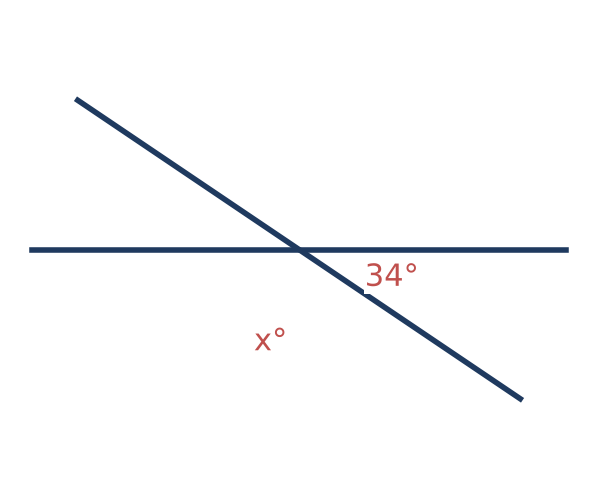
- The marked angles are adjacent angles on a straight line.
- So they are supplementary.
- x = 180 − 34 = 146.
- A (17): halved the given angle
- B (34): thought the angles are vertical (equal)
- C (56): used complementary angles
- D (112): subtracted the given angle twice from 180°: 180 − 2 × 34 = 112
Parallel lines and transversals
Method. Parallel lines: all acute angles are equal, all obtuse angles are equal, and an acute + an obtuse = 180°.
Worked example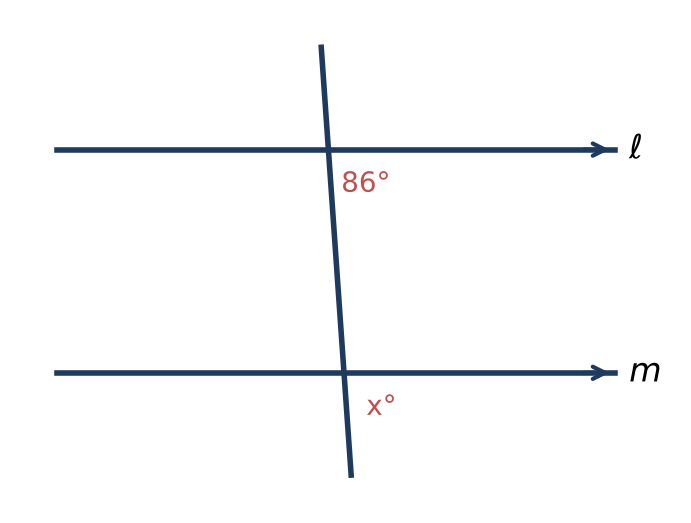
- The angle marked 86° and the angle marked x° are corresponding angles.
- With parallel lines, corresponding angles are equal.
- So x = 86.
- A (4): used complementary angles
- B (8): subtracted the angle twice from 180°
- D (94): assumed the angles are supplementary
- E (274): subtracted the angle from 360°: 360 − 86 = 274
Angle relationships with algebra
Method. Write the angle relationship as an equation, then solve.
Worked example- Vertical angles are equal: 3x − 13 = 2x + 5.
- Subtract 2x and add 13 to both sides: x = 18.
- The first angle is 3(18) − 13 = 41°.
- A (8): moved the 5 with the wrong sign and gave x: 3x − 13 = 2x − 5, so x = 8
- B (11): moved the 5 with the wrong sign: x = 8, so 3(8) − 13 = 11
- C (18): gave x instead of the angle
- E (139): gave the supplement: 180 − 41 = 139
Triangles
The angles of a triangle add to 180°. An exterior angle equals the sum of the two interior angles not next to it. An isosceles triangle has two equal angles; every angle of an equilateral triangle is 60°.
Key formulas| Angle sum | |
| Exterior angle | |
| Isosceles | |
| Equilateral | |
| Triangle inequality | |
| Area |
Angle sum of a triangle
Method. Third angle = 180° − (sum of the other two).
Worked example- The angles of a triangle add to 180°.
- So the third angle is 180° − 32° − 98° = 50°.
- B (66): subtracted the two angles
- C (82): subtracted only the larger angle from 180°: 180° − 98° = 82°
- D (130): added the two angles
- E (230): used 360° for the angle sum
Exterior angles of a triangle
Method. Exterior angle = sum of the two remote interior angles.
Worked example- An exterior angle equals the sum of the two remote interior angles.
- So 37° + x = 114°, and x = 114 − 37 = 77°.
- A (29): subtracted both angles from 180°
- B (66): gave the adjacent interior angle
- D (143): subtracted the known angle from 180°: 180° − 37° = 143°
- E (151): added instead of subtracting
Triangle angle problems
Method. Add the three expressions, set the sum equal to 180 and solve.
Worked example- The angles add to 180°.
- So 7x − 2 = 180.
- Then 7x = 182.
- So x = 26.
- A (): used 90° for the angle sum
- B (): left out the −6 when combining the constants: 7x + 4 = 180, x =
- C (): moved the constants with the wrong sign
- D (): ignored the constants
Area and Perimeter
Area measures square units inside a figure; perimeter adds the side lengths. Split composite figures into simple shapes, then add or subtract their areas.
Key formulas| Square | |
| Rectangle | |
| Triangle | |
| Parallelogram | |
| Trapezoid | |
| Circle |
Area of triangles
Method. Use the perpendicular height, not the slanted side.
Worked example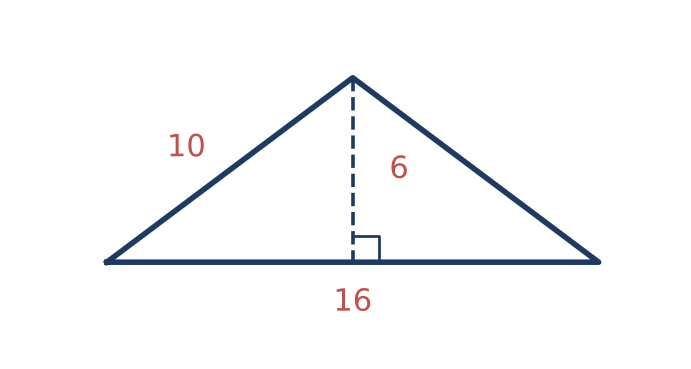
- Area of a triangle = ½ × base × height.
- The height is the dashed segment, 6, which is perpendicular to the base 16.
- So A = ½ × 16 × 6 = 48.
- B (60): multiplied the height by the slanted side: 6 × 10 = 60
- C (80): used the slanted side as the height
- D (96): forgot to multiply by ½
- E (160): used the slanted side and forgot the ½
Perimeter of polygons
Method. Parallelogram: A = base × height; P uses the slanted sides.
Worked example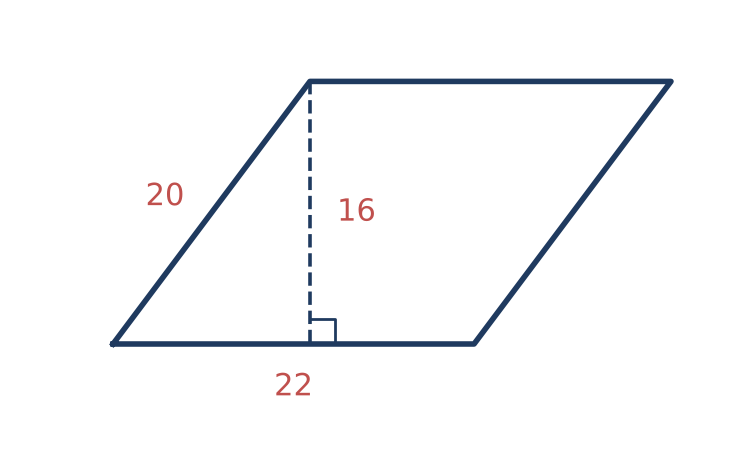
- A parallelogram has two pairs of equal sides: 22 and 20.
- The height is not a side.
- So P = 2 × (22 + 20) = 84.
- A (42): added only two sides
- B (58): added the three labeled lengths
- C (76): used the height instead of the slanted side
- E (100): counted the height as a side too: 2 × (22 + 20) + 16 = 100
Area of parallelograms and trapezoids
Method. Average the two bases, then multiply by the height.
Worked example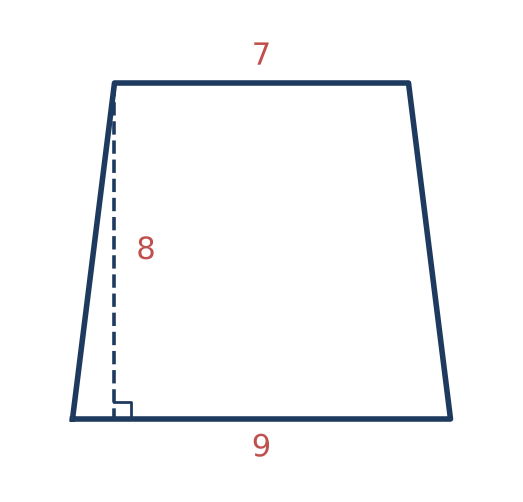
- Area of a trapezoid = ½ × (base₁ + base₂) × height.
- So A = ½ × (7 + 9) × 8 = ½ × 16 × 8 = 64.
- B (72): used only the longer base
- C (128): forgot to multiply by ½
- D (252): multiplied the two bases instead of adding them: ½ × (7 × 9) × 8 = 252
- E (504): multiplied all three lengths without the ½: 7 × 9 × 8 = 504
Composite figures
Method. Area of a composite figure: add the areas of the parts (rectangle + half of πr², with r = half the shared side).
Worked example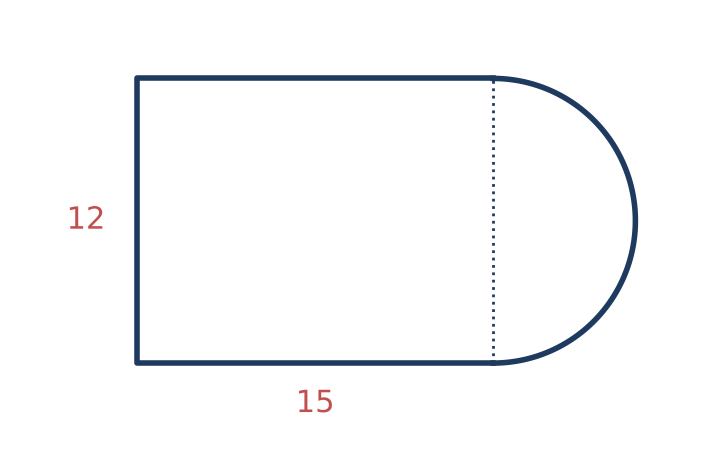
- Rectangle: 15 × 12 = 180.
- The semicircle has radius 12 ÷ 2 = 6.
- So its area is ½ × 3.14 × = 56.52.
- Total area = 180 + 56.52 = 236.52.
- A (123.48): subtracted the semicircle
- B (180): left out the semicircle
- C (198.84): added half the circle's circumference instead of its area: 180 + 3.14 × 6 = 198.84
- E (293.04): added a whole circle
Circles
The diameter is twice the radius. Circumference is the distance around a circle and area is the space inside; both use π (about 3.14 or 22/7). A semicircle is half a circle, so its perimeter is half the circumference plus the diameter.
Key formulas| Diameter | |
| Circumference | |
| Area | |
| Value of π | |
| Semicircle perimeter | |
| Work backward |
Circumference
Method. C = πd = r: multiply the diameter by π.
Worked example- The circumference is C = πd.
- So C ≈ 3.14 × 24 = 75.36 meters.
- A (37.68): used the radius in place of the diameter: 3.14 × 12 = 37.68
- C (150.72): used the diameter as the radius
- D (452.16): used the area formula πr²
- E (1808.64): used π times the diameter squared
Area of a circle
Method. A = πr²; halve the diameter first.
Worked example- The radius is 12 ÷ 2 = 6.
- The area is A = πr².
- So A = π × = square feet.
- A (): forgot to square the radius
- B (): found the circumference
- D (): used r² (mixed up the area and circumference formulas): × =
- E (): used the diameter as the radius
Working backward with circles
Method. Find the radius first, then use the other formula.
Worked example- C = r = .
- So r = 3.
- The area is A = πr² = π × = square units.
- A (): forgot to square the radius
- B (): gave the circumference
- D (): mixed up the formulas and used r²: × =
- E (): used the diameter as the radius
Semicircles and quarter circles
Method. Take the right fraction of the full circle, then add any straight edges.
Worked example- The curved part is half the circumference: 3.14 × 20 ÷ 2 = 31.4.
- The straight side is the diameter, 20.
- So the perimeter is 31.4 + 20 = 51.4 meters.
- A (31.4): left out the diameter
- B (41.4): added the radius instead of the diameter
- D (62.8): gave the full circumference instead of the perimeter: 3.14 × 20 = 62.8
- E (82.8): used the full circumference and added the diameter: 62.8 + 20 = 82.8
Volume and Surface Area
Volume measures cubic units inside a solid; for a prism or cylinder it is the base area times the height. Surface area adds the areas of all the faces.
Key formulas| Cube | |
| Rectangular box | |
| Prism | |
| Triangular prism | |
| Cylinder |
Volume of rectangular prisms
Method. Cube: V = and SA = 6.
Worked example- Volume of a cube = edge³.
- So V = 7 × 7 × 7 = 343.
- A (21): multiplied the edge by 3
- B (49): found the area of one face
- C (196): found the area of the four side faces: 4 × 49 = 196
- D (294): found the surface area
Volume with fractional edges
Method. Change mixed numbers to improper fractions, then multiply.
Worked example- V = l × w × h.
- Write 2 as .
- So V = × 6 × 6 = = 99 cubic feet.
- A (14 ): added the three dimensions
- B (16 ): found only the area of the base
- C (72): dropped the fraction part of the length
- D (72 ): multiplied only the whole number part and kept the fraction: 2 × 6 × 6 + = 72
Surface area of prisms
Method. SA = 2(lw + lh + wh): add the three different faces, then double.
Worked example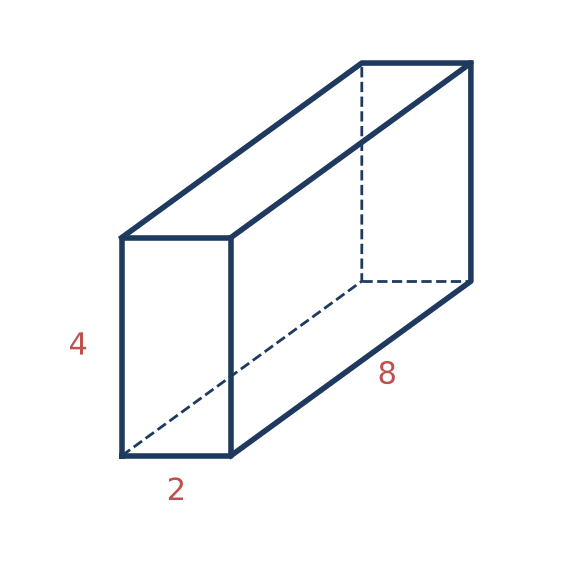
- A rectangular prism has three pairs of equal faces.
- The faces have areas 2 × 8 = 16, 2 × 4 = 8 and 8 × 4 = 32.
- So SA = 2 × (16 + 8 + 32) = 2 × 56 = 112.
- A (48): left out the two largest faces (8 × 4): 2 × (16 + 8) = 48
- B (56): forgot to double each face
- C (64): found the volume
- E (224): counted each face twice
Volume of cylinders
Method. Cylinder: V = πr²h; SA = r² + rh.
Worked example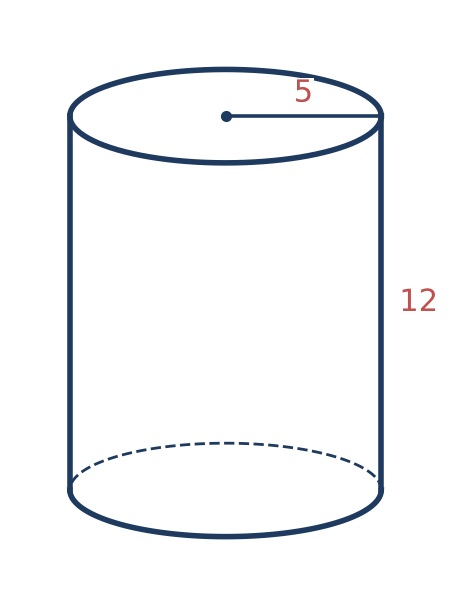
- V = πr²h.
- V = π × × 12.
- So V = .
- A (): forgot to square the radius
- B (): used the cone formula
- C (): found the lateral area rh
- E (): used the diameter as the radius: π × × 12 =
Volume of triangular prisms
Method. Prism: V = base area × length; use the legs for a right triangle.
Worked example- V = (area of base) × length.
- The base area is ½ × 9 × 12 = 54.
- So V = 54 × 3 = 162 cubic units.
- B (): used the hypotenuse in place of the second leg: ½ × 9 × 15 × 3 =
- C (216): found the surface area instead: 2 × 54 + (9 + 12 + 15) × 3 = 216
- D (270): used the hypotenuse in place of the first leg: ½ × 15 × 12 × 3 = 270
- E (324): forgot the ½ in the triangle's area
Surface area of cylinders
Method. Bases: 2 × π × = ; side: circumference × height = × 8 = ; total + = .
Worked example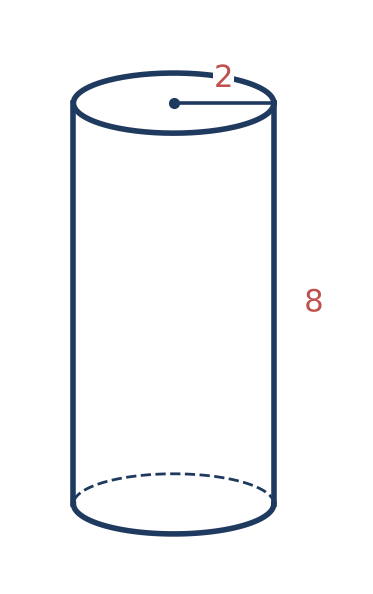
- SA = r² + rh.
- SA = × + × 2 × 8 = + .
- So SA = .
- A (): found only the lateral area
- B (): included only one circular base
- D (): used r² for the bases: × + = + =
- E (): used the diameter as the radius
The Coordinate Grid
A point (x, y) is x units across and y units up or down from the origin. On a horizontal or vertical line, the distance between two points is the difference of the coordinates that change. Reflections flip a point over a line.
Key formulas| Same y (horizontal) | |
| Same x (vertical) | |
| Reflect over the x-axis | |
| Reflect over the y-axis | |
| Translation |
Distance along grid lines
Method. Same x or same y: subtract the other coordinates (a point left of or below zero adds its distance).
Worked example- The points have the same x-coordinate.
- So the distance is the difference of the other coordinates.
- 6 − (−5) = 11.
- A (1): subtracted the absolute values
- C (12): counted grid points instead of units
- D (30): multiplied the sizes of the y-coordinates: 6 × 5 = 30
- E (121): squared the difference and forgot the square root: = 121
Polygons on the coordinate plane
Method. Find side lengths by subtracting coordinates.
Worked example- The width is 2 − (−8) = 10 and the height is 3 − 0 = 3.
- So the perimeter is 2 × (10 + 3) = 26.
- A (13): added only two sides
- B (18): dropped the negative sign: width 8 − 2 = 6, so 2 × (6 + 3) = 18
- C (23): left out one side
- E (30): found the area
Measurement and Units
Convert by multiplying by a fraction equal to 1 (such as 12 inches over 1 foot) so the old unit cancels. For time, carry 60 minutes as 1 hour.
Key formulas| Length (US) | |
| Metric length | |
| Weight and capacity | |
| Liquid (US) | |
| Time | |
| Unit factor |
Mixed-number feet to inches
Method. 3 feet is 36 inches and foot is 6 inches: 36 + 6 = 42.
Worked example- There are 12 inches in 1 foot.
- 3 × 12 = 36 + 6 = 42 inches.
- A (35): used 10 inches in a foot instead of 12
- B (36): dropped the foot and converted only 3 feet
- D (48): rounded 3 feet up to 4 feet before converting
- E (126): used 36 inches in a foot, the number of inches in a yard
Rate conversion: gallons per day to cups per hour
Method. 48 cups a day spread over 24 hours is 2 cups an hour.
Worked example- 1 gallon = 4 quarts and 1 quart = 4 cups, so 1 gallon = 16 cups.
- 3 gallons = 3 × 16 = 48 cups each day.
- A day has 24 hours, so 48 ÷ 24 = 2 cups each hour.
- A (): found gallons per hour, = , and did not convert to cups
- B (): used 4 cups in a gallon (4 is the number of cups in a quart)
- C (1): used 8 cups in a gallon (8 is the number of pints in a gallon)
- E (48): found cups per day, 48, and did not divide by 24 hours