Data Analysis and Probability: Practice Paper 1
Choose one answer for each question, then select Check my answers. Every question has a full worked solution.
1.
Carlos has 3 pairs of pants and 3 jackets. An outfit uses one of each. How many different outfits are possible?
Show solution
AnswerC — 9
Step-by-step
- By the counting principle, multiply the number of choices.
- 3 × 3 = 9.
Fast methodMultiply the number of choices for each independent step.
Quick checka tree diagram would have 3 × 3 = 9 final branches ✓.
Why the other choices are wrong
- A (6): added instead of multiplying
- B (8): subtracted one
- D (10): added one extra outfit
- E (18): counted each outfit twice, once in each order: 2 × 3 × 3 = 18
2.
What is the median of the data set 78, 15, 87, 82, 55, 36, 68, 81?
Show solution
AnswerD — 73
Step-by-step
- Order the values.
- So 15, 36, 55, 68, 78, 81, 82, 87.
- There are 8 values.
- The two middle values are 68 and 78, and their mean is (68 + 78) ÷ 2 = 73.
- So the median is 73.
Fast methodSort first; odd count → middle value, even count → mean of the two middle values.
Quick check4 values lie on each side of 73 in the ordered list ✓.
Why the other choices are wrong
- A (4.5): gave the middle position instead of the value
- B (62.75): gave the mean
- C (68.5): did not put the values in order first
- E (78): took only the upper middle value
3.
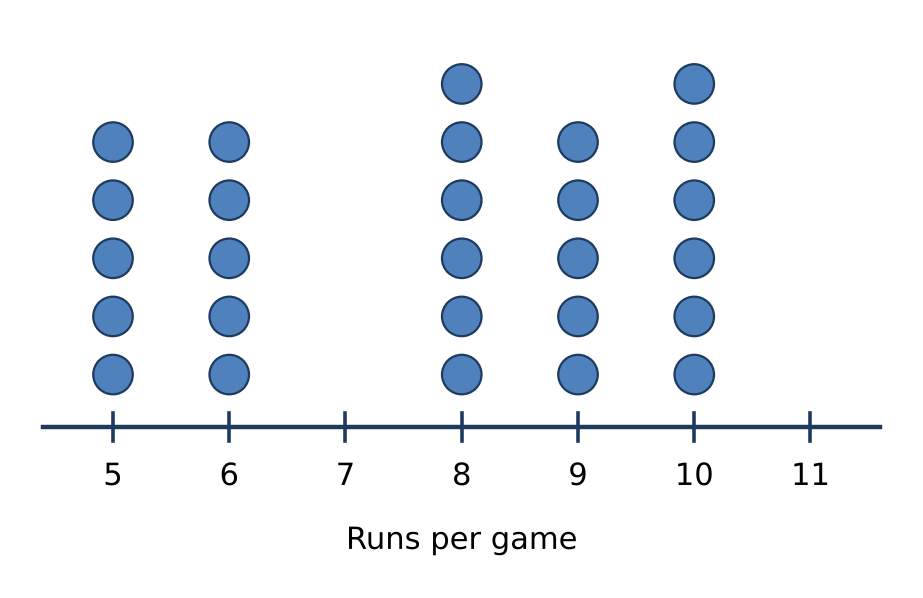
The dot plot shows the number of runs for some games. Each dot is one of the games. What fraction of the games had a number of runs of at most 9?
Show solution
AnswerC —
Step-by-step
- At most 9 means 9 or less.
- There are 21 such dots out of 27 in all.
- So the fraction is = .
Fast methodFraction = count that fits ÷ total count.
Quick checkthe dots above 9 number 6, and 21 + 6 = 27 ✓.
Why the other choices are wrong
- A (): found the fraction greater than 9
- B (): used less than 9 instead of at most 9
- D (): inverted the fraction: =
- E (): divided by the count on the other side, not the total
4.
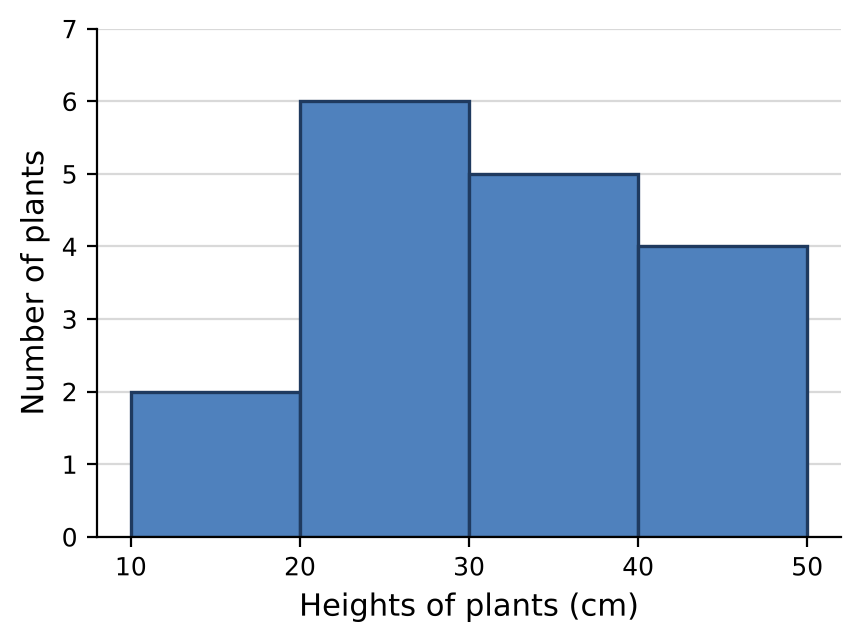
The histogram shows the heights of some plants. Each bar includes its left edge but not its right edge. How many plants had heights of at least 30 cm?
Show solution
AnswerD — 9
Step-by-step
- At least 30 starts with the bar 30–40.
- Add that bar and every bar to its right.
- So 5 + 4 = 9.
Fast methodAdd the heights of the bars from 30 onward.
Quick checkthe bars below 30 add to 8, and 8 + 9 = 17 ✓.
Why the other choices are wrong
- A (4): used only the bar farthest to the right
- B (5): used only the 30–40 bar
- C (8): counted the bars below
- E (17): counted every bar
5.
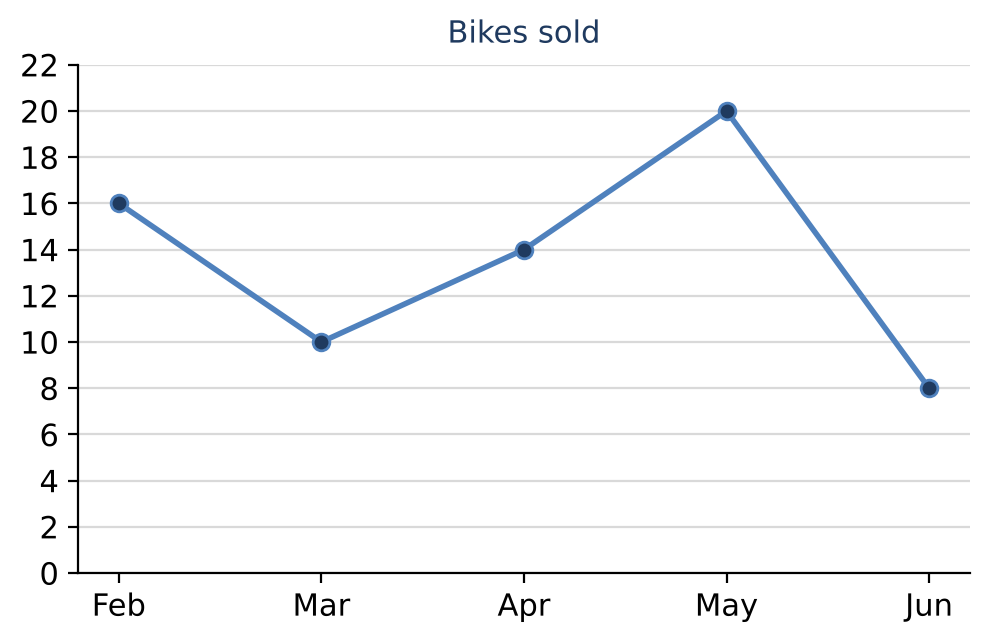
The line graph shows bikes sold each month. By how many bikes did the amount increase from February to May?
Show solution
AnswerB — 4
Step-by-step
- Read the points.
- So February = 16 and May = 20.
- The increase is 20 − 16 = 4.
Fast methodRead both points on the scale, then subtract the smaller from the larger.
Quick check16 + 4 = 20, the higher of the two points ✓.
Why the other choices are wrong
- A (2): misread one point by one grid line the other way
- C (6): misread one point by one grid line (2 bikes)
- D (16): gave the February value
- E (20): gave the May value
6.
The data set 115, 20, 25, 23, 14, 13 has an outlier. By how much does the mean decrease when the outlier is removed?
Show solution
AnswerA — 16
Step-by-step
- The mean with every value is 210 ÷ 6 = 35.
- The outlier is 115.
- Without it, the mean is 95 ÷ 5 = 19.
- The decrease is 35 − 19 = 16.
Fast methodFind both means, then subtract; an outlier pulls the mean toward it.
Quick check19 + 16 = 35, the original mean ✓.
Why the other choices are wrong
- B (19): gave the new mean
- C (35): gave the original mean
- D (80): gave the outlier's distance from the original mean: 115 − 35 = 80
- E (96): gave the outlier's distance from the new mean
7.
Data set A is 26, 45, 38, 10, 43. Data set B is 15, 34, 26, 27, 27. How much greater is the median of A than the median of B?
Show solution
AnswerB — 11
Step-by-step
- Ordered, A is 10, 26, 38, 43, 45.
- So its median is 38.
- Ordered, B is 15, 26, 27, 27, 34.
- So its median is 27.
- The difference is 38 − 27 = 11.
Fast methodFind the median of each set separately, then subtract.
Quick check27 + 11 = 38, the median of A ✓.
Why the other choices are wrong
- A (6.6): compared the means instead
- C (12): took the middle value of B without ordering it: 38 − 26 = 12
- D (16): compared the ranges
- E (33): compared the sums
8.
A box holds 20 granola bars: 5 apple, 7 oat, and 8 berry. Mia eats one berry bar. If she then picks one of the remaining bars at random, what is the probability that it is a berry bar?
Show solution
AnswerA —
Step-by-step
- After Mia eats one berry bar, 7 berry bars remain.
- The box now has 20 − 1 = 19 bars.
- The probability of a berry bar is .
Fast methodTake one away from both the berry count and the total: = .
Quick check + (apple or oat) = 1 ✓
Why the other choices are wrong
- B (): ignored the bar Mia ate, using
- C (): lowered the total to 19 but kept 8 berry bars
- D (): found the probability of not berry using the full box
- E (): found the probability of not berry after the bar was eaten
9.
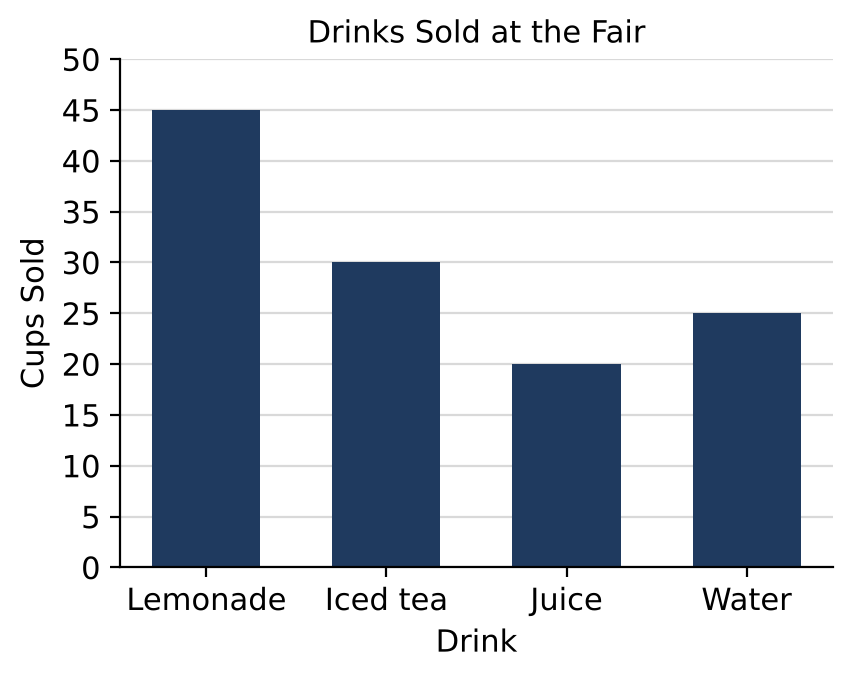
The bar graph shows the number of cups of each drink sold at a school fair. What percent of all the cups sold were lemonade or iced tea?
Show solution
AnswerD — 62.5%
Step-by-step
- From the graph: lemonade 45, iced tea 30, juice 20, water 25, for a total of 120 cups.
- Lemonade or iced tea: 45 + 30 = 75 cups.
- = = 62.5%.
Fast method simplifies to , and = 62.5%.
Quick checkJuice and water: = 37.5%, and 62.5% + 37.5% = 100% ✓
Why the other choices are wrong
- A (25%): found the percent for iced tea only
- B (37.5%): found the percent for lemonade only
- C (50%): used 2 of the 4 kinds of drinks, ignoring the bar heights
- E (75%): gave the number of cups, 75, as a percent
10.
The mean weight of 8 packages is 15 pounds. When one package is removed, the mean weight of the other 7 packages is 14 pounds. How many pounds does the removed package weigh?
Show solution
AnswerE — 22
Step-by-step
- Total of 8 packages: 8 × 15 = 120 pounds.
- Total of the other 7: 7 × 14 = 98 pounds.
- Removed package: 120 − 98 = 22 pounds.
Fast methodTotal before minus total after: 8 × 15 − 7 × 14 = 22.
Quick check(98 + 22) ÷ 8 = 120 ÷ 8 = 15 ✓
Why the other choices are wrong
- A (1): subtracted the two means
- B (7): multiplied the 1-pound drop in the mean by 7 but did not add the original mean
- C (14): gave the new mean
- D (15): gave the original mean
11.
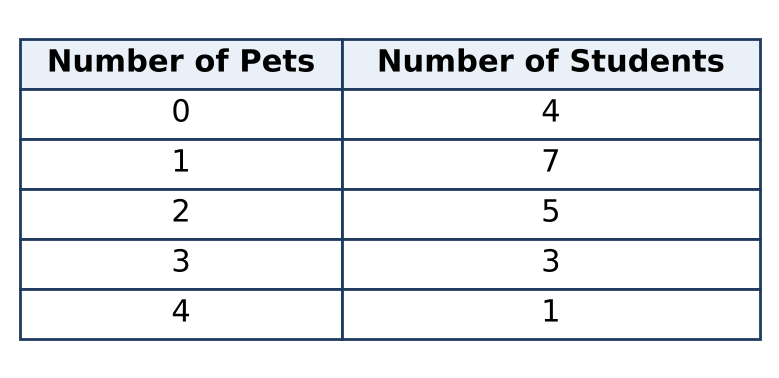
The table shows the number of pets owned by each of 20 students. What is the median number of pets owned?
Show solution
AnswerA — 1
Step-by-step
- List the 20 values in order: four 0s, then seven 1s, then five 2s, and so on.
- The median is the mean of the 10th and 11th values.
- The first 4 values are 0 and values 5 through 11 are 1, so the 10th and 11th values are both 1. The median is 1.
Fast methodCount down the table to reach the 10th and 11th students: 4 have 0 pets, and 4 + 7 = 11 have at most 1 pet, so both are 1.
Quick check9 students have 0 or 1 pet below the 10th spot and 9 students have 2 or more ✓
Why the other choices are wrong
- B (1.5): found the mean, 30 ÷ 20, instead of the median
- C (2): took the middle of the pet numbers 0 to 4 without using the counts
- D (4): found the median of the student counts 4, 7, 5, 3, 1
- E (7): gave the largest number of students in one row
12.
A fair number cube with faces numbered 1 through 6 is rolled once. What is the probability that the number rolled is a factor of 12?
Show solution
AnswerE —
Step-by-step
- The factors of 12 that can be rolled are 1, 2, 3, 4, and 6.
- That is 5 of the 6 equally likely outcomes, so the probability is .
Fast methodOnly 5 is not a factor of 12, so the probability is 1 − = .
Quick check12 ÷ 1, 2, 3, 4, 6 are whole numbers and 12 ÷ 5 is not ✓
Why the other choices are wrong
- A (): found the probability of NOT rolling a factor (only 5)
- B (): counted only the prime factors 2 and 3
- C (): counted only the even factors 2, 4, and 6
- D (): forgot that 1 is a factor of 12
13.
In a class of 28 students, the probability that a randomly chosen student is a girl is . Then 4 boys join the class. What is the probability now that a randomly chosen student is a girl?
Show solution
AnswerA —
Step-by-step
- Girls: of 28 = 12. Boys: 28 − 12 = 16.
- After 4 boys join, there are 32 students and still 12 girls.
- Probability of a girl = = .
Fast method12 girls out of 28 + 4 = 32 students: .
Quick checkBoys = , and + = 1 ✓
Why the other choices are wrong
- B (): assumed the probability did not change
- C (): added the 4 new students to the girls
- D (): gave the original probability of choosing a boy
- E (): found the new probability of choosing a boy
14.
A family's monthly budget is $2,400. In a circle graph of the budget, the section for rent has a central angle of 150°. How many dollars are budgeted for rent?
Show solution
AnswerB — $1,000
Step-by-step
- A full circle is 360°, so the rent section is = of the budget.
- of $2,400 = $1,000.
Fast method of $2,400 is $200, and 150° is 5 twelfths of 360°, so 5 × $200 = $1,000.
Quick check$1,000 is 1,,400 = of the budget, and × 360° = 150° ✓
Why the other choices are wrong
- A ($16): divided $2,400 by 150
- C ($1,400): found the amount for the rest of the budget (210°)
- D ($2,000): used 180° instead of 360° for the whole circle
- E ($3,600): treated 150° as 150%
15.
Five friends read 3, 8, 5, 12, and 7 books this summer. A sixth friend read 11 books. What is the median number of books read by the six friends?
Show solution
AnswerB — 7.5
Step-by-step
- In order, the six numbers are 3, 5, 7, 8, 11, 12.
- With six values, the median is the mean of the 3rd and 4th: (7 + 8) ÷ 2 = 7.5.
Fast methodSort, then average the middle pair 7 and 8: 7.5.
Quick checkTwo values (3, 5) below 7 and two (11, 12) above 8, so 7.5 is in the middle ✓
Why the other choices are wrong
- A (7): gave the median of the original five friends
- C (8): took only the 4th value in order instead of averaging the two middle values
- D (8.5): averaged the two middle numbers of the unsorted list, 5 and 12
- E (9.5): averaged the 4th and 5th values, 8 and 11
16.
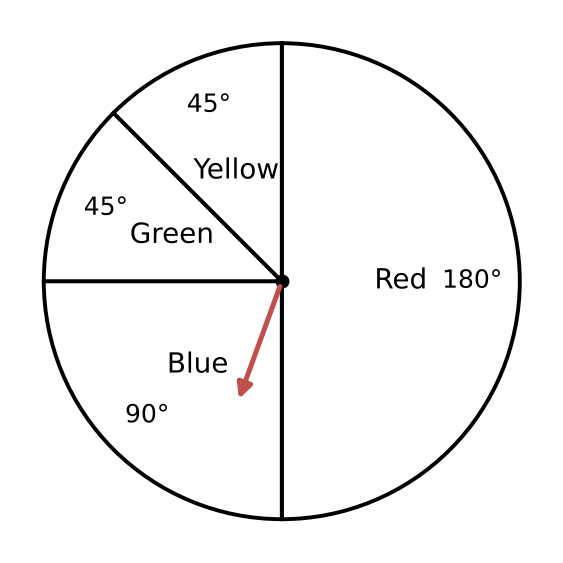
The spinner shown is divided into four sections, with the central angle of each section marked. If the arrow is spun once, what is the probability that it lands on neither red nor green?
Show solution
AnswerC —
Step-by-step
- Neither red nor green means blue or yellow.
- Blue and yellow together have 90° + 45° = 135° of the 360° circle.
- Probability = = .
Fast methodBlue is and yellow is , so + = .
Quick checkRed or green is = , and + = 1 ✓
Why the other choices are wrong
- A (): counted only the yellow section
- B (): counted only the blue section
- D (): treated the 4 sections as equally likely, 2 out of 4
- E (): found the probability of red or green
17.
At a bake sale, 10 volunteers baked a mean of 18 cookies each. A second group of volunteers baked a mean of 24 cookies each. The mean for all the volunteers together was 22 cookies. How many volunteers were in the second group?
Show solution
AnswerE — 20
Step-by-step
- Let n be the size of the second group. The total number of cookies is 10 × 18 + 24n = 180 + 24n.
- The combined mean is 22, so 180 + 24n = 22(10 + n) = 220 + 22n.
- Then 2n = 40, so n = 20.
Fast methodBalance around 22: the first group is 4 below for 10 people (−40), and each second-group volunteer is 2 above, so 40 ÷ 2 = 20 volunteers.
Quick check(180 + 480) ÷ 30 = 660 ÷ 30 = 22 ✓
Why the other choices are wrong
- A (2): gave the difference 24 − 22
- B (4): gave the difference 22 − 18
- C (6): gave the difference between the two group means
- D (10): assumed the groups were the same size
18.
Raj's mean score on 4 quizzes is 85. What score must he earn on the 5th quiz so that his mean score on all 5 quizzes is 87?
Show solution
AnswerC — 95
Step-by-step
- Total needed for a mean of 87 on 5 quizzes: 5 × 87 = 435.
- Total so far: 4 × 85 = 340.
- Score needed: 435 − 340 = 95.
Fast methodThe 5th score must be 87 plus 2 points for each of the 4 earlier quizzes: 87 + 8 = 95.
Quick check(340 + 95) ÷ 5 = 435 ÷ 5 = 87 ✓
Why the other choices are wrong
- A (87): thought the new score only had to equal the new mean
- B (89): added the 2-point raise to 87 only once
- D (97): added 2 points for all 5 quizzes instead of the 4 earlier ones
- E (435): gave the total needed for 5 quizzes
19.
A bag has 2 yellow and 5 blue marbles. Two marbles are drawn without replacement. What is the probability that both are yellow?
Show solution
AnswerA —
Step-by-step
- First draw: P(yellow) = .
- After one yellow marble is removed, 1 yellow marble remains out of 6.
- So P(both) = × = = .
Fast methodWithout replacement, reduce both the favorable count and the total for the second draw.
Quick checkchoosing 2 of the 7 marbles gives 21 pairs, and only 1 pair is both yellow, so the probability is ✓.
Why the other choices are wrong
- B (): replaced the first marble
- C (): did not reduce the number of yellow marbles
- D (): gave the probability for the first draw only:
- E (): added the first-draw probability to itself: + =
20.
Zoe swam 4, 7, 7, 9, and x laps on five days, where x is a whole number. The mean of the five numbers equals the median. What is the value of x?
Show solution
AnswerC — 8
Step-by-step
- The two 7s are in the middle of the list no matter where x falls, so the median is 7.
- For the mean to be 7, the total must be 5 × 7 = 35.
- x = 35 − (4 + 7 + 7 + 9) = 35 − 27 = 8.
Fast methodMedian is 7 for every x, so x makes the total 35: x = 35 − 27 = 8.
Quick check4, 7, 7, 8, 9: median 7 and mean 35 ÷ 5 = 7 ✓
Why the other choices are wrong
- A (6.75): found the mean of the four known values
- B (7): gave the median, 7, as the value of x
- D (27): gave the sum of the four known values
- E (35): gave the total needed, 5 × 7, without subtracting the known values