Quantitative: Unit Study Guide
- 03.01 Number Concepts and Operations
- 03.02 Algebra
- 03.03 Geometry and Measurement
- 03.04 Data Analysis and Probability
03.01 Number Concepts and Operations
The Middle Level SSAT (grades 5–7) has two 25-question Quantitative sections, 30 minutes each, with five answer choices and no calculator. A wrong answer loses ¼ point, so guess only after eliminating choices. This topic covers number concepts: whole numbers and integers, fractions, decimals and percents, order of operations, factors, multiples and primes, place value, estimation, and simple exponents and square roots.
Integers, the Number Line and the Coordinate Grid
Integers are the whole numbers and their opposites. Numbers to the right on a number line are greater. Learn the sign rules, use absolute value as distance from 0, follow the order of operations, and know the odd and even rules. A point on the coordinate grid is written (x, y): across first, then up or down.
Key formulas| Add with the same sign | |
| Add with different signs | |
| Subtract | |
| Multiply or divide | |
| Absolute value | |
| Distance on a number line | |
| Order of operations | |
| Odd and even | |
| Distributive | |
| Point on a grid |
Whole numbers on a number line
Method. Find the value of one space (10), then multiply by the number of spaces to P (1).
Worked example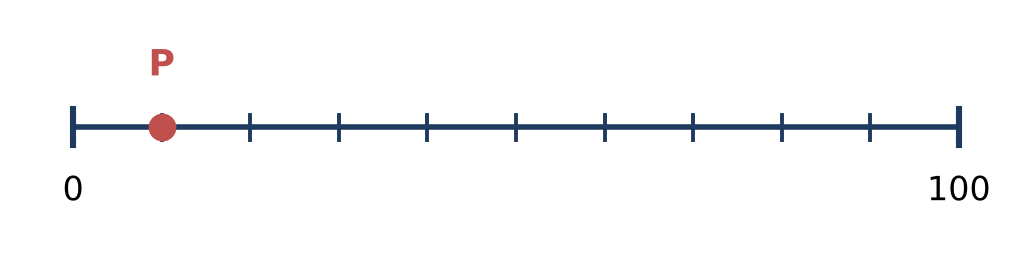
- From 0 to 100 there are 10 equal spaces.
- So each space is 100 ÷ 10 = 10.
- P is 1 space from 0: 1 × 10 = 10.
- A (1): gave the number of spaces to P (1) instead of its value
- C (20): counted tick marks (including the one at 0) instead of spaces: 2 × 10 = 20
- D (90): counted the spaces back from the right end: 9 × 10 = 90
- E (100): gave the whole length shown instead of counting spaces to P: 10 spaces × 10 = 100
Subtract integers
Method. Keep – change – change: keep the first number, change − to +, change the sign of the second number.
Worked example- Subtracting a number is the same as adding its opposite: −20 − 15 = −20 + (−15).
- Then add: −35.
- B (−5): added instead of subtracting (did not change the sign of the second number)
- C (5): ignored the signs and subtracted the sizes
- D (35): gave the opposite sign
- E (300): multiplied instead of subtracting: (−20) × (−15) = 300
Divide integers
Method. Find the size first, then the sign: an even number of negative signs gives +, an odd number gives −.
Worked example- Divide the sizes: 108 ÷ 9 = 12.
- Same signs give a positive quotient.
- So the answer is 12.
- A (−117): added instead of dividing
- B (−99): subtracted instead of dividing
- C (−12): used the wrong sign rule
- E (99): subtracted the sizes instead of dividing and used the same-sign rule: 108 − 9 = 99
Absolute value — distance on a number line
Method. Points on opposite sides of 0: add their distances from 0: 30.
Worked example- Distance is the absolute value of the difference.
- |−22 − 8| = |−30|.
- So |−22 − 8| = 30.
- A (14): subtracted the sizes, ignoring that the points are on opposite sides of 0
- B (22): gave only the distance from −22 to 0
- D (31): counted the tick marks instead of the spaces between the numbers
- E (176): multiplied the sizes
Absolute value — evaluate
Method. Absolute value is never negative: simplify inside, drop the sign, then do the outside operation.
Worked example- Work inside the bars first: |−5| = 5 and |2 − 3| = |−1| = 1.
- Then 5 − 1 = 4.
- A (−6): treated |−5| as −5
- C (5): multiplied instead of subtracting
- D (6): treated |2 − 3| as −1
- E (10): added the absolute values of all three numbers: 5 + 2 + 3 = 10
Integers in context — temperature
Method. Start at −8 on a number line and move 12 down.
Worked example- Falling means subtract.
- −8 − 12 = −20°F.
- B (−12): gave only the change in temperature
- C (−8): gave the starting temperature
- D (4): moved the wrong way on the number line
- E (20): gave the opposite sign
Coordinate plane — read a point
Method. Run before you rise: read across (x) first, then up or down (y).
Worked example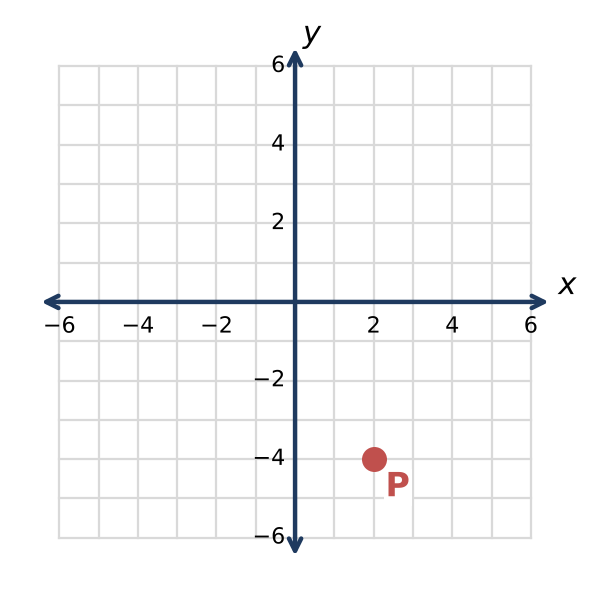
- Start at the origin.
- P is 2 units right (x = 2) and 4 units down (y = −4).
- So P = (2, −4).
- A ((−4, 2)): swapped the x- and y-coordinates
- B ((−2, −4)): used the wrong sign for x
- C ((2, 4)): used the wrong sign for y
- D ((−2, 4)): used the wrong sign for both coordinates
Coordinate plane — distance on a grid line
Method. Opposite signs → add the sizes: 2 + 9 = 11.
Worked example- The x-coordinates are equal.
- So the points lie on a vertical line.
- The distance is the absolute value of the difference of the other coordinates: |2 − (−9)| = 11.
- A (−11): gave a negative distance
- B (0): found the difference of the x-coordinates instead: −3 − (−3) = 0
- C (7): subtracted the sizes, ignoring that the points are on opposite sides of an axis
- E (14): added the coordinate that stays the same
Evaluate an expression with a negative number
Method. Put every negative value in parentheses before squaring or multiplying.
Worked example- Substitute with parentheses.
- − 4 × (−8) = 64 − (−32).
- − 4 × (−8) = 64 + 32.
- So − 4 × (−8) = 96.
- A (−32): computed as a negative number: −64 + 32 = −32
- B (16): treated as 2x: 2 × (−8) − 4 × (−8) = −16 + 32 = 16
- C (32): used x as positive in the second term: 64 − 4 × 8 = 32
- E (144): subtracted before squaring: = 144
Odd and even — parity rules
Method. Test with small numbers: a = 1, b = 1 gives 2a + b = 3, which is odd; check one more pair to be sure.
Worked example- Use the rules: even ± even = even, odd ± odd = even, odd ± even = odd.
- Even × anything = even, odd × odd = odd.
- Here a is odd and b is odd.
- So 2a + b is always odd.
- A (a + b): chose an expression that is always even
- B (b + 1): chose an expression that is always even
- D (ab + 1): chose an expression that is always even
- E (2a): chose an expression that is always even
Integer expression — order of operations
Method. Find both products with their signs, then change the subtraction to adding the opposite: 28 + 36 = 64.
Worked example- Multiply first: −7 × (−4) = 28 and (−4) × 9 = −36.
- Then subtract: 28 − (−36) = 64.
- A (−64): gave the opposite sign
- B (−8): got the sign of the second product wrong
- C (8): got the sign of the first product wrong
- D (28): found only the first product: −7 × (−4) = 28
Fractions
A fraction names equal parts of a whole. Use a common denominator to compare, add or subtract; multiply straight across; divide by multiplying by the reciprocal. Always simplify the answer.
Key formulas| Equivalent fractions | |
| Add / subtract | |
| Multiply | |
| Divide | |
| Mixed number | |
| Fraction of a number |
Compare fractions
Method. Compare each fraction with and with 1 first; for close ones cross-multiply: > when a × d > b × c.
Worked example- Compare each fraction with first: and are less than (4 × 2 < 17 and 3 × 2 < 13).
- and are greater than , so the answer is one of these two.
- Cross-multiply: 6 × 3 = 18 and 11 × 2 = 22; since 18 < 22, < .
- The greatest fraction is .
- A (): chose the fraction with the greatest top number
- B (): chose the fraction with the greatest bottom number
- C (): chose the least fraction instead of the greatest
- D (): chose the fraction with the least bottom number
Fraction of a whole number
Method. Divide by the bottom, multiply by the top: 30 ÷ 5 × 3 = 18.
Worked example- Find one part first: 30 ÷ 5 = 6.
- So of 30 is 6.
- Then take 3 of those parts: 3 × 6 = 18.
- A (6): found one part only (did not multiply by the top number)
- B (10): divided by the top number instead of the bottom
- C (12): found the part that is left instead
- E (50): used the reciprocal : 30 ÷ 3 × 5 = 50
Fraction of a whole number (word problem)
Method. Divide by the bottom, multiply by the top: 10 ÷ 5 × 2 = 4.
Worked example- Find one part first: 10 ÷ 5 = 2.
- So of 10 is 2.
- Then take 2 of those parts: 2 × 2 = 4.
- A (1): divided by the top number instead of multiplying: 10 ÷ 5 ÷ 2 = 1
- B (2): found one part only (did not multiply by the top number)
- D (6): found the part that is left instead
- E (20): multiplied by the top number only
Add — unlike denominators
Method. Butterfly method: = , then simplify to .
Worked example- The least common denominator of 2 and 4 is 4.
- Rename: = and = .
- Add the tops: 2 + 1 = 3.
- So .
- A (): added the tops and added the bottoms
- C (1): added the tops and kept the smaller bottom number
- D (1 ): renamed as instead of : + = = 1
- E (1 ): put the cross-products over the least common denominator
Subtract — unlike denominators
Method. Butterfly method: = , which is already in simplest form.
Worked example- The least common denominator of 8 and 11 is 88.
- Rename: = and = .
- Subtract the tops: 33 − 8 = 25.
- So .
- A (): used a common bottom number but did not rename the tops
- B (): multiplied instead of subtracting
- C (): subtracted the tops and added the bottoms: =
- E (): added instead of subtracting
Divide — fraction ÷ fraction
Method. Keep – change – flip: keep , change ÷ to ×, flip to .
Worked example- Dividing by is the same as multiplying by its reciprocal .
- × = = = 1 .
- A (): multiplied without flipping the second fraction
- B (): flipped the first number instead of the second
- D (1 ): flipped both fractions: × = = 1
- E (1 ): added instead of dividing
Divide — whole number ÷ fraction
Method. Keep – change – flip: keep 2, change ÷ to ×, flip to .
Worked example- Dividing by is the same as multiplying by its reciprocal .
- 2 × = = = 5.
- A (): flipped the first number instead of the second
- B (): multiplied without flipping the second fraction
- C (1): divided by the top of the second fraction but did not multiply by its bottom: 2 ÷ 2 = 1
- E (10): multiplied by the bottom of the second fraction but did not divide by its top
Improper fraction to mixed number
Method. Find the largest multiple of 7 not above 34: 28 = 4 × 7; what is left is 34 − 28 = 6.
Worked example- Divide the top by the bottom: 34 ÷ 7 = 4 remainder 6.
- The quotient 4 is the number of wholes and the remainder 6 is the top of the fraction part, over the same bottom 7.
- So = 4 .
- A (3 ): took one whole too few
- B (4 ): used the amount needed to reach the next whole instead of the remainder
- C (4 ): put 1 over the remainder instead of the remainder over the bottom: 4
- D (4 ): kept the original top number as the new bottom
Find the whole from a fractional part
Method. Divide by the fraction: 24 ÷ = 24 × = 56.
Worked example- of the whole is 24.
- So one part is 24 ÷ 3 = 8.
- The whole has 7 parts: 7 × 8 = 56.
- A (8): found the size of one part only
- B (10 ): took of the part instead of finding the whole: × 24 = 10
- C (32): gave the rest instead of the whole
- E (168): multiplied by the bottom only
Fraction between two fractions
Method. Change all fractions to decimals (top ÷ bottom) and pick the one strictly between the two given decimals.
Worked example- Rename with the common denominator 120: = , = and = .
- Only has a top number strictly between 24 and 80.
- A (): is less than , so it is not between
- B (): is equal to , so it is not between
- D (): is equal to , so it is not between
- E (): is greater than , so it is not between
Number line — mixed numbers
Method. P is past 1, so start at 1 and count 1 space of size : 1 .
Worked example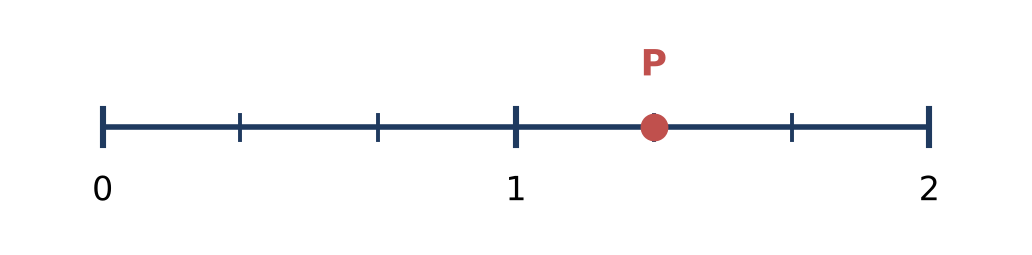
- Each whole is cut into 3 equal spaces.
- So each space is .
- P is 4 spaces from 0, which is = 1 (one whole and more).
- A (): left out the whole from 0 to 1
- B (): used all the spaces from 0 to 2 as the bottom number
- C (1): counted the tick marks in one unit instead of the spaces
- D (1 ): counted the tick marks in one unit instead of the spaces but kept the whole: 1 + = 1
Add mixed numbers
Method. Change to improper fractions and add: + = 8 ; or add wholes and fractions separately and carry any extra whole.
Worked example- Add the whole numbers: 3 + 4 = 7.
- Add the fractions with the common denominator 15: + = = 1 .
- Combine: 7 + 1 = 8 .
- A (7 ): did not carry the extra whole from the fraction part
- B (7 ): multiplied the fractions instead of adding them: 7 + × = 7
- C (7 ): used a common bottom number but did not rename the tops
- D (7 ): added the whole numbers, then added the tops and added the bottoms
Subtract mixed numbers (regrouping)
Method. Use improper fractions: − = 1 ; this avoids regrouping.
Worked example- Rename with denominator 72: 11 − 9 .
- Since is less than , regroup one whole: 11 = 10 .
- Now subtract: 10 − 9 = 1 and − = .
- Answer: 1 .
- B (1 ): took 1 from the whole number but subtracted the smaller fraction from the larger: 1 + = 1
- C (2 ): regrouped but did not take 1 from the whole number
- D (2 ): subtracted the smaller fraction from the larger instead of regrouping
- E (2 ): added the fraction parts instead of subtracting
Multiply mixed numbers
Method. Never multiply the whole parts and the fraction parts separately; convert to improper fractions and cross-cancel first.
Worked example- Change each mixed number to an improper fraction: 1 = and 2 = .
- Multiply: = = 4 .
- A (): divided instead of multiplying
- B (2 ): multiplied the whole numbers and the fractions separately
- C (3 ): multiplied the whole numbers and added the fractions: 1 × 2 + = 3
- D (4 ): added instead of multiplying
Divide a mixed number by a fraction
Method. Keep – change – flip after converting the mixed number to an improper fraction.
Worked example- Change 6 to .
- Multiply by the reciprocal of : × = = 8 .
- A (): flipped the first number instead of the second
- B (5 ): multiplied without flipping the second fraction
- C (7 ): left out the : 6 × = 7
- D (8): divided only the whole number part
Find the whole from a fractional part (word problem)
Method. Divide by the fraction: 4 ÷ = 4 × = 6.
Worked example- of the whole is 4.
- So one part is 4 ÷ 2 = 2.
- The whole has 3 parts: 3 × 2 = 6.
- A (2 ): took of the part instead of finding the whole: × 4 = 2
- C (7): added the bottom number to the part
- D (8): multiplied the part by the top number: 4 × 2 = 8
- E (12): multiplied by the bottom only
Order of operations with fractions
Method. Do the × first, simplify it, then add with a common denominator.
Worked example- Multiply before adding: × = .
- Then add: + = .
- A (): multiplied all three
- B (): gave only the product and forgot to add: × =
- C (): added first, then multiplied (worked left to right)
- E (1 ): added all three
Complex fraction
Method. Multiply the top and the bottom of the complex fraction by 40 (the LCD) to clear the small fractions, then divide.
Worked example- Work out the top first: 1 − = − = .
- Then divide by the bottom: ÷ = × = .
- A (): divided before subtracting
- C (): left out the 1 − part
- D (1 ): added instead of subtracting
- E (2 ): divided the bottom by the top: ÷ = = 2
Decimals
Line up the decimal points to add or subtract. To multiply, multiply as whole numbers and count the decimal places. To divide by a decimal, move both decimal points to make the divisor a whole number.
Key formulas| Place value | |
| Multiply | |
| Divide | |
| Decimal to fraction | |
| Rounding |
Decimals on a number line
Method. Find the size of one space (0.1), then count spaces from the left end.
Worked example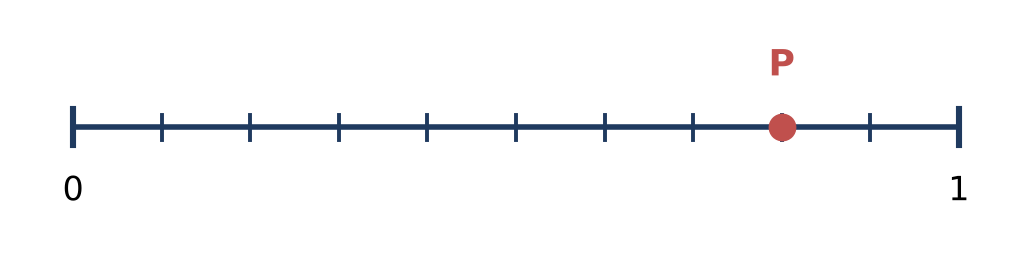
- From 0 to 1 there are 10 equal spaces.
- So each space is (1 − 0) ÷ 10 = 0.1.
- P is 8 spaces past 0: 0 + 8 × 0.1 = 0.8.
- A (0.2): counted the spaces back from the right end
- C (0.9): counted tick marks (including the first one) instead of spaces
- D (1.6): read each space as two tenths: 8 × 0.2 = 1.6
- E (8): read each space as ten times its size
Multiply decimals
Method. Estimate first: about 5 × 8 = 40, then place the point in 408 to get a number near that: 40.8.
Worked example- Multiply as whole numbers: 51 × 8 = 408.
- The factors have 1 + 0 = 1 decimal place in all.
- So the product has 1: 40.8.
- A (4.08): counted one decimal place too many
- B (13.1): added instead of multiplying
- D (48): treated 0.1 × 8 as 1 × 8: 5 × 8 + 1 × 8 = 48
- E (408): counted one decimal place too few
Multiply and divide by powers of 10
Method. Count the zeros in 100 (2) and slide the point that many places left, filling empty places with zeros.
Worked example- Dividing by 100 moves the decimal point 2 places to the left (one place for each zero).
- 43.6 ÷ 100 = 0.436.
- B (4.36): moved the decimal point one place too few
- C (21.8): divided by the number of zeros instead of the power of ten
- D (436): moved the decimal point one place the wrong way (multiplied by 10)
- E (4,360): moved the decimal point the wrong way
Divide a decimal by a whole number
Method. Split 118.8 into easy parts that 6 divides, e.g. think of 118.8 as 1188 tenths: 1188 ÷ 6 = 198, then shift back: 19.8.
Worked example- Divide as with whole numbers and place the decimal point in the quotient directly above the decimal point in 118.8.
- 118.8 ÷ 6 = 19.8.
- A (1.98): put the decimal point one place too far left
- C (198): put the decimal point one place too far right
- D (712.8): multiplied instead of dividing
- E (1980): put the decimal point two places too far right
Divide by a decimal
Method. Move the decimal point 1 place right in both numbers, then divide.
Worked example- Make the divisor a whole number: multiply both numbers by 10.
- 2.4 × 10 = 24 and 0.6 × 10 = 6.
- Now divide: 24 ÷ 6 = 4.
- A (0.4): moved the decimal point in the divisor but not in the dividend
- C (40): put the decimal point one place too far right
- D (400): put the decimal point two places too far right
- E (4,000): put the decimal point three places too far right: 4 × 1,000 = 4,000
Estimate a product of decimals
Method. Round first, then multiply the easy whole numbers: 11 × 6 = 66.
Worked example- 10.8 rounds to 11 and 5.8 rounds to 6.
- Multiply the rounded numbers: 11 × 6 = 66.
- A (6.6): placed the decimal point in the estimate
- B (17): added instead of multiplying
- C (50): rounded both numbers down: 10 × 5 = 50
- E (660): put one extra zero on the estimate
Estimation with money
Method. Round, then multiply whole numbers: 18 × 4 = 72.
Worked example- $3.66 rounds to $4 and 18.2 rounds to 18.
- Estimate: 18 × $4 = $72.
- A ($54): rounded the price down instead of to the nearest dollar: 18 × $3 = $54
- C ($72.80): rounded only the price, not the amount: $4 × 18.2 = $72.80
- D ($76): rounded the amount the wrong way: 19 × $4 = $76
- E ($720): put one extra zero on the estimate
Decimal to fraction (simplest form)
Method. Read the decimal aloud (36 hundredths), write that fraction and simplify.
Worked example- 0.36 has 2 decimal places.
- So it is .
- Simplify by the greatest common factor 4: .
- A (): used one place too many for the bottom number
- C (): wrote the digits as top and bottom
- D (): wrote the reciprocal of the answer: =
- E (): used one place too few for the bottom number
Decimals in money — multi-step
Method. Work in cents: 8 × 415 = 3320 cents; 5000 − 3320 = 1680 cents = $16.80.
Worked example- Total cost: 8 × $4.15 = $33.20.
- Change: $50.00 − $33.20 = $16.80.
- A ($10.00): rounded the price up to $5 before multiplying: $50 − 8 × $5 = $10.00
- B ($12.65): multiplied by one item too many
- D ($33.20): gave the total cost instead of the change
- E ($45.85): subtracted the price of only one item
Reasonableness — place the decimal point
Method. Count decimal places: 1 + 1 = 2, so put the point 2 places from the right of 9632: 96.32.
Worked example- Estimate: 30.1 is about 30 and 3.2 is about 3.
- So the product is about 90.
- The only choice near that is 96.32.
- A (0.09632): placed the decimal point three places too far left
- B (0.9632): placed the decimal point two places too far left
- C (9.632): placed the decimal point one place too far left
- E (963.2): placed the decimal point one place too far right
Factors, Multiples and Primes
A prime has exactly two factors, 1 and itself; 1 is not prime and 2 is the only even prime. Break numbers into primes to find the greatest common factor (shared primes) and the least common multiple (every prime to its highest power). Divisibility rules save time.
Key formulas| Prime factorization | |
| GCF | |
| LCM | |
| GCF × LCM | |
| Number of factors | |
| Divisible by 2, 5 or 10 | |
| Divisible by 3 or 9 | |
| Divisible by 4 | |
| Divisible by 8 |
Primes — which is prime
Method. Test the small primes 2, 3, 5, 7 only (any composite below 100 has one of them as a factor): digit sum for 3, last digit for 2 and 5, and 7 by trial.
Worked example- A prime has exactly two factors, 1 and itself.
- 21 = 3 × 7, 51 = 3 × 17, 91 = 7 × 13 and 95 = 5 × 19, so these are not prime.
- 53 is not divisible by 2, 3, 5 or 7, so 53 is prime.
- A (21): overlooked that 21 = 3 × 7
- B (51): overlooked that 51 = 3 × 17
- D (91): overlooked that 91 = 7 × 13
- E (95): overlooked that 95 = 5 × 19
Factors — how many factors
Method. Write the prime factorization, add 1 to each exponent, and multiply: (2+1) × (1+1) = 6.
Worked example- List them in pairs: 1, 2, 3, 4, 6, 12.
- That is 6 factors.
- A (2): counted only the prime factors
- B (3): counted factor pairs, not factors
- C (4): left out 1 and the number itself
- E (28): added the factors instead of counting them: 1 + 2 + 3 + 4 + 6 + 12 = 28
Divisibility — which number is divisible
Method. Rule for 8: last three digits divisible by 8.
Worked example- Use the divisibility rule for 8 (last three digits divisible by 8).
- 2,752 passes.
- The others leave remainders.
- A (2,278): failed the 8-rule: remainder 6
- C (5,724): failed the 8-rule: remainder 4 (checked only the 4-rule)
- D (9,695): failed the 8-rule: remainder 7
- E (9,729): failed the 8-rule: remainder 1
GCF — two numbers
Method. Euclid: 72 mod 54 … repeat until the remainder is 0; the last divisor is 18. Or divide both by common primes until nothing common is left.
Worked example- 54 = 2 × and 72 = × .
- Take each common prime to the lower power: GCF = 18.
- A (3): gave the greatest common prime factor instead of the GCF: 3
- B (6): multiplied only the distinct common primes
- C (9): stopped at a common factor that is not the greatest
- E (216): found the LCM instead
LCM — two numbers
Method. LCM = 14 × 34 ÷ GCF = 476 ÷ 2 = 238.
Worked example- 14 = 2 × 7 and 34 = 2 × 17.
- Take every prime at its higher power: LCM = 238.
- A (2): found the GCF instead
- B (34): chose the larger number
- C (119): left out the shared factor 2: 7 × 17 = 119
- E (476): multiplied the numbers
Primes — count the primes
Method. Cross out the evens and the multiples of 3, 5 and 7; what is left in the range are the primes.
Worked example- List the primes in the range: 53, 59, 61, 67.
- That is 4 primes.
- A (2): counted only the primes in the 50s: 53 and 59
- B (3): left out a prime
- D (5): counted a composite number as prime
- E (10): counted every odd number as prime
GCF/LCM — word problem
Method. LCM = 12 × 21 ÷ GCF = 252 ÷ 3 = 84.
Worked example- Each row length must be a multiple of the tile length used.
- So the length must be a common multiple of 12 and 21.
- The shortest such length is the LCM: 12 = × 3 and 21 = 3 × 7, so LCM = × 3 × 7 = 84 cm.
- A (3): found the GCF instead
- B (33): added the two numbers
- D (168): gave a common multiple that is not the least: 2 × 84 = 168
- E (252): multiplied the two numbers
Factors — count from prime factorization
Method. Exponent-plus-one rule: 3 × 3 × 2 = 18.
Worked example- Add 1 to each exponent and multiply.
- (2+1) × (2+1) × (1+1) = 18.
- A (4): multiplied the exponents (forgot to add 1)
- B (5): added the exponents
- C (16): left out 1 and the number itself
- E (36): counted each factor twice (once in each factor pair): 2 × 18 = 36
Exponents and Square Roots
An exponent tells how many times to multiply a number by itself. A square root undoes squaring and a cube root undoes cubing. Learn the perfect squares up to 15² and the perfect cubes up to 5³ so you can estimate roots that are not whole numbers.
Key formulas| Exponent | |
| Square root | |
| Cube root | |
| Estimate a root | |
| Same base, multiply | |
| Zero exponent | |
| Powers of 10 |
Square roots of perfect squares
Method. Recall the small perfect squares: 1, 4, 9, 16, …; 9 = .
Worked example- is the non-negative number whose square is 9.
- Since 3 × 3 = 9, = 3.
- B (4): chose the root of the nearby square 16
- C (4.5): divided by 2 instead of taking the square root
- D (18): doubled the number instead of taking its square root: 9 × 2 = 18
- E (81): squared the number instead of taking its square root
Square roots in context — side of a square
Method. Ask which number times itself is 1,444: 38.
Worked example- Area of a square = side × side.
- The side is the square root of the area: ,444 = 38 cm.
- A (19): divided the area by 4 and then took the square root: = 19
- C (361): divided the area by 4 (as if it were the perimeter)
- D (722): divided the area by 2
- E (2,085,136): squared the area
Estimate a square root
Method. List the perfect squares until you pass the number; the roots of the two squares around it are the answer.
Worked example- Find the perfect squares on either side of 142: = 121 and = 144.
- Since 121 < 142 < 144, is between 11 and 12.
- A (10 and 11): picked the pair one step too low
- C (12 and 13): picked the pair one step too high
- D (14 and 15): divided by 10 instead of taking the square root: 142 ÷ 10 = 14.2
- E (71 and 72): divided by 2 instead of taking the square root: 142 ÷ 2 = 71
Exponent laws — product rule
Method. Multiply numbers, add exponents of the same base.
Worked example- Multiply the coefficients: 3 × 6 = 18.
- Same base.
- So add the exponents: · = .
- Answer: 18.
- A (18): multiplied the exponents instead of adding them
- B (9): added the coefficients instead of multiplying them
- C (18): subtracted the exponents instead of adding them: 9 − 6 = 3
- E (9): added the coefficients and multiplied the exponents
Zero exponent
Method. Replace every (nonzero)⁰ by 1 first.
Worked example- Any nonzero number to the power 0 is 1.
- So 9 · = 9 · 1 = 9.
- Then = 49.
- Sum: 9 + 49 = 58.
- A (23): found = 1 correctly but treated as 7 × 2: 9 + 14 = 23
- B (49): treated the zero power as 0
- D (59): added 1 for the zero power instead of multiplying: 9 + 1 + 49 = 59
- E (112): treated the zero power as the base
Cube roots
Method. Memorise cubes –; a negative number has a negative cube root.
Worked example- The cube root is the number that, used as a factor three times, gives 64: 4 × 4 × 4 = 64.
- So = 4.
- B (6): gave the number of times 2 is a factor of 64
- C (8): took the square root instead of the cube root
- D (16): squared the root
- E (): divided by 3 instead of taking the cube root
Percents
Percent means per hundred. Change the percent to a fraction or decimal, then multiply. Discounts and markups change a price by a percent of the original; percent change compares the change with the original amount.
Key formulas| Fraction, decimal, percent | |
| Percent of | |
| Find the percent | |
| Find the whole | |
| Discount | |
| Tax, tip or markup | |
| Percent change | |
| Simple interest |
Percent of a number
Method. Split the percent into easy parts (10%, 5%, 1%): 12% of 24 = 2.88.
Worked example- 12% means 12 per 100.
- So multiply by 0.12: 0.12 × 24 = 2.88.
- B (12): subtracted the percent number from the number: 24 − 12 = 12
- C (21.12): found the amount left after taking the percent
- D (28.8): moved the decimal point one place too far right
- E (36): added the percent to the number
Fraction to percent
Method. Scale the fraction to a denominator of 100 if you can: = = 17.5%.
Worked example- Divide to get a decimal.
- Then multiply by 100: 7 ÷ 40 = 0.175, and 0.175 × 100 = 17.5%.
- A (0.175%): wrote the decimal as the percent (did not multiply by 100)
- B (7.40%): put a decimal point between the top and bottom numbers
- D (82.5%): used the other part (100% minus the answer)
- E (175%): moved the decimal point three places instead of two: 0.175 × 1000 = 175%
Percent to fraction (simplest form)
Method. Write the percent over 100, clear any decimal, then simplify.
Worked example- 175% = .
- This simplifies to .
- A (): used 1,000 as the bottom number instead of 100
- B (): wrote the reciprocal of the answer: =
- C (): subtracted 100% first
- E (): used 10 as the bottom number instead of 100
Find the percent
Method. Write the fraction and scale it to a denominator of 100.
Worked example- Percent = part ÷ whole × 100.
- 126 ÷ 360 × 100 = 0.35 × 100.
- So 126 is 35% of 360.
- A (0.35%): did not multiply by 100: 126 ÷ 360 = 0.35
- C (65%): found the percent that is left over
- D (126%): gave the part as the percent
- E (234%): subtracted the part from the whole
Discounts and sale prices
Method. Pay 35% of the price: 0.35 × $460.00 = $161.00.
Worked example- Discount = 65% of $460.00 = $299.00.
- Sale price = $460.00 − $299.00 = $161.00.
- B ($299.00): gave the discount instead of the sale price
- C ($395.00): subtracted 65 dollars instead of 65%
- D ($430.10): used 6.5% instead of 65%: $460.00 − $29.90 = $430.10
- E ($759.00): added the discount instead of subtracting
Tax and tips
Method. Multiply by 1.15 (115%) in one step: 1.15 × $29.60 = $34.04.
Worked example- Tip = 15% of $29.60 = 0.15 × $29.60 = $4.44.
- Total = $29.60 + $4.44 = $34.04.
- A ($4.44): gave the tip only, not the total
- C ($34.10): found the tip on $30 instead of $29.60: $29.60 + $4.50 = $34.10
- D ($44.60): added 15 dollars instead of 15%
- E ($74.00): moved the decimal point when finding the percent
Percent increase and decrease
Method. New ÷ original = 1.5, so the change is 1.5 − 1 = +0.5 → 50%.
Worked example- Change = $390.00 − $260.00 = $130.00.
- Percent change = change ÷ original × 100 = 130 ÷ 260 × 100 = 50%.
- A (0.5%): did not multiply by 100
- C (130%): gave the amount of change as the percent
- D (150%): gave the new value as a percent of the original
- E (200%): divided the original by the change: 260 ÷ 130 × 100 = 200%
Simple interest
Method. One year's interest is $115.00; multiply by 4 years.
Worked example- Simple interest I = P × r × t.
- I = $2,300 × 0.05 × 4.
- So I = $460.00.
- B ($2,415.00): gave the total after only one year: $2,300 + $2,300 × 0.05 = $2,415
- C ($2,760.00): gave the total amount instead of the interest
- D ($4,600.00): moved the decimal point one place too far right in the rate
- E ($46,000.00): used the percent without dividing by 100
Markup
Method. Multiply the cost by 1.35: $270.00.
Worked example- Markup = 35% of $200.00 = $70.00.
- Selling price = $200.00 + $70.00 = $270.00.
- A ($70.00): gave the markup only, not the selling price
- B ($235.00): added 35 dollars instead of 35%
- D ($340.00): added the markup twice: $200.00 + 2 × $70.00 = $340.00
- E ($7,000.00): used the percent without dividing by 100
03.02 Algebra
The Middle Level SSAT (grades 5–7) has two 25-question Quantitative sections, 30 minutes each, with five answer choices and no calculator. A wrong answer loses ¼ point, so guess only after eliminating choices. This topic covers early algebra: solving simple equations and inequalities, number patterns and input–output rules, and ratios, rates and proportions in word problems.
Solving Equations
Undo operations in reverse order, doing the same thing to both sides. Distribute and combine like terms first; if the variable is on both sides, move it to one side. Check by substituting your answer.
Key formulas| Two-step equation | |
| Example | |
| Distribute first | |
| Variable on both sides | |
| Fractions | |
| Check |
Two-step equations
Method. Undo addition/subtraction first, then multiplication.
Worked example- Add 9 on both sides: 12x = −72.
- Divide by 12: x = −6.
- A (−864): multiplied by the coefficient instead of dividing
- B (−72): forgot to divide by the coefficient
- C (−): subtracted the constant instead of adding it
- D (−): ignored the constant: x = −81 ÷ 12 = −
Multi-step equations — distributing
Method. Divide both sides by 2 first: x + 4 = 10, so x = 6.
Worked example- Distribute: 2x + 8 = 20.
- Subtract 8: 2x = 12.
- Divide by 2: x = 6.
- B (8): multiplied only x by 2
- C (10): found x + 4 instead of x: 20 ÷ 2 = 10
- D (12): forgot to divide by 2
- E (14): used the wrong sign when moving the constant
Equations with fractions
Method. Multiply every term by 9 to clear the fraction: x − 54 = −63, so x = −9.
Worked example- Add 6: = −1.
- Multiply by 9: x = −9.
- A (−117): subtracted the constant instead of adding it
- B (−57): multiplied by the denominator before moving the constant but not on every term
- D (−1): added 6 but forgot to multiply by 9: x = −1
- E (−): divided by the denominator instead of multiplying
Variables on both sides
Method. Collect x-terms on one side and numbers on the other; then divide.
Worked example- Subtract 14x from both sides: −21x + 4 = −122.
- Subtract 4: −21x = −126.
- Divide by −21: x = 6.
- A (−18): added the x-terms instead of subtracting
- B (): added the constants instead of subtracting
- D (9): ignored the x-term on the left side: 4 = 14x − 122, x = 126 ÷ 14 = 9
- E (18): ignored the x-term on the right side
Equations with decimals
Method. Multiply every term by 10 to clear the decimals, then solve.
Worked example- Subtract 5.8: 0.6x = 4.8.
- Divide by 0.6: x = 8.
- A (0.8): misplaced the decimal point when dividing (one place too far left)
- B (2.88): multiplied by the coefficient instead of dividing
- C (4.2): subtracted the coefficient instead of dividing: 4.8 − 0.6 = 4.2
- D (4.8): forgot to divide by the coefficient
Multi-step equations — combining like terms
Method. Distribute, combine like terms on each side, then solve the two-step equation.
Worked example- Distribute: 8x + 24 − 2x + 9 = 15.
- Combine like terms: 6x + 33 = 15.
- So 6x = −18 and x = −3.
- A (−18): forgot to divide by the x-coefficient
- C (−): did not combine the x-terms
- D (−): added the x-terms instead of subtracting: 10x + 33 = 15, x = −
- E (): multiplied only x by 8
Inequalities
An inequality compares two amounts with <, >, ≤ or ≥. Solve it like an equation, but reverse the sign when you multiply or divide both sides by a negative number. On a number line an open dot means the number is not included and a closed dot means it is.
Key formulas| Symbols | |
| Solve | |
| Flip rule | |
| Between |
Choose the value that satisfies a one-step inequality
Method. Test the choices: 4 × 6 = 24, which is less than 28; 4 × 7 = 28 is not less than 28.
Worked example- Divide both sides of 4n < 28 by 4: n < 7.
- Of the choices, only 6 is less than 7.
- B (7): treated < as ≤ and chose the boundary value 28 ÷ 4 = 7
- C (8): reversed the inequality to n > 7 and chose the next whole number, 8
- D (24): subtracted 4 from 28 instead of dividing by 4
- E (32): added 4 to 28 instead of dividing by 4
Greatest whole-number solution of a two-step inequality
Method. Undo in reverse order: 16 + 5 = 21, 21 ÷ 3 = 7, so x < 7 and the greatest whole number is 6.
Worked example- Add 5 to both sides: 3x < 21.
- Divide both sides by 3: x < 7.
- The greatest whole number less than 7 is 6.
- A (3): subtracted 5 from 16 instead of adding: 3x < 11, so x is at most 3
- C (7): solved 3x < 21 to get 7 but kept the boundary value, which does not satisfy <
- D (10): divided 16 by 3 before adding 5: x < + 5 = 10
- E (20): forgot to divide by 3: the greatest whole number less than 21
Greatest whole number from an at-most word inequality
Method. Take out the admission first: $50 − $8 = $42, and $42 ÷ $3 = 14 tickets.
Worked example- Let t be the number of ride tickets. Total cost: 8 + 3t, and "at most $50" means 8 + 3t ≤ 50.
- Subtract 8: 3t ≤ 42.
- Divide by 3: t ≤ 14, so the greatest number of tickets is 14.
- A (8): divided $50 by $3 first to get 16 tickets, then subtracted 8
- B (13): treated "at most" as "less than": 3t < 42 gives at most 13
- D (16): ignored the $8 admission: 3t ≤ 50 gives 16
- E (19): added the admission instead of subtracting: 3t ≤ 58 gives 19
Ratios, Rates and Proportions
A ratio compares two quantities; a proportion sets two ratios equal and is solved by cross-multiplying. A unit rate is the amount for one unit. Convert units by multiplying by a fraction equal to 1, and remember that square units use the conversion squared.
Key formulas| Proportion | |
| Unit rate | |
| Proportional relationship | |
| Scale | |
| Unit conversion | |
| Square units | |
| Density |
Ratios in context
Method. Write the two counts in the order asked, then simplify.
Worked example- First find the number of cats: 30 − 27 = 3.
- The ratio of cats to dogs is 3:27.
- Divide both by 3: 1:9.
- A (1:27): divided only the cats by 3 when simplifying: 3:27 → 1:27
- B (1:10): compared cats to all pets: 3:30 = 1:10
- D (9:10): compared dogs to all pets: 27:30 = 9:10
- E (9:1): reversed the order of the ratio
Measurement conversions
Method. Larger unit → smaller unit: multiply by 36.
Worked example- Each yard is 36 inches.
- Going from a larger unit to a smaller unit, multiply: 12 × 36 = 432 inches.
- A (): divided instead of multiplying
- B (48): added the conversion factor instead of multiplying
- C (120): used 10 inches per yard instead of 36
- E (1,296): changed yards to feet, then multiplied by 36 instead of 12: 12 × 3 × 36 = 1,296
Proportional relationships — find a value
Method. Set up equal ratios: = , so y = 35 × 30 ÷ 14 = 75.
Worked example- Proportional means y = kx.
- Find k: k = y ÷ x = 35 ÷ 14 = 2.5.
- Then y = 2.5 × 30 = 75.
- A (2.5): gave the constant of proportionality instead of y
- B (12): used x divided by y as the constant
- C (51): added the same amount to y as was added to x
- E (87.5): multiplied the constant by the old y instead of the new x: 2.5 × 35 = 87.5
Proportional relationships — constant from a graph
Method. Read any labelled point (x, y) on the line and divide y by x.
Worked example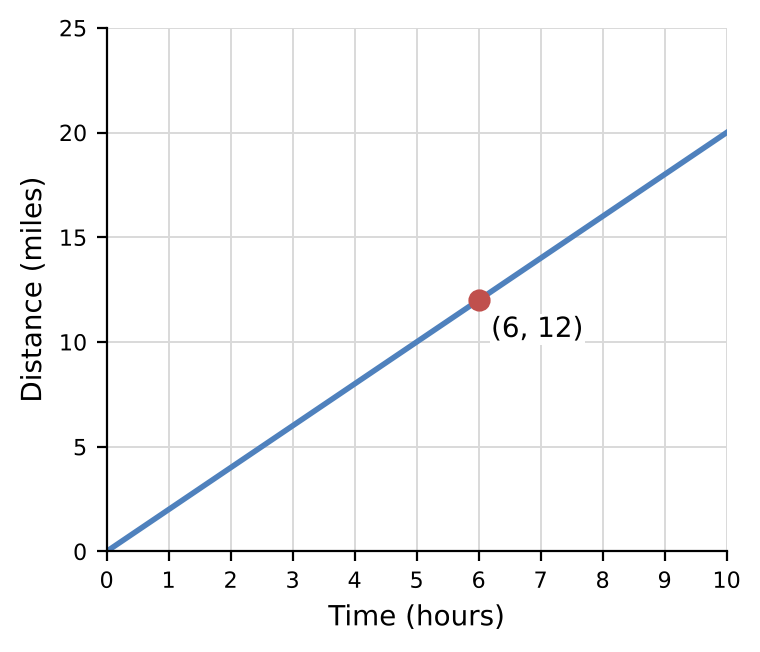
- The line passes through the origin and the point (6, 12).
- k = y ÷ x = 12 ÷ 6 = 2.
- B (6): subtracted the coordinates
- C (12): gave the y-value of the point
- D (18): added the coordinates: 6 + 12 = 18
- E (72): multiplied the coordinates
Scale drawings and maps
Method. Map → real: multiply by the scale; real → map: divide by the scale.
Worked example- Each centimeter stands for 50 km.
- So multiply: 4.8 × 50 = 240 km.
- A (0.096): divided by the scale instead of multiplying
- B (54.8): added the scale to the map distance
- D (600): treated the 0.8 as 8: 4 × 50 + 8 × 50 = 600
- E (2,400): put an extra zero on the answer
Speed — find the distance
Method. Change the minutes to hours first: 1 hour 30 minutes = 1.5 hours, so distance = 72 × 1.5 = 108 miles.
Worked example- 30 minutes = = 0.5 hour.
- So the time is 1.5 hours.
- Distance = speed × time = 72 × 1.5 = 108 miles.
- A (72): ignored the minutes
- B (93.6): treated 1 hour 30 minutes as 1.30 hours: 72 × 1.3 = 93.6
- D (144): rounded 1 hour 30 minutes up to 2 hours: 72 × 2 = 144
- E (2,232): treated the 30 minutes as 30 hours: 72 × (1 + 30) = 72 × 31 = 2,232
Unit conversions with square and cubic units
Method. Square units use the factor squared ; cubic units use it cubed .
Worked example- One square foot is 12 × 12 = 144 square inches, because every dimension is converted.
- So 4 square feet = 4 × 144 = 576 square inches.
- A (): divided instead of multiplying
- B (48): multiplied by the length factor 12 only
- C (96): doubled the length factor instead of squaring it: 4 × 12 × 2 = 96
- E (6,912): used the cubic factor instead of the square factor
Density
Method. Density = mass ÷ volume; check by multiplying density × volume to get the mass.
Worked example- Density = mass ÷ volume.
- Density = 249.2 ÷ 28.
- So Density = 8.9 grams per cubic centimeter.
- B (89): misplaced the decimal point in the quotient: 2,492 ÷ 28 = 89
- C (221.2): subtracted volume from mass
- D (277.2): added mass and volume
- E (6,977.6): multiplied mass by volume
Word Problems
Name the unknown, translate the words into an equation, solve, and answer the question that was asked, with units.
Key formulas| Distance | |
| Moving toward each other | |
| Total from an average | |
| Consecutive integers | |
| Working together | |
| Change |
Money — making change
Method. Multiply first (total cost), then subtract from the amount paid.
Worked example- Total cost: 5 × $6.87 = $34.35.
- Change: $100 − $34.35 = $65.65.
- A ($34.35): gave the total cost instead of the change
- C ($70.00): dropped the cents from the price: $100 − 5 × $6 = $70.00
- D ($72.52): counted one item too few
- E ($93.13): subtracted the price of only one pen
Time and unit conversion
Method. 45 minutes = hour = 0.75 hour, so 1.75 × 6 = 10.5 hours.
Worked example- Change each session to minutes: 1 h 45 min = 60 + 45 = 105 minutes.
- Multiply by 6 days: 105 × 6 = 630 minutes.
- Change to hours: 630 ÷ 60 = 10.5 hours.
- A (6): ignored the minutes: 1 × 6 = 6
- B (6.3): found 630 minutes, then used 100 minutes in an hour: 630 ÷ 100 = 6.3
- C (8.7): treated 1 hour 45 minutes as 1.45 hours: 1.45 × 6 = 8.7
- E (630): gave the total in minutes, not hours
Unit price
Method. Find the cost of one, then multiply.
Worked example- Price of one: $29.60 ÷ 8 = $3.70.
- Cost of 10: 10 × $3.70 = $37.
- A ($2.96): divided the total cost by 10
- B ($3.70): gave the price of one bottle of juice
- C ($29.60): gave the cost of 8 bottles of juice
- D ($33.30): added the price of only one more bottle: $29.60 + $3.70 = $33.30
Simple interest
Method. Simple interest I = P × r × t with r as a decimal; total = P + I.
Worked example- Interest: I = Prt = $4,000 × 0.06 × 2 = $480.
- Total: $4,000 + $480 = $4,480.
- A ($480): gave only the interest
- C ($4,494.40): used compound interest
- D ($8,800): used 0.6 instead of 0.06 for the rate: $4,000 + $4,000 × 0.6 × 2 = $8,800
- E ($52,000): used the rate as a whole number instead of a percent
Consecutive integers
Method. The middle (average) is 200 ÷ 5; step out from the middle.
Worked example- Let the smallest be n.
- The 5 consecutive integers are n, n + 1, n + 2, n + 3, n + 4.
- Their sum: 5n + 10 = 200.
- Subtract 10: 5n = 190.
- Divide: n = 38.
- The smallest is 38.
- A (37): counted one step too far
- C (39): gave the second-smallest number
- D (40): gave the average (middle value)
- E (42): gave the largest number
Averages
Method. New score = new average + (number of old tests) × (rise in average) = 81 + 4 × 2.
Worked example- Current total: 4 × 79 = 316.
- Needed total for 5 tests: 5 × 81 = 405.
- Next score: 405 − 316 = 89.
- A (8): used 4 tests instead of 5 for the new total: 4 × 81 − 4 × 79 = 8
- B (10): multiplied the gap by 5
- C (81): gave the target average
- D (83): averaged the old average and the new score only
Distance, rate and time
Method. Distance = rate × time; opposite directions or toward each other → add speeds, same direction → subtract.
Worked example- Moving toward each other, the gap closes at 8 + 4 = 12 miles per hour.
- Time = distance ÷ rate: 18 ÷ 12 = 1.5 hours.
- B (2.25): used only Tom's speed
- C (3): divided by the average speed instead of the sum of the speeds
- D (4.5): subtracted the speeds instead of adding
- E (6): subtracted the combined speed from the distance: 18 − 12 = 6
Age problems
Method. Add the same number of years to BOTH ages before setting up the multiple.
Worked example- Let Carlos's age now be b.
- So Ava is 4b.
- In 20 years: 4b + 20 = 2(b + 20).
- Expand: 4b + 20 = 2b + 40.
- Subtract 2b and 20: 2b = 20.
- Divide: b = 10.
- B (20): stopped at 2b = 20 and did not divide by 2
- C (30): gave Carlos's age in 20 years
- D (40): gave Ava's age instead of Carlos's
- E (60): gave Ava's age in 20 years
Work problems
Method. Together time = (product)/(sum) of the two times.
Worked example- Leo does of the job per hour and Dev does .
- Together: + = of the job per hour.
- Time = 1 ÷ = 5 hours.
- A (0.2): gave the combined rate (jobs per hour) instead of the time
- C (18): averaged the two times
- D (24): subtracted the two times: 30 − 6 = 24
- E (36): added the two times
Patterns and Input–Output Rules
In an input–output table the same rule turns every input into its output. Look at how the output changes when the input goes up by 1; test your rule on every pair. Some patterns grow by a different amount each time, so check the differences.
Key formulas| Constant change | |
| Example | |
| Test the rule | |
| Changing differences |
Finding the rule
Method. Test each choice on ALL pairs, not just the first one.
Worked example- Test the rule on every pair.
- 5 → 5 × 4 + 2 = 22.
- 8 → 8 × 4 + 2 = 34.
- 9 → 9 × 4 + 2 = 38.
- All three pairs match.
- A (Multiply by 3, then add 7): checked only the first pair
- B (Add 17): checked only the first pair and used the difference: 22 − 5 = 17
- D (Add 12): used the change in the outputs as the rule
- E (Add 2, then multiply by 4): did the operations in the wrong order
Input–output tables
Method. Find how much the output grows per 1 input (the multiplier), then fix the starting amount.
Worked example- Each time the input goes up by 1, the output goes up by 3.
- So the rule starts by multiplying the input by 3.
- Input 1 gives 6 = 3 × 1 + 3, so the rule then adds 3.
- The rule is: multiply by 3, then add 3.
- For input 10: 3 × 10 + 3 = 33.
- A (15): used only the first pair (6 − 1 = 5) and added 5: 10 + 5 = 15
- B (18): found only the next output
- C (30): used only the multiplication part of the rule
- E (45): added the step to the last output once for each unit of the input: 15 + 3 × 10 = 45
Nonlinear patterns
Method. If the changes grow by a constant amount, compare the outputs with the square numbers.
Worked example- The changes in output are 3, 5, 7, which grow by 2.
- So the rule involves squaring.
- Compare with the squares: −1 = − 2, 2 = − 2, 7 = − 2, 14 = − 2.
- The rule is output = (input)² − 2.
- For 10: − 2 = 98.
- A (18): doubled the input instead of squaring it
- B (56): continued with the last change in y as if the function were linear
- C (68): added the next change in y once for every step
- E (100): forgot to subtract 2: = 100
03.03 Geometry and Measurement
The Middle Level SSAT (grades 5–7) has two 25-question Quantitative sections, 30 minutes each, with five answer choices and no calculator. A wrong answer loses ¼ point, so guess only after eliminating choices. This topic covers geometry and measurement: angles, triangles, quadrilaterals and circles, perimeter, area and volume, the coordinate grid and unit conversions.
Lines and Angles
Angle pairs: complementary angles add to 90°, supplementary angles add to 180°, and vertical angles are equal. When a line crosses two parallel lines, corresponding angles and alternate interior angles are equal. The angles of a quadrilateral add to 360°.
Key formulas| Complementary | |
| Supplementary (straight line) | |
| Vertical angles | |
| Around a point | |
| Parallel lines | |
| Same-side interior | |
| Quadrilateral | |
| Clock |
Angles on a clock
Method. Each hour mark is 30°; the hour hand also moves 0.5° per minute.
Worked example- The 12 hour marks split 360° into 12 parts of 30°.
- At 9:00 the hands are 3 hour marks apart.
- So the smaller angle is 3 × 30° = 90°.
- A (54°): multiplied the hour 9 by 6° (the minute-hand rate per mark): 9 × 6° = 54°
- C (108°): split 360° into 10 parts instead of 12: 3 × 36° = 108°
- D (120°): counted one hour mark too many
- E (270°): measured the reflex angle
Complementary and supplementary angles
Method. Complement → 90° − angle; supplement → 180° − angle.
Worked example- Complementary angles add to 90°.
- The complement of 33° is 90° − 33° = 57°.
- A (33°): gave the same angle
- C (123°): added instead of subtracting: 90° + 33° = 123°
- D (147°): used the supplement instead of the complement
- E (327°): subtracted from 360°
Vertical and adjacent angles
Method. Vertical angles are equal; angles on a straight line add to 180°.
Worked example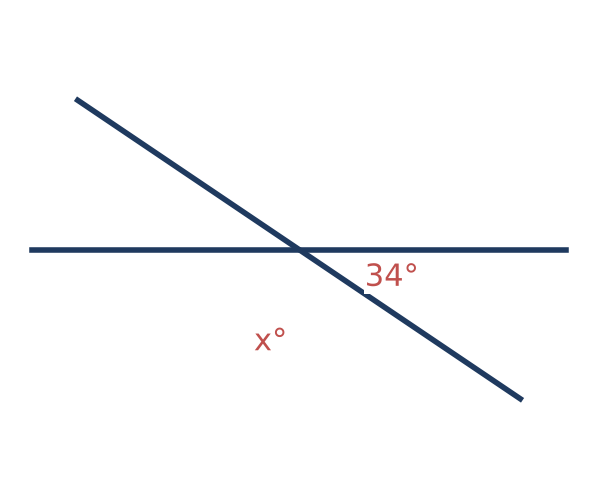
- The marked angles are adjacent angles on a straight line.
- So they are supplementary.
- x = 180 − 34 = 146.
- A (17): halved the given angle
- B (34): thought the angles are vertical (equal)
- C (56): used complementary angles
- D (112): subtracted the given angle twice from 180°: 180 − 2 × 34 = 112
Parallel lines and transversals
Method. Parallel lines: all acute angles are equal, all obtuse angles are equal, and an acute + an obtuse = 180°.
Worked example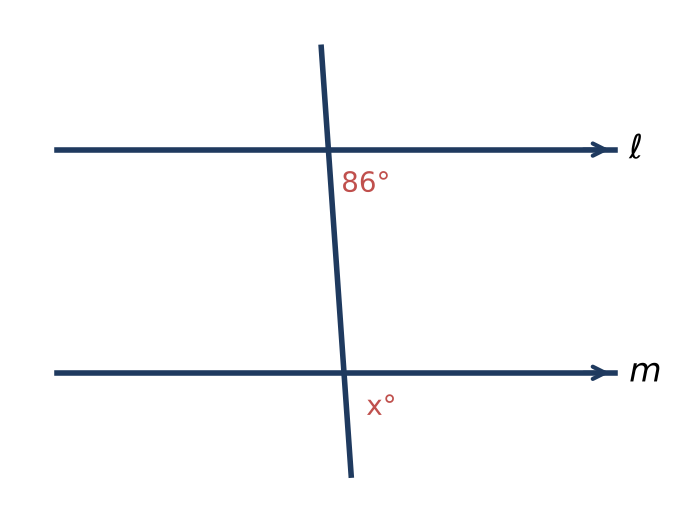
- The angle marked 86° and the angle marked x° are corresponding angles.
- With parallel lines, corresponding angles are equal.
- So x = 86.
- A (4): used complementary angles
- B (8): subtracted the angle twice from 180°
- D (94): assumed the angles are supplementary
- E (274): subtracted the angle from 360°: 360 − 86 = 274
Angle relationships with algebra
Method. Write the angle relationship as an equation, then solve.
Worked example- Vertical angles are equal: 3x − 13 = 2x + 5.
- Subtract 2x and add 13 to both sides: x = 18.
- The first angle is 3(18) − 13 = 41°.
- A (8): moved the 5 with the wrong sign and gave x: 3x − 13 = 2x − 5, so x = 8
- B (11): moved the 5 with the wrong sign: x = 8, so 3(8) − 13 = 11
- C (18): gave x instead of the angle
- E (139): gave the supplement: 180 − 41 = 139
Triangles
The angles of a triangle add to 180°. An exterior angle equals the sum of the two interior angles not next to it. An isosceles triangle has two equal angles; every angle of an equilateral triangle is 60°.
Key formulas| Angle sum | |
| Exterior angle | |
| Isosceles | |
| Equilateral | |
| Triangle inequality | |
| Area |
Angle sum of a triangle
Method. Third angle = 180° − (sum of the other two).
Worked example- The angles of a triangle add to 180°.
- So the third angle is 180° − 32° − 98° = 50°.
- B (66): subtracted the two angles
- C (82): subtracted only the larger angle from 180°: 180° − 98° = 82°
- D (130): added the two angles
- E (230): used 360° for the angle sum
Exterior angles of a triangle
Method. Exterior angle = sum of the two remote interior angles.
Worked example- An exterior angle equals the sum of the two remote interior angles.
- So 37° + x = 114°, and x = 114 − 37 = 77°.
- A (29): subtracted both angles from 180°
- B (66): gave the adjacent interior angle
- D (143): subtracted the known angle from 180°: 180° − 37° = 143°
- E (151): added instead of subtracting
Triangle angle problems
Method. Add the three expressions, set the sum equal to 180 and solve.
Worked example- The angles add to 180°.
- So 7x − 2 = 180.
- Then 7x = 182.
- So x = 26.
- A (): used 90° for the angle sum
- B (): left out the −6 when combining the constants: 7x + 4 = 180, x =
- C (): moved the constants with the wrong sign
- D (): ignored the constants
Area and Perimeter
Area measures square units inside a figure; perimeter adds the side lengths. Split composite figures into simple shapes, then add or subtract their areas.
Key formulas| Square | |
| Rectangle | |
| Triangle | |
| Parallelogram | |
| Trapezoid | |
| Circle |
Area of triangles
Method. Use the perpendicular height, not the slanted side.
Worked example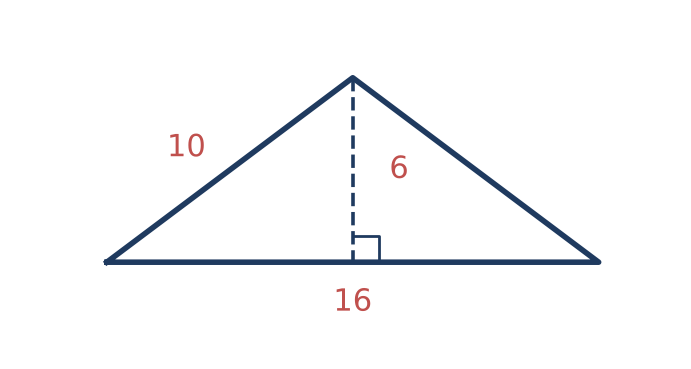
- Area of a triangle = ½ × base × height.
- The height is the dashed segment, 6, which is perpendicular to the base 16.
- So A = ½ × 16 × 6 = 48.
- B (60): multiplied the height by the slanted side: 6 × 10 = 60
- C (80): used the slanted side as the height
- D (96): forgot to multiply by ½
- E (160): used the slanted side and forgot the ½
Perimeter of polygons
Method. Parallelogram: A = base × height; P uses the slanted sides.
Worked example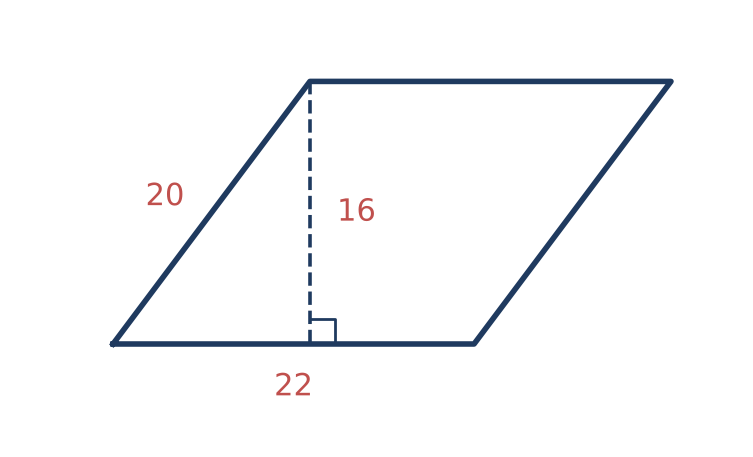
- A parallelogram has two pairs of equal sides: 22 and 20.
- The height is not a side.
- So P = 2 × (22 + 20) = 84.
- A (42): added only two sides
- B (58): added the three labeled lengths
- C (76): used the height instead of the slanted side
- E (100): counted the height as a side too: 2 × (22 + 20) + 16 = 100
Area of parallelograms and trapezoids
Method. Average the two bases, then multiply by the height.
Worked example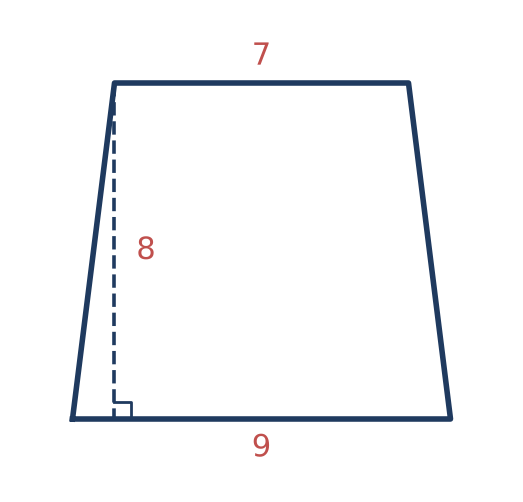
- Area of a trapezoid = ½ × (base₁ + base₂) × height.
- So A = ½ × (7 + 9) × 8 = ½ × 16 × 8 = 64.
- B (72): used only the longer base
- C (128): forgot to multiply by ½
- D (252): multiplied the two bases instead of adding them: ½ × (7 × 9) × 8 = 252
- E (504): multiplied all three lengths without the ½: 7 × 9 × 8 = 504
Composite figures
Method. Area of a composite figure: add the areas of the parts (rectangle + half of πr², with r = half the shared side).
Worked example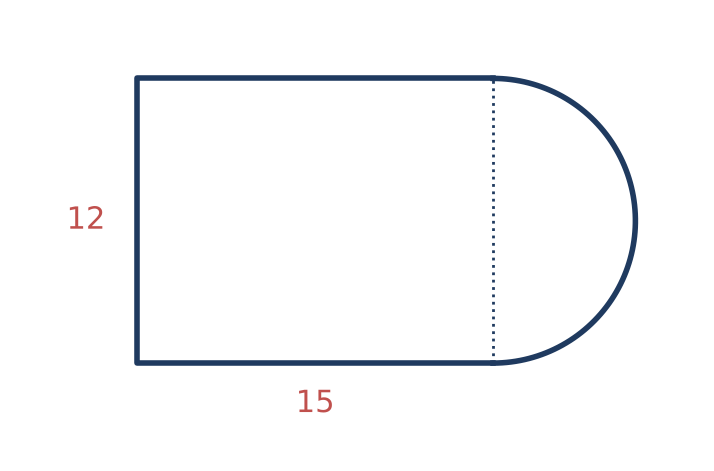
- Rectangle: 15 × 12 = 180.
- The semicircle has radius 12 ÷ 2 = 6.
- So its area is ½ × 3.14 × = 56.52.
- Total area = 180 + 56.52 = 236.52.
- A (123.48): subtracted the semicircle
- B (180): left out the semicircle
- C (198.84): added half the circle's circumference instead of its area: 180 + 3.14 × 6 = 198.84
- E (293.04): added a whole circle
Circles
The diameter is twice the radius. Circumference is the distance around a circle and area is the space inside; both use π (about 3.14 or 22/7). A semicircle is half a circle, so its perimeter is half the circumference plus the diameter.
Key formulas| Diameter | |
| Circumference | |
| Area | |
| Value of π | |
| Semicircle perimeter | |
| Work backward |
Circumference
Method. C = πd = r: multiply the diameter by π.
Worked example- The circumference is C = πd.
- So C ≈ 3.14 × 24 = 75.36 meters.
- A (37.68): used the radius in place of the diameter: 3.14 × 12 = 37.68
- C (150.72): used the diameter as the radius
- D (452.16): used the area formula πr²
- E (1808.64): used π times the diameter squared
Area of a circle
Method. A = πr²; halve the diameter first.
Worked example- The radius is 12 ÷ 2 = 6.
- The area is A = πr².
- So A = π × = square feet.
- A (): forgot to square the radius
- B (): found the circumference
- D (): used r² (mixed up the area and circumference formulas): × =
- E (): used the diameter as the radius
Working backward with circles
Method. Find the radius first, then use the other formula.
Worked example- C = r = .
- So r = 3.
- The area is A = πr² = π × = square units.
- A (): forgot to square the radius
- B (): gave the circumference
- D (): mixed up the formulas and used r²: × =
- E (): used the diameter as the radius
Semicircles and quarter circles
Method. Take the right fraction of the full circle, then add any straight edges.
Worked example- The curved part is half the circumference: 3.14 × 20 ÷ 2 = 31.4.
- The straight side is the diameter, 20.
- So the perimeter is 31.4 + 20 = 51.4 meters.
- A (31.4): left out the diameter
- B (41.4): added the radius instead of the diameter
- D (62.8): gave the full circumference instead of the perimeter: 3.14 × 20 = 62.8
- E (82.8): used the full circumference and added the diameter: 62.8 + 20 = 82.8
Volume and Surface Area
Volume measures cubic units inside a solid; for a prism or cylinder it is the base area times the height. Surface area adds the areas of all the faces.
Key formulas| Cube | |
| Rectangular box | |
| Prism | |
| Triangular prism | |
| Cylinder |
Volume of rectangular prisms
Method. Cube: V = and SA = 6.
Worked example- Volume of a cube = edge³.
- So V = 7 × 7 × 7 = 343.
- A (21): multiplied the edge by 3
- B (49): found the area of one face
- C (196): found the area of the four side faces: 4 × 49 = 196
- D (294): found the surface area
Volume with fractional edges
Method. Change mixed numbers to improper fractions, then multiply.
Worked example- V = l × w × h.
- Write 2 as .
- So V = × 6 × 6 = = 99 cubic feet.
- A (14 ): added the three dimensions
- B (16 ): found only the area of the base
- C (72): dropped the fraction part of the length
- D (72 ): multiplied only the whole number part and kept the fraction: 2 × 6 × 6 + = 72
Surface area of prisms
Method. SA = 2(lw + lh + wh): add the three different faces, then double.
Worked example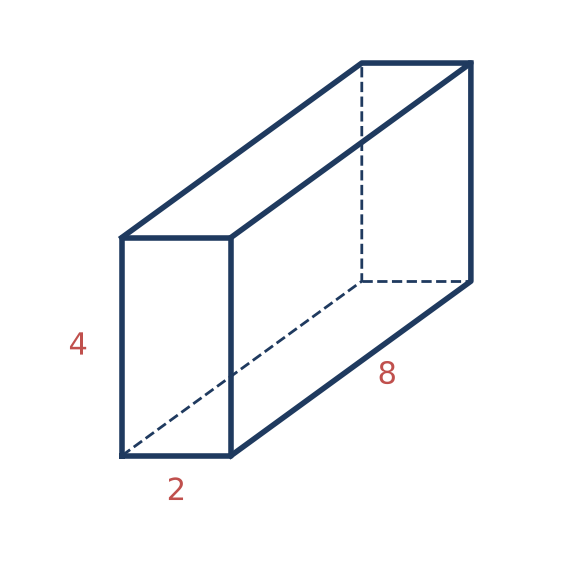
- A rectangular prism has three pairs of equal faces.
- The faces have areas 2 × 8 = 16, 2 × 4 = 8 and 8 × 4 = 32.
- So SA = 2 × (16 + 8 + 32) = 2 × 56 = 112.
- A (48): left out the two largest faces (8 × 4): 2 × (16 + 8) = 48
- B (56): forgot to double each face
- C (64): found the volume
- E (224): counted each face twice
Volume of cylinders
Method. Cylinder: V = πr²h; SA = r² + rh.
Worked example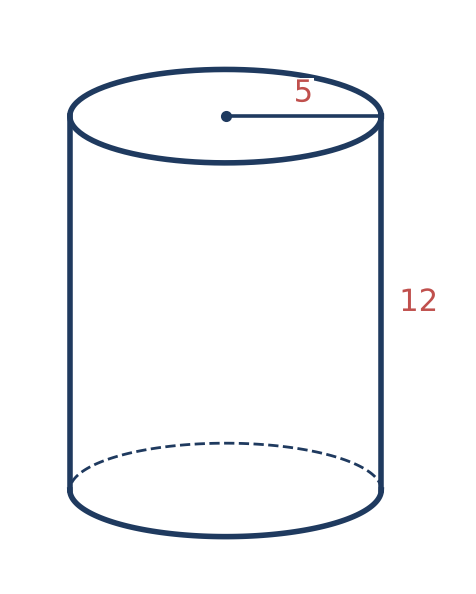
- V = πr²h.
- V = π × × 12.
- So V = .
- A (): forgot to square the radius
- B (): used the cone formula
- C (): found the lateral area rh
- E (): used the diameter as the radius: π × × 12 =
Volume of triangular prisms
Method. Prism: V = base area × length; use the legs for a right triangle.
Worked example- V = (area of base) × length.
- The base area is ½ × 9 × 12 = 54.
- So V = 54 × 3 = 162 cubic units.
- B (): used the hypotenuse in place of the second leg: ½ × 9 × 15 × 3 =
- C (216): found the surface area instead: 2 × 54 + (9 + 12 + 15) × 3 = 216
- D (270): used the hypotenuse in place of the first leg: ½ × 15 × 12 × 3 = 270
- E (324): forgot the ½ in the triangle's area
Surface area of cylinders
Method. Bases: 2 × π × = ; side: circumference × height = × 8 = ; total + = .
Worked example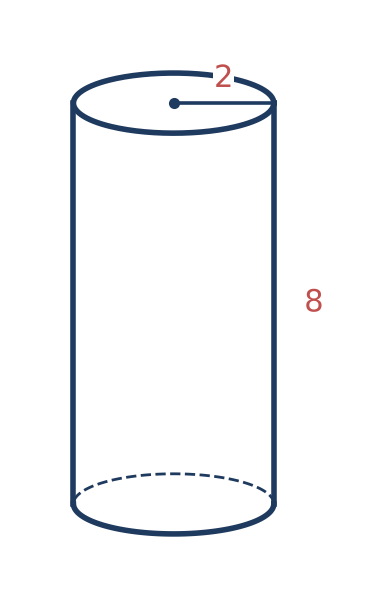
- SA = r² + rh.
- SA = × + × 2 × 8 = + .
- So SA = .
- A (): found only the lateral area
- B (): included only one circular base
- D (): used r² for the bases: × + = + =
- E (): used the diameter as the radius
The Coordinate Grid
A point (x, y) is x units across and y units up or down from the origin. On a horizontal or vertical line, the distance between two points is the difference of the coordinates that change. Reflections flip a point over a line.
Key formulas| Same y (horizontal) | |
| Same x (vertical) | |
| Reflect over the x-axis | |
| Reflect over the y-axis | |
| Translation |
Distance along grid lines
Method. Same x or same y: subtract the other coordinates (a point left of or below zero adds its distance).
Worked example- The points have the same x-coordinate.
- So the distance is the difference of the other coordinates.
- 6 − (−5) = 11.
- A (1): subtracted the absolute values
- C (12): counted grid points instead of units
- D (30): multiplied the sizes of the y-coordinates: 6 × 5 = 30
- E (121): squared the difference and forgot the square root: = 121
Polygons on the coordinate plane
Method. Find side lengths by subtracting coordinates.
Worked example- The width is 2 − (−8) = 10 and the height is 3 − 0 = 3.
- So the perimeter is 2 × (10 + 3) = 26.
- A (13): added only two sides
- B (18): dropped the negative sign: width 8 − 2 = 6, so 2 × (6 + 3) = 18
- C (23): left out one side
- E (30): found the area
Measurement and Units
Convert by multiplying by a fraction equal to 1 (such as 12 inches over 1 foot) so the old unit cancels. For time, carry 60 minutes as 1 hour.
Key formulas| Length (US) | |
| Metric length | |
| Weight and capacity | |
| Liquid (US) | |
| Time | |
| Unit factor |
Mixed-number feet to inches
Method. 3 feet is 36 inches and foot is 6 inches: 36 + 6 = 42.
Worked example- There are 12 inches in 1 foot.
- 3 × 12 = 36 + 6 = 42 inches.
- A (35): used 10 inches in a foot instead of 12
- B (36): dropped the foot and converted only 3 feet
- D (48): rounded 3 feet up to 4 feet before converting
- E (126): used 36 inches in a foot, the number of inches in a yard
Rate conversion: gallons per day to cups per hour
Method. 48 cups a day spread over 24 hours is 2 cups an hour.
Worked example- 1 gallon = 4 quarts and 1 quart = 4 cups, so 1 gallon = 16 cups.
- 3 gallons = 3 × 16 = 48 cups each day.
- A day has 24 hours, so 48 ÷ 24 = 2 cups each hour.
- A (): found gallons per hour, = , and did not convert to cups
- B (): used 4 cups in a gallon (4 is the number of cups in a quart)
- C (1): used 8 cups in a gallon (8 is the number of pints in a gallon)
- E (48): found cups per day, 48, and did not divide by 24 hours
03.04 Data Analysis and Probability
The Middle Level SSAT (grades 5–7) has two 25-question Quantitative sections, 30 minutes each, with five answer choices and no calculator. A wrong answer loses ¼ point, so guess only after eliminating choices. This topic covers data and probability: mean, median, mode and range, reading tables, bar graphs, line graphs and circle graphs, and simple probability.
Mean, Median, Mode and Range
The mean, median and mode describe the center of a data set; the range (greatest minus least) describes how spread out it is. An outlier pulls the mean toward it but barely moves the median.
Key formulas| Mean | |
| Sum from the mean | |
| Median | |
| Median (even count) | |
| Mode | |
| Range | |
| Add k to every value |
Mean
Method. Mean = sum of the values ÷ how many values there are.
Worked example- Add the values.
- So 3 + 8 + 4 = 15.
- Divide by the number of values, 3.
- So the mean is 15 ÷ 3 = 5.
- A (3.5): averaged only the first and last values listed
- B (3.75): divided by one more than the count
- C (4): gave the median
- E (7.5): divided by one less than the count: 15 ÷ 2 = 7.5
Median
Method. Sort first; odd count → middle value, even count → mean of the two middle values.
Worked example- Order the values.
- So 2, 3, 17, 21, 22.
- There are 5 values.
- The middle one is value 3, which is 17.
- So the median is 17.
- A (3): gave the middle position instead of the value
- B (13): gave the mean
- D (20): gave the range: 22 − 2 = 20
- E (22): did not put the values in order first
Effect of outliers
Method. Find both means, then subtract; an outlier pulls the mean toward it.
Worked example- The mean with every value is 198 ÷ 6 = 33.
- The outlier is 88.
- Without it, the mean is 110 ÷ 5 = 22.
- The decrease is 33 − 22 = 11.
- A (0): found the change in the median
- C (22): gave the new mean
- D (33): gave the original mean
- E (88): gave the decrease in the total instead of in the mean: 198 − 110 = 88
Comparing data sets
Method. Find the median of each set separately, then subtract.
Worked example- Ordered, A is 39, 55, 63, 73, 74, 74.
- So its median is 68.
- Ordered, B is 4, 12, 42, 55, 66, 67.
- So its median is 48.5.
- The difference is 68 − 48.5 = 19.5.
- B (20): did not put the data in order before finding the medians: 68.5 − 48.5 = 20
- C (22): compared the means instead
- D (116.5): added the medians
- E (132): compared the sums
Graphs and Tables
Read the title, axes, scale and units before reading values. Bar graphs compare categories, line graphs show change over time, circle graphs show parts of a whole, and dot plots, stem-and-leaf plots and histograms show how data are spread.
Key formulas| Percent of whole | |
| Circle graph | |
| Change | |
| Stem-and-leaf | |
| Two-way table |
Line graphs
Method. Read both points on the scale, then subtract the smaller from the larger.
Worked example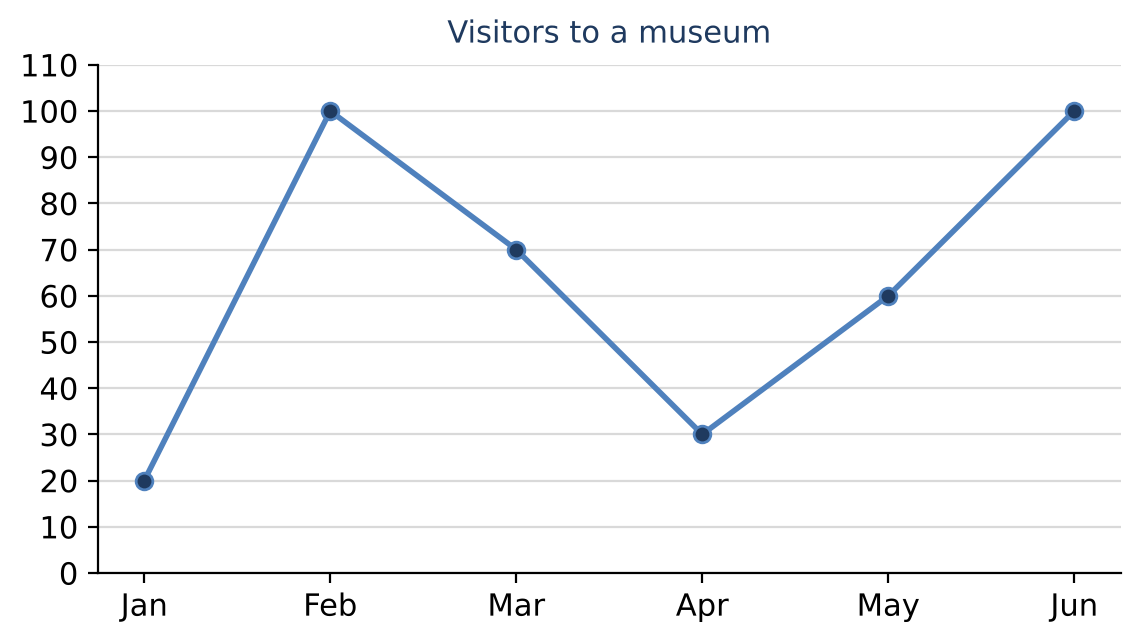
- Read the points.
- So February = 100 and March = 70.
- The decrease is 100 − 70 = 30.
- A (10): misread both points by one grid line toward each other: 90 − 80 = 10
- B (20): misread one point by one grid line the other way
- D (70): gave the March value
- E (100): gave the February value
Circle graphs
Method. Number = percent × total ÷ 100.
Worked example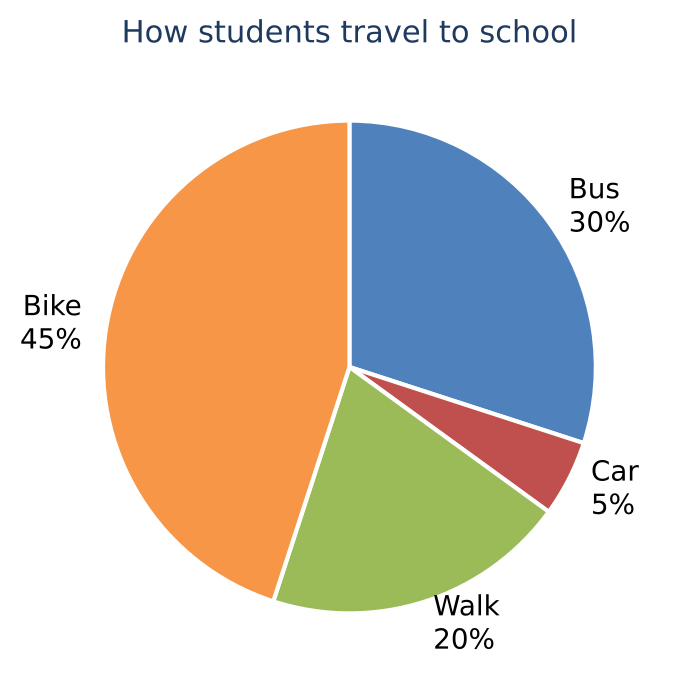
- The percents differ by 45% − 20% = 25%.
- Then 25% of 160 is × 160 = 40.
- A (25): subtracted the percents but did not find them of the total
- C (72): gave the number for Bike only
- D (90): took the percent difference of 360° instead of 160 students: 25% × 360 = 90
- E (104): added instead of subtracting
Line plots and dot plots
Method. Fraction = count that fits ÷ total count.
Worked example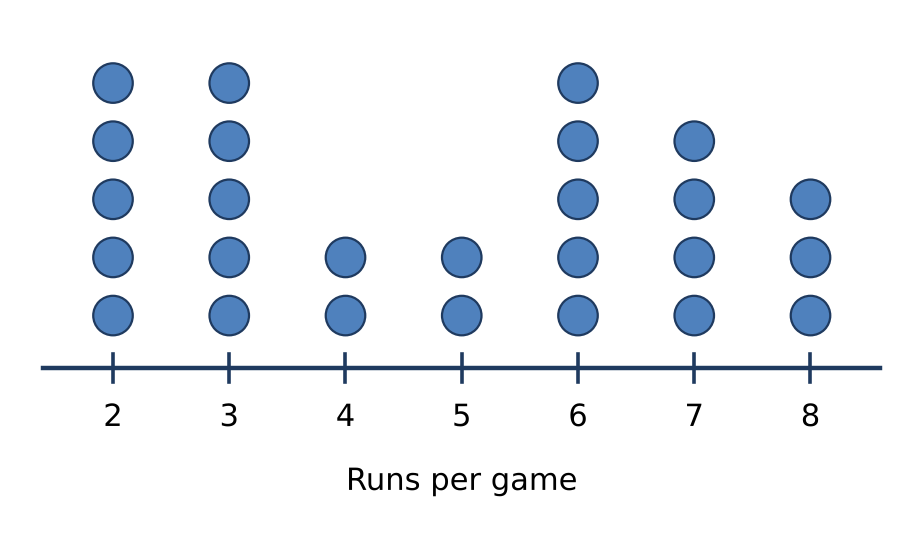
- At most 5 means 5 or less.
- There are 14 such dots out of 26 in all.
- So the fraction is = .
- A (): used only the dots at 5
- B (): used less than 5 instead of at most 5
- C (): counted one extra dot in the total
- E (): counted one dot too few in the total:
Histograms
Method. Add the heights of the bars from 30 onward.
Worked example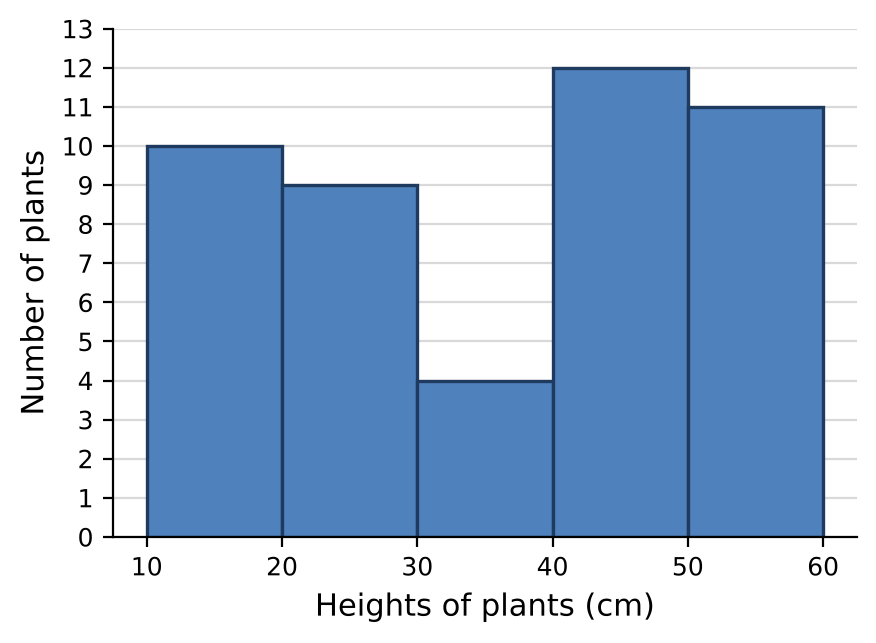
- At least 30 starts with the bar 30–40.
- Add that bar and every bar to its right.
- So 4 + 12 + 11 = 27.
- A (4): used only one bar
- B (16): left out the last bar: 4 + 12 = 16
- C (19): counted the bars below
- D (23): started one bar too late
Stem-and-leaf plots
Method. Count the leaves after 64 in its row, then every leaf below that row.
Worked example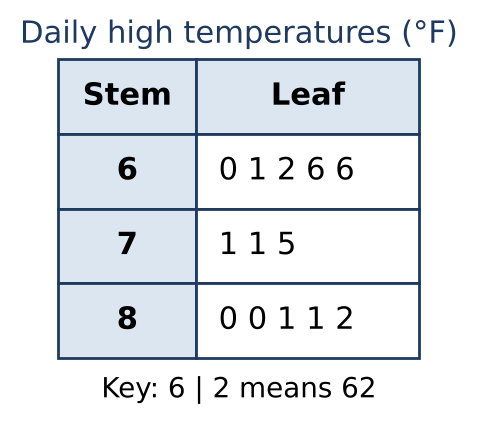
- In the row with stem 6, the leaves greater than 4 give 2 values.
- Every value in the rows below it is greater, adding 8 more.
- So there are 10 values.
- A (2): counted only the stem-6 values greater than 64 and left out the rows below: 2
- B (3): counted the values below
- C (5): counted only the row with stem 6
- D (8): counted only the rows below the one with stem 6
Two-way tables
Method. Add the two row totals; together they cover every cell.
Worked example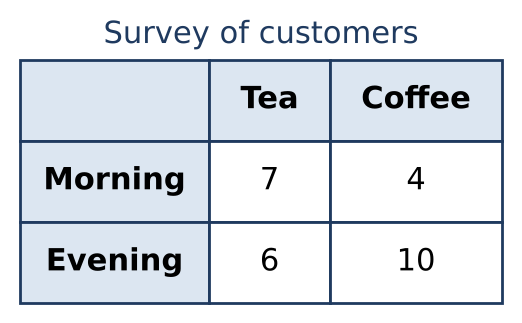
- Every customer is in exactly one cell.
- Add all four cells.
- So 7 + 4 + 6 + 10 = 27.
- A (11): added only the Morning row
- B (13): added only the Tea column
- C (16): added only the other row: 6 + 10 = 16
- E (37): made a carrying error of 10
Building data displays
Method. Tally each value into its interval; the bar height is the tally.
Worked example- Find the scores from 50 to 59, which are 50, 51, 52, 56, 58.
- That is 5 scores.
- So the bar is 5 tall.
- A (2): counted the next interval
- B (4): left out 50, the lower end of the interval: 51, 52, 56, 58 = 4
- D (6): also counted 60
- E (7): counted the values outside the interval
Probability
Probability is the number of favorable outcomes over the number of equally likely outcomes; it is between 0 and 1. Count outcomes by listing or by multiplying the choices at each step. The expected count is the probability times the number of trials.
Key formulas| Basic | |
| Range of values | |
| Complement | |
| Counting principle | |
| Two separate events | |
| Expected count |
Simple probability
Method. List the favorable outcomes and divide by the total number of outcomes.
Worked example- The favorable outcomes are 2, 4, 6, 8, which is 4 out of 8.
- So the probability is = .
- A (): counted only one outcome
- C (): counted 7 possible outcomes instead of 8:
- D (): counted one extra outcome
- E (1): divided by the outcomes that do not count
Experimental and theoretical probability
Method. Expected count = probability × number of trials.
Worked example- Multiply the probability by the number of trials.
- So × 40 = 16.
- A (): gave the probability, not a count
- B (8): found of 40 and did not multiply by 2: 40 ÷ 5 = 8
- D (20): divided the trials by the top number of the probability: 40 ÷ 2 = 20
- E (24): found the expected count of the other outcome
Sample spaces and counting
Method. Multiply the number of choices for each independent step.
Worked example- By the counting principle, multiply the number of choices.
- 3 × 4 × 2 = 24.
- A (9): added instead of multiplying
- B (12): left out one category
- C (14): added hats and pants, then multiplied by shirts: (3 + 4) × 2 = 14
- D (23): subtracted one
Compound events
Method. Independent “and” → multiply the probabilities.
Worked example- The two results are independent.
- So multiply.
- P(a 6) = and P(blue) = .
- So P(both) = × = .
- A (): counted only one combined outcome
- C (): used only the first event
- D (): used only the second event
- E (): added the probabilities