Algebra: Study Guide
The Upper Level SSAT (grades 8–11) has two 25-question Quantitative sections, 30 minutes each, with five answer choices and no calculator. A wrong answer loses ¼ point, so guess only after eliminating choices. This topic covers algebra: expressions, linear equations and inequalities, ratios, rates and proportions, word problems, functions and slope, systems of equations, and factoring and simple quadratics.
- Linear Equations
- Linear Inequalities
- Ratios, Rates and Proportions
- Word Problems
- Function Notation
- Equations of Lines
- Polynomial Expressions
- Quadratic Equations
- Systems of Linear Equations
Linear Equations
Undo operations in reverse order, doing the same thing to both sides. Clear fractions first by multiplying by the common denominator, and check by substituting.
Key formulas| Inverse operations | |
| Clearing fractions | |
| Literal equations | |
| No solution / all reals |
Multi-step equations — distributing
Method. Divide both sides by −8 first: x + 10 = −13, so x = −23.
Worked example- Distribute: −8x − 80 = 104.
- Add 80: −8x = 184.
- Divide by −8: x = −23.
- B (−13): divided by −8 but forgot to subtract the 10: 104 ÷ (−8) = −13
- C (−): multiplied only x by −8
- D (−3): used the wrong sign when moving the constant
- E (184): forgot to divide by −8
Variables on both sides
Method. Collect x-terms on one side and numbers on the other; then divide.
Worked example- Add 6x to both sides: −2x − 7 = −21.
- Add 7: −2x = −14.
- Divide by −2: x = 7.
- A (−7): made a sign error moving the constants
- B (1): added the x-terms instead of subtracting
- D (14): added the constants instead of subtracting
- E (28): multiplied by −2 instead of dividing: (−14) × (−2) = 28
Equations with decimals
Method. Multiply every term by 10 to clear the decimals, then solve.
Worked example- Subtract 0.9: 0.9x = −8.1.
- Divide by 0.9: x = −9.
- A (−10): subtracted the constant twice: (−7.2 − 0.9 − 0.9) ÷ 0.9 = −10
- C (−8.1): forgot to divide by the coefficient
- D (−7.29): multiplied by the coefficient instead of dividing
- E (−7): added the constant instead of subtracting it
Multi-step equations — combining like terms
Method. Distribute, combine like terms on each side, then solve the two-step equation.
Worked example- Distribute: 4x − 24 + 2x + 4 = −8.
- Combine like terms: 6x − 20 = −8.
- So 6x = 12 and x = 2.
- A (−1): distributed the 4 to x only: 4x − 6 + 2x + 4 = −8, so 6x = −6
- C (3): did not combine the x-terms
- D (6): subtracted the x-terms instead of adding
- E (12): forgot to divide by the x-coefficient
Literal equations
Method. Undo the last operation done to h first (inverse operations).
Worked example- Isolate h by undoing each operation on it in reverse order.
- h = 2.
- A (h = ): divided by 2 instead of multiplying
- B (h = 2Ab): multiplied by b instead of dividing
- C (h = 2A − b): subtracted b instead of dividing by it
- E (h = ): divided the wrong way
Number of solutions
Method. Compare x-coefficients first, then constants.
Worked example- Distribute the left side to get 6x + 6.
- Equal x-coefficients with different constants give no solution.
- Identical sides give infinitely many.
- Different x-coefficients give exactly one.
- 6(x + 1) = 6x + 6 has infinitely many solutions.
- B (6(x + 1) = 7x + 6): chose an equation that has exactly one solution (x = 0)
- C (6(x + 1) = 6x + 5): chose an equation that has no solution
- D (6(x + 1) = 5x + 4): chose an equation that has exactly one solution
- E (6(x + 1) = 6x + 9): chose an equation that has no solution
Equations from word problems — ages
Method. Take away the difference and share equally: (74 − 4) ÷ 2 = 35 for Leo; add 4 for Maya.
Worked example- Let Leo be L.
- Then Maya is L + 4, and L + (L + 4) = 74.
- So 2L = 70 and L = 35.
- Maya is 39.
- A (31): subtracted the difference twice
- B (33): halved the sum, then subtracted the full difference: 74 ÷ 2 − 4 = 33
- D (39): gave Maya's age
- E (70): forgot to divide by 2
Equations from word problems — consecutive integers
Method. The average 8 is the middle of the list; count up from it in steps of 2.
Worked example- Let the smallest be n: n + (n + 2) + (n + 4) = 24.
- So 3n + 6 = 24 and n = 6.
- The numbers are 6, 8, 10.
- The largest is 10.
- A (6): gave the smallest number
- B (7): used steps of 1 and gave the smallest: n + (n + 1) + (n + 2) = 24, n = 7
- C (8): gave the middle (average) value
- D (9): used steps of 1 instead of 2
Parameters — no solution
Method. No solution ⇔ same x-coefficient on both sides and different constants.
Worked example- Collect x-terms: (k − (−9))x = 14.
- Since 14 ≠ 0, there is no solution exactly when the x-coefficient is 0: k = −9.
- B (0): thought k = 0 makes the equation have no solution
- C (5): set the x-coefficient k + 9 equal to 14 instead of 0: k = 5
- D (9): changed the sign of the coefficient
- E (14): set k equal to the difference of the constants
Solving for an expression
Method. No need to find x: 12x − 21 = 3(4x − 3) − 12 = 3(−27) − 12 = −93.
Worked example- x = = −6.
- Then 12x − 21 = 12(−6) − 21 = −93.
- B (−81): forgot the change to the constant (multiplied the equation by 3 only)
- C (−72): left out the constant term
- D (−51): added 21 instead of subtracting it: 12(−6) + 21 = −51
- E (−6): gave x instead of the value of the expression
Equations from word problems — perimeter
Method. Half the perimeter is length + width = 54: 3w − 3 = 54, so w = 19.
Worked example- Let the width be w.
- Length = 2w − 3.
- Perimeter: 2w + 2(2w − 3) = 108.
- So 6w − 6 = 108 and w = 19.
- Length = 35.
- A (18): ignored the 3 cm
- C (35): gave the length
- D (37): used one length plus one width as the perimeter: w + (2w − 3) = 108, so w = 37
- E (54): gave half the perimeter
Linear Inequalities
Solve like an equation, but reverse the sign when you multiply or divide by a negative number. A compound 'and' inequality is a single interval; an 'or' inequality is two pieces. A two-variable inequality is a half-plane: test a point to decide which side is shaded; a solid boundary means ≤ or ≥.
Key formulas| Flip rule | |
| Compound (and) | |
| Compound (or) | |
| Absolute value (less than) | |
| Absolute value (greater than) | |
| Two variables | |
| Test a point |
Solving inequalities
Method. Solve it like an equation; the sign flips only when you multiply or divide by a negative number.
Worked example- Subtract 12 on both sides: 11x ≥ −99.
- Divide by 11 (positive, so the sign stays): x ≥ −9.
- A (x ≤ −9): reversed the inequality sign without a reason
- B (x ≥ −): added the constant instead of subtracting it
- C (x ≥ −99): forgot to divide by 11: 11x ≥ −99 read as x ≥ −99
- E (x > −9): changed whether the endpoint is included
Solving inequalities — negative coefficient
Method. Dividing (or multiplying) both sides by a negative number reverses the inequality.
Worked example- Add 9: −6x ≥ 12.
- Divide by −6 and reverse the sign (dividing by a negative): x ≤ −2.
- A (x ≥ −2): forgot to reverse the sign when dividing by a negative number
- B (x ≤ 2): dropped the negative sign of the coefficient but still reversed the sign
- C (x ≥ 2): divided by the positive number instead of the negative one
- D (x ≤ 1): subtracted 9 instead of adding: −6x ≥ −6, so x ≤ 1
Inequalities with variables on both sides
Method. Collect x on one side; watch for dividing by a negative.
Worked example- Move the x-terms to the left: 18x ≥ −108.
- Divide by 18: x ≥ −6.
- A (x ≤ −6): reversed the sign without dividing by a negative
- B (x ≥ −18): added the x-terms instead of subtracting
- C (x ≥ −): used the wrong sign when moving the constant
- D (x ≥ 6): lost the negative sign when dividing: −108 ÷ 18 = 6
Two-variable inequalities — solutions
Method. Points that satisfy it lie below the line y = x + 4.
Worked example- Substitute the point.
- For (4, 4), (4) + 4 = 8, and y = 4 < 8 ✓.
- A ((0, 4)): chose a point on the boundary line, which is not included
- B ((1, 6)): swapped x and y when substituting (tested x < y + 4)
- D ((−5, 1)): chose a point above the line
- E ((−5, 5)): chose a point above the line
Compound inequalities — and
Method. Treat the middle as the target and apply each step to all three parts.
Worked example- Do the same thing to all three parts.
- Subtract 5: 6 ≤ 6x ≤ 24.
- Divide by 6: 1 ≤ x ≤ 4.
- A ( ≤ x ≤ ): divided all three parts but did not subtract the constant
- B (6 ≤ x ≤ 24): subtracted the constant but did not divide
- C ( ≤ x ≤ ): added the constant instead of subtracting it: 16 ≤ 6x ≤ 34
- E (1 < x < 4): switched which endpoints are included
Compound inequalities — or
Method. “Or” keeps everything from both parts; “and” keeps only the overlap.
Worked example- Solve each part.
- 4x + 2 < −26 gives x < −7.
- 5x − 6 > −26 gives x > −4.
- With “or”, the solution is either part: x < −7 or x > −4.
- A (−7 < x < −4): took the values between the endpoints instead of outside them
- C (x < −7 or x > −): subtracted 6 instead of adding it in the second part: 5x > −32
- D (x > −7 or x < −4): reversed both inequality signs
- E (x ≤ −7 or x ≥ −4): included the endpoints
Interval notation
Method. Square bracket = endpoint included; parenthesis = not included; ∞ always gets a parenthesis.
Worked example- −2x ≥ 8.
- So x ≤ −4 (sign reversed: divided by a negative).
- In interval notation: (−∞, −4].
- A ((−∞, −4)): used the wrong kind of bracket at the endpoint
- B ([−4, ∞)): reversed the direction (did not flip the sign for the negative coefficient)
- C ((−∞, 4]): made a sign error in the endpoint
- D ((−∞, 10]): subtracted 14 instead of adding it: −2x ≥ −20, so x ≤ 10
Absolute-value inequalities
Method. |stuff| < k → between −k and k (“and”); |stuff| > k → outside (“or”).
Worked example- Distance from 6 is at most 2: 6 − 2 ≤ x ≤ 6 + 2.
- So 4 ≤ x ≤ 8.
- A (x ≤ 4 or x ≥ 8): used “or” (outside) instead of “and” (between)
- B (−8 ≤ x ≤ −4): used the wrong sign for the center
- D (x ≥ 4): solved only the negative case
- E (x ≤ 8): solved only the positive case
Inequality word problems
Method. Subtract the fixed weight, divide by the weight of one box, and round DOWN.
Worked example- Let n be the number of boxes: 180 + 45n ≤ 1,200.
- Then 45n ≤ 1,020.
- So n ≤ 1,020 ÷ 45 = 22⅔.
- The greatest whole number is 22.
- B (23): rounded up instead of down: 22⅔ → 23
- C (26): ignored the worker's weight: 1,200 ÷ 45 = 26⅔, so 26
- D (27): ignored the worker's weight and rounded up: 26⅔ → 27
- E (30): added the worker's weight to the limit: 1,380 ÷ 45 = 30⅔, so 30
Two-variable inequalities — graphs
Method. Line: read the y-intercept and slope. Dashed → < or >; solid → ≤ or ≥. Above → y >; below → y <.
Worked example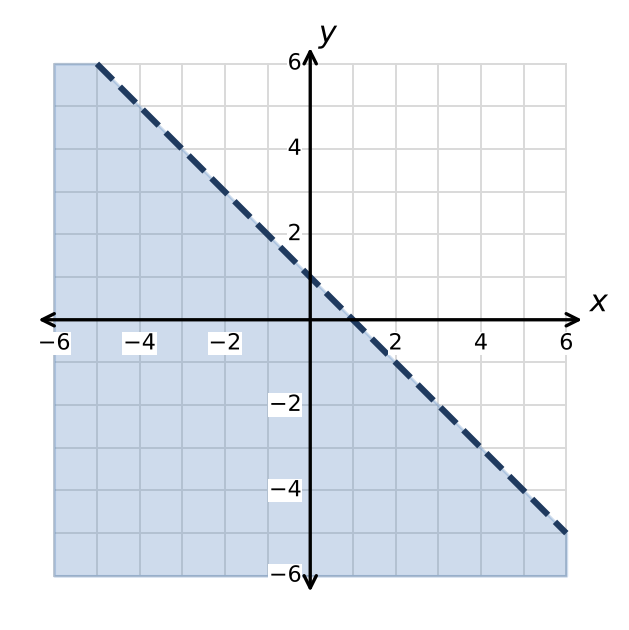
- The boundary passes through (0, 1) with slope −1.
- So it is y = −x + 1.
- It is dashed (not included) and the shading is below the line: y < −x + 1.
- A (y ≤ −x + 1): misread the dashed/solid boundary line
- B (y > −x + 1): chose the wrong side of the line
- C (y < x + 1): used the wrong sign for the slope
- E (y < −x − 1): used the wrong sign for the y-intercept
Systems of linear inequalities
Method. A solution of a system must satisfy every inequality; test each choice in both.
Worked example- Test (3, 6) in both.
- 6 < 7 ✓ and 6 > 4 ✓.
- A ((3, −3)): checked only the first inequality
- B ((−5, 3)): checked only the second inequality
- C ((3, 4)): chose a point on the boundary line y = 2x − 2, treating > as ≥: 4 > 2(3) − 2 = 4 is false
- E ((−1, −5)): chose a point that satisfies neither inequality
Ratios, Rates and Proportions
A ratio compares quantities; a proportion sets two ratios equal and is solved by cross-multiplying. Unit rates divide by the second quantity. In direct variation y/x stays the same; in inverse variation xy stays the same.
Key formulas| Proportion | |
| Unit rate | |
| Scale | |
| Direct variation | |
| Inverse variation | |
| Average speed | |
| Square and cubic units |
Proportional relationships — constant from a graph
Method. Read any labelled point (x, y) on the line and divide y by x.
Worked example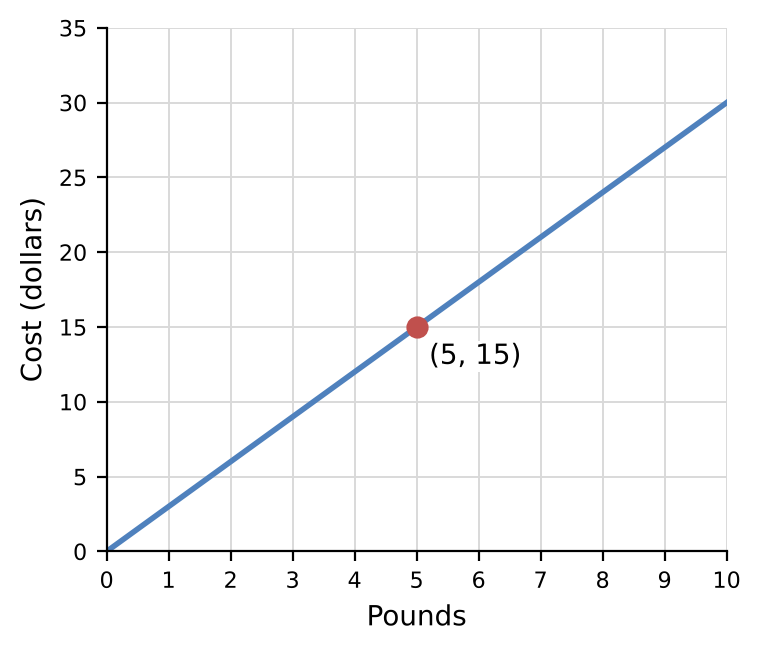
- The line passes through the origin and the point (5, 15).
- k = y ÷ x = 15 ÷ 5 = 3.
- A (0): gave the y-intercept (the value of y when x = 0) instead of k
- B (): divided x by y instead of y by x
- D (10): subtracted the coordinates
- E (15): gave the y-value of the point
Unit conversions with square and cubic units
Method. Square units use the factor squared ; cubic units use it cubed .
Worked example- One square yard is 3 × 3 = 9 square feet, because every dimension is converted.
- So 6 square yards = 6 × 9 = 54 square feet.
- A (): divided instead of multiplying
- B (2): divided by the length factor 3 instead of multiplying by 9: 6 ÷ 3 = 2
- C (18): multiplied by the length factor 3 only
- D (36): multiplied by 3 × 2 instead of 3 to the power 2
Density
Method. Density = mass ÷ volume; estimate 250 ÷ 25 = 10, so the answer is a little under 10: 8.9.
Worked example- Density = mass ÷ volume.
- Density = 249.2 ÷ 28.
- So Density = 8.9 grams per cubic centimeter.
- B (89): misplaced the decimal point when dividing: 249.2 ÷ 28 = 89
- C (221.2): subtracted volume from mass
- D (277.2): added mass and volume
- E (6,977.6): multiplied mass by volume
Speed — find the distance
Method. Rate = amount ÷ time (or mass ÷ volume); amount = rate × time. Convert minutes to hours first.
Worked example- 15 minutes = = 0.25 hour.
- So the time is 4.25 hours.
- Distance = speed × time = 68 × 4.25 = 289 miles.
- A (16): divided the speed by the time
- B (272): ignored the minutes
- C (282.2): treated 4 hours 15 minutes as 4.15 hours
- D (287): added the 15 minutes as 15 miles: 68 × 4 + 15 = 287
Sharing in a ratio
Method. Add the ratio numbers, find one part, then multiply.
Worked example- Total parts: 5 + 6 + 9 = 20.
- One part = $140 ÷ 20 = $7.
- The smallest share is 5 × $7 = $35.
- A ($7): gave the value of one part only
- B ($28): divided the total by the ratio number instead of by the total number of parts
- D ($42): gave the middle share: 6 × $7 = $42
- E ($63): gave the largest share
Ratios — find the total
Method. Total = boys × (total parts ÷ boy parts) = 40 × = 72.
Worked example- 5 parts are 40 boys.
- So one part is 40 ÷ 5 = 8.
- The club has 5 + 4 = 9 parts: 9 × 8 = 72 students.
- A (8): found the size of one part only: 40 ÷ 5 = 8
- B (32): found the number of girls only
- C (44): added the girls' ratio number to the number of boys
- D (49): added the ratio total to the number of boys
Inverse variation — work problems
Method. Multiply the given pair, then divide by the new number of pumps.
Worked example- The number of pumps and the time are inversely related: pumps × hours stays constant.
- 2 × 20 = 40 pump-hours.
- So the time is 40 ÷ 10 = 4 hours.
- B (10): divided the hours by the original number of pumps: 20 ÷ 2 = 10
- C (12): kept the sum of pumps and hours constant: 22 − 10 = 12
- D (40): gave the constant 2 × 20 = 40 instead of the time
- E (100): used direct variation instead of inverse variation: 20 × 10 ÷ 2 = 100
Dimensional analysis — rate conversions
Method. Multiply by conversion fractions so unwanted units cancel; check every unit is converted.
Worked example- 36 km/h × (1,000 m / 1 km) × (1 h / 3,600 s) = 36 × 1,000 ÷ 3,600.
- So 36 km/h × (1,000 m / 1 km) × (1 h / 3,600 s) = 10 .
- A (0.6): divided by 60 only (hours to minutes)
- C (129.6): multiplied by 3.6 instead of dividing
- D (600): converted hours to minutes only: 36 × 1,000 ÷ 60 = 600
- E (36,000): converted kilometers to meters but not hours to seconds
Multi-step rate problems
Method. Find the per-minute rate first, convert all time to minutes, then multiply.
Worked example- Rate: 24 ÷ 4 = 6 pages per minute.
- Time: 2 × 60 + 24 = 144 minutes.
- Pages: 6 × 144 = 864.
- A (720): ignored the extra minutes
- C (1,344): treated 2 hours as 200 minutes
- D (1,728): used 24 pages every 2 minutes instead of every 4 minutes: 12 × 144 = 1,728
- E (3,456): used 24 pages per minute instead of per 4 minutes
Average speed for a round trip
Method. For equal distances, average speed = 2ab/(a + b) = 2 × 60 × 90 ÷ 150 = 72.
Worked example- Time out = 180 ÷ 60 = 3 h.
- Time back = 180 ÷ 90 = 2 h.
- Total distance 360 miles ÷ total time 5 h = 72 mph.
- B (75): averaged the two speeds
- C (120): used only the time for the first part of the trip
- D (150): added the two speeds instead of averaging: 60 + 90 = 150
- E (180): used only the time for the return trip
Inverse variation
Method. Multiply the given pair, then divide by the new value.
Worked example- Inverse variation: x × y stays constant.
- 5 × 6 = 30.
- So y = 30 ÷ 3 = 10.
- A (3.6): used direct variation instead of inverse variation
- B (4): added the change in x to y
- C (8): kept the sum of x and y constant
- E (90): multiplied the constant by 3 instead of dividing: 30 × 3 = 90
Word Problems
Name the unknown, translate the words into an equation, solve, and answer the question that was asked, with units.
Key formulas| Distance | |
| Work | |
| Mixture | |
| Consecutive integers |
Consecutive integers
Method. The middle (average) is 100 ÷ 5; step out from the middle.
Worked example- Let the smallest be n.
- The 5 consecutive integers are n, n + 1, n + 2, n + 3, n + 4.
- Their sum: 5n + 10 = 100.
- Subtract 10: 5n = 90.
- Divide: n = 18.
- The smallest is 18.
- B (19): added 1 to the smallest number
- C (20): gave the average (middle value)
- D (21): gave the fourth integer: 18 + 3 = 21
- E (22): gave the largest number
Averages
Method. New score = new average + (number of old tests) × (rise in average) = 89 + 4 × 2.
Worked example- Current total: 4 × 87 = 348.
- Needed total for 5 tests: 5 × 89 = 445.
- Next score: 445 − 348 = 97.
- A (10): multiplied the gap by 5
- B (89): gave the target average
- C (91): averaged the old average and the new score only
- D (95): added the old tests' total shortfall to the old average: 87 + 4 × 2 = 95
Simple interest
Method. Simple interest I = P × r × t with r as a decimal; total = P + I.
Worked example- Simple interest: I = Prt = $800 × 0.02 × 3.
- One year: $16.
- 3 years: $48.
- B ($480): used 0.2 for 2%: $800 × 0.2 × 3 = $480
- C ($576): used months instead of years
- D ($848): gave the total amount instead of the interest
- E ($4,800): used the rate as a whole number instead of a percent
Distance, rate and time
Method. Distance = rate × time; opposite directions or toward each other → add speeds, same direction → subtract.
Worked example- Moving apart, the distance grows at 30 + 48 = 78 miles per hour.
- Time = distance ÷ rate: 234 ÷ 78 = 3 hours.
- B (4.875): used only the faster car's speed: 234 ÷ 48 = 4.875
- C (6): divided by the average speed instead of the sum of the speeds
- D (7.8): used only the first car's speed
- E (13): subtracted the speeds instead of adding
Writing equations from words
Method. Fixed amount = constant; per-unit amount = coefficient of x.
Worked example- The fee is paid once: 40.
- The rate is paid for each of the x months: 15x.
- Total cost = fee + rate × x.
- So 40 + 15x = 115.
- A (15 + 40x = 115): swapped the fixed fee and the rate
- B (40 + 15 + x = 115): added x instead of multiplying it by the rate
- C (40x + 15x = 115): multiplied both the fee and the rate by x
- E (15x = 115 + 40): added the fee to the total instead of to the cost
Writing inequalities from words
Method. “At most / no more than” → ≤; “at least” → ≥; “more than” → >; “less than” → <.
Worked example- Total spent = fee + price × rides = 15 + 4n.
- “No more than” 120 means ≤ 120.
- So 15 + 4n ≤ 120.
- A (15 + 4n ≥ 120): reversed the inequality sign
- B (4n ≤ 120): left out the fixed fee
- C (4 + 15n ≤ 120): swapped the fee and the price per ride
- E (15 + 4n < 120): changed whether the boundary is included
Interpreting linear models
Method. Change in output = slope × change in input; the constant cancels.
Worked example- The coefficient 25 is the change in C for each increase of 1 in h.
- For an increase of 3: 25 × 3 = 75 dollars.
- The constant 40 does not change.
- A (25): gave the increase for 1 unit, not 3
- C (115): added the starting value
- D (120): multiplied the starting value by 3
- E (195): multiplied the whole expression by 3: 3 × (25 + 40) = 195
Age problems
Method. Add the same number of years to BOTH ages before setting up the multiple.
Worked example- Let Carlos's age now be b.
- So Ava is 4b.
- In 20 years: 4b + 20 = 2(b + 20).
- Expand: 4b + 20 = 2b + 40.
- Subtract 2b and 20: 2b = 20.
- Divide: b = 10.
- B (20): stopped at 2b = 20 and did not divide by 2
- C (30): gave Carlos's age in 20 years
- D (40): gave Ava's age instead of Carlos's
- E (60): gave Ava's age in 20 years
Work problems
Method. Together time = (product)/(sum) of the two times.
Worked example- Mia does of the job per hour and Tom does .
- Together: + = of the job per hour.
- Time = 1 ÷ = 3 hours.
- A (): gave the combined rate (jobs per hour) instead of the time
- B (): gave the fraction of the fence Tom paints instead of the time: 3 × =
- C (2): halved the faster time
- E (8): averaged the two times
Mixture problems
Method. Balance the differences: 36 × (30 − 20) = y × (60 − 30).
Worked example- Let y = liters of the 60% solution.
- Acid: 0.2(36) + 0.6y = 0.3(36 + y).
- Multiply by 100: 720 + 60y = 1080 + 30y.
- Collect: 30y = 360.
- Divide: y = 12 liters.
- A (6): divided by 60 instead of 60 − 30: 36 × 10 ÷ 60 = 6
- B (9): divided by 60 − 20 instead of 60 − 30
- D (36): assumed equal amounts of the two solutions
- E (108): inverted the ratio of the differences
Function Notation
f(a) is the output when the input is a; solving f(x) = k asks for the inputs that give output k. Read values from graphs and tables, and find the domain and range from the graph or the formula.
Key formulas| Evaluate | |
| Solve | |
| Composition | |
| Domain | |
| Piecewise |
Recognizing functions
Method. Scan the x-values only: a repeated x with different y's means NOT a function.
Worked example- A relation is a function when no input (x-value) is paired with two different outputs.
- In {(4, 4), (−2, 7), (7, −2), (−4, 8)} the x-values 4, −2, 7, −4 are all different.
- So it is a function.
- Each of the other sets uses one x-value twice with different y-values.
- A ({(−1, −1), (2, 2), (−4, 7), (2, −4)}): chose a set in which the input 2 has two different outputs
- B ({(5, 0), (1, 1), (−1, −1), (−1, −4)}): chose a set in which the input −1 has two different outputs
- C ({(1, −2), (3, 7), (0, 1), (0, 2)}): chose a set in which the input 0 has two different outputs
- D ({(3, 5), (−2, 1), (6, 0), (3, −7)}): chose a set in which the input 3 has two different outputs
Linear versus nonlinear
Method. Equal steps in x must give equal changes in y for a linear function.
Worked example- Find the change in y for each step of 1 in x: 6 − 4 = 2, 12 − 6 = 6, 22 − 12 = 10, 36 − 22 = 14.
- The changes are not all equal.
- So the function is nonlinear.
- A (Linear, because the x-values increase by 1): looked only at the x-values
- C (Linear, because the changes in y increase by the same amount (4) each time): confused constant second differences with a constant rate of change
- D (Linear, because y changes by 2 each time x increases by 1): used only the first change in y
- E (Linear, because y always increases): thought an increasing function must be linear
Function notation — evaluating
Method. Put negative inputs in parentheses; square before multiplying by the coefficient.
Worked example- Substitute x = −3 with parentheses: f(−3) = 3 + 3(−3) − 3.
- Square first: = 9.
- Then 27 − 9 − 3 = 15.
- A (−39): squared −3 as −9: 3(−9) − 9 − 3 = −39
- C (21): made a sign error with the constant
- D (33): evaluated f(3) instead of f(−3)
- E (69): multiplied by 3 before squaring
Function notation — solving f(x) = k
Method. f(x) = k asks for the INPUT; undo the operations in reverse order.
Worked example- Set f(x) = 27: −2x + 11 = 27.
- Subtract 11: −2x = 16.
- Divide by −2: x = −8.
- A (−43): found f(27) instead of solving f(x) = 27
- B (−): divided before subtracting the constant
- C (−19): moved the constant with the wrong sign
- E (8): lost the negative sign when dividing by −2: −2x = 16 gives x = 8
Vertical line test
Method. Vertical line test: two points on one vertical line → not a function.
Worked example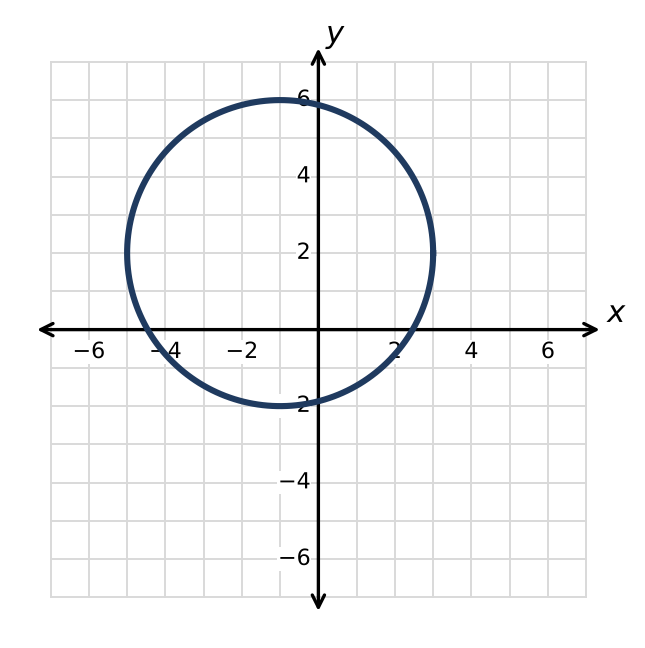
- Use the vertical line test: y is a function of x when no vertical line meets the graph twice.
- The graph is a circle.
- The vertical line x = 0 meets it at two points.
- So it is NOT a function.
- A (Yes, because every vertical line crosses the graph at most once): checked only a vertical line outside the graph
- B (No, because the graph is not a straight line): thought only straight lines are functions
- D (No, because some horizontal line crosses the graph more than once): gave a horizontal-line reason
- E (Yes, because the graph is one connected curve): thought any connected curve is a function
Nonlinear patterns
Method. If the changes grow by a constant amount, compare the outputs with the square numbers.
Worked example- The changes in output are 3, 5, 7, which grow by 2.
- So the rule involves squaring.
- Compare with the squares: 0 = − 1, 3 = − 1, 8 = − 1, 15 = − 1.
- The rule is output = (input)² − 1.
- For 8: − 1 = 63.
- A (15): doubled the input instead of squaring it
- B (43): continued with the last change in y as if the function were linear
- D (64): forgot the constant
- E (65): added the constant instead of subtracting it: + 1 = 65
Range
Method. Range of a parabola = from the vertex y-value upward (a > 0) or downward (a < 0).
Worked example- The vertex form a + k has vertex (−6, −4).
- Since a = −2 is negative, the parabola opens down.
- So −4 is the greatest value.
- The range is y ≤ −4.
- A (y ≥ −4): reversed the direction of the parabola
- B (y ≤ −6): used the x-coordinate of the vertex
- D (y < −4): left out the vertex value (used a strict inequality)
- E (y ≤ 4): used the wrong sign for the vertical shift
Piecewise functions
Method. First pick the piece whose condition the input satisfies (watch < versus ≤ at the boundary).
Worked example- Decide which piece applies: x = 1 satisfies x ≥ 1.
- So use f(x) = 2.
- Substitute: f(1) = 2 = 2.
- A (−7): used the wrong piece: −4(1) − 3 = −7
- B (−5): added the two pieces: −7 + 2 = −5
- C (−2): made a sign error in the second piece: −2 = −2
- D (1): forgot to multiply by 2: = 1
Reading key features from graphs
Method. Inputs are read on the x-axis, outputs on the y-axis.
Worked example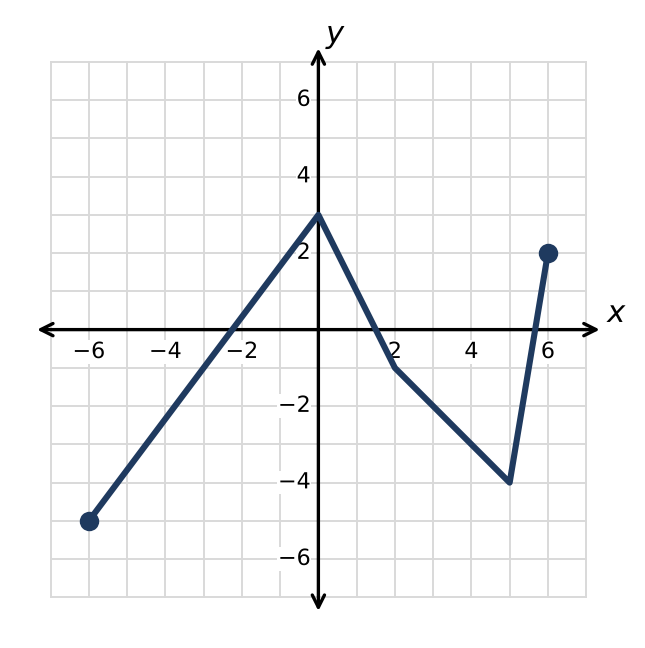
- The domain is the set of x-values the graph covers.
- The graph starts at x = −6 and ends at x = 6, with both endpoints included.
- So the domain is −6 ≤ x ≤ 6.
- A (−5 ≤ x ≤ 3): gave the y-values (range) instead of the x-values
- C (0 ≤ x ≤ 6): used only the part of the graph to the right of the y-axis
- D (−6 < x < 6): left out the endpoints
- E (all real numbers): assumed the graph continues forever
Domain
Method. Square roots: inside ≥ 0. Fractions: denominator ≠ 0.
Worked example- The expression under the square root must not be negative: 3x − 12 ≥ 0.
- Divide by 3: x − 4 ≥ 0.
- So x ≥ 4.
- A (x ≤ 4): reversed the inequality
- B (x ≥ −4): used the wrong sign for the endpoint
- C (x > 4): excluded the endpoint where the root is 0
- D (x ≥ 12): forgot to divide by 3: 3x ≥ 12 read as x ≥ 12
Equations of Lines
Find the slope, then use a point to write the equation. In y = mx + b, m is the slope and b is the y-intercept. Parallel lines have equal slopes; perpendicular slopes are negative reciprocals.
Key formulas| Slope | |
| Slope-intercept | |
| Point-slope | |
| Standard form | |
| Parallel / perpendicular | |
| Intercepts |
Slope from two points
Method. Rise over run: change in y on top, change in x below, both in the same order.
Worked example- Slope = .
- Slope = = −.
- So Slope = .
- A (−15): added the coordinates instead of subtracting
- B (−9): gave the change in y only: 3 − 12 = −9
- C (−): divided run by rise and made a sign error
- D (−): subtracted the coordinates in opposite orders
Slope from a graph
Method. The line rises from left to right, so the slope is positive; count rise ÷ run between the dots.
Worked example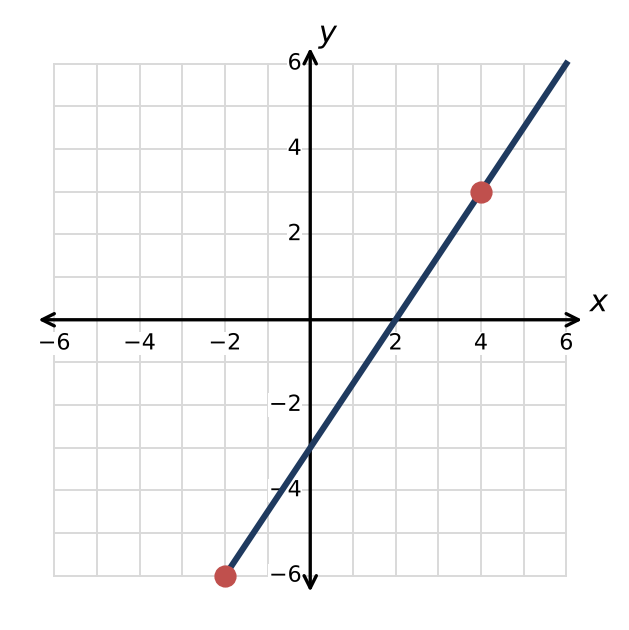
- The marked points are (−2, −6) and (4, 3).
- Slope = = .
- A (−): read the direction of the line the wrong way
- B (−): divided run by rise and reversed the sign
- C (): divided run by rise
- D (): divided the y-coordinate of one marked point by its x-coordinate:
Slope as a rate of change
Method. The rate is the slope: Δ(amount)/Δ(time).
Worked example- Rate = change in amount ÷ change in time.
- Rate = = .
- So Rate = 30 liters per minute.
- A (22.5): divided the change in amount by the later time only: 180 ÷ 8 = 22.5
- C (35): divided the second amount by its time (ignored the starting amount)
- D (50): divided the first amount by its time (ignored the starting amount)
- E (180): gave the change in amount without dividing by the time
Equation of a line from its graph
Method. Read b where the line meets the y-axis; count rise/run for m.
Worked example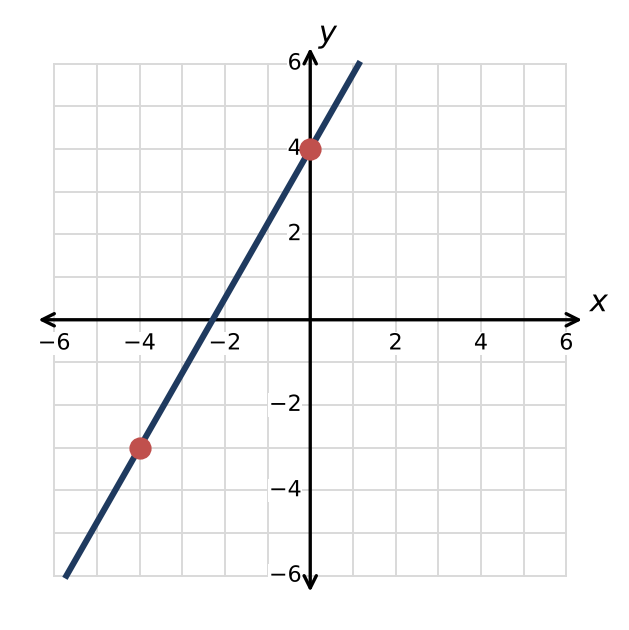
- The line crosses the y-axis at (0, 4).
- So b = 4.
- Between the marked points (0, 4) and (−4, −3) the slope is .
- Equation: y = x + 4.
- A (y = −x + 4): used the wrong sign for the slope
- B (y = x + 4): used run over rise for the slope
- D (y = 4x + ): swapped the slope and the y-intercept
- E (y = x − 4): used the wrong sign for the y-intercept
Points on a line
Method. Plug each x-value into the equation and compare the y-value.
Worked example- Substitute x = −3: y = 3(−3) − 7 = −16.
- So (−3, −16) is on the line.
- A ((−16, −3)): swapped the coordinates
- C ((−3, −7)): added 3 and x instead of multiplying: y = 3 + (−3) − 7 = −7
- D ((−3, −2)): used the wrong sign for the y-intercept
- E ((−3, 2)): used the wrong sign for the slope
Slope from standard form
Method. For Ax + By = C the slope is −.
Worked example- Solve for y: −3y = 5x + 1.
- So y = −x − .
- The slope is −.
- A (−5): used the x-coefficient as the slope
- C (−): divided B by A
- D (−): gave the y-intercept instead of the slope
- E (): forgot the negative sign in −
Linear models — interpreting coefficients
Method. Slope = rate per unit of the input; intercept = value when the input is 0.
Worked example- In C = 75m + 20, 75 multiplies m (dollars per month, the slope) and 20 is the cost when m = 0 (the intercept).
- So 75 is the cost for each additional month.
- B (the total cost for m months): confused the coefficient with the whole expression
- C (the fixed cost charged before any time is used): mixed up the slope and the intercept
- D (the total cost for one month): added the two numbers in the equation
- E (the number of months that can be bought): confused the input with a coefficient
Midpoint
Method. Midpoint = average of the x's and average of the y's; to find an endpoint, go the same step again past the midpoint.
Worked example- Midpoint = .
- Midpoint = .
- So Midpoint = .
- B (): divided only the x-sum by 2
- C (): subtracted the coordinates instead of adding
- D ((−17, 9)): forgot to divide by 2
- E (): swapped the x- and y-coordinates
Point-slope form
Method. b = y₁ − m·x₁ = 7 − (2) = .
Worked example- Point-slope: y − 7 = (x − 2).
- Distribute and solve for y: y = −x + + 7 = −x + .
- A (y = −x + ): used the wrong sign when solving for b
- B (y = −x + ): forgot to multiply the slope by the x-coordinate: b = 7 + =
- D (y = −x − ): solved for b with both signs reversed
- E (y = −x + 7): used the y-coordinate of the point as the y-intercept
Equation through two points
Method. Find m from the two points, then b from either point.
Worked example- Slope: = −.
- Then b = 1 − (−3) = −1.
- Equation: y = −x − 1.
- B (y = −x + 1): used the y-value of the first point as b
- C (y = −x − ): used run over rise for the slope
- D (y = x + 3): used the wrong sign for the slope
- E (y = −x + 3): used the wrong sign when solving for b
Parallel lines
Method. Keep the slope; find the new b from the point.
Worked example- Parallel lines have equal slopes: m = .
- b = −6 − (−3) = −5.
- Equation: y = x − 5.
- A (y = −3x − 15): used the perpendicular slope
- B (y = x + 7): copied the original line
- C (y = x − 6): used the y-coordinate of the point as the y-intercept
- E (y = x − 7): used the wrong sign when solving for b
Perpendicular lines
Method. Flip the slope and change its sign; then find b from the point.
Worked example- Perpendicular slopes are opposite reciprocals: − = −2.
- b = −6 − (−2)(−5) = −16.
- Equation: y = −2x − 16.
- A (y = −x − ): used only the opposite sign (not the reciprocal)
- B (y = 2x + 4): used only the reciprocal (not the opposite sign)
- C (y = x − ): used the same slope (parallel, not perpendicular)
- D (y = −2x + 4): used the wrong sign when solving for b: b = −6 + 10 = 4
Distance between two points
Method. Draw the right triangle: legs |Δx| and |Δy|, distance is the hypotenuse.
Worked example- d = .
- d = = .
- So d = 15.
- A (21): added the horizontal and vertical distances
- C (): made a sign error with −1: used 11 − 1 = 10, so =
- D (225): forgot the square root
- E (3): subtracted the squares
Polynomial Expressions
Combine like terms, distribute, and use the special-product patterns. To factor, take out the GCF first, then look for a trinomial pattern or a difference of squares. Check a factoring by multiplying back.
Key formulas| Square of a sum | |
| Square of a difference | |
| Difference of squares | |
| FOIL | |
| Trinomial |
Combining like terms
Method. Only terms with exactly the same variable part can be combined; keep each sign with its term.
Worked example- Group the terms: −9 and −3 make −12.
- Group the x-terms: −3x is the only x-term.
- Group the constants: 1 and 12 make 13.
- Write the result: −12 − 3x + 13.
- A (−15 + 13): combined and x terms as if they were like terms
- B (−6 − 3x + 13): used the wrong sign for one term
- D (−12 + 3x + 13): used the wrong sign for the x-term
- E (−12 − 3x − 11): used the wrong sign for a constant
Distributive property
Method. Multiply the outside number by EVERY term inside, keeping the sign of the outside number.
Worked example- Distribute: 2(4x − 9) = 8x − 18 and 2(8x − 1) = 16x − 2.
- Combine: 24x − 20.
- A (24x − 19): multiplied only the first term in the second parentheses by 2
- B (−8x − 16): subtracted the second product instead of adding
- C (24x − 10): multiplied only the first term in each parentheses by 2: 8x − 9 + 16x − 1 = 24x − 10
- E (24x − 11): multiplied only the first term in the first parentheses by 2
Multiplying a monomial by a polynomial
Method. Multiply coefficients and ADD exponents for each term.
Worked example- 6 · −2x = −12 and 6 · 1 = 6.
- So the product is −12 + 6.
- A (12 + 6): dropped the negative sign on the first term
- C (−12 + ): multiplied only the first term
- D (−12 + 6x): multiplied the constant term by x instead of by
- E (−12 + 6x): did not add the exponent on the first term
Adding and subtracting polynomials
Method. Line up like terms (, x, constants); with subtraction, change every sign in the second polynomial.
Worked example- Distribute the minus sign to every term of the second polynomial.
- Then combine like terms: 4 + 3x − 3.
- A (4 − x + 1): changed the sign of only the first term of the second polynomial
- B (−6 − x + 1): added instead of subtracting
- C (4 + 3x + 1): did not change the sign of the last term of the second polynomial
- E (4): combined the x-terms with the constants
Multiplying binomials
Method. First, Outer, Inner, Last — then combine the two middle terms.
Worked example- FOIL: first 2x·3x = 6.
- Outer 2x·8 = 16x.
- Inner 1·3x = 3x.
- Last 1·8 = 8.
- Total: 6 + 19x + 8.
- B (6 + 16x + 8): left out the inner product: 6 + 16x + 8
- C (6 + 8): multiplied only the first terms and the last terms
- D (6 + 13x + 8): subtracted the outer and inner products
- E (6 + 19x − 8): made a sign error on the last term
Special products
Method. Use the patterns = ± 2pq + and (p + q)(p − q) = − .
Worked example- = + 2pq + with p = x, q = −2.
- + 2(x)(−2) + 4 = − 4x + 4.
- A ( + 4): squared each term and forgot the middle term
- B ( − 2x + 4): used ab instead of 2ab for the middle term
- D ( − 4x − 4): used the wrong sign for the last term: = −4
- E ( + 4x + 4): used the wrong sign for the middle term
Factoring — greatest common factor
Method. Find the largest number and the lowest power of x that divide every term.
Worked example- Every term contains 3x: 12 + 15 + 18x = 3x.
- The trinomial 4 + 5x + 6 has no common factor left.
- A (3): factored out only the number, not the variable
- B (3(4x + 5)): factored out 3 from the first two terms and dropped the 18x term, which has no factor
- C (3x): did not divide the last term by 3
- D (x): factored out only the variable, not the number
Factoring trinomials (leading coefficient 1)
Method. Product = c, sum = b; the signs of c and b tell you the signs of the two numbers.
Worked example- Find two numbers with product 45 and sum 14: 9 and 5.
- So + 14x + 45 = (x + 9)(x + 5).
- B ((x + 7)(x + 7)): split the middle coefficient into two equal halves without checking the product
- C ((x − 9)(x − 5)): used the wrong signs in both factors
- D ((x + 9)(x − 5)): used the wrong sign in one factor
- E ((x + 1)(x + 45)): chose a factor pair of 45 that does not add to 14
Factoring — difference of squares
Method. − = (p + q)(p − q); take out any common factor first.
Worked example- 49 − 36 = − .
- So it factors as (7x + 6)(7x − 6).
- A ((7x − 6)(7x − 6)): wrote a perfect square instead of a difference of squares
- B ((7x + 18)(7x − 18)): took half of 36 instead of its square root
- D ((7x + 6)(7x + 6)): used + in both factors
- E ((49x + 6)(x − 6)): did not take the square root of the coefficient
Factoring trinomials (leading coefficient ≠ 1)
Method. Check the outer and inner products of each candidate against the middle coefficient.
Worked example- Use the ac-method: a·c = 50.
- Find two numbers with product 50 and sum −27: −25 and −2.
- Split the middle term and group: 5 − 27x + 10 = (5x − 2)(x − 5).
- A ((5x − 1)(x − 10)): chose factors of 10 that give the right constant but the wrong middle term
- C ((5x − 5)(x − 2)): placed the constants in the wrong factors
- D ((5x + 2)(x + 5)): used the wrong signs in both factors
- E ((5x − 2)(x + 5)): used the wrong sign in one factor
Quadratic Equations
Get 0 on one side, then factor and set each factor equal to 0. If there is no x-term, take square roots and remember both signs. Completing the square or the quadratic formula works when factoring does not.
Key formulas| Standard form | |
| Zero-product property | |
| Square-root method | |
| Quadratic formula | |
| Completing the square |
Square-root equations x² = k
Method. = k (k > 0) always has two solutions, ±.
Worked example- Take the square root of both sides, remembering both signs.
- x = ±.
- So x = ±13.
- A (x = ±84.5): halved 169 instead of taking the square root: 169 ÷ 2 = 84.5
- C (x = 13): forgot the negative square root
- D (x = 169): did not take the square root
- E (x = ±26): doubled the square root
Zero-product property
Method. Set each factor equal to 0; each root is the opposite of the number in its factor.
Worked example- A product is 0 only when a factor is 0.
- x + 1 = 0 gives x = −1.
- x − 6 = 0 gives x = 6.
- So x = −1 or x = 6.
- B (x = 6 only): solved only the second factor and missed x = −1
- C (x = −6 or x = 1): used the numbers in the factors with their signs instead of the zeros
- D (x = −6 or x = −1): changed the sign of only one root
- E (x = 1 or x = 6): changed the sign of only the other root
Square-root method
Method. Isolate the squared bracket, take the ± square root of both sides, then undo the shift inside the bracket.
Worked example- Take square roots: x − 8 = ± = ±5.
- Add 8 (move the constant): x = 3 or x = 13.
- A (x = −13 or x = −3): used the wrong sign for h
- B (x = 13): forgot the negative square root
- C (x = 3): forgot the positive square root
- E (x = −17 or x = 33): forgot to take the square root
Solving by factoring
Method. Get 0 on one side, factor, then set each factor to 0.
Worked example- Move everything to one side: + 12x + 20 = 0.
- Factor: (x + 10)(x + 2) = 0, since 10 × 2 = 20 and 10 + 2 = 12.
- Zero-product property: x = −10 or x = −2.
- A (x = 2 or x = 10): used the numbers from the factors without changing their signs
- B (x = −10 or x = 2): made a sign error on one root
- D (x = −2 or x = 10): made a sign error on the other root
- E (x = −20 or x = −1): chose a factor pair of 20 that does not add to 12
Quadratic word problems — area
Method. Look for two numbers 10 apart whose product is 336: 14 and 24.
Worked example- Let w be the width: w(w + 10) = 336.
- So + 10w − 336 = 0.
- Factor: (w − 14)(w + 24) = 0.
- So w = 14 (a width cannot be negative).
- Length = 14 + 10 = 24.
- A (14): gave the width
- C (38): added the width and the length: 14 + 24 = 38
- D (163): solved w + (w + d) = area
- E (168): halved the area
Solving by factoring (leading coefficient ≠ 1)
Method. Use the ac-method (or test rational roots ±(factors of c)/(factors of a)).
Worked example- Factor: (x − 5)(5x + 2) = 0.
- Set each factor to 0: x − 5 = 0 gives x = 5.
- 5x + 2 = 0 gives x = −.
- A (x = −5 or x = ): solved each factor with the wrong sign
- B (x = −2 or x = 5): forgot to divide by the x-coefficient in each factor
- C (x = − or x = 5): flipped the fraction when solving 5x + 2 = 0
- E (x = −2 or x = 1): divided by 5 in the wrong factor: x = 5 ÷ 5 = 1 and x = −2
Completing the square
Method. Shortcut: + bx + c = 0 becomes = − c.
Worked example- Move the constant: + 16x = −4.
- Half of 16 is 8, and = 64.
- Add it to both sides: + 16x + 64 = 60.
- Write the left side as a square: = 60.
- B ( = −4): added 64 to the left side only, so the right side stayed −4
- C ( = 68): added the constant instead of subtracting it
- D ( = 252): used b instead of
- E ( = 60): used the wrong sign inside the square
Systems of Linear Equations
Solve by substitution or elimination. Compare slopes to count solutions: different slopes give one solution, same slope with different intercepts gives none, and the same line gives infinitely many.
Key formulas| Elimination | |
| Substitution | |
| One solution | |
| No solution (graphs) | |
| Infinitely many (graphs) | |
| No solution (coefficients) | |
| Infinitely many (coefficients) |
Systems — checking a solution
Method. Test each choice in BOTH equations; one failure rules it out.
Worked example- A solution must make both equations true.
- (−4, 7): −2(−4) + (−4)(7) = −20 ✓ and 4(−4) + (−6)(7) = −58 ✓.
- A ((−8, 9)): checked only the first equation
- B ((4, −7)): used the wrong sign for both coordinates
- D ((−1, 9)): checked only the second equation
- E ((7, −4)): swapped the coordinates of the solution
Systems — substitution
Method. When one equation already gives y, substitute it straight into the other.
Worked example- Substitute y = 5x − 5 into the second equation: −6x + (−1)(5x − 5) = −6.
- So −11x + 5 = −6.
- So x = 1.
- Then y = 5(1) − 5 = 0.
- A ((0, 1)): swapped x and y
- C ((−1, −10)): made a sign error when dividing by −11: x = −1, then y = 5(−1) − 5 = −10
- D ((1, 10)): used the wrong sign for b when finding y
- E (): used the wrong sign for the constant after substituting
Systems — elimination
Method. Scale the equations so one variable has opposite (or equal) coefficients, then add (or subtract).
Worked example- Add the two equations to eliminate x: −14y = −140.
- So y = 10.
- Substitute into the second equation: 5x − 70 = −75.
- So 5x = −5 and x = −1.
- A ((10, −1)): swapped x and y
- B ((1, −10)): changed the sign of both x and y
- C ((−1, −10)): gave y with the wrong sign
- E ((1, 10)): gave x with the wrong sign: 5x = −5 read as x = 1
Systems — parameter for infinitely many solutions
Method. Infinitely many solutions ⇔ one equation is a constant multiple of the other.
Worked example- For infinitely many solutions the second equation is a multiple of the first.
- The y-coefficients give the factor = 5 (and the constants agree: − = 5).
- So p = 5 × 1 = 5.
- A (−5): made a sign error when scaling
- B (): divided by the scale factor instead of multiplying: 1 ÷ 5 =
- C (1): did not scale the coefficient
- E (6): added the scale factor instead of multiplying
Systems — word problems (two totals)
Method. If all 116 were adult tickets they would bring $1,044.00; each child ticket adds $9.00, so children = ($1,584.00 − $1,044.00) ÷ $9.00 = 60.
Worked example- Let a = adult tickets and c = child tickets: a + c = 116 and 9a + 18c = 1584.
- Substitute c = 116 − a: 9a + 18(116 − a) = 1584.
- So −9a = −504 and a = 56.
- c = 60.
- A (56): found the number of the other kind of ticket
- B (58): split the tickets evenly between the two kinds: 116 ÷ 2 = 58
- D (88): divided the total money by one price only
- E (116): gave the total number of tickets
Systems — finding an expression directly
Method. Combine the equations so the coefficients of x and y become equal; then divide.
Worked example- Add: 4x + 4y = −56, which is 4(x + y) = −56.
- So x + y = −14.
- (Here x = −9 and y = −5.)
- A (−56): added the equations but did not divide
- B (−48): subtracted the equations without dividing
- D (−9): gave the value of x instead of x + y
- E (−4): found x − y instead
Systems — parameter for no solution
Method. Same slope, different intercept ⇒ no solution: match the coefficient ratio.
Worked example- No solution means parallel lines: the x- and y-coefficients must be in the same ratio while the constants are not.
- The y-coefficients give the ratio − = −2.
- So k = −2 × (−4) = 8.
- The constants 14 and −2 × (−8) = 16 differ.
- So the lines are parallel.
- A (−8): made a sign error in the matching coefficient
- B (−4): matched the coefficient without scaling
- C (2): scaled by the wrong factor
- E (16): scaled the constant instead of the x-coefficient: −2 × (−8) = 16