Geometry and Measurement: Practice Paper 1
Choose one answer for each question, then select Check my answers. Every question has a full worked solution.
1.
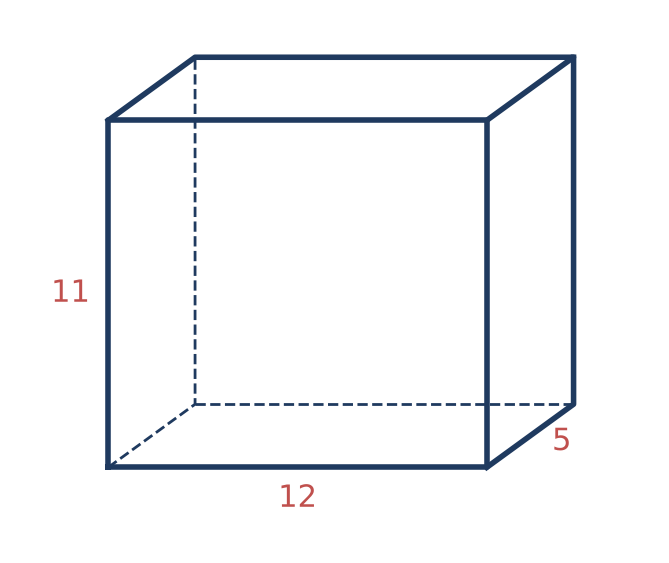
What is the surface area of the rectangular prism shown?
Show solution
AnswerA — 494
Step-by-step
- A rectangular prism has three pairs of equal faces.
- The faces have areas 12 × 5 = 60, 12 × 11 = 132 and 5 × 11 = 55.
- So SA = 2 × (60 + 132 + 55) = 2 × 247 = 494.
Fast methodSA = 2(lw + lh + wh): add the three different faces, then double.
Quick checkthe six faces are 60, 60, 132, 132, 55 and 55, which add to 494 ✓.
Why the other choices are wrong
- B (660): found the volume
- C (741): multiplied the sum of the three face areas by 3 instead of 2: 3 × 247 = 741
- D (792): used the largest face for all six faces
- E (988): counted each face twice
2.
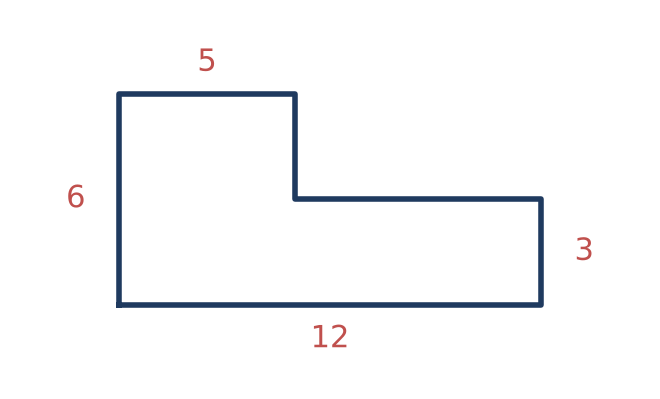
The figure shown is made of rectangles, and all corners are right angles. What is its area, in square units?
Show solution
AnswerD — 51
Step-by-step
- Think of the figure as a 12 × 6 rectangle with a 7 × 3 corner removed (7 = 12 − 5 and 3 = 6 − 3).
- The big rectangle is 12 × 6 = 72.
- The corner is 7 × 3 = 21.
- So the area is 72 − 21 = 51.
Fast methodSplit the figure into rectangles or subtract the missing corner.
Quick checksplit another way, 5 × 6 + 7 × 3 = 30 + 21 = 51 ✓.
Why the other choices are wrong
- A (15): multiplied the two short sides
- B (21): found the area of the missing corner only: 7 × 3 = 21
- C (36): found the perimeter
- E (72): did not remove the missing corner
3.
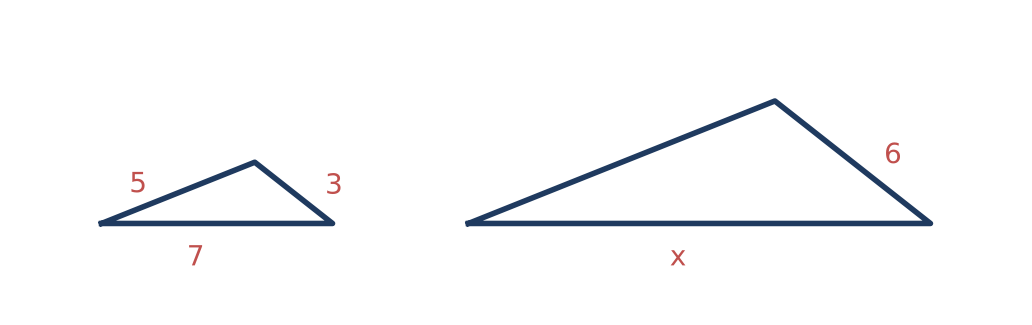
The two triangles shown are similar, with corresponding sides in matching positions. What is the value of x?
Show solution
AnswerE — 14
Step-by-step
- The triangles are similar.
- So corresponding sides are proportional.
- The scale factor from the first triangle to the second is 6 ÷ 3 = 2.
- So x = 7 × 2 = 14.
Fast methodFind the scale factor from one known pair, then multiply.
Quick check14 ÷ 7 = 2, the same ratio as 6 ÷ 3 ✓.
Why the other choices are wrong
- A (): divided by the scale factor
- B (7): gave the corresponding side of the first triangle
- C (9): added the scale factor instead of multiplying: 7 + 2 = 9
- D (10): added the difference instead of multiplying by the scale factor
4.
What is the midpoint of the segment with endpoints (−2, 9) and (−6, −7)?
Show solution
AnswerE — (−4, 1)
Step-by-step
- Average the x-coordinates: (−2 + (−6)) ÷ 2 = −4.
- Average the y-coordinates: (9 + (−7)) ÷ 2 = 1.
- So the midpoint is (−4, 1).
Fast methodMidpoint: average the x's and average the y's.
Quick check(−4, 1) is the same distance from both endpoints along each axis ✓.
Why the other choices are wrong
- A ((−2, −8)): subtracted the coordinates before halving
- B ((−8, 2)): added without dividing by 2
- C ((1, −4)): reversed the x- and y-coordinates
- D ((−4, 8)): halved the difference of the y-coordinates: (9 − (−7)) ÷ 2 = 8
5.
What is the sum of the interior angles of a polygon with 20 sides?
Show solution
AnswerB — 3240
Step-by-step
- Use the formula (n − 2) × 180° with n = 20.
- (20 − 2) × 180° = 18 × 180°.
- So (20 − 2) × 180° = 3240°.
Fast methodInterior sum (n − 2)·180°; exterior sum always 360°.
Quick checkinterior + exterior = 180° at each vertex, and 20 exterior angles of 18° make 360° ✓.
Why the other choices are wrong
- A (360): gave the exterior-angle sum
- C (3420): used (n − 1) × 180°
- D (3600): used n × 180°
- E (6480): used 360° instead of 180°: (20 − 2) × 360° = 6480
6.
A triangle has base 6x and height x. Its area is 27. What is the value of x?
Show solution
AnswerA — 3
Step-by-step
- Area = ½ × base × height = ½ × 6x × x = 3.
- So 3 = 27, = 9 and x = 3.
Fast methodWrite the formula with the unknown, then solve.
Quick check½ × 18 × 3 = 27 ✓.
Why the other choices are wrong
- B (3): multiplied by ½ twice
- C (4.5): set the base equal to the area: 6x = 27, so x = 4.5
- D (9): forgot to take the square root
- E (18): gave the base
7.
What is the distance between (−6, −1) and (−21, −9)?
Show solution
AnswerB — 17
Step-by-step
- d = .
- The differences are −21 − (−6) = −15 and −9 − (−1) = −8.
- So d = = = 17.
Fast methodDistance = ; look for a Pythagorean triple.
Quick check = 289 = 225 + 64 ✓.
Why the other choices are wrong
- A (): subtracted the squares
- C (23): added the horizontal and vertical distances
- D (): added the coordinates instead of subtracting: =
- E (289): forgot to take the square root
8.
In a 30°-60°-90° triangle, the longer leg has length 5. What is the length of the shorter leg?
Show solution
AnswerB — 5
Step-by-step
- In a 30°-60°-90° triangle the sides are in the ratio 1 : : 2 (shorter leg : longer leg : hypotenuse).
- So the longer leg is times the shorter leg.
- The shorter leg is 5 ÷ = 5.
Fast method45°-45°-90°: 1 : 1 : . 30°-60°-90°: 1 : : 2.
Quick checkthe sides are 5, 5 and 10, and + = 25 + 75 = 100 = ✓.
Why the other choices are wrong
- A (5): divided the longer leg by 2 instead of by : 5 ÷ 2 = 5
- C (5): gave the longer leg instead
- D (10): gave the hypotenuse instead: 2 × 5 = 10
- E (15): multiplied by instead of dividing: 5 × = 15
9.
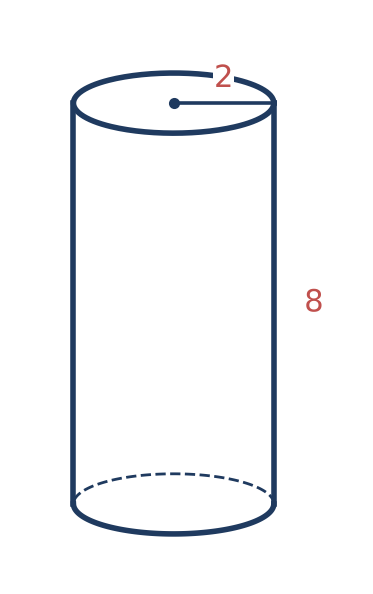
What is the total surface area of the cylinder shown? Give your answer in terms of π.
Show solution
AnswerC —
Step-by-step
- SA = r² + rh.
- SA = × + × 2 × 8 = + .
- So SA = .
Fast methodBases: 2 × π × = ; side: circumference × height = × 8 = ; total + = .
Quick checkthe two bases are 2 × π × = , and the curved side unrolls to a rectangle × 2 = wide and 8 tall, so × 8 = ; + = ✓.
Why the other choices are wrong
- A (): found only the lateral area
- B (): included only one circular base
- D (): used r² for the bases: × + = + =
- E (): used the diameter as the radius
10.
A figure has an area of 4 square units. Each length is multiplied by . What is the area of the new figure?
Show solution
AnswerA — 1
Step-by-step
- When lengths are multiplied by k, the area is multiplied by .
- So the new area is 4 × = 4 × = 1.
Fast methodArea scales by ; length ratio is the square root of the area ratio.
Quick check1 ÷ 4 = = ✓.
Why the other choices are wrong
- B (2): multiplied the area by the scale factor
- C (4): multiplied the area by twice the scale factor
- D (): added the square of the scale factor
- E (16): divided by the square of the scale factor instead of multiplying: 4 ÷ = 16
11.
In a circle with radius 9, a central angle of 60° intercepts an arc. What is the length of the arc?
Show solution
AnswerB —
Step-by-step
- Arc length = (central angle ÷ 360°) × r.
- So the arc length is × × 9 = × = .
Fast methodArc = × circumference.
Quick check ÷ = = ✓.
Why the other choices are wrong
- A (): used πr instead of r
- C (): used the diameter as the radius: × × 18 =
- D (): found the sector area
- E (): gave the whole circumference
12.
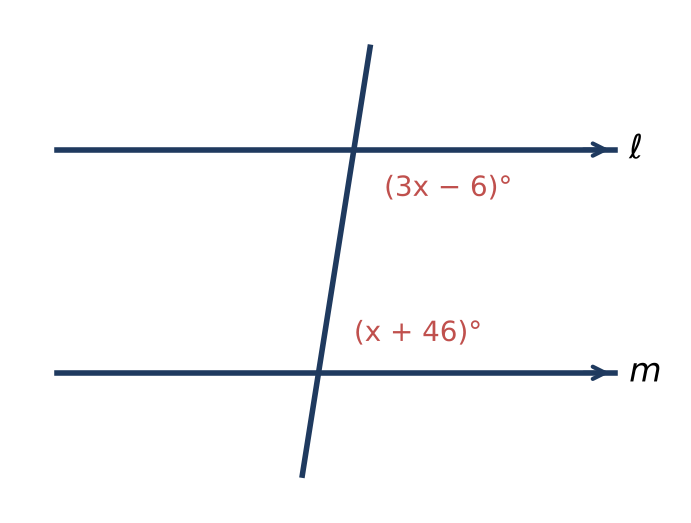
In the figure, lines ℓ and m are parallel. What is the value of x?
Show solution
AnswerE — 35
Step-by-step
- The two angles are same-side interior angles.
- So they are supplementary: (3x − 6) + (x + 46) = 180.
- Solving gives x = 35.
- So the angles are 99° and 81°.
Fast methodDecide equal or supplementary first, then solve the linear equation.
Quick checkwith x = 35 the angles are 99° and 81°, which add to 180° ✓.
Why the other choices are wrong
- A (): set the angles to add to 90°: 4x + 40 = 90, so x =
- B (20): assumed the angles are equal and moved the constants with the wrong sign: 3x − x = 46 − 6, so x = 20
- C (26): assumed the angles are equal: 3x − 6 = x + 46, so x = 26
- D (32): added 6 instead of subtracting it: 4x + 52 = 180, so x = 32
13.
Two angles measure (7x + 2)° and (2x − 11)°. The angles are supplementary. What is the measure of the first angle, in degrees?
Show solution
AnswerE — 149
Step-by-step
- Supplementary angles add to 180°: (7x + 2) + (2x − 11) = 180.
- So 9x − 9 = 180, 9x = 189 and x = 21.
- The first angle is 7(21) + 2 = 149°.
Fast methodWrite the angle relationship as an equation, then solve.
Quick checkthe angles are 149° and 31°, which add to 180° ✓.
Why the other choices are wrong
- A (21): gave x instead of the angle
- B (31): gave the other angle
- C (79): used 90° instead of 180°: 9x − 9 = 90, x = 11, so 7(11) + 2 = 79
- D (147): forgot the constant
14.
Two sides of a triangle have lengths 4 and 21. Which inequality describes all possible lengths x of the third side?
Show solution
AnswerD — 17 < x < 25
Step-by-step
- By the triangle inequality, the third side must be greater than the difference and less than the sum of the other two sides.
- 21 − 4 = 17 and 4 + 21 = 25.
- So 17 < x < 25.
Fast methodThird side: difference < x < sum.
Quick checkx = 17 or x = 25 would make a flat triangle, so both endpoints are excluded ✓.
Why the other choices are wrong
- A (17 ≤ x ≤ 25): included the endpoints
- B (x < 25): forgot the lower bound
- C (4 < x < 21): used the two given sides as the bounds
- E (x > 17): forgot the upper bound
15.
A sector of a circle with radius 4 has a central angle of 135°. What is the area of the sector?
Show solution
AnswerC —
Step-by-step
- Sector area = (central angle ÷ 360°) × πr².
- So the area is × π × = × = .
Fast methodSector = × area of the circle.
Quick check ÷ = = ✓.
Why the other choices are wrong
- A (): forgot to square the radius
- B (): found the arc length
- D (): found the area of the larger sector: × =
- E (): gave the whole area
16.
Point P lies on segment AB with A(9, 10) and B(4, 0), and AP : PB = 2 : 3. What are the coordinates of P?
Show solution
AnswerC — (7, 6)
Step-by-step
- P is of the way from A to B.
- The change from A to B is (−5, −10).
- of that is (−2, −4).
- So P = (9 + (−2), 10 + (−4)) = (7, 6).
Fast methodP = A + (B − A).
Quick checkAP is of AB and PB is of AB, a ratio of 2 : 3 ✓.
Why the other choices are wrong
- A ((6, 4)): reversed the ratio
- B ((11, 14)): added the change with the wrong sign: (9 + 2, 10 + 4)
- D (): found the midpoint
- E (): used of the segment instead of
17.
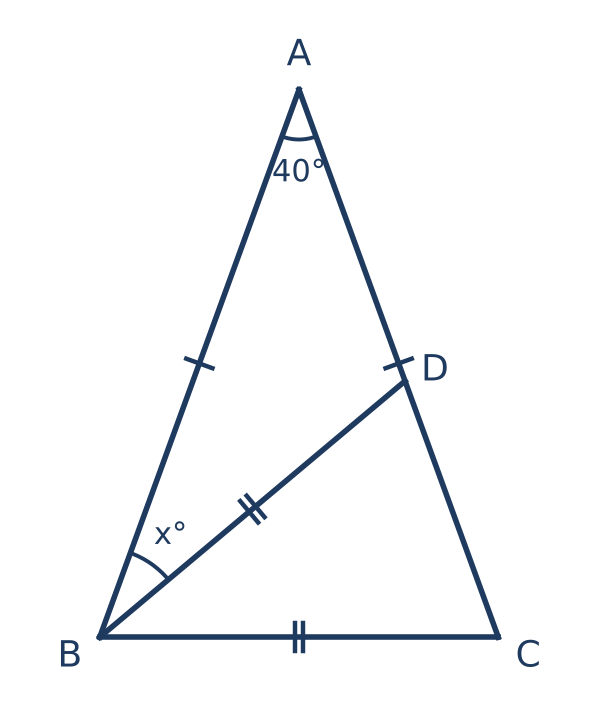
In the figure, AB = AC and BD = BC. What is the value of x?
Show solution
AnswerB — 30
Step-by-step
- AB = AC, so angles B and C of triangle ABC are equal: (180 − 40) ÷ 2 = 70° each.
- BD = BC, so in triangle BDC the angles at D and C are equal: angle BDC = 70°.
- Then angle DBC = 180 − 70 − 70 = 40°.
- x = angle ABC − angle DBC = 70 − 40 = 30.
Fast methodBase angles 70°; triangle BDC copies the 70°, leaving 40° at B; x = 70 − 40.
Quick checktriangle ABD has angles 40, 30, and 180 − 70 = 110 (at D), and 40 + 30 + 110 = 180 ✓
Why the other choices are wrong
- A (15): made the angles at B and D of triangle BDC equal (55° each), so x = 70 − 55
- C (35): assumed BD bisects angle B: 70 ÷ 2
- D (40): gave angle DBC (40°) instead of angle ABD
- E (70): gave the whole base angle ABC
18.
A solid is a cylinder with radius 2 and height 12, with a cone of the same radius and height 3 on top. What is its volume? Give your answer in terms of π.
Show solution
AnswerD —
Step-by-step
- Cylinder: πr²h = π × × 12 = .
- Cone: ⅓πr²h = ⅓ × π × × 3 = .
- Total = + = .
Fast methodFind each part's volume and add.
Quick check is more than the cylinder alone, ✓.
Why the other choices are wrong
- A (): forgot to square the radius: π × 2 × 12 + ⅓ × π × 2 × 3 =
- B (): subtracted the cone
- C (): left out the cone
- E (): forgot the ⅓ for the cone
19.
A chord is 21 units from the center of a circle with radius 29. What is the length of the chord?
Show solution
AnswerA — 40
Step-by-step
- The perpendicular from the center bisects the chord, forming a right triangle with hypotenuse 29 and leg 21.
- Half the chord is = = 20.
- So the chord is 2 × 20 = 40.
Fast methodHalf-chord² + distance² = radius².
Quick check + = 841 = ✓.
Why the other choices are wrong
- B (50): added the radius and the distance: 29 + 21 = 50
- C (58): gave the diameter
- D (2): added the squares
- E (400): forgot to take the square root
20.
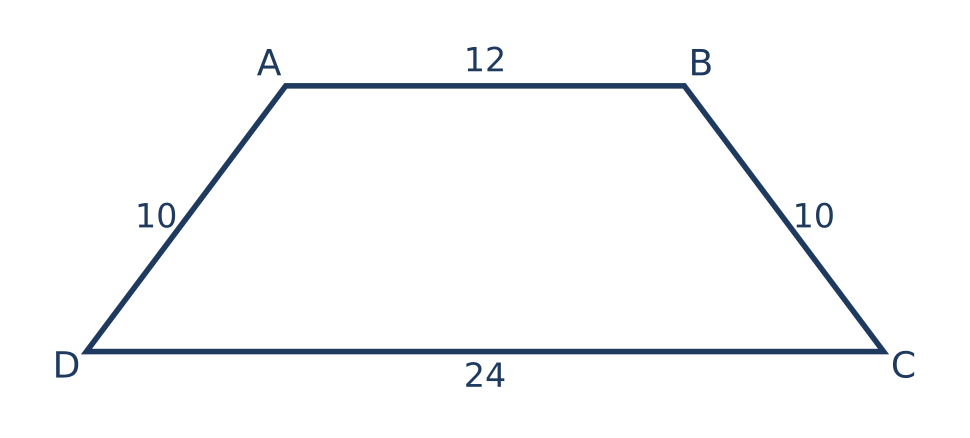
In the figure, ABCD is a trapezoid with AB parallel to DC. What is the area of ABCD?
Show solution
AnswerC — 144
Step-by-step
- Drop perpendiculars from A and B to DC; they cut off two equal pieces of length (24 − 12) ÷ 2 = 6.
- Each leg is 10, so the height is = = 8.
- Area = ½ × (12 + 24) × 8 = 18 × 8 = 144.
Fast methodSpot the 6-8-10 right triangle at each end: height 8, then average base 18 × 8.
Quick checkrectangle 12 × 8 = 96 plus two triangles ½ × 6 × 8 = 24 each: 96 + 48 = 144 ✓
Why the other choices are wrong
- A (96): multiplied the shorter base by the height (12 × 8) and left out the two end triangles
- B (108): used the 6-unit end piece as the height: ½ × 36 × 6
- D (180): used the slanted leg 10 as the height: ½ × 36 × 10
- E (288): forgot the ½ in the trapezoid formula: 36 × 8