Geometry and Measurement: Study Guide
The Upper Level SSAT (grades 8–11) has two 25-question Quantitative sections, 30 minutes each, with five answer choices and no calculator. A wrong answer loses ¼ point, so guess only after eliminating choices. This topic covers geometry and measurement: angles and parallel lines, triangles and the Pythagorean theorem, similar figures, perimeter, area and volume, circles, the coordinate plane and unit conversions.
- Lines and Angles
- Triangles
- Area and Perimeter
- Circles
- Volume and Surface Area
- Coordinate Geometry and Transformations
- Measurement and Units
Lines and Angles
Angle pairs: complementary angles add to 90°, supplementary angles add to 180°, and vertical angles are equal. When a line crosses two parallel lines, corresponding angles are equal, alternate interior angles are equal, and same-side interior angles add to 180°.
Key formulas| Complementary | |
| Supplementary | |
| Vertical angles | |
| Around a point | |
| Parallel lines | |
| Same-side interior | |
| Polygon angle sum | |
| Regular polygon |
Parallel lines and transversals
Method. Parallel lines: all acute angles are equal, all obtuse angles are equal, and an acute + an obtuse = 180°.
Worked example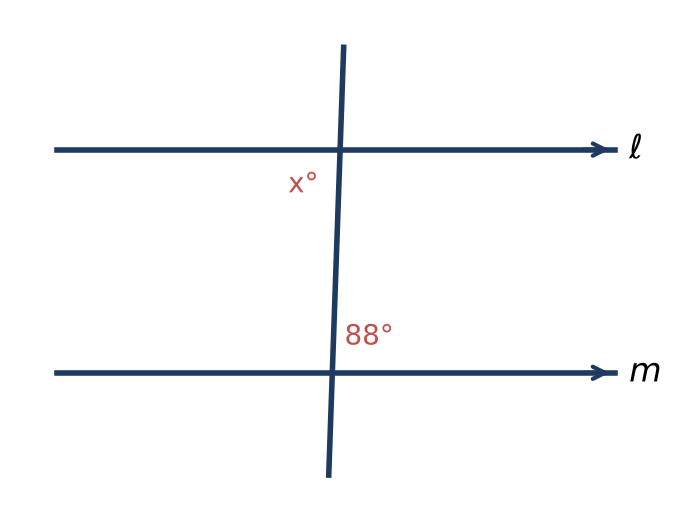
- The angle marked 88° and the angle marked x° are alternate interior angles.
- With parallel lines, alternate interior angles are equal.
- So x = 88.
- A (2): used complementary angles
- C (92): assumed the angles are supplementary
- D (178): added 90° instead of subtracting from it: 88 + 90 = 178
- E (272): subtracted from 360°
Angle relationships with algebra
Method. Write the angle relationship as an equation, then solve.
Worked example- Vertical angles are equal: 5x + 12 = 4x + 17.
- So x = 5.
- The first angle is 5(5) + 12 = 37°.
- A (5): gave x instead of the angle
- B (25): forgot the constant
- C (29): moved the 12 with the wrong sign and gave x: x = 17 + 12 = 29
- E (143): gave the supplement
Angles in polygons
Method. Interior sum (n − 2)·180°; exterior sum always 360°.
Worked example- The exterior angles of any polygon add to 360°.
- Each of the 20 equal exterior angles is 360° ÷ 20 = 18°.
- B (20): divided by n − 2 instead of n: 360 ÷ 18 = 20
- C (144): subtracted the exterior from the interior angle
- D (162): gave the interior angle
- E (342): subtracted from 360°
Exterior angles of triangles
Method. Exterior angle = sum of the two remote interior angles.
Worked example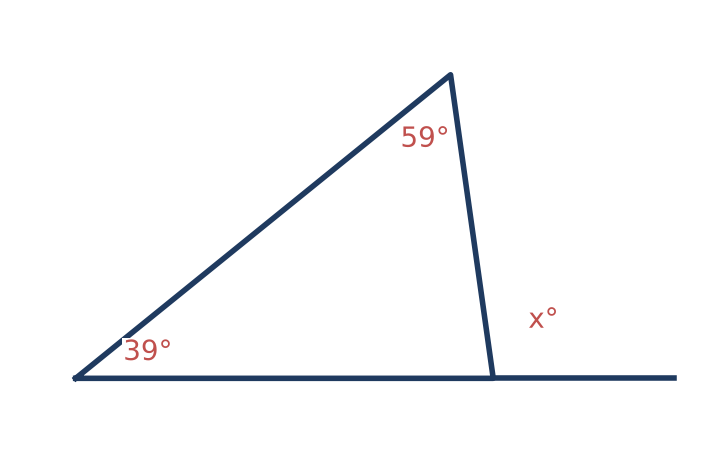
- An exterior angle of a triangle equals the sum of the two remote interior angles.
- x = 39 + 59.
- So x = 98.
- A (20): subtracted the remote angles instead of adding: 59 − 39 = 20
- B (82): gave the interior angle at that vertex
- D (141): used only one remote angle
- E (262): subtracted from 360°
Parallel lines with algebra
Method. Decide equal or supplementary first, then solve the linear equation.
Worked example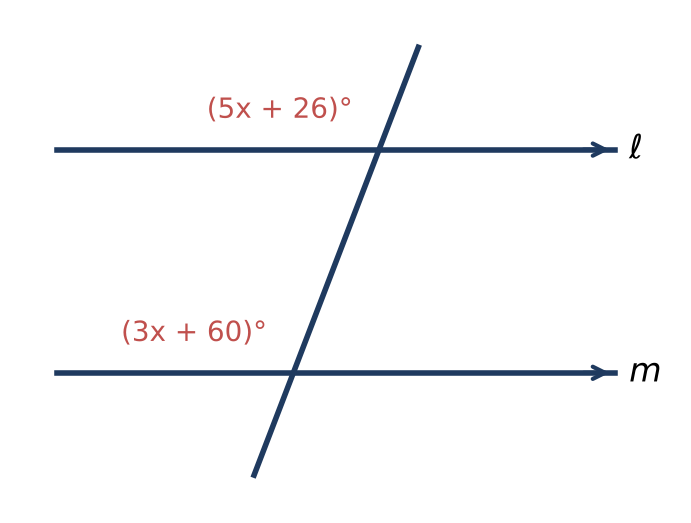
- The two angles are corresponding angles.
- So they are equal: (5x + 26) = (3x + 60).
- Solving gives x = 17.
- So the angles are 111° and 111°.
- A (): assumed the angles are supplementary
- C (43): moved the constants with the wrong sign
- D (69): gave the supplement of the angle instead of x: 180 − 111 = 69
- E (111): gave the angle instead of x
Triangles
Angles sum to 180°, the Pythagorean theorem links right-triangle sides, and similar triangles have equal angles and proportional sides.
Key formulas| Angle sum | |
| Pythagorean theorem | |
| Exterior angle | |
| Special right triangles | |
| Similar triangles | |
| Triangle inequality | |
| Area |
Triangle angle problems
Method. Largest angle = 180 × (largest part ÷ sum of the parts).
Worked example- Let the angles be 2k, 5k and 8k.
- Then 15k = 180.
- So k = 12.
- The largest angle is 8 × 12 = 96°.
- A (12): gave the value of one part
- B (24): gave the smallest angle
- C (60): assumed the three angles are equal
- E (192): used 360° for the angle sum: 8 × 24 = 192
Pythagorean theorem
Method. Recognize the triple 20–21–29.
Worked example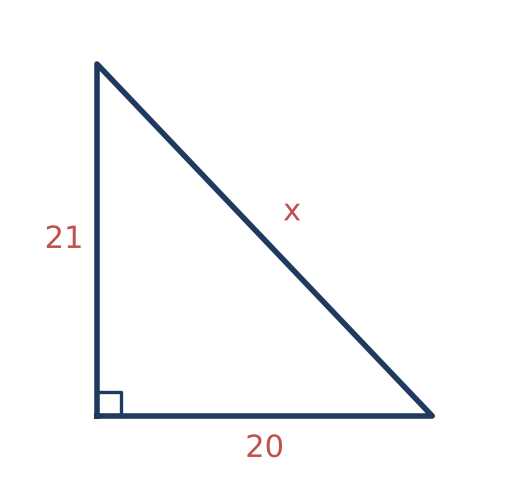
- By the Pythagorean theorem, = + = 441 + 400 = 841.
- So x = = 29.
- A (1): subtracted the legs: 21 − 20 = 1
- B (): subtracted the squares: =
- D (41): added the legs: 21 + 20 = 41
- E (841): forgot to take the square root: 441 + 400 = 841
Similar triangles
Method. Find the scale factor from one known pair, then multiply.
Worked example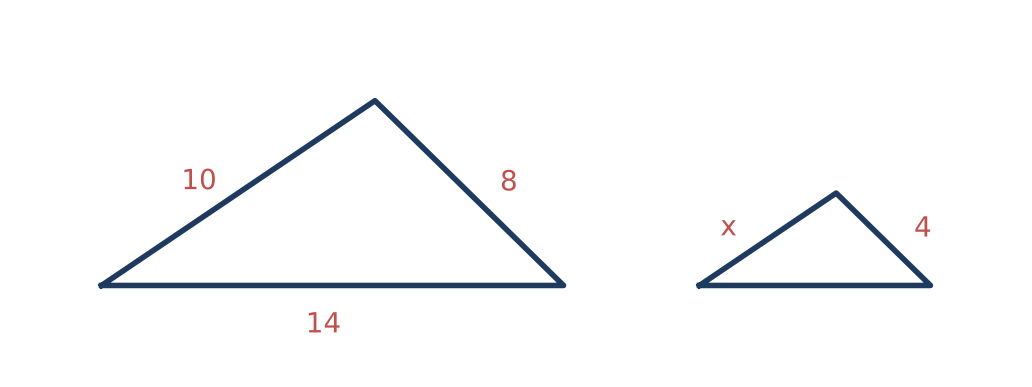
- The triangles are similar.
- So corresponding sides are proportional.
- The scale factor from the first triangle to the second is 4 ÷ 8 = .
- So x = 10 × = 5.
- B (6): added the difference instead of multiplying by the scale factor
- C (10): gave the corresponding side of the first triangle
- D (20): divided by the scale factor
- E (40): multiplied by the side length instead of by the scale factor: 10 × 4 = 40
Similar triangles in context
Method. Height ÷ shadow is constant at one time of day.
Worked example- The sun's rays make similar right triangles.
- So height ÷ shadow is the same for both.
- = .
- So x = 5 × 40 ÷ 8 = 25.
- A (1): multiplied the pole's height by its shadow and divided by the tree's shadow
- C (37): added the difference instead of using a ratio
- D (40): gave the tree's shadow length as its height
- E (64): set up the proportion upside down
Special right triangles
Method. 45°-45°-90°: 1 : 1 : . 30°-60°-90°: 1 : : 2.
Worked example- In a 30°-60°-90° triangle the sides are in the ratio 1 : : 2 (shorter leg : longer leg : hypotenuse).
- The longer leg is 2.
- So the shorter leg is 2.
- Then the hypotenuse is 4.
- A (2): gave the shorter leg instead
- B (2): found the shorter leg 2, then used the 45°-45°-90° ratio: 2
- C (2): gave the longer leg instead
- E (4): doubled the longer leg instead of the shorter leg: 2 × 2 = 4
Triangle inequality
Method. Third side: difference < x < sum.
Worked example- The third side must be strictly between 10 − 3 = 7 and 3 + 10 = 13.
- Only 9 lies strictly between 7 and 13.
- A (5): checked only that the side is less than the sum (5 < 13) and ignored the difference
- B (7): allowed the third side to equal the difference
- D (13): allowed the third side to equal the sum
- E (15): allowed a side longer than the sum
Area and Perimeter
Area measures square units inside a figure; perimeter adds the side lengths. Split composite figures into simple shapes. If lengths are multiplied by k, the perimeter is multiplied by k and the area by k².
Key formulas| Rectangle | |
| Triangle | |
| Parallelogram | |
| Trapezoid | |
| Circle | |
| Scale factor k |
Composite figures
Method. Split the figure into rectangles or subtract the missing corner.
Worked example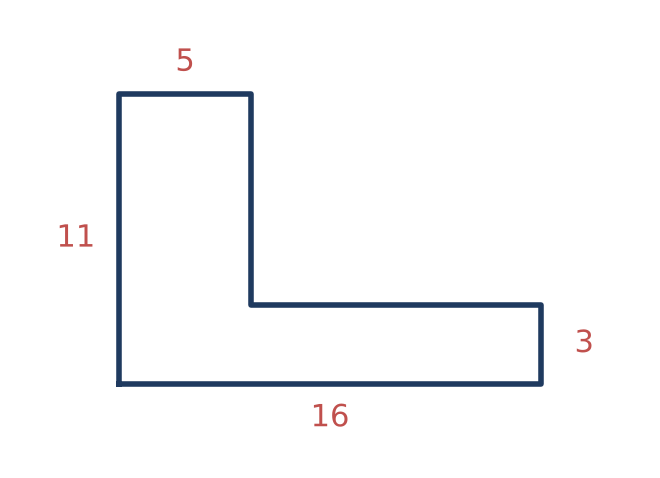
- Think of the figure as a 16 × 11 rectangle with an 11 × 8 corner removed (11 = 16 − 5 and 8 = 11 − 3).
- The big rectangle is 16 × 11 = 176.
- The corner is 11 × 8 = 88.
- So the area is 176 − 88 = 88.
- A (15): multiplied the two short sides
- B (54): found the perimeter
- D (103): counted the overlapping corner twice: 5 × 11 + 16 × 3 = 55 + 48 = 103
- E (176): did not remove the missing corner
Area and perimeter with algebra
Method. Write the formula with the unknown, then solve.
Worked example- P = 2 × (sum of the two sides).
- So 2(3x + 7) = 26.
- Then 3x + 7 = 13.
- So 3x = 6 and x = 2.
- B (): ignored the constants
- C (6): gave 3x instead of x: 3x = 13 − 7 = 6
- D (): forgot to double the sum of the sides
- E (): moved the constants with the wrong sign
Scaling and area
Method. Area scales by ; length ratio is the square root of the area ratio.
Worked example- When lengths are multiplied by k, the area is multiplied by .
- So the new area is 13 × = 13 × 16 = 208.
- A (29): added the square of the scale factor
- B (52): multiplied the area by the scale factor
- C (104): multiplied the area by twice the scale factor
- D (169): squared the original area instead of the scale factor: = 169
Shaded regions
Method. Shaded area = outer area − inner area.
Worked example- The square's diagonal is the diameter, 20.
- A square with diagonal d has area ÷ 2 = 400 ÷ 2 = 200.
- Circle area = π × = .
- Shaded area = − 200.
- A ( − 400): used a square whose side is the diameter: − = − 400
- C (200): gave the area of the square: ÷ 2 = 200
- D ( − 100): used for the square's area: − = − 100
- E ( − 200): used the diameter as the radius of the circle: π × − 200 = − 200
Area in the coordinate plane
Method. Use a horizontal or vertical side as the base, or box the figure and subtract.
Worked example- Two vertices have y = 4.
- So that side is horizontal with length 3 − (−5) = 8.
- The height is the vertical distance from the third vertex: |−5 − 4| = 9.
- So A = ½ × 8 × 9 = 36.
- A (4): made a sign slip in the height: |−5 + 4| = 1, so ½ × 8 × 1 = 4
- B (): added the base and height, then halved: ½ × (8 + 9) =
- C (12): used the horizontal distance from (−5, 4) to (−2, −5), which is 3, as the height: ½ × 8 × 3 = 12
- E (72): forgot to multiply by ½: 8 × 9 = 72
Circles
Circumference and area use π; an arc or a sector is the fraction θ/360° of the whole circle. An inscribed angle is half the central angle on the same arc, and a tangent is perpendicular to the radius at the point of contact.
Key formulas| Diameter | |
| Circumference | |
| Area | |
| Arc length | |
| Sector area | |
| Inscribed angle | |
| Tangent |
Area of a circle
Method. A = πr²; halve the diameter first.
Worked example- The area is A = πr².
- So A ≈ 3.14 × = 3.14 × 529 = 1661.06 square feet.
- A (72.22): multiplied π by r instead of : 3.14 × 23 = 72.22
- B (144.44): used the circumference formula r
- D (3322.12): multiplied the area by 2
- E (6644.24): used the diameter instead of the radius
Working backward with circles
Method. Find the radius first, then use the other formula.
Worked example- C = r = .
- So r = 6.
- The area is A = πr² = π × = square units.
- A (): forgot to square the radius
- B (): gave the circumference
- C (): halved the area formula (semicircle): π × ÷ 2 =
- E (): used the diameter as the radius
Semicircles and quarter circles
Method. Take the right fraction of the full circle, then add any straight edges.
Worked example- The curved part is half the circumference: 3.14 × 6 ÷ 2 = 9.42.
- The straight side is the diameter, 6.
- So the perimeter is 9.42 + 6 = 15.42 meters.
- A (9.42): left out the diameter
- B (12.42): added the radius instead of the diameter: 9.42 + 3 = 12.42
- D (18.84): gave the full circumference only
- E (24.84): used the full circumference
Arc length
Method. Arc = × circumference.
Worked example- Arc length = (central angle ÷ 360°) × r.
- So the arc length is × × 11 = × = .
- A (): used πr instead of r
- C (): used 180° instead of 360°: × × 11 =
- D (): found the sector area
- E (): gave the whole circumference
Sector area
Method. Sector = × area of the circle.
Worked example- Sector area = (central angle ÷ 360°) × πr².
- So the area is × π × = × = .
- A (): forgot to square the radius
- B (): found the arc length
- C (): found the area of the rest of the circle
- D (): used half the circle instead of : ½ × =
Tangent lines
Method. Radius ⊥ tangent, so use the Pythagorean theorem.
Worked example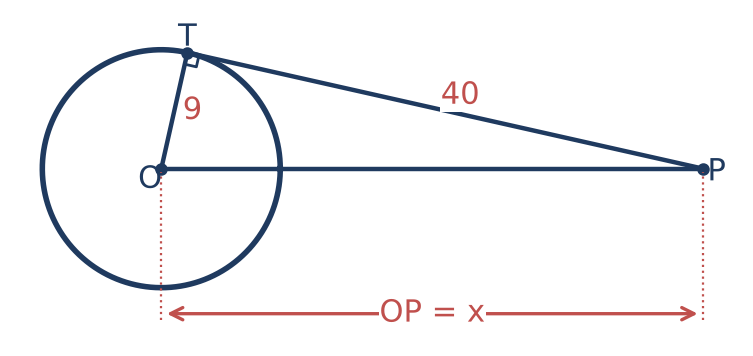
- A tangent is perpendicular to the radius at the point of tangency.
- So the triangle is a right triangle with legs 9 and 40.
- = + = 81 + 1600 = 1681.
- So x = 41.
- A (31): subtracted the lengths
- B (7): subtracted the squares
- D (49): added the lengths
- E (1681): forgot to take the square root: + = 1681
Chords
Method. Half-chord² + distance² = radius².
Worked example- The perpendicular from the center bisects the chord, forming a right triangle with hypotenuse 29 and leg 20.
- Half the chord is = = 21.
- So the chord is 2 × 21 = 42.
- A (18): subtracted the lengths instead of the squares, then doubled: 2 × (29 − 20) = 18
- B (21): gave half the chord
- D (58): gave the diameter instead of the chord: 2 × 29 = 58
- E (2): added the squares: 2 = 2
Volume and Surface Area
Volume measures cubic units; prisms and cylinders use base area × height, pyramids and cones take one third of that. If lengths are multiplied by k, surface area is multiplied by k² and volume by k³.
Key formulas| Prism / cylinder | |
| Pyramid / cone | |
| Sphere | |
| Rectangular box | |
| Cylinder surface | |
| Scale factor k |
Surface area of prisms
Method. SA = 2(lw + lh + wh): add the three different faces, then double.
Worked example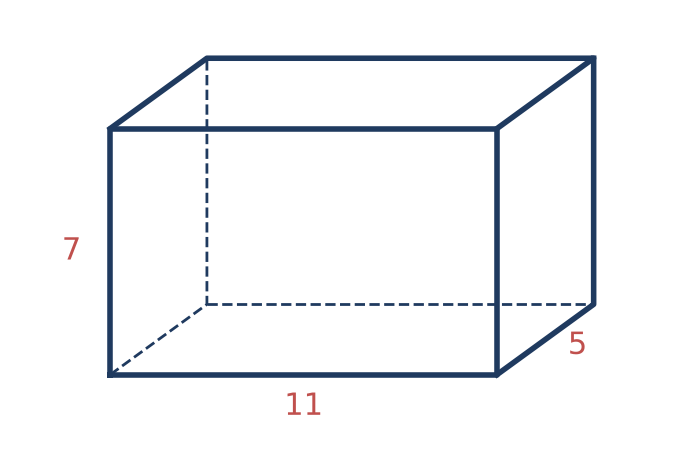
- A rectangular prism has three pairs of equal faces.
- The faces have areas 11 × 5 = 55, 11 × 7 = 77 and 5 × 7 = 35.
- So SA = 2 × (55 + 77 + 35) = 2 × 167 = 334.
- A (167): added the three face areas but forgot to double: 55 + 77 + 35 = 167
- C (385): found the volume
- D (462): used the largest face for all six faces
- E (668): counted each face twice
Volume with fractional edges
Method. Change mixed numbers to improper fractions, then multiply.
Worked example- V = l × w × h.
- Write 1 as .
- So V = × 8 × 4 = 56 cubic feet.
- A (13 ): added the three dimensions: 1 + 8 + 4 = 13
- B (14): multiplied only two of the dimensions: × 8 = 14
- C (24): read 1 as 1 × : × 8 × 4 = 24
- D (32): dropped the fraction part of the length: 1 × 8 × 4 = 32
Volume of cylinders
Method. Cylinder: V = πr²h; SA = r² + rh.
Worked example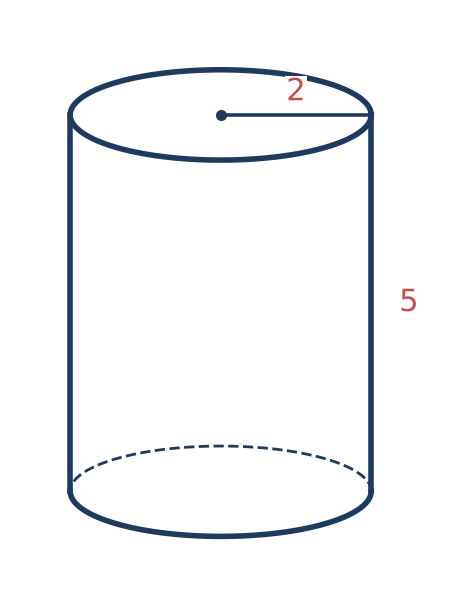
- V = πr²h.
- V = π × × 5.
- So V = .
- A (): found the area of the base only (forgot the height): π × =
- B (): used the cone formula
- C (): forgot to square the radius
- E (): used the diameter as the radius
Volume of triangular prisms
Method. Prism: V = base area × length; use the legs for a right triangle.
Worked example- V = (area of base) × length.
- The base area is ½ × 9 × 12 = 54.
- So V = 54 × 15 = 810 cubic units.
- A (540): found the lateral area
- C (): used the hypotenuse as a leg
- D (1350): used the hypotenuse in place of the leg 9: ½ × 12 × 15 × 15 = 1350
- E (1620): forgot the ½ in the triangle's area
Surface area of cylinders
Method. Cylinder: V = πr²h; SA = r² + rh.
Worked example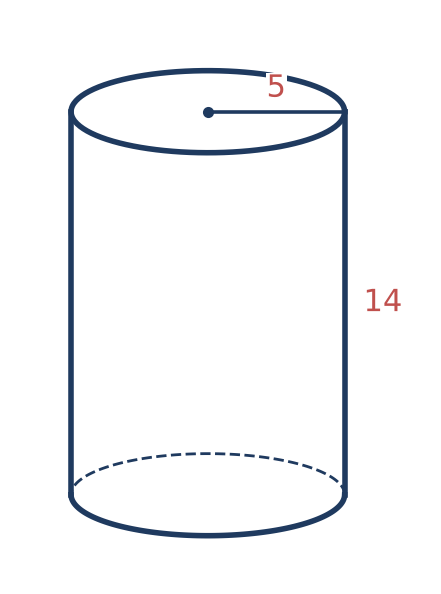
- SA = r² + rh.
- SA = × + × 5 × 14 = + .
- So SA = .
- B (): counted the curved surface twice
- C (): found the volume
- D (): used the diameter as the radius
- E (): swapped the radius and the height: × + × 14 × 5 =
Cones and pyramids
Method. Cone: V = ⅓πr²h; height is perpendicular, not the slant.
Worked example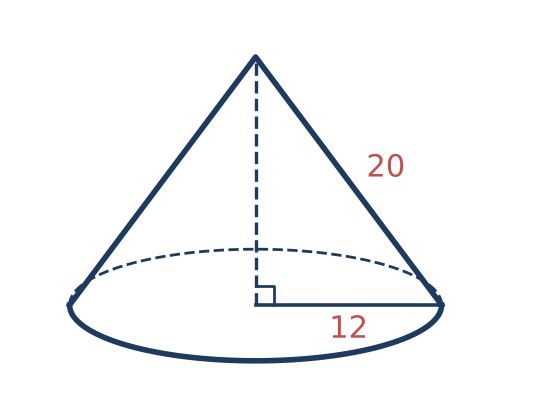
- The height, slant height and radius form a right triangle.
- So h = = = 16.
- V = ⅓πr²h = ⅓ × π × × 16 = ⅓ × = .
- B (): used the slant height as the height
- C (): used ½ instead of ⅓: ½ × π × × 16 =
- D (): forgot the ⅓
- E (): used the diameter as the radius
Spheres
Method. Sphere: V = πr³ and SA = r².
Worked example- SA = r².
- SA = 4 × π × .
- So SA = .
- A (): found the area of a great circle
- C (): found the volume
- D (): used the diameter as the radius
- E (): cubed the radius instead of squaring it: × =
Scaling and volume
Method. Volume scales by ; area by .
Worked example- When lengths are multiplied by k, volume is multiplied by .
- So the new volume is 34 × = 34 × 64 = 2176.
- A (136): multiplied the volume by the scale factor
- B (408): multiplied by 4 × 3 instead of : 34 × 12 = 408
- C (544): squared the scale factor
- E (2210): added the original volume
Solving for a dimension
Method. Substitute into the volume formula and solve for the unknown.
Worked example- V = πr²h.
- So = π × × 4.
- Divide by : = 25.
- So r = 5.
- B (10): gave the diameter
- C (): divided by 2h instead of taking a square root
- D (20): multiplied by the height instead of dividing: = 100 × 4 = 400, r = 20
- E (25): forgot to take the square root
Composite solids
Method. Find each part's volume and add.
Worked example- Cylinder: πr²h = π × × 3 = .
- Hemisphere: ½ × πr³ = × π × = .
- Total = + = .
- A (): subtracted the hemisphere
- B (): gave only the hemisphere's volume
- C (): left out the hemisphere
- D (): squared the radius in the hemisphere
Coordinate Geometry and Transformations
Distance and midpoint formulas come from the Pythagorean theorem and averaging. A translation slides every point by the same amount; reflections and rotations move points by the fixed coordinate rules below.
Key formulas| Distance | |
| Midpoint | |
| Point a fraction t of the way from A to B | |
| Translation | |
| Reflect over x-axis / y-axis | |
| Rotate 90° counterclockwise | |
| Rotate 180° |
Transformations on coordinates
Method. Right/left changes x; up/down changes y.
Worked example- Moving right or left changes x: 8 − 5 = 3.
- Moving up or down changes y: 8 + 4 = 12.
- The image is (3, 12).
- B ((13, 12)): moved right instead of left
- C ((13, 4)): moved in the opposite directions
- D ((12, 3)): applied the horizontal move to y and the vertical move to x
- E ((3, 4)): moved the wrong way vertically
Midpoint formula
Method. Midpoint: average the x's and average the y's.
Worked example- Average the x-coordinates: (1 + 2) ÷ 2 = .
- Average the y-coordinates: (−5 + (−5)) ÷ 2 = −5.
- So the midpoint is .
- B (): divided only the x-sum by 2
- C (): subtracted the coordinates before halving
- D ((3, −10)): added without dividing by 2
- E (): reversed the x- and y-coordinates
Distance formula
Method. Distance = ; look for a Pythagorean triple.
Worked example- d = .
- The differences are 5 − (−2) = 7 and −1 − (−4) = 3.
- So d = = .
- A (): forgot to square the differences: =
- B (): added the coordinates instead of subtracting
- C (2): subtracted the squares
- E (58): forgot to take the square root
Partitioning a segment
Method. P = A + (B − A).
Worked example- P is of the way from A to B.
- The change from A to B is (3, −12).
- of that is (2, −8).
- So P = (0 + 2, 8 + (−8)) = (2, 0).
- A ((1, 4)): reversed the ratio
- B (): found the midpoint
- C ((2, −8)): gave of the change instead of adding it to A
- E ((6, −16)): used of the segment instead of
Measurement and Units
Convert by multiplying by a fraction equal to 1 (such as 12 inches over 1 foot) so the old unit cancels. For time, carry 60 minutes as 1 hour.
Key formulas| Length (US) | |
| Metric | |
| Weight and capacity | |
| Liquid (US) | |
| Time | |
| Unit factor |
Speed conversion: feet per second to miles per hour
Method. Use 88 feet per second = 60 miles per hour: 22 is of 88, so the speed is of 60 = 15.
Worked example- An hour has 60 × 60 = 3,600 seconds, so 22 feet per second is 22 × 3,600 = 79,200 feet per hour.
- A mile is 5,280 feet, so 79,200 ÷ 5,280 = 15 miles per hour.
- A (0.25): multiplied by 60 only once, which gives miles per minute
- C (45): divided by 1,760, the number of yards in a mile, instead of 5,280 feet
- D (1,320): found feet per minute, 22 × 60, and stopped
- E (79,200): found feet per hour, 22 × 3,600, and did not convert feet to miles
Area unit conversion inside a cost problem
Method. 20 square yards × 9 = 180 square feet, and 180 × $2 = $360.
Worked example- Convert the sides to feet: 4 yards = 12 feet and 5 yards = 15 feet.
- Area = 12 × 15 = 180 square feet (or 20 square yards × 9 square feet per square yard).
- Cost = 180 × $2 = $360.
- A ($40): did not convert: 20 square yards × $2
- B ($108): used the perimeter, 18 yards = 54 feet, instead of the area
- C ($120): used 3 square feet in a square yard instead of 9
- D ($180): found the area, 180 square feet, but did not multiply by $2