Data Analysis and Probability: Practice Paper 1
Choose one answer for each question, then select Check my answers. Every question has a full worked solution.
1.
A lock code has 4 positions, each filled with one of the digits 1–6. Digits may repeat. How many codes are possible?
Show solution
AnswerD — 1296
Step-by-step
- Each of the 4 positions has 6 choices, and the choices are independent.
- By the counting principle, 6 × 6 × 6 × 6 = = 1296.
Fast methodMultiply the number of choices for each independent step.
Quick checkthere are 6 × 6 = 36 ways to fill two positions, and 36 × 36 = 1296 ✓
Why the other choices are wrong
- A (24): multiplied the number of digits by the length
- B (216): used one position too few
- C (360): did not allow repeated digits
- E (4096): raised the length to the power of the number of digits: = 4096
2.
The mean height of 4 plants is 15 centimeters. A fifth plant that is 20 centimeters tall is added to the group. What is the mean height of the 5 plants, in centimeters?
Show solution
AnswerA — 16
Step-by-step
- Total height of the 4 plants: 4 × 15 = 60 cm.
- Add the fifth plant: 60 + 20 = 80 cm.
- Mean of 5 plants = 80 ÷ 5 = 16 cm.
Fast methodThe new plant is 5 cm above the mean; spread over 5 plants that adds 1: 15 + 1.
Quick check16 × 5 = 80 = 60 + 20 ✓
Why the other choices are wrong
- B (17.5): averaged the old mean and the new height, (15 + 20) ÷ 2
- C (20): divided the new total 80 by 4 instead of 5
- D (35): added the old mean and the new height
- E (80): gave the new total height instead of the mean
3.
A spinner has 1 green, 5 purple and 6 blue equal sections. It is spun 156 times. About how many times should it land on green?
Show solution
AnswerC — 13
Step-by-step
- P(green) = .
- Multiply by the number of spins.
- So × 156 = 13.
Fast methodExpected count = probability × number of spins.
Quick checkthe expected counts for all three colors add to 156 ✓.
Why the other choices are wrong
- A (): gave the probability, not the count
- B (1): gave the number of green sections instead of the expected count
- D (52): treated the three colors as equally likely
- E (143): found the expected number of non-green results
4.
Mia makes each free throw she attempts with probability , and her attempts are independent. If she attempts 2 free throws, what is the probability that she makes at least one?
Show solution
AnswerE —
Step-by-step
- “At least one” is the complement of “none”.
- P(none) = = = .
- So P(at least one) = 1 − = .
Fast methodP(at least one) = 1 − P(none).
Quick checkP(none) + P(at least one) = + = 1 ✓.
Why the other choices are wrong
- A (): found the probability that all succeed
- B (): found the chance of one order only (miss, then make): × =
- C (): used only one try
- D (): found the probability that none succeed
5.
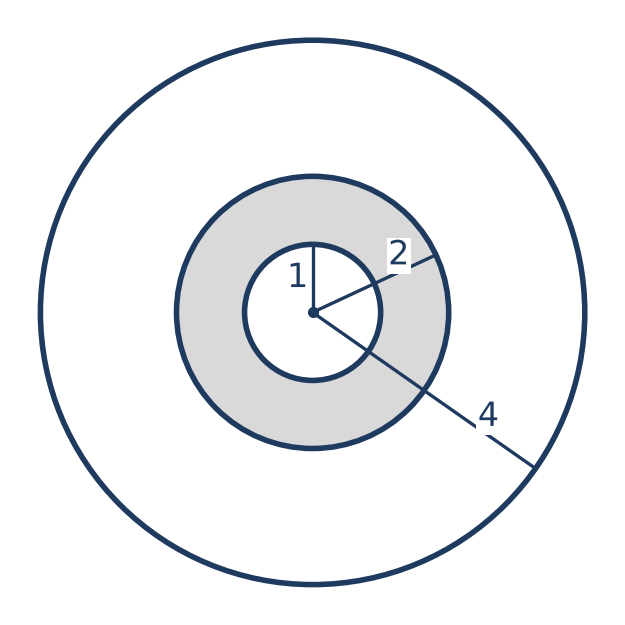
The target in the figure is made of three circles with the same center; the radii are shown. A dart that hits the target is equally likely to land at any point on it. What is the probability that it lands in the shaded ring?
Show solution
AnswerB —
Step-by-step
- Area of the whole target: π × = .
- Area of the shaded ring: π × − π × = − π = .
- Probability = ÷ = .
Fast methodCompare squares of radii: ÷ = .
Quick checkinner disk + ring + outer ring = ✓
Why the other choices are wrong
- A (): found the probability of the small center circle,
- C (): compared radii instead of areas: ring width 1 out of radius 4
- D (): treated the three regions as equally likely
- E (): found the probability of the outer ring,
6.
The data set 115, 20, 25, 23, 14, 13 has an outlier. By how much does the mean decrease when the outlier is removed?
Show solution
AnswerA — 16
Step-by-step
- The mean with every value is 210 ÷ 6 = 35.
- The outlier is 115.
- Without it, the mean is 95 ÷ 5 = 19.
- The decrease is 35 − 19 = 16.
Fast methodFind both means, then subtract; an outlier pulls the mean toward it.
Quick check19 + 16 = 35, the original mean ✓.
Why the other choices are wrong
- B (19): gave the new mean
- C (35): gave the original mean
- D (80): gave the outlier's distance from the original mean: 115 − 35 = 80
- E (96): gave the outlier's distance from the new mean
7.
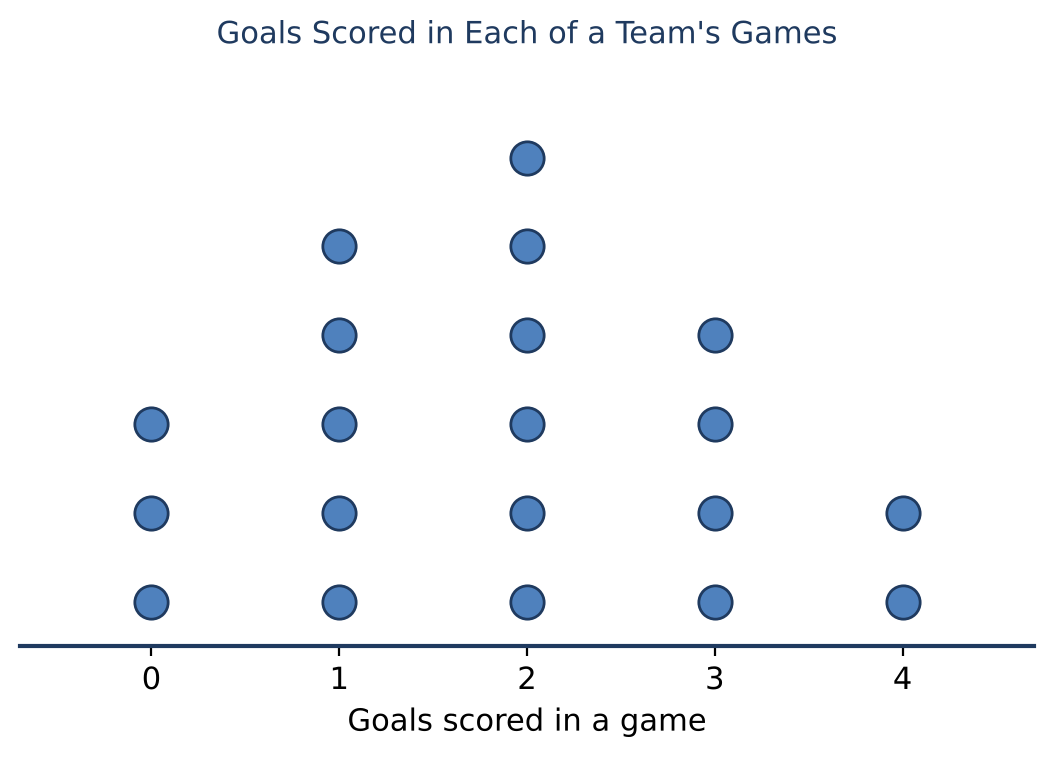
The dot plot shows the number of goals a soccer team scored in each of its games this season. What was the mean number of goals per game?
Show solution
AnswerA — 1.85
Step-by-step
- Count the games (dots): 3 + 5 + 6 + 4 + 2 = 20.
- Total goals: 0×3 + 1×5 + 2×6 + 3×4 + 4×2 = 0 + 5 + 12 + 12 + 8 = 37.
- Mean = 37 ÷ 20 = 1.85.
Fast methodMultiply each value by its number of dots, add, and divide by 20.
Quick check1.85 × 20 = 37 ✓
Why the other choices are wrong
- B (2): gave the median (the 10th and 11th games both had 2 goals)
- C (4): averaged the column heights: 20 games ÷ 5 columns
- D (6): gave the tallest column, the number of games with 2 goals
- E (7.4): divided the 37 goals by the 5 columns instead of the 20 games
8.
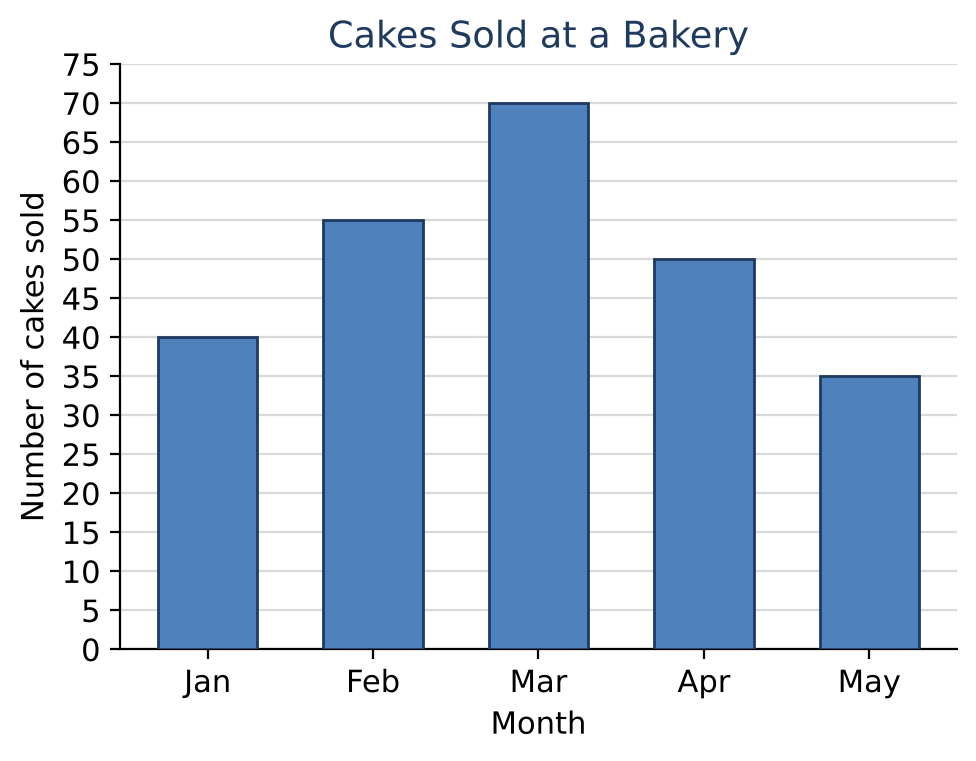
The bar graph shows the number of cakes a bakery sold in each of five months. What percent of all the cakes sold in the five months were sold in March and April combined?
Show solution
AnswerD — 48%
Step-by-step
- From the graph: 40, 55, 70, 50, and 35 cakes.
- Total: 40 + 55 + 70 + 50 + 35 = 250.
- March and April: 70 + 50 = 120.
- 120 ÷ 250 = 48 ÷ 100 = 48%.
Fast method = (multiply top and bottom by 0.4).
Quick checkthe other three months give = 52%, and 48% + 52% = 100% ✓
Why the other choices are wrong
- A (20%): used April alone, 50 of 250
- B (28%): used March alone, 70 of 250
- C (40%): counted months instead of cakes: 2 of the 5 months
- E (52%): found the percent for the other three months, 130 of 250
9.
One class of 8 students has a mean score of 66. Another class of 12 students has a mean score of 88. What is the mean score of all 20 students?
Show solution
AnswerC — 79.2
Step-by-step
- Total for the first class is 8 × 66 = 528.
- Total for the second class is 12 × 88 = 1056.
- The combined mean is (528 + 1056) ÷ 20 = 79.2.
Fast methodCombined mean = total of all scores ÷ total count, not the average of the two means.
Quick check79.2 is closer to 88, the mean of the larger class ✓.
Why the other choices are wrong
- A (74.8): matched each mean with the other group's size
- B (77): averaged the two means
- D (88): used only the mean of the larger class
- E (1584): gave the total, not the mean
10.
The mean of 10 students' test scores was 72. Later, the teacher found that one score had been recorded as 64 instead of the correct score, 94. What is the correct mean of the 10 scores?
Show solution
AnswerC — 75
Step-by-step
- Total of the scores as recorded: 10 × 72 = 720.
- Correcting the score adds 94 − 64 = 30 to the total: 750.
- Correct mean = 750 ÷ 10 = 75.
Fast methodThe total rises by 30, so the mean rises by 30 ÷ 10 = 3: 72 + 3.
Quick check75 × 10 = 750 = 720 − 64 + 94 ✓
Why the other choices are wrong
- A (69): subtracted the 3-point change instead of adding it
- B (72): assumed the mean stays the same because the number of scores did not change
- D (83): averaged the old mean with the correct score, (72 + 94) ÷ 2
- E (102): added the whole 30-point change to the mean without dividing by 10
11.
The range of the numbers 7, 12, x, 4, and 15 is 14. Which of the following could be the value of x?
Show solution
AnswerD — 18
Step-by-step
- Without x, the least number is 4 and the greatest is 15, a range of only 11.
- So x must be a new greatest or a new least value.
- If x is the greatest: x − 4 = 14, so x = 18. (If x were the least, 15 − x = 14 gives x = 1, which is not a choice.)
- x = 18.
Fast methodTest the choices: only 18 changes the range to 18 − 4 = 14.
Quick check4, 7, 12, 15, 18 has range 18 − 4 = 14 ✓
Why the other choices are wrong
- A (10): subtracted the least number from the range, 14 − 4; this x leaves the range at 11
- B (11): gave the range of the known numbers, 15 − 4; this x leaves the range at 11
- C (14): chose the range itself as x; this x leaves the range at 11
- E (29): added the range to the greatest number, 15 + 14; this x gives range 25
12.
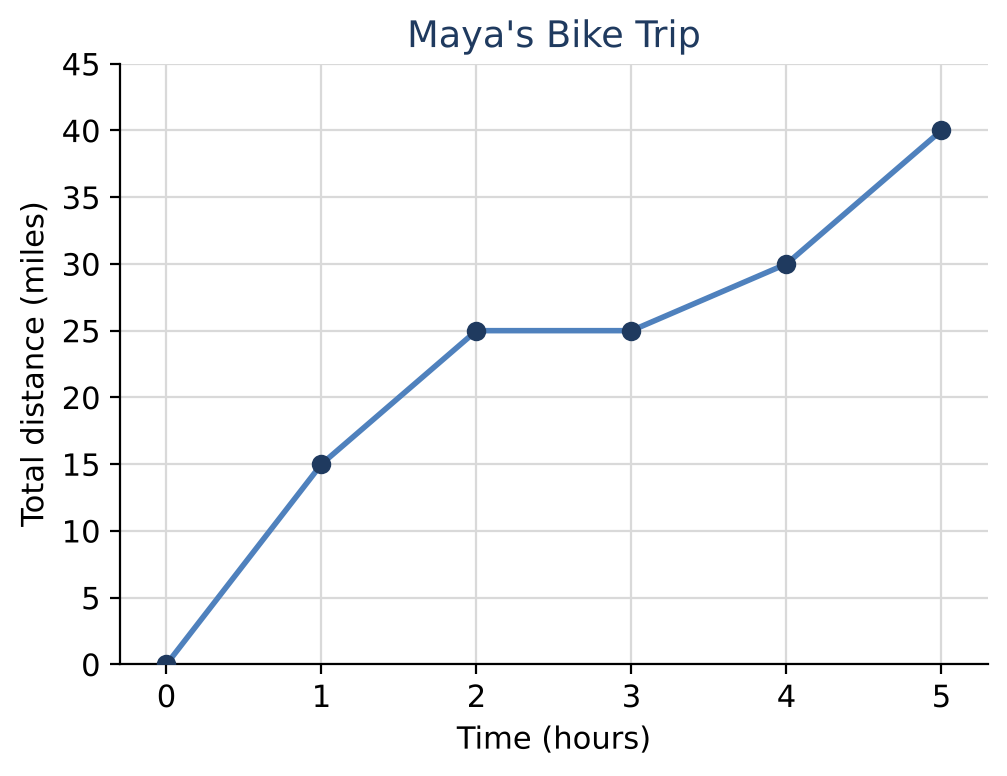
The graph shows the total distance Maya had biked at the end of each hour of a 5-hour trip. For the hours during which she was moving, what was her average speed, in miles per hour?
Show solution
AnswerB — 10
Step-by-step
- Total distance at 5 hours: 40 miles.
- From hour 2 to hour 3 the graph is flat (25 to 25 miles), so she was not moving that hour.
- She was moving for 5 − 1 = 4 hours.
- Average speed while moving = 40 ÷ 4 = 10 miles per hour.
Fast methodFlat segment = stop; 40 miles over 4 moving hours.
Quick checkhourly distances 15 + 10 + 0 + 5 + 10 = 40, over the 4 non-zero hours ✓
Why the other choices are wrong
- A (8): divided by all 5 hours, including the hour she was stopped
- C (15): gave the distance covered in the first (fastest) hour
- D (25): gave the distance at which the graph is flat (where she stopped)
- E (40): gave the total distance instead of a speed
13.
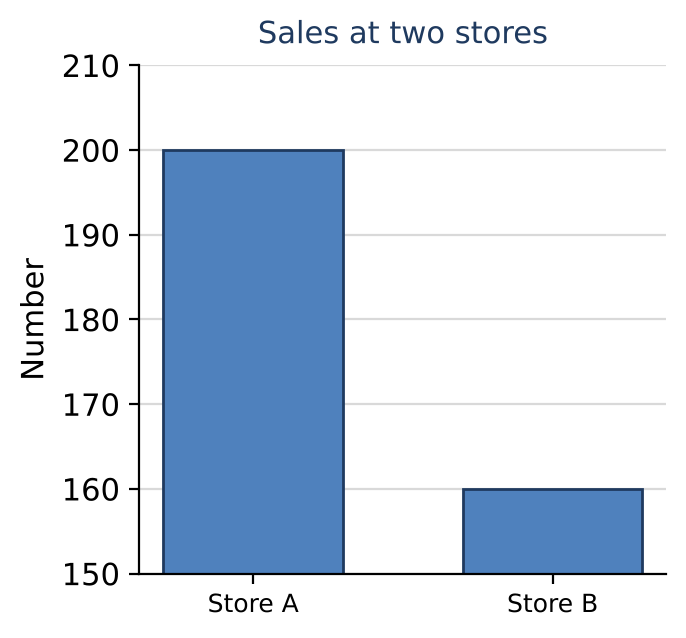
The bar graph shows sales at two stores. Its vertical axis starts at 150, not 0. How many times as tall as the bar for Store B does the bar for Store A look?
Show solution
AnswerD — 5
Step-by-step
- Each bar's drawn height starts at 150.
- Store A's bar is 200 − 150 = 50 tall and Store B's is 160 − 150 = 10 tall.
- So it looks 50 ÷ 10 = 5 times as tall.
Fast methodRead values on the scale; a cut axis makes the bars' heights misleading.
Quick check10 × 5 = 50, the drawn height of the Store A bar ✓.
Why the other choices are wrong
- A (): inverted the ratio
- B (): subtracted the starting value from one bar only
- C (): used the actual values instead of the bar heights
- E (20): subtracted the starting value from Store B only: 200 ÷ 10 = 20
14.
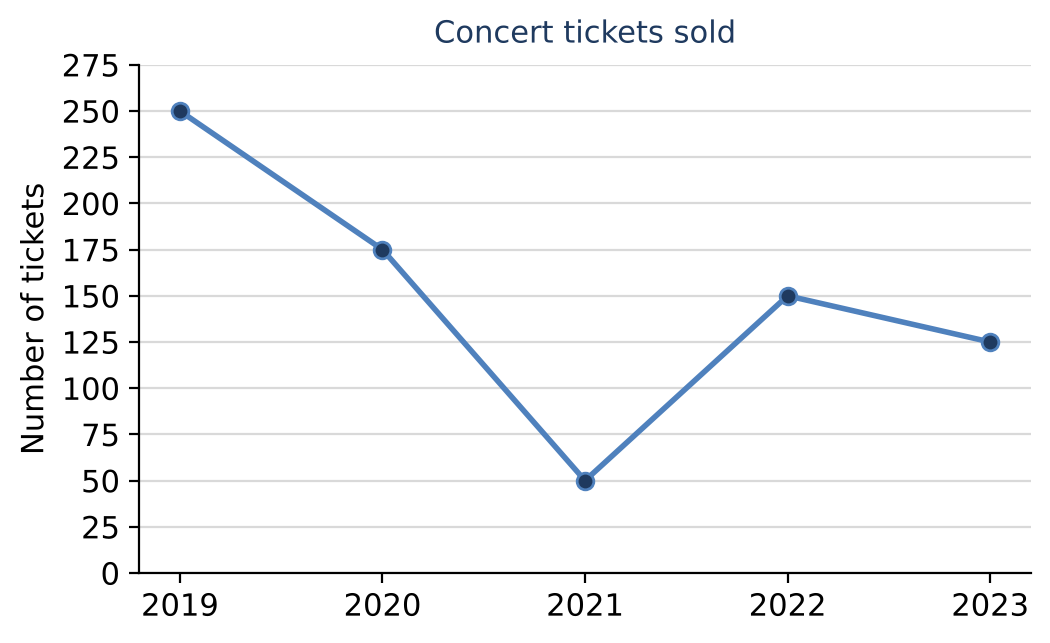
The line graph shows concert tickets sold each year. What was the percent decrease from 2019 to 2021?
Show solution
AnswerB — 80%
Step-by-step
- Read the graph.
- So 2019 = 250 and 2021 = 50.
- The change is 200.
- Percent decrease = change ÷ original × 100 = 200 ÷ 250 × 100 = 80%.
Fast methodPercent change = (new − old) ÷ old × 100; always divide by the earlier year.
Quick check250 − 80% of 250 = 250 − 200 = 50 ✓.
Why the other choices are wrong
- A (20%): gave the new value as a percent of the original
- C (200%): gave the change, not the percent change
- D (400%): divided by the new value instead of the original
- E (500%): divided the original by the new value: 250 ÷ 50 × 100 = 500%
15.
A bag has 3 green and 3 purple marbles. Two marbles are drawn without replacement. What is the probability that both are green?
Show solution
AnswerB —
Step-by-step
- First draw: P(green) = .
- After removing one green marble, 2 green remain out of 5.
- So P(both) = × = = .
Fast methodWithout replacement, reduce both the favorable count and the total for the second draw.
Quick checkchoosing 2 of 6 gives 15 pairs, and 3 are both green, so = ✓.
Why the other choices are wrong
- A (): did not reduce the total after the first draw: × =
- C (): replaced the first marble
- D (): did not reduce the number of green marbles
- E (1): added the two probabilities as if the marble were replaced: + = 1
16.
How many 3-digit whole numbers have no two neighboring digits equal? (For example, 121 is counted, but 112 and 344 are not.)
Show solution
AnswerD — 729
Step-by-step
- Hundreds digit: 1 to 9, so 9 choices (it cannot be 0).
- Tens digit: any of 0 to 9 except the hundreds digit, so 9 choices (0 is now allowed).
- Ones digit: any digit except the tens digit, so 9 choices; it may equal the hundreds digit, as in 121.
- Total = 9 × 9 × 9 = 729.
Fast method9 × 9 × 9 = 729.
Quick check900 three-digit numbers − 729 = 171 have a repeated neighbor, and 9 × 10 + 9 × 10 − 9 = 171 by counting those directly ✓
Why the other choices are wrong
- A (171): counted the numbers that do have two equal neighboring digits
- B (648): required all three digits to be different, so 121 was wrongly excluded
- C (720): required all three digits different and also let the first digit be 0: 10 × 9 × 8
- E (900): counted every 3-digit number, ignoring the restriction
17.
A list of five different positive integers has a median of 10 and a mean of 12. What is the greatest possible value of the largest integer in the list?
Show solution
AnswerA — 36
Step-by-step
- The sum of the five integers is 5 × 12 = 60.
- The median is the middle value, 10, so two integers are less than 10 and two are greater.
- To make the largest as big as possible, make the others as small as possible: 1, 2, 10, and 11 (the fourth must be different from 10).
- Largest = 60 − (1 + 2 + 10 + 11) = 60 − 24 = 36.
Fast methodSmallest choices 1, 2, 10, 11 use up 24 of the total 60, leaving 36.
Quick check1, 2, 10, 11, 36 are different, have median 10 and sum 60, so mean 12 ✓
Why the other choices are wrong
- B (37): let the fourth integer equal 10, ignoring that the integers are different
- C (38): allowed repeats: 1, 1, 10, 10
- D (47): forgot that a fourth integer must lie above the median: 60 − 1 − 2 − 10
- E (50): subtracted only the median from the total
18.
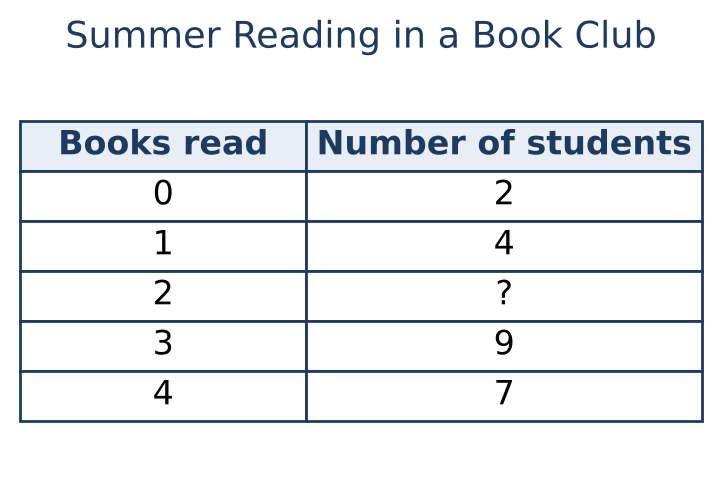
The table shows how many books each student in a book club read over the summer, but the number of students who read 2 books is missing. If the mode and the median are both 2 books, what is the least possible number of students who read 2 books?
Show solution
AnswerC — 11
Step-by-step
- Mode 2: the missing count must be greater than 9 (the count for 3 books), so it is at least 10.
- Try 10: there are 2 + 4 + 10 + 9 + 7 = 32 students, and the median is the mean of the 16th and 17th values.
- Students reading 0, 1 or 2 books: 2 + 4 + 10 = 16, so the 16th value is 2 but the 17th is 3, giving a median of 2.5.
- Try 11: 33 students, median is the 17th value; 2 + 4 + 11 = 17, so the 17th value is 2.
- Least possible number = 11.
Fast methodNeed more students at 2 or fewer than at 3 or more (16): 6 + x > 16 gives x ≥ 11, which also beats 9 for the mode.
Quick checkwith 11, there are 17 values at 2 or below and 16 above, so the middle (17th) value is 2, and 11 > 9 makes 2 the mode ✓
Why the other choices are wrong
- A (9): made the count equal to 9, which only ties 3 books for the mode
- B (10): used only the mode condition; with 10 the median is 2.5
- D (16): set the count equal to the 16 students who read 3 or more books
- E (17): made the 2-book count by itself greater than the 16 students who read 3 or more books
19.
A red number cube and a blue number cube, each numbered 1 to 6, are rolled. What is the probability that the sum of the two numbers is greater than 8 and the two numbers are different?
Show solution
AnswerA —
Step-by-step
- There are 6 × 6 = 36 equally likely outcomes (red, blue).
- Sums greater than 8: sum 9 has 4 outcomes, sum 10 has 3, sum 11 has 2, sum 12 has 1, so 10 outcomes.
- Remove the doubles among them, (5, 5) and (6, 6): 10 − 2 = 8 outcomes.
- Probability = = .
Fast methodList sums 9 to 12 (4 + 3 + 2 + 1 = 10), drop the 2 doubles: = .
Quick checkthe 8 outcomes are (3,6), (6,3), (4,5), (5,4), (4,6), (6,4), (5,6), (6,5), and = ✓
Why the other choices are wrong
- B (): removed the 6 doubles from the total as well, using
- C (): forgot the numbers must be different and kept (5, 5) and (6, 6):
- D (): counted sums of 8 or more instead of greater than 8:
- E (): counted sums of 8 or more and also kept the doubles:
20.
A data set has a mean of 12 and a range of 8. Each value in the data set is multiplied by 3, and then 4 is subtracted from each result. What is the range of the new data set?
Show solution
AnswerD — 24
Step-by-step
- Range = greatest value − least value.
- Multiplying every value by 3 multiplies the gap between the greatest and least by 3: 8 × 3 = 24.
- Subtracting 4 from every value shifts them all equally, so the gap does not change.
- New range = 24.
Fast methodRange ignores shifts and scales with multiplication: 3 × 8.
Quick checke.g. values 8 and 16 (range 8) become 20 and 44, and 44 − 20 = 24 ✓
Why the other choices are wrong
- A (7): treated 'multiplied by 3' as 'add 3' and also subtracted 4: 8 + 3 − 4
- B (8): assumed the range does not change at all
- C (20): applied both steps to the range: 3 × 8 − 4
- E (32): found the new mean, 3 × 12 − 4, instead of the range